The first Trading Identity cards for ORIGIN, the first season of Bitbase Points, were generated on November 9 at 00:00 UTC. Log in and open the points page at bitbase.com/points to find your card under My Trading Identity.
In our last post we covered what each of the seven identities stands for. This one takes a different angle: once you have your card, how should you read it, and what can it tell you?
How cards are generated and updated
Your card is generated from your trading over the previous week and updated every Monday at 00:00 UTC. It then stays the same until the next update, while the trades you make this week shape next Monday's card. The next update is on November 16.
That makes the card a weekly snapshot rather than a verdict on your long-term style. Trade mostly short-term one week and hold the next, and you will get two different cards. That is how it is meant to work.
What the card shows
Each card shows an identity name, a one-line description and a matching character. The name sums up the main trait of your trading last week, the line puts that style into words, and each of the seven identities has its own character.
The seven identities
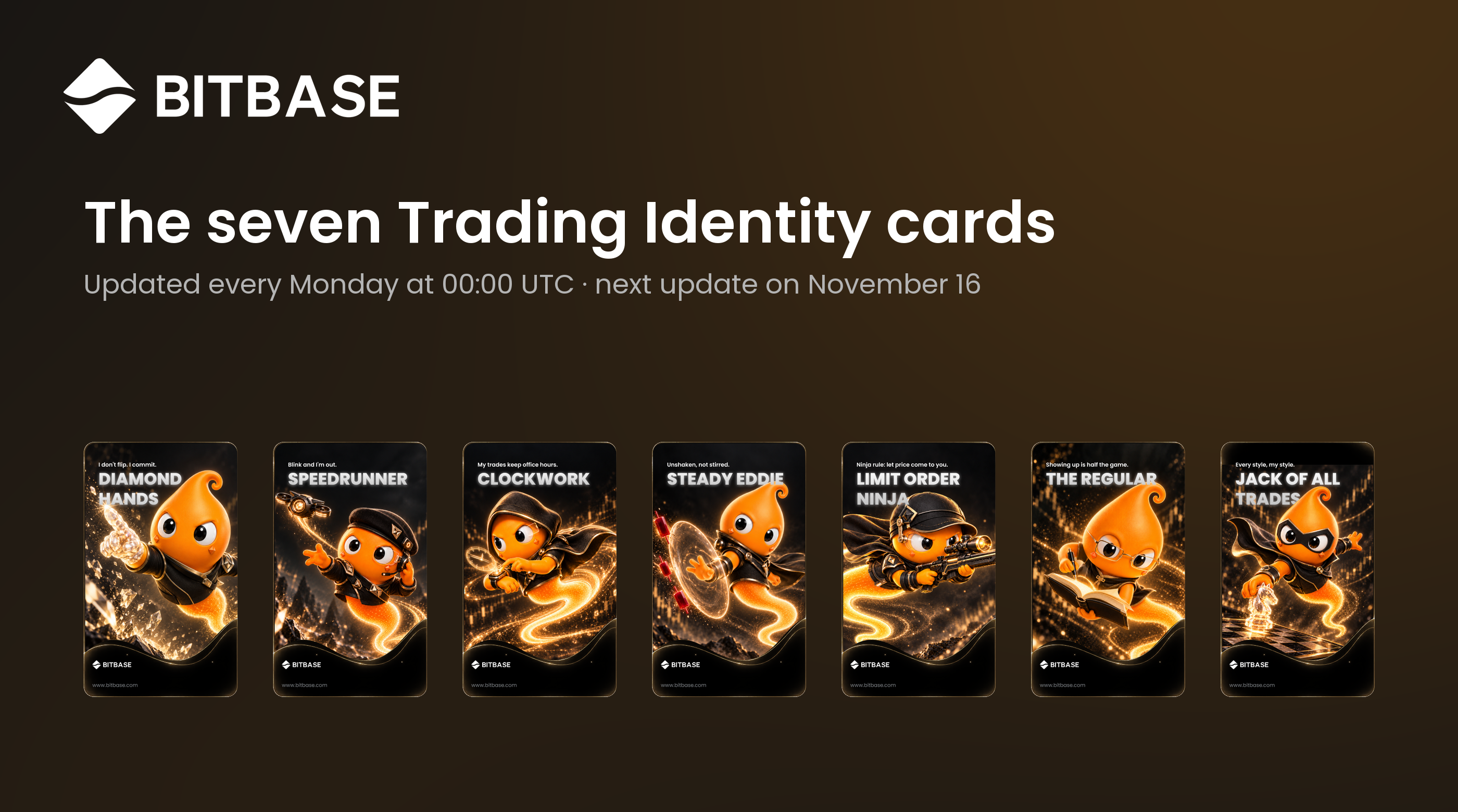
Diamond Hands | I don't flip. I commit. You held positions for longer last week, and short-term swings did not move you much. For holders like this, a change of card usually comes from a change in holding period.
Speedrunner | Blink and I'm out. Short-term trades led your week, with little time between opening and closing. If next week brings a different card, your pace may simply have slowed.
Clockwork | My trades keep office hours. Your trading clustered in a few fairly fixed hours of the day. The card is about timing, not about how often you trade.
Steady Eddie | Unshaken, not stirred. Your position management was measured last week and your account moved within a narrow range. The card looks at how you handled risk, not at profit or loss.
Limit Order Ninja | Ninja rule: let price come to you. You relied on limit orders, setting a price and waiting for the market to meet it. The share of limit orders in your trading is what this card mainly reflects.
The Regular | Showing up is half the game. You traded on many days last week and kept taking part. The card is about how consistently you show up, not the size of each trade.
Jack of All Trades | Every style, my style. No single style dominated your week; your trading was balanced across several. If next week brings a different card, you have started leaning into one style more than the others.
These readings explain what each identity means. Cards are generated according to platform rules.
The first batch
| Identity | Share |
|---|---|
| The Regular | 24.7% |
| Diamond Hands | 18.7% |
| Speedrunner | 18.7% |
| Limit Order Ninja | 15.0% |
| Steady Eddie | 11.8% |
| Clockwork | 8.2% |
| Jack of All Trades | 2.9% |
In the first batch of cards, The Regular accounts for 24.7%, and Diamond Hands and Speedrunner for 18.7% each, together more than 60%. In ORIGIN's first week, showing up consistently, holding for the long term and trading short-term were the three most common patterns. Jack of All Trades came in at just 2.9%: staying balanced across several styles is harder than it looks.
Cards and points
No identity ranks above another, and a card says nothing about profit or loss. It also records something different from your points. Points measure how much you contributed to the platform, allocated daily by your share of that day's contribution. Your card shows how you traded, and it is generated weekly. One answers "how much", the other "how".
When your card changes
A single card describes one week; several in a row reveal a habit. The same card week after week points to a steady rhythm. A card that moves between identities usually means your approach is adjusting as the market changes.
Over the course of ORIGIN, we will add more identity types and different kinds of share cards, so that record becomes fuller.
If your card shows "Generating"
The card shows "Generating" until the Monday update completes. If it still says "Generating" afterwards, there was usually not enough trading data from the previous week to generate it accurately. This does not affect your participation in ORIGIN: keep trading to build up more data, and your card can be generated at next Monday's update.
FAQ
Can I choose my identity?
No. Cards are generated automatically from your trading characteristics.
My card doesn't match how I see myself. Is that normal?
Yes. The card looks only at the previous week. If you traded differently from usual that week, the card reflects that week.
Can I share my card?
Yes. You can share your card from the points page, and more kinds of share cards will roll out during ORIGIN.
Will there be new identities?
Yes. Seven are available at launch, and more will follow.
Full rules are available at bitbase.com/points.
Every Move Counts.
Related reading
Other Bitbase articles on this topic:
- ORIGIN Is Live: From Sign-Up to Your First Points
- Your Alpha Points Have Arrived: ORIGIN Starts Here
- How to Trade Crypto on the Bitbase App (Spot and Futures)
- How to Trade Futures on Bitbase: A Beginner's Guide
- What Is Bitbase? The Exchange, the Company and What You Can Trade
Disclaimer: This article is educational content from Bitbase, provided for information only. It is not investment, trading, tax, or financial advice, and not a promise of returns. Trading crypto assets and leveraged products carries significant risk, including the possible loss of your capital. Written as of November 2026.