News Center




Restaking Explained: $20B in Assets, EigenLayer and Cosmos Racing on Two Fronts, Security Gains and Risks Go Hand in Hand
 ETHGalaxy ResearchEigenLayerRestaking





Restaking Explained: $20B in Assets, EigenLayer and Cosmos Racing on Two Fronts, Security Gains and Risks Go Hand in Hand
The second installment in a Galaxy Research series takes a systematic look at the restaking sector: as of June 25, 2024, total restaked assets reached $20.14 billion, with Ethereum alone accounting for $19.4 billion, Cosmos replicated security holding about $1.7 billion, and Solana and wrapped BTC seeing smaller-scale participation. The report details how EigenLayer enables intersubjective slashing through the EIGEN token, and notes the trend of LST liquidity flowing back to L1 while LRTs rise rapidly on L2. It stresses that restaking remains in a very early experimental stage, with security islands, liquidity rebalancing, and unknown risks.
ETHGalaxy ResearchEigenLayerRestaking6 hours ago
Ethereum Spot ETFs Are Coming: Galaxy Estimates $5 Billion Net Inflows in First 5 Months, Just 30% of Bitcoin ETF's Pace
Galaxy Research, drawing on Bitcoin spot ETF performance, estimates Ethereum spot ETFs will see about $5 billion in net inflows over their first five months—only 30% of Bitcoin ETFs' pace. The report cites two structural drags: ETFs can't stake ETH, costing unstaked holders roughly 5.6 percentage points in annualized opportunity cost, and Grayscale's ETHE conversion could see monthly outflows of about 319,000 ETH (~$1.1 billion). It views the ETFs as broadly positive for adoption, but inflows may fall short of market expectations.
 BTCGalaxy ResearchEthereum Spot ETFInflow Forecast
6 hours ago
Q2 2024 Crypto VC Report: Funding Rises 28% QoQ to $3.194B, Median Valuation Soars to $37M — a Near Three-Year High
Galaxy Research's Q2 2024 crypto venture report shows blockchain startups raised $3.194 billion, up 28% quarter-over-quarter, across 577 deals (down 4%). Median pre-money valuation jumped 94% QoQ from $19M to $37M, the highest since Q4 2021. Web3 led with $758M, Layer 1 surged on large rounds for Monad and Berachain, and Bitcoin L2 funding hit $94.6M, up 174% QoQ. US companies captured 53% of capital, while early-stage deals took 78%. The report notes a breakdown in the correlation between Bitcoin's price and funding, and if the pace holds, 2024 could rank as the third-highest year on record.
BTCGalaxy ResearchLayer 1Bitcoin L26 hours ago
Michael Saylor Wants Banks to Custody Bitcoin, Predicts Digital Asset Industry Could Reach $100 Trillion
Michael Saylor, chairman of MicroStrategy (now Strategy), is urging U.S. banks to offer Bitcoin custody and collateralized lending services, arguing regulators should treat custody, lending, and proprietary trading as separate activities. He criticized the Basel framework's 1,250% risk weight on crypto assets as overly harsh and predicted the AI agent economy will drive digital assets into a $100 trillion industry. With the CLARITY Act stalled in the Senate, he's pinning his hopes on the SEC, CFTC, Treasury, and the White House, seeing regulators rather than Congress as the most viable path forward over the next two years.
BTCMichael SaylorClarity ActBitcoin bank custody6 hours ago
Hongguo Takes On Four Rivals as iQIYI, Youku, Tencent Video and Mango TV Stay Silent
ByteDance's short-drama platform Hongguo has surged to 168 million daily active users, surpassing iQIYI, Youku, Tencent Video and Mango TV combined, with users averaging 125 minutes per day. Its free model, ByteDance ecosystem synergy and low-cost AI-generated content have driven rapid expansion, with AI micro-dramas now accounting for over 95% of the industry. Yet 90% of players are losing money amid severe overcapacity and a hit rate of just 0.47%.
6 hours ago
When DeFi Yields Come from Apple and Nvidia: Ethena Brings Basis Trading to the Stock Market
On September 25, Ethena announced it would incorporate tokenized US stocks into USDe's basis trading strategy, with Binance as the first execution venue. The strategy involves holding bStocks (Binance's tokenized US equities) while shorting corresponding stock perpetual futures to capture funding rates—mirroring its earlier crypto model. The move comes as crypto funding rate yields shrink, while the stock market dwarfs crypto in scale. The article also flags risks including bStocks counterparty exposure, weekend trading gaps, funding rates turning negative, and Binance concentration, framing this as part of a broader trend where the boundary between DeFi and TradFi assets is increasingly blurred.
BTCEthenaTokenized StocksUSDe6 hours ago
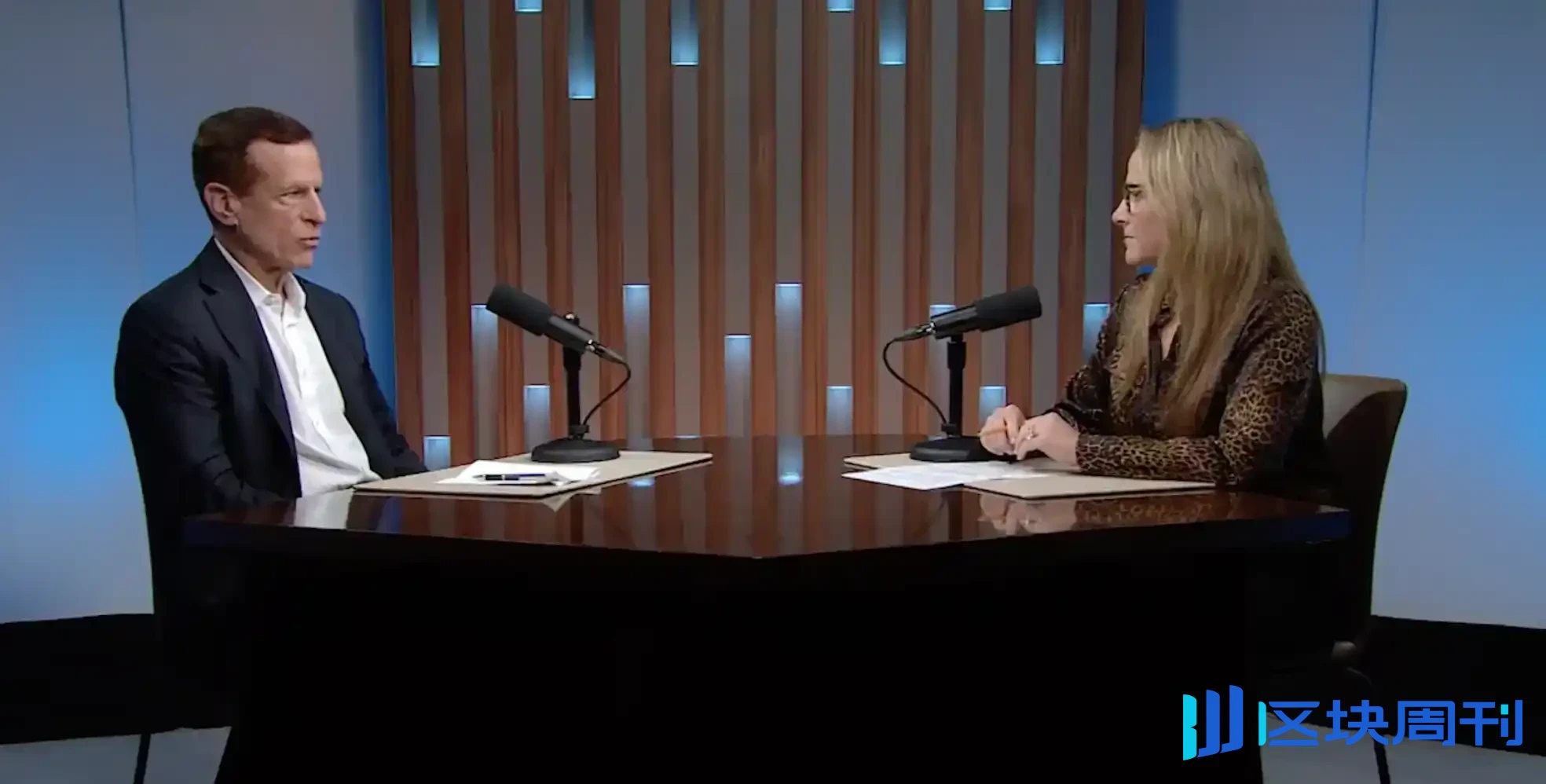
Goldman Sachs on Rate Hikes: Is the Market Overpricing Them? The Fed May Only Need One More
Based on an interview with Robert Kaplan, Vice Chairman of Goldman Sachs and former Dallas Fed President, on the Goldman Sachs Exchanges podcast, this article discusses the Fed's policy path after its September rate hike. Kaplan believes the Fed may need only one more hike to 4%-4.25% before pausing, and that the market may be overpricing the extent of tightening, with risk premiums tied to oil price trends and uncertainty over new Chair Warsh's policy reaction function. The article also examines structural issues including U.S. economic divergence, the mismatch between AI infrastructure investment and rate-sensitive sectors, and the impact of fiscal deficits on long-term Treasuries.
6 hours ago
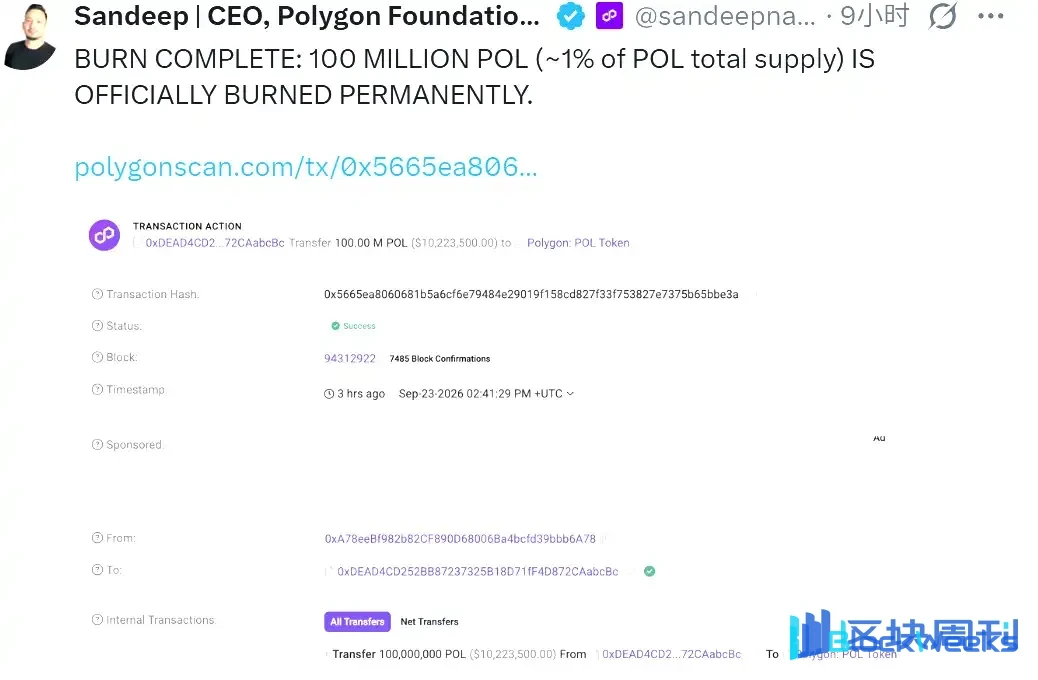
Polygon Burns Just $100M of a $10B Supply — Is the POL Deflation Story a Joke?
Polygon burned 100 million POL tokens — about 1% of total supply — but the coins came from a network fee collection contract, not a change to issuance policy. The one-time burn barely dents the roughly 2% annual inflation, and POL still trades near $0.1. The piece also covers Polygon's $24.5M in 2026 revenue, stablecoin transfer volumes, a Visa settlement pilot, co-founder departures, repeated layoffs, the scrapping of zkEVM, and the Coinme and Sequence acquisitions as the company pivots to payments. The market, it argues, cares more about whether annual issuance changes and whether quarterly burns can consistently outpace new minting.
 POLPolygonPOL burnstablecoin settlement
6 hours ago

Claude Just Made a Breakthrough in Theoretical Physics—With One Prompt and a Few Thousand Dollars
Anthropic announced that its Claude model, running nearly unsupervised for days on the Claude Science platform, computed nine-loop six-particle scattering amplitudes in planar N=4 super Yang-Mills theory, breaking an eight-loop record that had stood for three years. The entire calculation required just a single task description and roughly one to two thousand dollars. Lance Dixon, who set the previous eight-loop record, personally verified the result and said Claude understands his team's papers better than anyone. A Chinese team led by Song He achieved most of the same results around the same time with GPT-6's help. The article explores the limits of AI's capabilities in basic research and the compute bottleneck.
6 hours ago
Galaxy Deep Dive: Ethereum Staking Rewards and Risks Explained — Staking Rate May Top 30%, Developers Weigh Issuance Policy Changes
Galaxy Research has released an in-depth report on Ethereum staking. As of July 15, 2024, staked ETH exceeds $111 billion, representing 28% of total supply. The report categorizes staking into direct staking, delegated staking, and liquid staking, outlining the risk spectrum of each, and notes that Lido holds roughly a 29% staking share. It argues that MEV revenue may be severely underestimated, with median rewards for MEV-Boost-built blocks potentially rising by 400%. As liquid staking lowers barriers to entry, the staking rate is expected to surpass 30%. Developers are quietly exploring changes to issuance policy, but with a growing number of stakeholders, revising monetary policy has become increasingly contentious and difficult.
ETHGalaxy ResearchEthereum StakingLiquid Staking6 hours ago