Issue 21 closed on a curve that had flattened on an inflation print and asked whether the two-year would hold above 4.60% through a Federal Open Market Committee decision. It held, the Committee raised, and the flattening did not stop — it accelerated [1][3].
The single most useful fact in this issue is a difference between two numbers the Committee published on the same afternoon. The decision was a quarter point: the target range for the federal funds rate went to 3-3/4 to 4 percent on a 12–0 vote [1]. The projections released alongside it moved the median policy path for 2027, 2028 and 2029 up by half a point each, from 3.6, 3.4 and 3.1 to 4.1, 3.9 and 3.6 [2]. The Committee moved once; the projection moved four years at once, and in the outer three it moved twice as far as the decision did. That is the event of this window, and it is not the headline anyone ran.
The Treasury curve read it that way. Against the prior close the two-year added 13 basis points and the thirty-year fell 1 [3]. The 2s30s spread closed the window at 58 basis points, from 72 at the prior close and 87 two windows ago [3]. A hiking cycle that the long end declines to extend is a flattening cycle, and this is now the third consecutive window in which this series has recorded the front end moving further than the back.
Bitcoin's worst session of the window was the Committee's first day and its best session was two days after the decision. September 15 closed −3.27% and printed the window low at 74,909.40; September 18 closed +5.86% [4]. The window ended +5.65% against the prior close, at 81,143.90 [4]. The event did not move it; what came after did — and open interest and funding both rose the whole way, on both venues this series tracks [5][6][7][8].
One buyer this series has followed since Issue 14 was absent again. Strategy disclosed no bitcoin purchase for a second consecutive filing, and directed $139.3m to repurchasing its own preferred stock instead [9]. Section 6 is about that absence, not about the price.
Week of September 14 to September 20, 2026
Bitbase Research · September 21, 2026
The one chart that matters
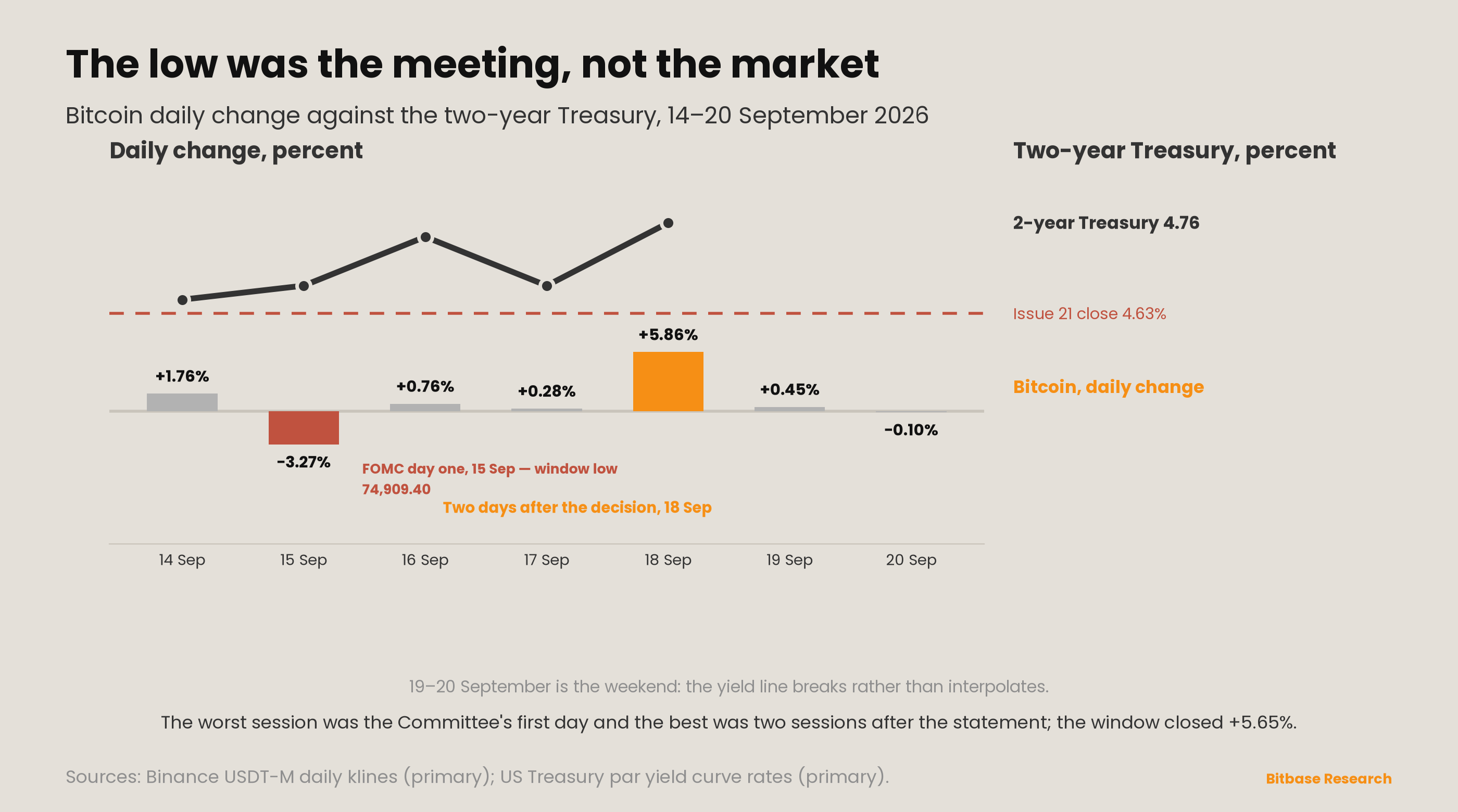
Daily closes for BTCUSDT perpetuals, USDT-margined futures, UTC, with the two-year Treasury par yield on the right axis [3][4]:
| Date (UTC) | Close | Session | 2Y par yield |
|---|---|---|---|
| September 13 (prior close) | 76,805.00 | −0.57% | — |
| September 14 | 78,153.30 | +1.76% | 4.65 |
| September 15 (FOMC day one) | 75,599.90 | −3.27% | 4.67 |
| September 16 (decision) | 76,174.60 | +0.76% | 4.74 |
| September 17 | 76,385.90 | +0.28% | 4.67 |
| September 18 | 80,863.00 | +5.86% | 4.76 |
| September 19 | 81,225.60 | +0.45% | — |
| September 20 | 81,143.90 | −0.10% | — |
The window low of 74,909.40 printed intraday on September 15, before the Committee had said anything [4]. The decision session itself closed higher. The largest single-session gain arrived on the second session after the statement, and the two sessions that followed added 0.35% between them — the move happened once and then stopped.
This is the second consecutive window in which the largest repricing did not coincide with the scheduled event. Issue 21 recorded the largest curve move on September 10, the day before an August CPI release embargoed for September 11 [3]. This window records the largest bitcoin move on September 18, two days after a decision released on September 16 [1][4]. In one window the market moved early, in the next it moved late. The pattern is that the scheduled session is not where the risk is — which is an observation about these two windows, and section 7 states what it is not.
The right-hand axis is the part worth holding onto. The two-year rose on four of the five sessions and ended at 4.76%, its highest close of the year to date in this series' records [3]. Bitcoin ended the window 5.65% higher [4]. Whatever the relationship between the policy path and this asset is, it did not express itself as a level relationship in this window.
This week's structural signal
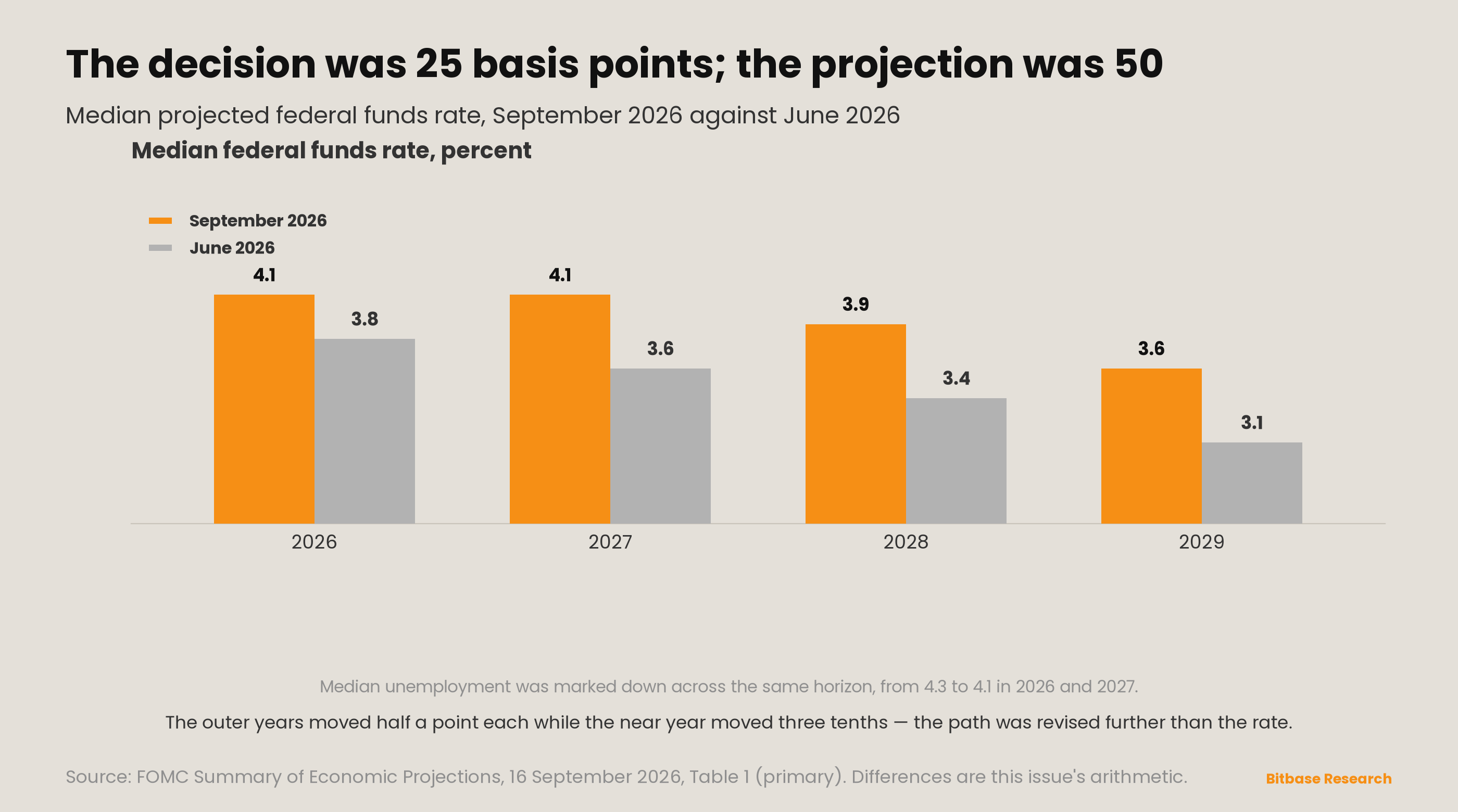
The Summary of Economic Projections publishes each variable's current median beside the June median in the same table [2]. The policy path row:
| Median, federal funds rate | 2026 | 2027 | 2028 | 2029 | Longer run |
|---|---|---|---|---|---|
| September 2026 | 4.1 | 4.1 | 3.9 | 3.6 | 3.2 |
| June 2026 | 3.8 | 3.6 | 3.4 | 3.1 | — |
| Change | +0.3 | +0.5 | +0.5 | +0.5 | — |
The near year moved less than the outer years. A single quarter-point hike accounts for most of the 2026 revision. Nothing that happened in this window accounts for 2029. The outer three years are the part of the table a decision cannot reach, and they are the part that moved by twice the size of the decision.
The labour row moved the other way, and that is what makes the policy row legible [2]:
| Median, unemployment rate | 2026 | 2027 | 2028 | 2029 |
|---|---|---|---|---|
| September 2026 | 4.1 | 4.1 | 4.1 | 4.1 |
| June 2026 | 4.3 | 4.3 | 4.2 | 4.2 |
| Change | −0.2 | −0.2 | −0.1 | −0.1 |
Participants marked unemployment down across the whole horizon and marked the policy path up across the whole horizon. The statement says economic activity "is expanding at a solid pace" [1]. Inflation medians moved up marginally: PCE 3.6 to 3.7 for 2026, core PCE 3.3 to 3.4 [2]. This is not a committee tightening into weakness. It is a committee that now expects to need a higher rate for longer because it expects the economy to tolerate one.
The curve's answer was to flatten, and the flattening is where the disagreement lives [3]:
| 09-11 (prior close) | 09-14 | 09-16 (decision) | 09-18 | |
|---|---|---|---|---|
| 2Y | 4.63 | 4.65 | 4.74 | 4.76 |
| 10Y | 4.96 | 4.97 | 5.01 | 5.01 |
| 30Y | 5.35 | 5.34 | 5.35 | 5.34 |
| 2s10s | 33bp | 32bp | 27bp | 25bp |
| 2s30s | 72bp | 69bp | 61bp | 58bp |
The thirty-year ended the window one basis point below where it started and unchanged from the day before the meeting [3]. Over three windows the 2s30s spread has gone 87, 72, 58 — it has lost 29 basis points while the front end has been repricing upward the entire time.
The structural reading is narrow and this series will hold it to that. A higher projected path for 2028 and 2029 with an unchanged thirty-year is the long end declining to extend the projection. The step in between is the one the table makes: the same span that added 13 basis points to the two-year took one off the thirty-year, so the revision was not absorbed as a shift in the whole curve — it was absorbed at the front. That is consistent with several things — a terminal rate the market already had higher, a view that the path will not be delivered, or supply and demand in the long bond that has nothing to do with either. The data here separate none of them, and section 7 says so.
Dual-track scoreboard
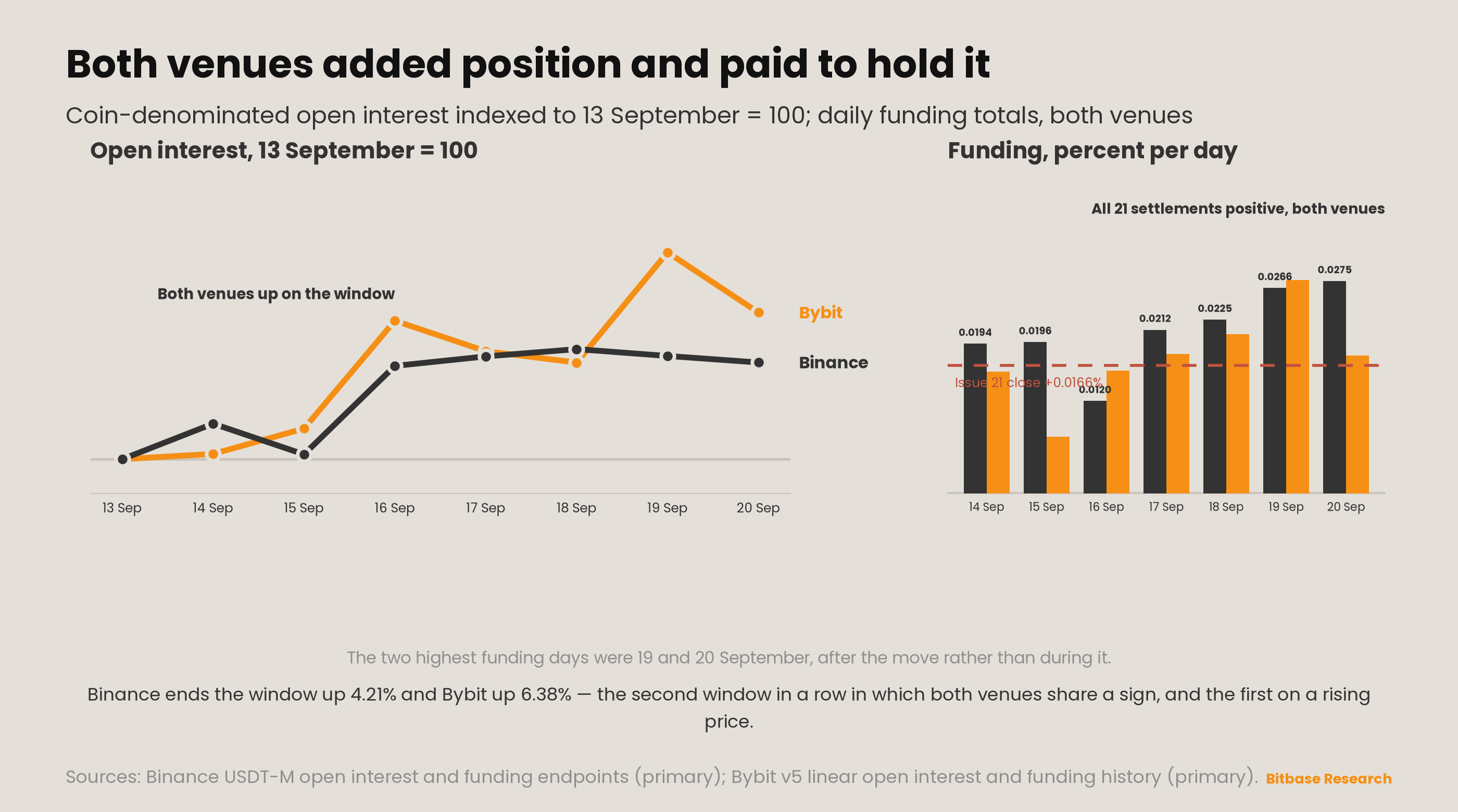
Coin-denominated open interest in BTCUSDT perpetuals, daily snapshots [5][7]:
| Date | Binance (BTC) | Bybit (BTC) |
|---|---|---|
| September 13 (prior close) | 103,300 | 53,279 |
| September 14 | 104,897 | 53,402 |
| September 15 | 103,517 | 53,988 |
| September 16 | 107,492 | 56,488 |
| September 17 | 107,918 | 55,782 |
| September 18 | 108,245 | 55,518 |
| September 19 | 107,939 | 58,072 |
| September 20 | 107,646 | 56,678 |
Binance ends the window up 4.21%; Bybit up 6.38% [5][7]. Issue 21 recorded the first window in three in which the two venues shared a sign. This is the second, and this time the shared sign is positive on a rising price — the previous convergence was both venues shedding position into a decline.
Funding, summed across the three eight-hour intervals in each UTC day [6][8]:
| Date | Binance | Bybit |
|---|---|---|
| September 14 | +0.0194% | +0.0158% |
| September 15 | +0.0196% | +0.0074% |
| September 16 | +0.0120% | +0.0159% |
| September 17 | +0.0212% | +0.0181% |
| September 18 | +0.0225% | +0.0206% |
| September 19 | +0.0266% | +0.0276% |
| September 20 | +0.0275% | +0.0179% |
| Window total | +0.1488% | +0.1233% |
Every interval on both venues was positive, and the decision day carried the lowest daily total on Binance of the seven [6]. The two highest Binance days were September 19 and 20 — after the move, not during it. Longs paid more to hold the position once the position was already profitable, which is what a crowded book looks like from the outside and which is not a prediction about what happens next.
What is absent from this scoreboard, and named rather than omitted: spot ETF daily flows, for the same reason recorded in Issue 21 — this series has no primary retrieval path for them and does not source them second-hand.
On the radar—week of September 21 to September 27
First, does the Strategy filing covering this window disclose a purchase? As of this issue's cut the filing does not exist: the most recent submission on the company's EDGAR index is the one filed September 14, covering September 8 to 13 [9]. Three consecutive disclosures now read one purchase, zero, zero. The next one either extends that run or ends it.
Second, does the two-year hold above 4.70% now that it has a hiking Committee behind it? It closed at 4.76% after four higher sessions in five [3]. Issue 21 retired the 4.30% test as uninformative once the level became irrelevant; this series replaces it with a level the market is actually trading around, and will retire this one the same way if it stops mattering.
Third, does the 2s30s spread go below 50 basis points? It has lost 29 basis points across three windows and sits at 58 [3]. A named threshold is the only way to make section 2's structural claim falsifiable, and 50 is chosen because it is the next round number below the current reading, not because it carries meaning.
Fourth, is a Treasury long-end buyback result obtainable at all? Issue 21 asked this and the answer this window is again no — three endpoints returned nothing from this machine, detailed in section 7. The question is being kept open deliberately: a retrieval failure repeated across two windows is a finding about the source, not about the operation.
Fifth, does funding stay positive through a week without a scheduled Federal Reserve event? Every interval on both venues was positive in a week containing an FOMC decision [6][8]. The next window contains no FOMC meeting [13]. Whether the bid pays to stay is a cleaner question without one.
Signal tracking update
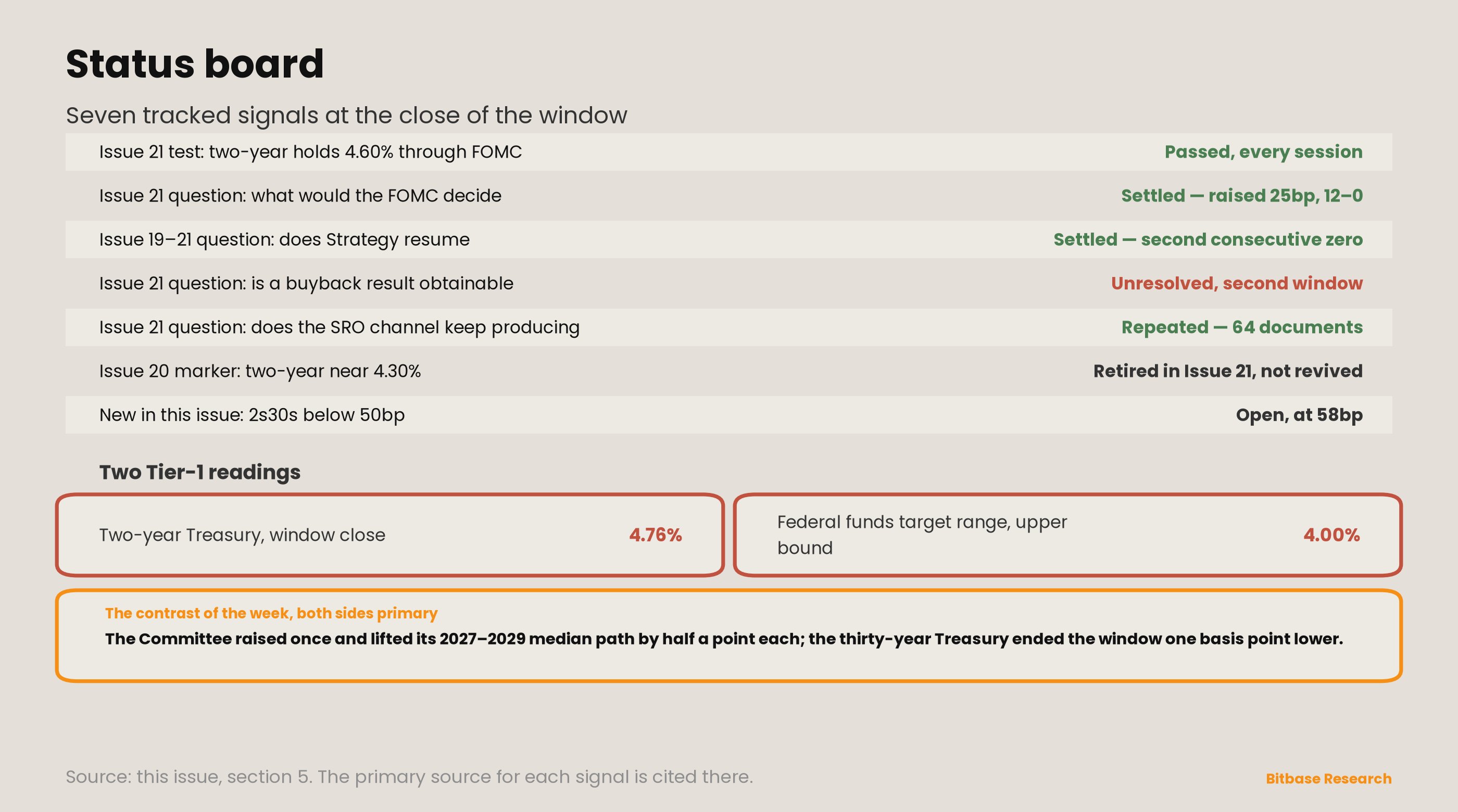
Issue 21's radar asked five questions. Three settle cleanly, one settles against its own framing, and one does not settle at all — for the second window running.
First, what would the FOMC decide on September 15 and 16? It raised by a quarter point to 3-3/4 to 4 percent, unanimously [1]. Issue 21 framed this as the meeting a conditional from early September pointed at, with both branches holding a number after the August CPI split hot on the headline and soft on the core. The Committee resolved it in the direction the headline pointed and the core did not. Tier-1, settled, and section 2 records that the projections did considerably more work than the decision. Nothing in that answer depends on interpretation: the target range is a published number and the vote is a published count.
Second, did the two-year hold above 4.60% through the decision? Yes, on every session [3]. Readings 4.65, 4.67, 4.74, 4.67, 4.76 — the lowest was 5 basis points above the level and the close was 16 above. Unlike the 4.30% test in Issue 21, this one was answered by the level being respected rather than abandoned, and section 4 raises it rather than retires it. The level was therefore cleared on every session without being tested on any of them. What a pass of that kind does not show is that the level held anything up: a front end repricing upward all week clears a line beneath it whether or not anything is defending it.
Third, did Strategy resume? No, for a second consecutive filing [9]. The 8-K filed September 14 states that between September 8 and 13 the company "did not sell any shares under its at-the-market offering program and did not purchase or sell any bitcoin." Holdings remain approximately 845,050 bitcoin at an aggregate $63.73bn and an average $75,412 [9]. Issue 19 asked whether the June-to-August pause was over; Issue 20 said one purchase does not answer it; Issue 21 recorded a zero; this issue records a second. The question is answered: the single purchase was the exception. It took four issues because the question was built to need them — one purchase is compatible with a resumption and with an exception, and only what follows it separates the two. What settles is the run of filings, not an intention, which none of these documents states.
Fourth, did a long-end buyback run at the new cap, and is the result obtainable? Unresolved, and for the second window the failure is retrieval rather than absence [12]. Three endpoints were attempted and returned nothing from this machine; the web results table is populated by client-side script and was retrieved empty. This series does not record "no operation" when what it observed was "no data," and section 7 states the failure mode. Carrying it unresolved a second time costs a slot on the radar that a decidable question could hold, and it is carried anyway, because retiring it would turn a retrieval gap into a silence and a silence reads the same as a negative answer.
Fifth, did the SRO channel keep producing? Yes — 64 documents matching the Federal Register's self-regulatory-organizations term were published in the window [11]. Issue 21 established the count as meaningful only if repeated; this is the repetition. This issue reports the number and declines to interpret it further, because a single prior count is not a baseline and two is barely one. The question settles regardless because it was scoped to production rather than to content: whether the channel produced is decidable from a document count, and nothing in that count requires the documents to be read.
New dimension—the rally that the disclosed buyer sat out
This series has tracked Strategy since Issue 14 as the cleanest available proxy for discretionary, non-flow-driven demand: one disclosed buyer, filing weekly, with a published average cost. Issue 21 recorded that the window low stopped 0.78% above that cost and the company bought nothing. This window produces the other half of that observation, and it is about where the money went instead.
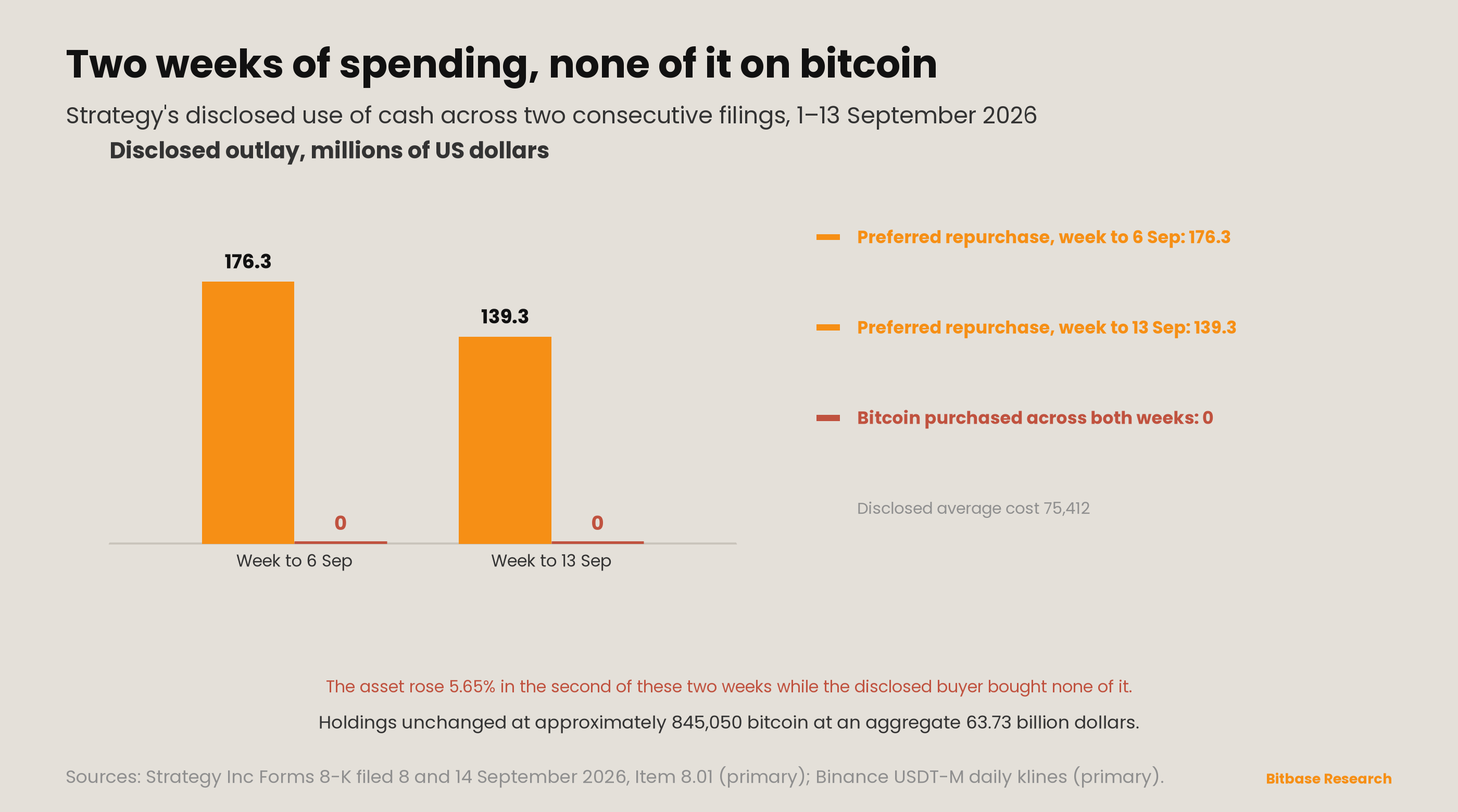
The filing covering September 8 to 13 discloses no bitcoin purchase and no at-the-market share sales [9]. In the same period the company repurchased 1,420,467 shares of its variable-rate Series A Perpetual Stretch preferred stock for $139.3m, and recorded zeroes against its Strife, Strike and Stride preferred programmes [9]. The prior filing recorded $176.3m directed to the same kind of purchase [10]. Across two consecutive disclosures the company has spent $315.6m on its own capital structure and nothing on the asset it exists to hold.
The observation this supports is about the identity of the bid, not about the price. Bitcoin rose 5.65% in this window [4]. Open interest rose on both venues and funding was positive at every interval on both [5][6][7][8]. The one buyer whose purchases are disclosed weekly did not participate, and the market that did move paid to hold the position the entire way up. That is a levered bid, at least in the part of the market this series can see. Identity is a narrower claim than size: this series can name who did not buy, because that buyer publishes, and cannot name who did, because the venues it reads report position and the cost of carrying it rather than the participants behind either.
What this does not establish. It does not establish that leverage caused the move; open interest rising alongside price is compatible with new longs, with shorts being forced, and with spot buyers hedging. It does not establish that discretionary demand is absent — it establishes that one disclosed source of it was. And it says nothing about the flows this series cannot retrieve, which section 3 names. New longs, forced shorts and hedged spot would each print the same open interest series and the same funding series, which is why the rise in both is reported as a fact about the book rather than as an account of who filled it.
The narrower point stands on its own. A company that raised capital to buy bitcoin has now spent two consecutive weeks buying its own preferred instead, while the asset rose almost six percent. Whatever that is, it is not accumulation, and a proxy for discretionary demand that has stopped demanding is worth reporting as a change in the proxy rather than as a signal about the asset.
Caveats
Section 1's "early then late" pattern is a description of two windows, not a regularity. Issue 21 found the largest move the day before a scheduled release; this issue finds it two days after one. Two observations with opposite signs around scheduled events do not make a rule, and this series will not treat a third as confirmation of one. The two are not even the same measurement — Issue 21's early move was a move in the Treasury curve and this issue's late move is a move in bitcoin — so the pair is a coincidence of timing across two different series rather than one series behaving twice. Nothing here establishes why September 18 moved, and the readings this issue holds for that session are all dated to it rather than ahead of it.
Section 2's flattening has more available explanations than the data can separate. A long end that does not follow a raised projection path is consistent with a market that already priced a higher terminal rate, with one that disbelieves the path, and with long-bond supply and demand unrelated to either. They are not ranked here because nothing in this issue ranks them: each one produces the same observable, a thirty-year that ends the window where it began, and a spread series cannot say which of them produced it. The run of 87, 72 and 58 is a direction, and the same three numbers would print under any of the three readings. This issue records the spread and declines to attribute it.
Section 6's $315.6m is two filings, not a policy. The company has not stated a change in strategy in the documents this series reads, and two weeks of preferred repurchase against zero bitcoin purchases is a pattern of exactly two observations. The inference drawn is deliberately limited to what the proxy now measures. The filings disclose what was done inside a stated period and not why, and this series does not read an intention into an item that states none. A third filing that resumed purchases would leave every number in section 6 standing and the reading of them wrong.
One quantity is absent rather than zero, for the second consecutive window, and the failure mode is stated. Treasury long-end buyback operation results: the two TreasuryDirect service endpoints for buybacks and the fiscal-data buybacks endpoint all returned no response from this machine, and the public results page is populated by client-side script and retrieved empty [12]. This is not evidence that no operation ran. Issue 21 recorded the same host as unreachable and drew the same distinction. An operation that ran and an operation that did not would arrive here as the same empty table, which is the whole of why the distinction is kept rather than collapsed into a zero.
One retrieval error was caught in production and is recorded because the judgement that caught it is reusable. The Treasury yield table read through a summarising fetch returned a two-year of 4.44 and a thirty-year of 5.38 for September 18; the raw published CSV gives 4.76 and 5.34 [3]. The summariser had shifted one column, reporting the one-year as the two-year and the twenty-year as the thirty-year. Every yield in this issue is taken from the CSV. The check that caught it was comparing the ten-year against the prior issue's table — that column matched exactly while the two-year was off by more than twenty basis points, which is not a shape that real data takes. The reusable part is the check rather than the shift: a series that already holds a prior reading of the same instrument can hold a new one against it, and a discrepancy confined to one column while its neighbour matches to the digit is a shape that misreading produces. What was at stake is section 2 — a thirty-year of 5.34 rather than 5.38 is the difference between a long end that ended the window below where it started and one that ended above it.
The SRO count is a count. Sixty-four documents matched a term query over a seven-day publication window [11]. This issue does not claim the documents are comparable to each other, that the term captures everything relevant, or that the count is a rate. It is one number with one method, stated so the next one can be compared to it. A term query returns what the term matched, which is as much a property of how the documents were indexed as of what they contain, and the sixty-four have not been read here.
Related reading
Other Bitbase articles on this topic:
Disclaimer: This article is market commentary from Bitbase Research, provided for information only. The views are those of Bitbase Research as of the date of writing and do not constitute investment, trading, tax, or financial advice, nor an offer or solicitation to trade. Data in this issue is current as of September 20, 2026; markets and disclosures may change, so refer to the latest information from authoritative sources. Trading crypto assets and leveraged products carries significant risk, including the possible loss of your capital.
References
[1] Federal Open Market Committee, statement of September 16, 2026, approved for release by a 12–0 vote. federalreserve.gov
[2] Federal Open Market Committee, Summary of Economic Projections, September 16, 2026, Table 1 (medians, with the June 2026 projection rows as published in the same table). federalreserve.gov
[3] US Treasury, Daily Treasury Par Yield Curve Rates, 2026 CSV download. home.treasury.gov
[4] Binance USDT-M futures, BTCUSDT daily klines, UTC. fapi.binance.com
[5] Binance USDT-M futures, open interest history, BTCUSDT, daily. fapi.binance.com
[6] Binance USDT-M futures, funding rate history, BTCUSDT. fapi.binance.com
[7] Bybit, open interest, linear BTCUSDT, daily. api.bybit.com
[8] Bybit, funding rate history, linear BTCUSDT. api.bybit.com
[9] Strategy Inc, Form 8-K filed September 14, 2026, accession 0001193125-26-389858, Item 8.01. sec.gov
[10] Strategy Inc, Form 8-K filed September 8, 2026, accession 0001193125-26-384402, Item 8.01. sec.gov
[11] Office of the Federal Register, documents API, publication window September 14–20, 2026, term "self-regulatory organizations". federalregister.gov
[12] TreasuryDirect, buyback announcements and results by operation date; retrieved empty, see section 7. treasurydirect.gov
[13] Board of Governors of the Federal Reserve System, FOMC meeting calendars, 2026. federalreserve.gov