
Issue 25 closed on a buyer whose USD Cash had fallen to $640.5m and a thirty-year that had broken 5.50% in a week with data, and asked whether the level would return in a week without. It did not, and the cash kept falling: the thirty-year never closed above 5.48%, and USD Cash ended at $132.7m [1][2][9][10]. This issue covers two weeks, October 19 to November 1, because there was no issue on October 26; it is published on November 5.
The single most useful fact in this issue is where the buyer's cash went. The three filings that cover October 12 to November 1 record $606.2m of repurchases of the company's Stretch preferred, all of it paid from USD Cash, against 1,078 bitcoin for $87.6m [1][9][10]. USD Cash fell from $640.5m to $132.7m [17][10], and in each filing the new balance equals the old one less the uses the filing states, plus the $98.5m of share-sale proceeds the last one says went into the account. Unlike Issue 25's second filing, none of the three leaves its repurchases unexplained.
The long end fell without a release and moved on the Fed. The thirty-year closed the window at 5.31%, 12 basis points lower; its largest move, −13 basis points on October 22, came on a day with no top-tier release [2]. The Federal Reserve held its target range at 3.75% to 4.00% on October 28, with two of twelve voters preferring a quarter-point increase [8]. That day the two-year fell 3 basis points and the thirty-year rose 7; the next day's GDP and PCE releases took both lower [14][15].
Bitcoin fell in both weeks, and one session did most of it. The contract ended the window −4.59% at 78,313.00; October 29 alone took 4.12% off, its worst session since June 5, and the other thirteen sessions together took 0.49% [3]. Open interest rose on both venues after three windows on opposite sides: Binance open interest ended 2.84% higher and Bybit's 14.65%, and funding paid about three times Issue 25's total on Binance and twice on Bybit [4][5][6][7].
One more item completes the issue. Section 6 reads the first final rule issued under the stablecoin law, published by the Office of the Comptroller of the Currency on October 23 [11].
Two weeks of October 19 to November 1, 2026
Bitbase Research · November 5, 2026
The one chart that matters
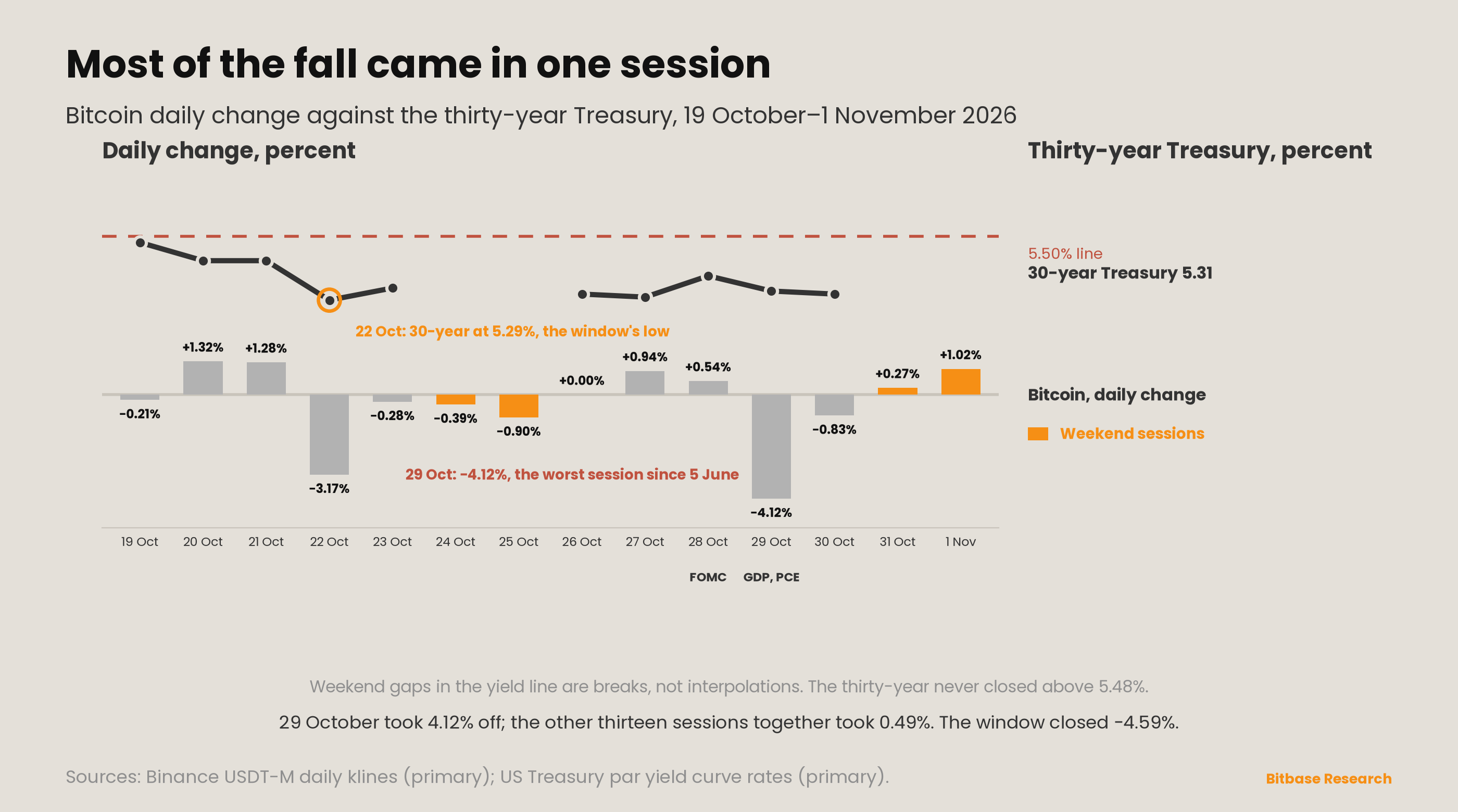
Daily closes for BTCUSDT perpetuals, USDT-margined futures, UTC, with the thirty-year Treasury par yield on the right axis and the 5.50% line marked [2][3]:
| Date (UTC) | Close | Session | Calendar | 30Y par yield |
|---|---|---|---|---|
| October 18 (prior close) | 82,078.00 | +0.76% | — | — |
| October 19 | 81,903.30 | −0.21% | — | 5.48 |
| October 20 | 82,984.80 | +1.32% | — | 5.42 |
| October 21 | 84,050.00 | +1.28% | — | 5.42 |
| October 22 | 81,384.60 | −3.17% | — | 5.29 |
| October 23 | 81,160.00 | −0.28% | — | 5.33 |
| October 24 | 80,843.70 | −0.39% | — | — |
| October 25 | 80,114.30 | −0.90% | — | — |
| October 26 | 80,115.90 | 0.00% | — | 5.31 |
| October 27 | 80,868.50 | +0.94% | — | 5.30 |
| October 28 | 81,308.80 | +0.54% | FOMC | 5.37 |
| October 29 | 77,962.60 | −4.12% | GDP, PCE | 5.32 |
| October 30 | 77,312.60 | −0.83% | — | 5.31 |
| October 31 | 77,522.60 | +0.27% | — | — |
| November 1 | 78,313.00 | +1.02% | — | — |
One session carried the window [3]. The contract lost 2.39% in the first week and 2.25% in the second. October 29 fell 4.12%, the worst session since June 5; on our arithmetic, the other thirteen sessions together took 0.49% off. The intraday low of 76,270.00 on October 30 was the lowest since September 18, and the close of 77,312.60 that day the lowest since September 17. October 29 and 30 were also the two heaviest sessions of the window, 253,736 and 241,631 bitcoin traded.
October 29 fell late in the UTC day, not at the release [3][14]. The 12:00 UTC hour, which contained the 12:30 GDP and PCE releases, closed 0.13% below its open. The 20:00 UTC hour lost 2.46% on 44,089 bitcoin, the most traded of any hour that day, and the session's low came in its last hour. This describes the timing of one day, not a response to the data. The hour of the Federal Reserve's statement, 18:00 UTC on October 28, closed 0.19% above its open.
Issue 25's weekend run ended at the next weekend [3]. Issue 25 recorded three weekends in a row on which bitcoin gained and called it a run, not a finding. On our arithmetic, the weekend of October 24 and 25 took 1.29% off, the first lower weekend since the one ending September 13, and the weekend of October 31 and November 1 added 1.29%. Two weekends, one each way, are what a run that was not a pattern looks like afterwards.
The right-hand axis stayed below the line throughout [2]. The thirty-year closed at 5.48 on October 19 and never higher; its low was 5.29 on October 22, the lowest close since September 22. The two worst bitcoin sessions fell on the two days the two-year yield fell most, October 22 and October 29. Two days are not a relationship, and section 7 says why the dates do not line up exactly.
This week's structural signal
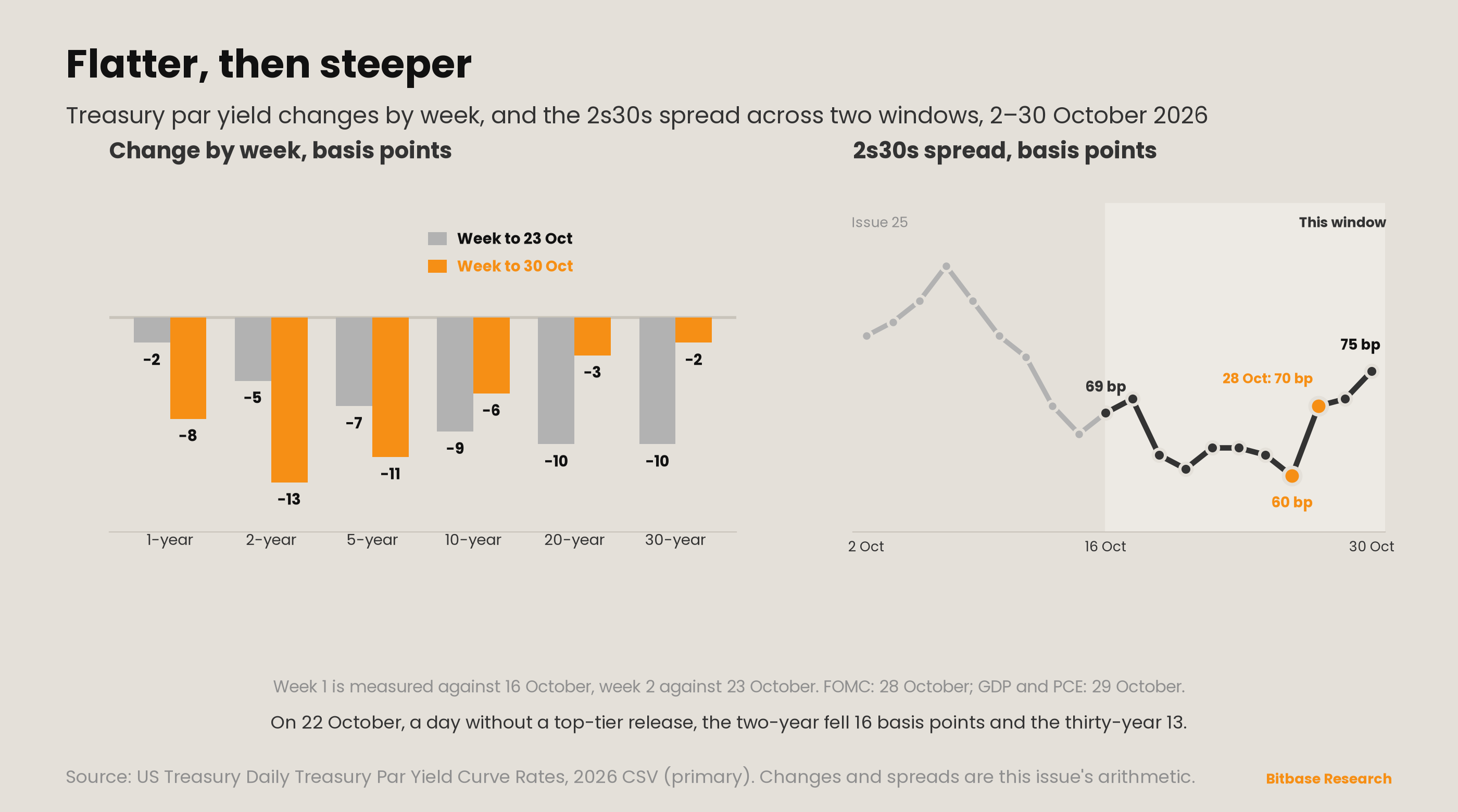
Change in basis points: the first week against the prior close of October 16, the second against October 23 [2]:
| 1Y | 2Y | 5Y | 10Y | 20Y | 30Y | |
|---|---|---|---|---|---|---|
| Week to October 23 | −2 | −5 | −7 | −9 | −10 | −10 |
| Week to October 30 | −8 | −13 | −11 | −6 | −3 | −2 |
| Window | −10 | −18 | −18 | −15 | −13 | −12 |
| Date | 2Y | 10Y | 30Y | 2s10s | 2s30s |
|---|---|---|---|---|---|
| October 16 (prior close) | 4.74 | 5.09 | 5.43 | 35bp | 69bp |
| October 19 | 4.77 | 5.15 | 5.48 | 38bp | 71bp |
| October 20 | 4.79 | 5.12 | 5.42 | 33bp | 63bp |
| October 21 | 4.81 | 5.13 | 5.42 | 32bp | 61bp |
| October 22 | 4.65 | 4.96 | 5.29 | 31bp | 64bp |
| October 23 | 4.69 | 5.00 | 5.33 | 31bp | 64bp |
| October 26 | 4.68 | 5.00 | 5.31 | 32bp | 63bp |
| October 27 | 4.70 | 4.99 | 5.30 | 29bp | 60bp |
| October 28 | 4.67 | 5.05 | 5.37 | 38bp | 70bp |
| October 29 | 4.61 | 4.98 | 5.32 | 37bp | 71bp |
| October 30 | 4.56 | 4.94 | 5.31 | 38bp | 75bp |
Every maturity from one year out ended lower, and the two weeks did it from opposite ends [2]. In the first week the long end fell more than the front: the thirty-year 10 basis points, the two-year 5. In the second the front fell more: the two-year 13, the thirty-year 2. On our arithmetic, the 2s30s spread narrowed from 69 to 60 basis points by October 27, its narrowest since September 24, and widened to 75 by October 30. A curve that flattens as it falls and then steepens as it falls has moved twice in two weeks, and the window as a whole ended steeper.
The largest move of the window came on a day without a release [2][14][15][27]. On October 22 the two-year fell 16 basis points, the ten-year 17 and the thirty-year 13. The series counts five releases as top-tier: the FOMC decision, CPI, the employment report, GDP and PCE. None fell on October 22, and the Bureau of Labor Statistics calendar shows no release that day. This issue records the size of the day and does not know its cause.
The two days with releases moved the curve in different ways [2][8][14][15]. The Federal Reserve held its target range at 3.75% to 4.00% on October 28 by a 10–2 vote; Lisa D. Cook and Beth M. Hammack preferred to raise it by a quarter point. At the previous meeting, on September 16, it had raised the range by a quarter point, 12–0 [19]. That day the two-year fell 3 basis points while the ten-year rose 6 and the thirty-year 7, and the 2s30s spread widened 10 basis points. The next day the Bureau of Economic Analysis reported third-quarter GDP up 3.4% at an annual rate, after 2.2% in the second, and the PCE price index up 3.6% on the year in September, 3.1% excluding food and energy. The two-year fell 6 basis points, the thirty-year 5.
Treasury's buybacks are visible to this series for the first time [20]. Two operations fell in the window: $0.75bn on October 21, from securities maturing between January 2028 and January 2036, and $6.0bn on October 27, from bonds maturing between February 2047 and February 2056. Both are labelled "Liquidity Support". From September 1 to November 1 Treasury ran thirteen operations: two "Cash Management" operations of $12.5bn each in September, in securities maturing in 2027 and 2028, and eleven "Liquidity Support" operations, four of them $6.0bn. This issue reports what was bought and when, not what it did to yields; the October 27 operation came the day before the thirty-year's 7-basis-point rise.
Dual-track scoreboard
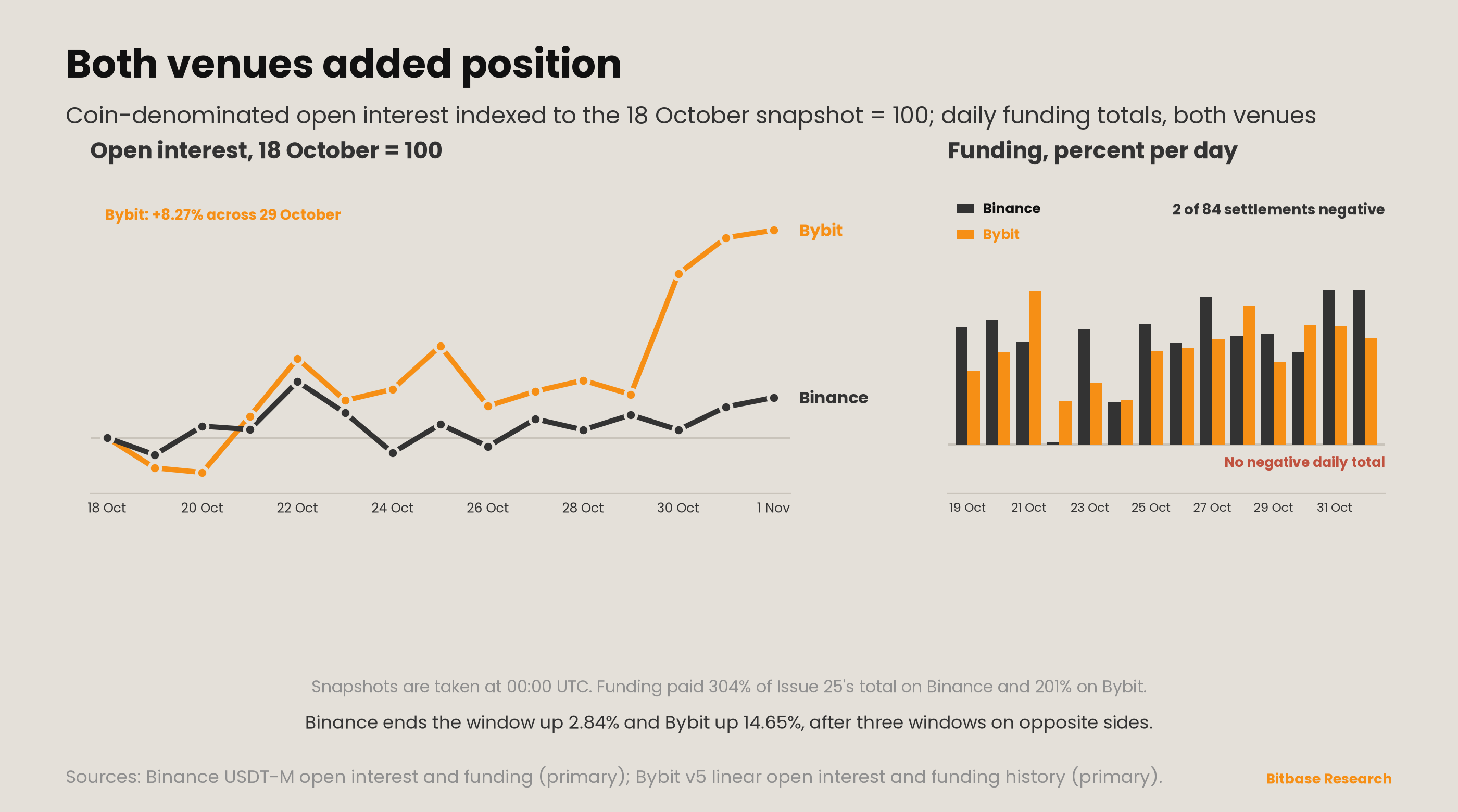
Coin-denominated open interest in BTCUSDT perpetuals, daily snapshots at 00:00 UTC [4][6]:
| Snapshot (00:00 UTC) | Binance (BTC) | Bybit (BTC) |
|---|---|---|
| October 18 (prior close) | 94,267 | 60,068 |
| October 19 | 93,131 | 58,787 |
| October 20 | 95,036 | 58,593 |
| October 21 | 94,819 | 60,980 |
| October 22 | 98,002 | 63,428 |
| October 23 | 95,912 | 61,647 |
| October 24 | 93,266 | 62,125 |
| October 25 | 95,166 | 63,962 |
| October 26 | 93,684 | 61,411 |
| October 27 | 95,514 | 62,041 |
| October 28 | 94,792 | 62,504 |
| October 29 | 95,786 | 61,902 |
| October 30 | 94,785 | 67,023 |
| October 31 | 96,320 | 68,556 |
| November 1 | 96,940 | 68,871 |
Binance ends the window 2.84% higher; Bybit 14.65% higher [4][6]. After three windows on opposite sides, both venues ended above where they began, and both did so in each of the two weeks: Binance 0.95% and then 1.86%, Bybit 6.48% and then 7.67%. Bybit's largest step, +8.27%, came across October 29, the session in which bitcoin fell 4.12%. Its November 1 snapshot of 68,871 is the highest of the 60 daily snapshots the venue's endpoint returns, which start on September 7. The two venues moved in the same direction on eight of the fourteen daily steps, the same count as in Issue 25; the difference is in where they ended.
Funding, summed across the three eight-hour settlements in each UTC day; window totals are summed from the unrounded settlements [5][7]:
| Date | Binance | Bybit |
|---|---|---|
| October 19 | +0.0229% | +0.0144% |
| October 20 | +0.0242% | +0.0180% |
| October 21 | +0.0200% | +0.0298% |
| October 22 | +0.0004% | +0.0084% |
| October 23 | +0.0224% | +0.0120% |
| October 24 | +0.0083% | +0.0087% |
| October 25 | +0.0234% | +0.0181% |
| October 26 | +0.0197% | +0.0187% |
| October 27 | +0.0287% | +0.0205% |
| October 28 | +0.0212% | +0.0269% |
| October 29 | +0.0215% | +0.0160% |
| October 30 | +0.0179% | +0.0232% |
| October 31 | +0.0300% | +0.0231% |
| November 1 | +0.0300% | +0.0207% |
| Window total | +0.2907% | +0.2583% |
Funding paid about three times Issue 25's total on Binance and twice on Bybit [5][7]. Both windows are two weeks long, so the totals compare directly: on our arithmetic, Binance's +0.2907% is 304% of Issue 25's +0.0956%, and Bybit's +0.2583% is 201% of +0.1285%. Two of the eighty-four settlements were negative, one on each venue, against twenty-one in Issue 25, and no daily total was. Binance's last two days, at +0.0300% each, were its highest daily totals since August 29; Bybit's highest, +0.0298% on October 21, its highest since August 24.
Longs paid more to hold positions in a window in which the price fell [3][5][7]. That was also true of the second week of Issue 25. The data shows the payment and the open interest, not who held the positions or why; section 7 says what coin-denominated open interest cannot separate.
What is absent from this scoreboard, and named rather than omitted: spot ETF daily flows, for the reason recorded in Issues 21 to 25 — this series has no primary retrieval path for them and does not source them second-hand.
On the radar—week of November 2 to November 8
This issue is published on November 5, three days into the week its radar asks about. The sessions of November 2 to 4 belong to the next issue and are not reported here; the questions below are about readings that do not exist at this issue's data cut, 10:03 UTC on November 5.
First, how does the filing covering November 2 to 8 pay for its Stretch repurchases, if it reports any? USD Cash was $132.7m as of November 1, less than the $208.2m the company spent from it on repurchases in the week to that date [10]. A week of repurchases at that size would need a source beyond the balance, and the filing either states one or the repurchases are smaller.
Second, does the company again route share-sale proceeds into USD Cash? The filing for October 26 to November 1 states that $98.5m of its $164.0m of share-sale proceeds was allocated to USD Cash; none of the weekly filings this series has read since the one filed on August 31 states such an allocation [10]. One allocation is an event; a second would make it a channel.
Third, does the October employment report, on November 6, move the two-year by more than 16 basis points? That was the size of October 22, a day without a release [2][28]. It is decidable from the same CSV, and it tests whether the window's largest day was large for a day with data or only for a day without.
Fourth, does Bybit open interest end the week above 68,871 bitcoin? That was its November 1 snapshot and the highest in the endpoint's 60 days [6]. A higher close extends the build; a lower one says the window's last three days were its peak.
Fifth, does a second final rule implementing the GENIUS Act reach the Federal Register, or does any open comment period move? One final rule and seven open comment periods are now on the record, the earliest closing on November 23 [11][12][13][21]. The same Federal Register query answers both.
Signal tracking update
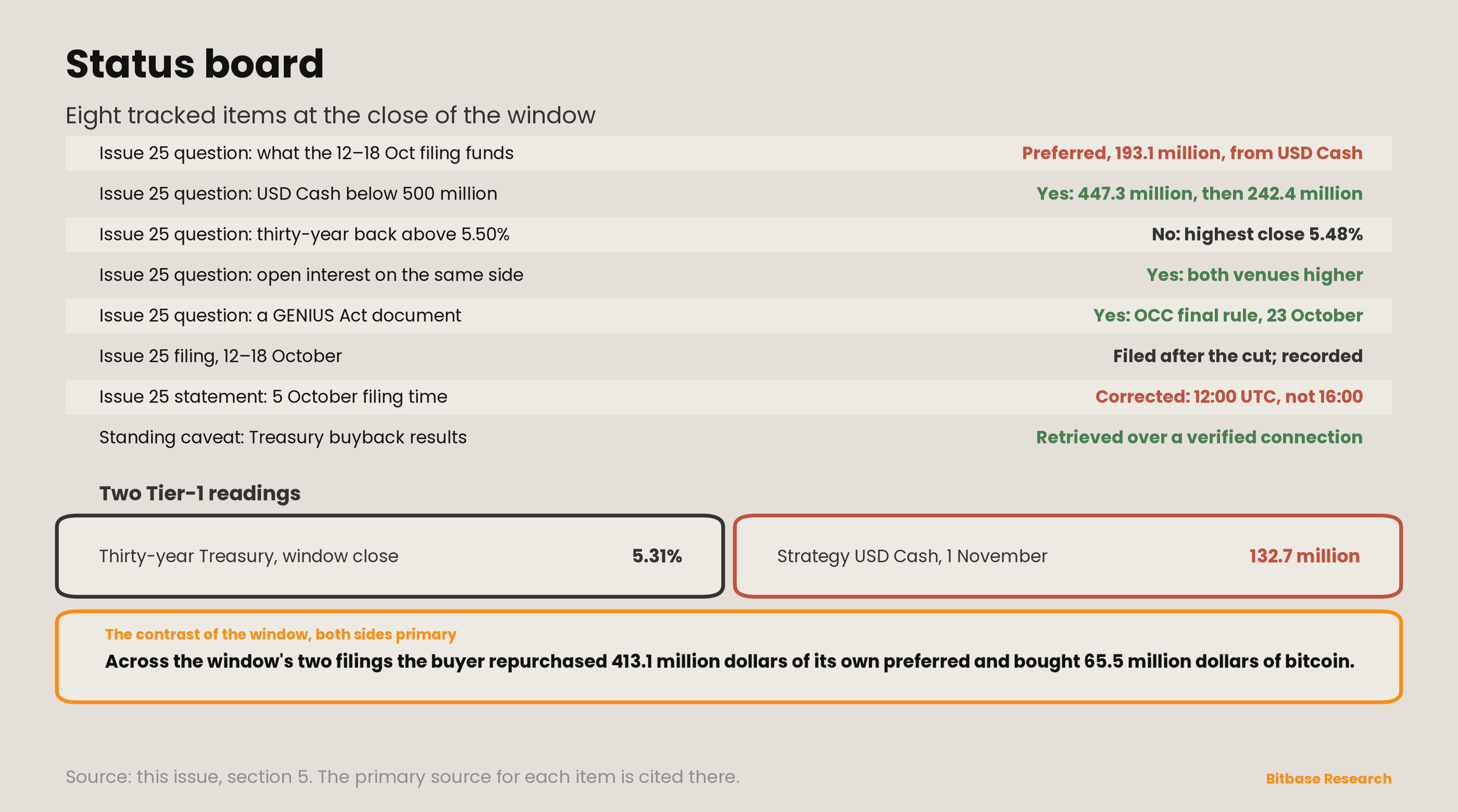
Issue 25's radar asked five questions about the week of October 19 to 25. All five settle on that week. The second week was not asked about; where it matters it is reported beside the answer, not scored. After them, one item Issue 25 could not report is recorded, and one statement it made is corrected.
First, what did the filing covering October 12 to 18 fund, and did it say how its preferred repurchases were paid for? Mostly the company's own preferred, and yes: from USD Cash [1]. Strategy's filing reports 1,938,780 Stretch shares repurchased for $193.1m, all of it from USD Cash, and 267 bitcoin bought for $22.1m, from $22.0m of common-stock sales and $0.1m of USD Cash. It also reports that the board raised the authorization for repurchasing the company's preferred from $2.0bn to $3.0bn, with $1.16bn left as of October 18. Issue 25 noted that the October 5 to 11 filing did not state the source of its repurchases; this one does, and so do the two after it [9][10]. STATUS: CONFIRMED. The special meeting of October 28 approved daily dividends on all four preferred series, 381,373,199 votes to 2,236,551; for Stretch the change was set to take effect on November 1 [16].
Second, did USD Cash print below $500m? Yes: $447.3m as of October 18, and $242.4m as of October 25 [1][9]. The October 26 filing reports no share sales, no bitcoin purchases and $204.9m of Stretch repurchases from USD Cash. On our arithmetic, each balance equals the previous one less the uses the filing states, to the tenth of a million. STATUS: CONFIRMED. The second week took the balance to $132.7m [10].
Third, did the thirty-year close back above 5.50% on any session of a week without a top-tier release? No [2]. Readings 5.48, 5.42, 5.42, 5.29, 5.33; the highest was the first. STATUS: UNCHANGED. The second week, with the FOMC decision and the GDP and PCE releases in it, did not take it back either: its highest close was 5.37% on October 28. A level that broke in a week with data and stayed broken through a week without, and then through another week with, is recorded here as a level that has not returned.
Fourth, did Binance and Bybit open interest end the week on the same side of where they began? Yes, both higher [4][6]. Binance's October 25 snapshot was 0.95% above October 18, and Bybit's 6.48%. Issue 25 said a fourth split would make the divergence a standing feature. There was no fourth split, so the divergence stays a run of three windows, and the second week went the same way. STATUS: CONFIRMED.
Fifth, did a document implementing the GENIUS Act reach the Federal Register, or did any of the five comment periods move? A document did; no period moved [11][21]. The Office of the Comptroller of the Currency published a final rule on October 23, with two notices requesting comment on its forms the same day. Re-reading the five documents' Federal Register records shows the same closing dates as in Issue 25: November 30, November 30, November 30, December 7 and December 14 [22][23][24][25][26]. STATUS: CONFIRMED. Section 6 reads the rule.
One item Issue 25 could not report is recorded here, as a completion rather than a correction. Issue 25 said that as of its data cut, 03:52 UTC on October 19, the filing covering October 12 to 18 did not exist. That was true at the cut: EDGAR's filing index records its acceptance at 08:00:13 Eastern time, which is 12:00 UTC, eight hours later [1]. What it contains is in the first two answers above.
One statement in Issue 25 is corrected here. Issue 25 said that the filing for September 28 to October 4 was accepted at 16:00 UTC on October 5, six and a half hours after Issue 24's cut. The filing index records acceptance at 08:00:15 Eastern time, which is 12:00 UTC, two and a half hours after the cut [18]. Issue 25 read the time from EDGAR's submissions feed, which then gave 16:00:15 and now gives 12:00:15 for the same filing; this issue reads it from the filing index instead. The conclusion Issue 25 drew, that the filing did not exist at Issue 24's cut, is unchanged.
New dimension—the stablecoin law's first final rule
Issues 24 and 25 recorded the GENIUS Act's dates and the documents that borrowed its definitions, and said this series would report documents and dates, not contents, until there was a final rule. In this window there is one, and this section reads what the document says about itself: its dates, what it says commenters disputed, and two choices it states plainly.
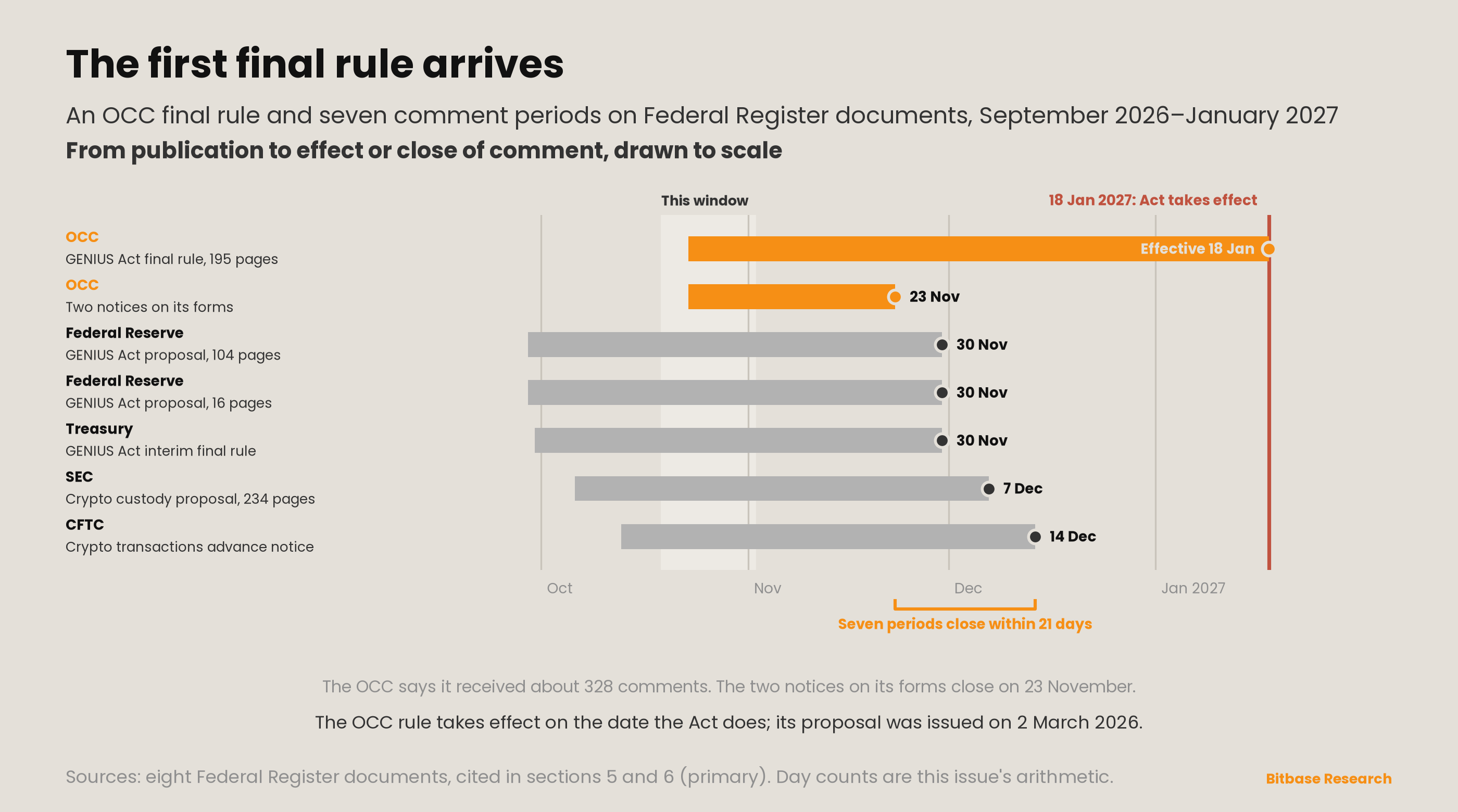
The OCC's final rule, published October 23, runs to 195 pages [11]. It implements the Act for payment stablecoin issuers under the OCC's jurisdiction and for certain custody activities of OCC-supervised entities. The proposal it finalizes, issued on March 2, 2026, covered subsidiaries of insured national banks and federal savings associations, federal qualified issuers, certain nonbank state-qualified issuers and foreign issuers; its comment period closed on May 1, and the OCC says it considered late comments until July 1. It is effective on January 18, 2027, the date the Act takes effect, 87 days after publication on our arithmetic.
The OCC received approximately 328 comments, and names four areas of disagreement [11]. They were reserve-asset management, liquidity and diversification; the prohibition on issuers paying interest or yield, including a proposed presumption about payments through affiliates and related third parties; whether redemptions could be frozen or extended during a spike in requests; and capital. The document says commenters "had diverging views on several of the proposal's key provisions", and that it expects to update the rule as issuers' practices develop.
Two choices are stated plainly [11]. On the yield prohibition, the OCC declines safe harbors for small payments and for arrangements that are securities: "The OCC is not adopting a safe harbor for de minimis payments". On reserves, the final rule caps exposure to any one counterparty at 40% of reserve assets and "modifies the counterparty limit by explicitly excluding exposures to the United States Government". Comments on anti-money-laundering and sanctions requirements are left to "a separate rulemaking".
The rule came with forms, and the forms have their own deadline [12][13][29]. Two OCC notices published the same day request comment on applications for licensing or registration, 4 pages, and on reporting forms for permitted issuers, 24 pages; a correction to the first followed on October 29. Both close on November 23. On our arithmetic, seven comment periods now close within 21 days of one another, from November 23 to December 14, and the Act takes effect 35 days after the last.
What this does not establish. It does not establish what the rule will require of any named issuer, and this series does not assess compliance. It does not establish the rules of the Federal Reserve, Treasury, the SEC or the CFTC, whose documents are still open for comment. It says nothing about stablecoin supply, which this series does not track. What it establishes is that one of the Act's regulators has finished its main rule, on a date that matches the Act's own.
Caveats
This issue reports two weeks as one window. Issue 25's questions are settled on the week they asked about, and the second week is reported but not scored. Issue 25 also covered two weeks, so this issue compares its totals with Issue 25's directly rather than per week.
Section 1's dates do not line up exactly across assets. Bitcoin sessions run from 00:00 to 24:00 UTC; Treasury par yields are end-of-day readings for the New York trading day. October 29's bitcoin fall came mostly at 20:00 UTC and later, after that day's yield reading was taken. That the worst bitcoin sessions and the largest falls in the two-year fell on the same two dates is a statement about the calendar, not a link between them.
Section 2's release accounting is arithmetic, not attribution. Assigning a day's move to the release published that day leaves out auctions, moves in other markets and positioning. The window's largest move came on a day with no release in this series' definition, which is a statement about the definition's coverage as much as about the market.
Section 2's buyback readings come from a source this series could not reach until now. For five windows the TreasuryDirect and fiscal-data hosts failed certificate verification on this machine. At this issue's data cut both verified, and the operations and per-security results were read from the fiscal-data API over a verified connection [20]. The limitation restated each issue since Issue 21 ends here, for buybacks. Auctions remain a gap: the same API's auction query returned five records for the window, through October 22, none with results [30].
Section 3's open interest counts contracts, not intentions. A rise on both venues while the price falls is compatible with new shorts, with new longs paying more to hold, and with both; coin-denominated open interest cannot separate them. The negative settlements are small, the deeper −0.0014%, and are reported for completeness.
Section 5's Strategy readings rest partly on this issue's arithmetic. The balance reconciliations assume that nothing other than the stated uses and allocations moved USD Cash; that they match to the tenth of a million is a match, not a disclosure. The share-sale total for October 26 to November 1 includes shares sold but not yet settled as of October 30, as the filing states [10].
Section 6 reads a final rule's account of itself, not its requirements. The four areas of disagreement and the two choices are as the OCC states them in the Federal Register; this issue has not read the Act itself and does not assess what the rule would require of any firm.
Related reading
Other Bitbase articles on this topic:
Disclaimer: This article is market commentary from Bitbase Research, provided for information only. The views are those of Bitbase Research as of the date of writing and do not constitute investment, trading, tax, or financial advice, nor an offer or solicitation to trade. Data in this issue is current as of November 1, 2026; markets and disclosures may change, so refer to the latest information from authoritative sources. Trading crypto assets and leveraged products carries significant risk, including the possible loss of your capital.
References
[1] Strategy Inc, Form 8-K filed October 19, 2026, accession 0001193125-26-424688, Item 8.01, period October 12–18, 2026. sec.gov
[2] US Treasury, Daily Treasury Par Yield Curve Rates, 2026 CSV download. home.treasury.gov
[3] Binance USDT-M futures, BTCUSDT klines, daily and hourly, UTC. fapi.binance.com
[4] Binance USDT-M futures, open interest history, BTCUSDT, daily. fapi.binance.com
[5] Binance USDT-M futures, funding rate history, BTCUSDT. fapi.binance.com
[6] Bybit, open interest, linear BTCUSDT, daily. api.bybit.com
[7] Bybit, funding rate history, linear BTCUSDT. api.bybit.com
[8] Board of Governors of the Federal Reserve System, FOMC statement, October 28, 2026. federalreserve.gov
[9] Strategy Inc, Form 8-K filed October 26, 2026, accession 0001193125-26-431146, Item 8.01, period October 19–25, 2026. sec.gov
[10] Strategy Inc, Form 8-K filed November 2, 2026, accession 0001193125-26-442707, Item 8.01, period October 26–November 1, 2026. sec.gov
[11] Office of the Comptroller of the Currency, final rule, Implementing the GENIUS Act for the Issuance of Stablecoins by Entities Subject to the Jurisdiction of the OCC, Federal Register document 2026-21706, October 23, 2026. govinfo.gov
[12] Office of the Comptroller of the Currency, notice and request for comment, Applications for Licensing or Registration, Federal Register document 2026-21704, October 23, 2026. govinfo.gov
[13] Office of the Comptroller of the Currency, notice and request for comment, Reporting Forms and Instructions for Permitted Payment Stablecoin Issuers, Federal Register document 2026-21705, October 23, 2026. govinfo.gov
[14] US Bureau of Economic Analysis, GDP (Advance Estimate), 3rd Quarter 2026, released October 29, 2026. bea.gov
[15] US Bureau of Economic Analysis, Personal Income and Outlays, September 2026, released October 29, 2026. bea.gov
[16] Strategy Inc, Form 8-K filed October 29, 2026, accession 0001193125-26-437776, Items 3.03, 5.03 and 5.07. sec.gov
[17] Strategy Inc, Form 8-K filed October 13, 2026, accession 0001193125-26-419726, Exhibit 99.1, period October 5–11, 2026. sec.gov
[18] Strategy Inc, Form 8-K filed October 5, 2026, accession 0001193125-26-413164, filing index. sec.gov
[19] Board of Governors of the Federal Reserve System, FOMC statement, September 16, 2026. federalreserve.gov
[20] US Treasury, Fiscal Data, Treasury Securities Buybacks: operations and security details, from September 1, 2026. fiscaldata.treasury.gov
[21] Federal Register, document search for "stablecoin", publication dates from September 1, 2026. federalregister.gov
[22] Board of Governors of the Federal Reserve System, proposed rule, Implementing the Federal Reserve Board's Responsibilities Under the GENIUS Act, Federal Register document 2026-19860, September 29, 2026. govinfo.gov
[23] Board of Governors of the Federal Reserve System, proposed rule on application procedures for a subsidiary to issue payment stablecoins, Federal Register document 2026-19899, September 29, 2026. govinfo.gov
[24] US Treasury, interim final rule, Forms and Procedures for Review of State Certifications by the Stablecoin Certification Review Committee, Federal Register document 2026-19966, September 30, 2026. govinfo.gov
[25] US Securities and Exchange Commission, proposed rule, Adviser and Regulated Fund Custody Rules; Crypto Custody Rules, Federal Register document 2026-20466, October 6, 2026. govinfo.gov
[26] US Commodity Futures Trading Commission, advance notice of proposed rulemaking, Regulation Crypto Asset Transactions and Regulation Crypto Asset Markets, Federal Register document 2026-20888, October 13, 2026. govinfo.gov
[27] US Bureau of Labor Statistics, schedule of selected releases, October 2026. bls.gov
[28] US Bureau of Labor Statistics, schedule of selected releases, November 2026. bls.gov
[29] Office of the Comptroller of the Currency, notice and request for comment; correction, Federal Register document 2026-22036, October 29, 2026. govinfo.gov
[30] US Treasury, Fiscal Data, Treasury Securities Auctions Data, auction dates October 19 to November 1, 2026. fiscaldata.treasury.gov