Apple announced its fiscal 2026 fourth-quarter results on November 2: revenue of $114.48 billion, up 12% year over year, above the LSEG estimate of $113.39 billion; diluted earnings per share (EPS) of $2.10, above the expected $1.99.
What drove the stock price change was not the earnings beat. Apple expects that, affected by rising memory chip costs, gross margin for the December quarter will fall from 47.9% to 45%–46%; services revenue growth of 8%–9%, below analysts' expectation of about 10.7%.
According to Reuters, Apple's stock price changed little after the earnings release, then fell about 4% during the earnings call.
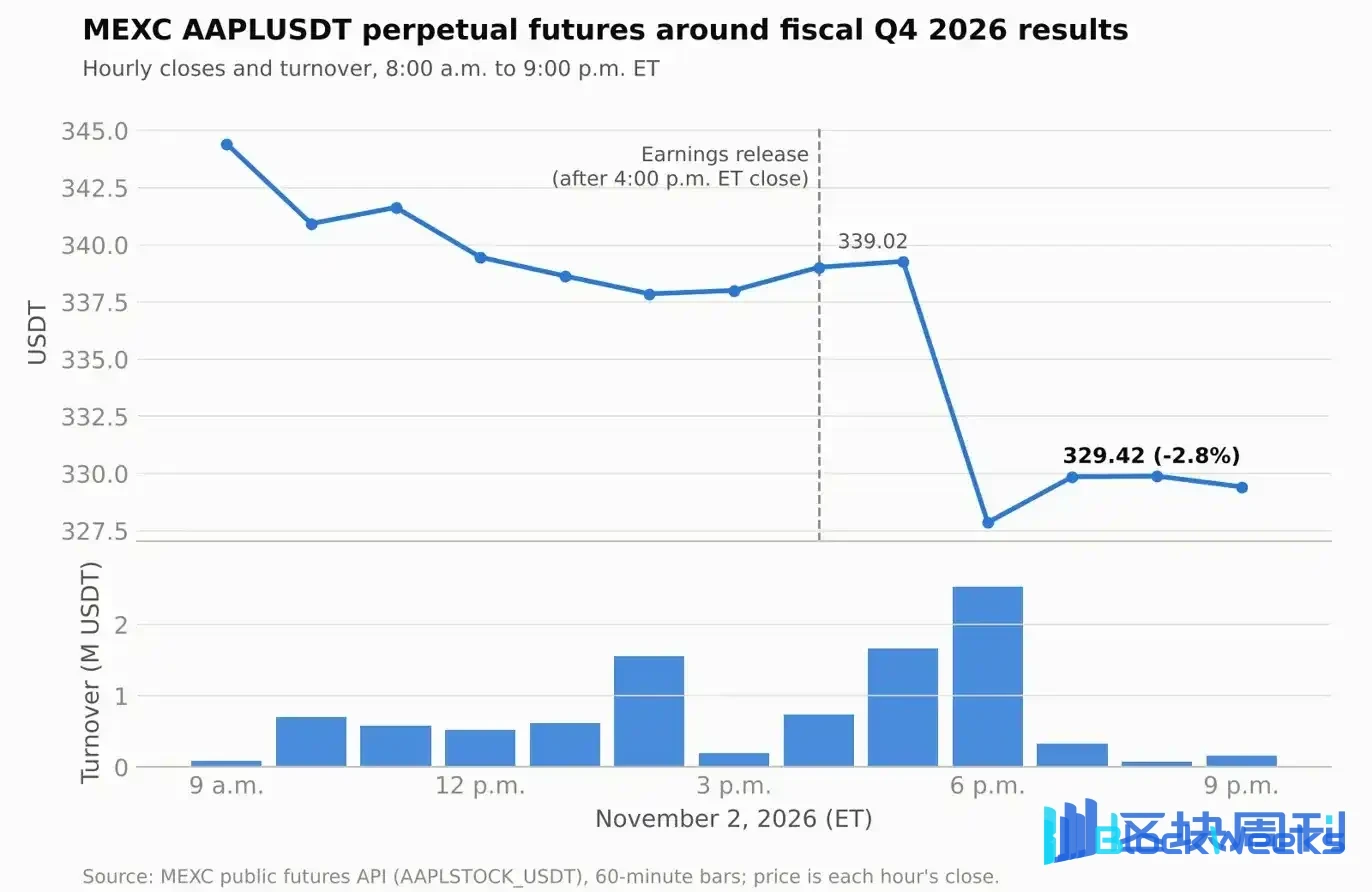
On MEXC, the AAPLUSDT perpetual contract was down 2.8% as of 21:00 ET.
Apple Fiscal 2026 Fourth-Quarter Results vs. Market Expectations
- Revenue: $114.48 billion, expected $113.39 billion (LSEG). Beat expectations.
- EPS: $2.10, expected $1.99. Beat expectations, including a $0.05 contribution from tariff refunds; still above expectations excluding this.
- iPhone: $57.58 billion, expected $56.54 billion (LSEG). Beat expectations, up 17.5% year over year.
- Services: $31.57 billion, expected $31.58 billion (LSEG). In line with expectations, up 9.8% year over year.
- Gross margin: 47.9%, expected 47.5% (LSEG), with tariff refunds contributing about 1 percentage point.
- December quarter guidance: Revenue growth of 7%–10%, services growth of 8%–9%, gross margin of 45%–46%. Services guidance below expectations.
Key Takeaways
- 13 consecutive beats: Apple's revenue and EPS beat expectations in each of its last 13 earnings reports, but in 8 of the previous 12, the stock fell after the release.
- Guidance is the key: In the 5 previous reports where guidance was below expectations, the stock fell every time; this report also fits that pattern.
- Memory costs: John Ternus, attending the earnings call as CEO for the first time, said current memory chip price changes are unprecedented and expects costs to continue rising.
- Strong iPhone and Mac performance: iPhone grew 17.5%, Mac grew 23.7%, while iPad and wearables declined.
- MEXC market reaction: During the hour of the earnings call, AAPLUSDT swung sharply between 348.44 and 324.23 USDT, closing the hour at 327.86, down 3.3% from the 16:00 ET price.
Apple Beat Expectations, So Why Did the Stock Fall?
Apple's stock fell because the business outlook was weaker than this quarter's performance. The December quarter gross margin guidance of 45%–46% is 2 to 3 percentage points lower than the fourth quarter's 47.9%, and also below the 50.1% Apple reported for its June quarter.
CFO Kevan Parekh said on the earnings call that the gross margin guidance mainly reflects rising memory costs, with some also from costs associated with scaling Siri AI. Ternus said the company is seeing higher memory costs than in the June quarter and expects them to continue rising after December.
The services guidance matters because services is Apple's highest-margin business; 8%–9% growth would be below the 9.8% just reported this quarter.
Tariff refunds also made this quarter's results look better. Apple said tariff refunds contributed about 1 percentage point to gross margin and $0.05 to EPS, and that most refunds have now been recovered, so this support will not recur.
iPhone, Mac and Services: Fiscal 2026 Fourth-Quarter Revenue by Segment
The following data all comes from Apple's fiscal 2026 fourth-quarter earnings press release.
- iPhone: $57.58 billion, up 17.5% year over year, a September-quarter record.
- Mac: $10.79 billion, up 23.7% year over year.
- iPad: $6.23 billion, down 10.4% year over year.
- Wearables, Home and Accessories: $8.30 billion, down 7.9% year over year.
- Services: $31.57 billion, up 9.8% year over year, an all-time high.
By region, Greater China revenue grew 21.0% to $17.54 billion, the Americas grew 10.2%, Europe grew 11.5%, and Japan edged down 1.4%.
Net income rose 11.8% to $30.71 billion. Apple returned $28 billion to shareholders this quarter and declared a dividend of $0.27 per share, payable on November 16 to shareholders of record on November 12.
Full-year fiscal 2026 revenue grew 15.1% to a record $478.83 billion; diluted EPS rose 20.4% to $8.98.
What Is Apple's Guidance for the December Quarter (Fiscal 2027 First Quarter)?
- Revenue: Up 7% to 10% year over year. Parekh said this will be Apple's highest-revenue quarter ever.
- Services: Growth of 8% to 9%.
- Gross margin: 45% to 46%.
- Operating expenses: $20.4 billion to $20.8 billion.
- Tax rate: About 17%.
Ternus said rising memory costs will be partly offset by price increases and by inventory previously purchased at lower prices. He also called the new iPhone Duo the most transformative iPhone since the original iPhone, and said supply is currently constrained.
How Does This Compare With Apple's Stock Reaction After Past Earnings?
Our Apple earnings dates and historical results recorded the 12 earnings reports before this one.
- Beats: Apple beat revenue and EPS expectations in all 12 reports.
- Stock reaction: The stock rose the next day only 4 times and fell 8 times, with an average move of 2.3%.
- Guidance pattern: In the 5 reports where guidance was below expectations, the stock fell every time.
The previous report is the most comparable. In July, Apple beat expectations but gave September-quarter revenue growth guidance of 9%–11%, below the roughly 12% expected, and the stock fell 7.4% the next day.
This time revenue guidance was better, but gross margin and services guidance missed expectations, so the stock reaction began with the earnings call rather than at the earnings release.
How AAPL Contracts Reacted on MEXC
AAPLUSDT on MEXC supports 7×24 trading, so moves during the earnings call can be tracked all the way into the Asian morning.

Hourly closing prices and trading volume of the MEXC AAPLUSDT perpetual contract from 8:00 to 21:00 ET on November 2, 2026. Source: MEXC public contract API.
Price: The contract closed the 15:00–16:00 ET hour at 339.02 USDT and was flat at 339.28 an hour after the earnings release. During the hour of the earnings call, the contract rose as much as 2.8% to 348.44, then fell to a low of 324.23, a drop of 4.4%, and closed the hour at 327.86. As of 21:00 it was at 329.42, down 2.83%.
Trading activity: The trading volume in the hour the earnings report was released was about 1.67 million USDT, and in the hour of the earnings call it was about 2.53 million USDT, which were 6.5 times and 9.9 times the average hourly level over the previous 24 hours, respectively.
Premium relative to the index price: The deviation between the hourly closing price and the index price remained within about 15 basis points, indicating that the contract tracked Apple's after-hours stock price performance.
Funding rate: AAPLUSDT settles every eight hours, and each settlement over the past two days was 0%, including the first settlement at 00:00 UTC on November 3 after the earnings release.
Tracking AAPL via MEXC
The AAPLUSDT perpetual contract on MEXC provides a 7×24-hour market, making it convenient to track Apple's price movements before and after earnings and outside Nasdaq trading hours. For specific steps, please refer to the MEXC stock futures trading guide.
In MEXC's spot market, you can also gain Apple-related exposure through AAPLON, which is a tokenized form of Apple stock.
For eligible users interested in holding stocks, MEXC RealStocks is another option; please directly check availability and supported securities.
Perpetual contracts do not confer any shareholder rights (including dividends) and involve funding rates, leverage, and forced liquidation risks.
Frequently Asked Questions
Did Apple's fiscal 2026 fourth-quarter earnings beat market expectations?
Yes. Revenue was $114.48 billion, above the LSEG estimate of $113.39 billion; EPS was $2.10, above the expected $1.99. iPhone revenue also beat expectations, while the services business was in line with expectations.
Why did Apple's stock fall even though earnings beat expectations?
Affected by rising memory costs, Apple expects gross margin for the December quarter to fall from 47.9% to 45%–46%, and services business growth of 8%–9%, below analysts' expectation of about 10.7%. The stock fell about 4% during the earnings call.
What is Apple's revenue guidance for the first quarter of fiscal 2027?
Apple expects December-quarter revenue to grow 7% to 10% year over year, services business growth of 8% to 9%, and gross margin of 45% to 46%.
How much did tariff refunds contribute to Apple's results?
Apple said that fourth-quarter tariff refunds contributed $0.05 to EPS and about 1 percentage point to gross margin, and that it has now recovered the vast majority of refunds.
How does Apple's stock price generally move after each earnings report?
In the 12 earnings reports before this one, Apple beat expectations each time, but the stock fell the next day 8 times. After all 5 earnings reports in which guidance was below expectations, the stock fell.