


Written by: Rita
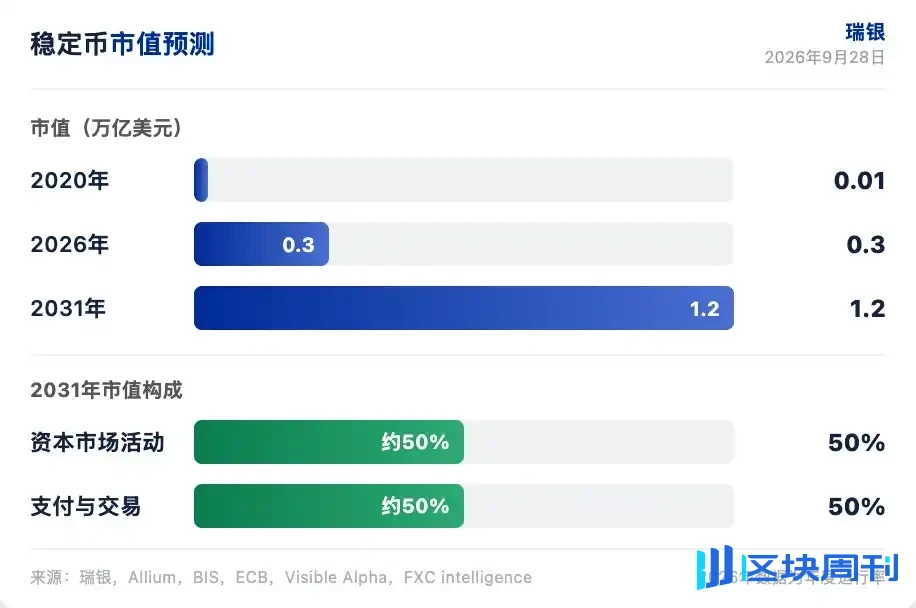
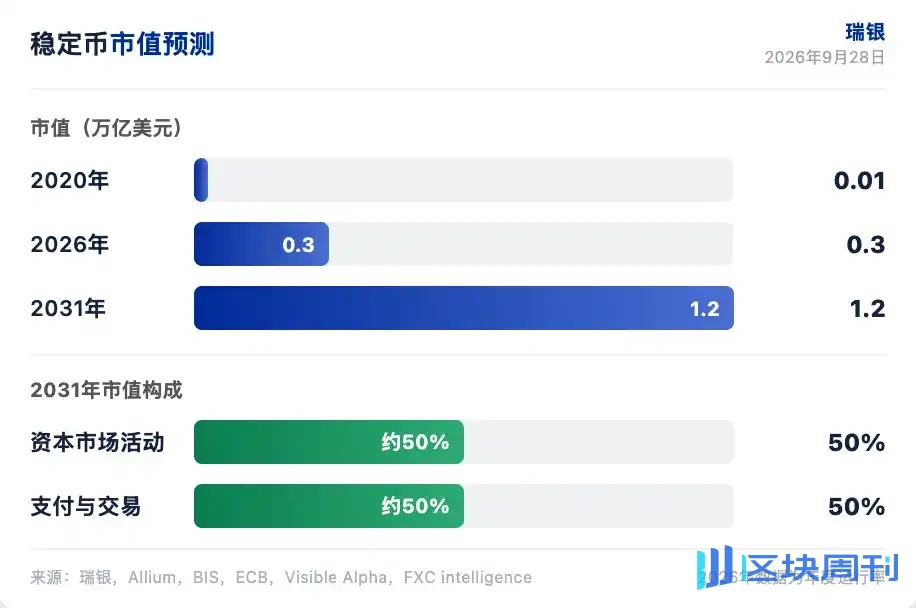
UBS Group initiated coverage of digital asset strategy for the first time, publishing a roughly 50-page in-depth report. In the report released on September 28, 2026, UBS pointed out that the stablecoin market's market capitalization will reach about $1.2 trillion by 2031, with real-world payment volume reaching about $3 trillion. Stablecoin issuers have become one of the largest holders of short-term U.S. Treasuries, holding about $175 billion in Treasury-related exposure. UBS believes the impact on the entire financial sector is neutral to moderately positive.
UBS analyst Justin Forsythe pointed out that the clearest near-term use cases for digital assets are concentrated at the infrastructure level: settlement, collateral liquidity, and machine-native payments. UBS spoke with more than 30 industry participants, including digital asset-native companies, traditional financial institutions, and native fintech companies. The report proposes five core themes: stablecoins as real-world payment rails, capital markets tokenization, blockchain rails for the agent economy, blockchain security compliance and regulation, and the invisibility of infrastructure.
Stablecoins Become Major Buyers of Short-Term Treasuries
The Bank for International Settlements estimates that a $3.5 billion inflow into stablecoins would lower the 3-month Treasury yield by about 0.7 basis points, and by about 4 basis points within ten days. UBS pointed out that the importance of stablecoin issuers is disproportionate to their size, because reserves are concentrated at the very front end of the yield curve, having a measurable impact on near-term funding rates. The GENIUS Act will allow reserves to be restricted to highly liquid assets, making this demand more structural.
Stablecoins currently have a market capitalization of about $300 billion, and UBS's model shows it reaching about $1.2 trillion by 2031. About half of that comes from capital markets activity, including real-world assets, and the rest from payments and trading margin storage. UBS believes stablecoin transaction volume is a more meaningful adoption indicator than market capitalization, and better reflects the actual use of blockchain technology.
Stablecoins are most valuable in "money movement" scenarios, and most valuable in emerging markets. UBS pointed out that emerging economy corridors traditionally require 3 to 4 times more prefunding than developed economy corridors, because settlement windows are longer, financial infrastructure is more fragmented, and there are capital controls and exchange rate risks. Stablecoins can enable instant funding, but still require local payment functionality.
Tokenization Unlocks Capital Efficiency
The securities repo market has daily trading volume of about $8 trillion. If 20% of securities are used twice per day, about $2.46 trillion in annualized trading volume could be unlocked. UBS pointed out that the main benefit of tokenization in capital markets is collateral liquidity and speed. Tokenization can compress issuance, transfer agency, custody, settlement, collateral movement, and reporting links.
Regulatory capital ratios also benefit. UBS pointed out that the world's 32 largest banks hold about $2.4 trillion in high-quality liquid asset buffers, exceeding regulatory requirements by about 30%. Instant settlement can improve the substitutability of individual assets within high-quality liquid asset portfolios, unlocking higher returns.
24/7 markets and prediction markets are another pillar of tokenization. Tokenized stocks provide international investors with low-fee democratized access, and foreign holdings of U.S. stocks amount to about $17 trillion. Perpetual contracts trade on both centralized and decentralized exchanges, and prediction markets have daily trading volume exceeding $2 billion. UBS believes these appear niche, but have institutional use cases, such as large-scale hedging of election outcomes and weekend trading volume hedging.
Agentic Commerce Needs Stablecoin Rails
By 2030, AI agents may facilitate about $2 trillion in global C2B e-commerce, accounting for about 15% of the total. UBS believes agentic commerce will expand the total addressable market of e-commerce. AI agents discover, evaluate, and purchase goods or services on behalf of consumers or businesses. UBS expects stablecoins to be used for about $56 billion of that, accounting for about 3%.
Stablecoins are most differentiated in open, machine-native commerce, where agents transact with unfamiliar counterparties, make high-frequency micropayments, or require programmable instant settlement. Closed ecosystems can adapt existing card rails for agents through tokenized credentials, delegated spending controls, and verifiable consumer intent. UBS expects open and closed models to coexist, with cards remaining relevant in curated consumer ecosystems, while stablecoins capture the subset of agentic commerce where traditional rails are less efficient.
x402 is an open internet-native payment standard launched by Coinbase, allowing apps, APIs, and AI agents to automatically negotiate and settle pay-per-use transactions. UBS pointed out that agent payments are still early, and B2B may be the first use case. AI subscriptions and app ARR are expected to reach $1 trillion to $2 trillion by 2030, of which about 30% could be supported by stablecoins, corresponding to an addressable market of $300 billion to $600 billion.
Compliance Costs Favor Scaled Operators
Regulatory clarity is pushing digital assets toward licensed financial infrastructure. The GENIUS Act was signed on July 18, 2025, establishing a federal framework for payment stablecoins and requiring 1-to-1 reserves. The CLARITY Act failed to advance in the Senate on September 15, 2026. The U.S. Securities and Exchange Commission (SEC) subsequently issued an innovation exemption on September 17, 2026, allowing approved tokenized securities to trade on blockchain platforms without registering as traditional exchanges.
Financial crime compliance costs exceed $200 billion per year. UBS pointed out that blockchain does not eliminate compliance obligations and is an incremental cost in the near term. But increased compliance requirements favor scaled operators, because the compliance stack cost is more fixed and supports persistent demand for blockchain analytics and identity infrastructure.
On security incidents, infrastructure and operational vulnerabilities accounted for about 15% of incidents in the first half of 2026, but about 76% of losses. UBS pointed out that capital will flow to platforms that are secure, supervisable, and capable of controlled intervention. AI should reduce vulnerabilities related to smart contract code, further shifting key institutional risk to people and control systems.
Infrastructure Invisibility Creates Opportunities
UBS pointed out that there are more than 5,000 blockchains on the market, and more than 15 economically important first-layer and second-layer blockchains (L1 and L2), and assets cannot natively interact, leading to low capital efficiency and user friction. Financial institutions need orchestration providers to connect networks and hide the complexity of routing, conversion, and settlement.
UBS believes that multi-chain architecture is structural, because blockchains are used in different ways. The Ethereum network has earned more than twice the total fees of Solana and Tron over the past three years, indicating that users are willing to pay a premium for certain use cases. Liquidity will concentrate, but not necessarily on one network, because settlement, trading, and distribution may consolidate in different venues.
UBS's allocation recommendations for digital assets focus on three directions. Stablecoin market capitalization is seen at $1.2 trillion by 2031, with issuers becoming important holders of short-term Treasuries. Tokenization unlocks collateral liquidity and capital efficiency in capital markets, with the repo market being the largest use case. Agentic commerce creates new payment opportunities for stablecoins, but card rails remain dominant in mainstream consumer commerce.

This article is Chaoxiang Research's compilation and interpretation of a third-party brokerage research report (UBS Group, September 28, 2026), combined with publicly available market information. The ratings, target prices, earnings forecasts, and related judgments cited in the article are all the views of the brokerage's analysts, represent only the position of their institution, do not represent the views of Chaoxiang Research, and do not constitute any investment advice.
Markets carry risk, and decisions must be independent. This article should not be used as a basis for buying or selling any securities.