Author: Zhao Ying, Wallstreetcn
As the global bond market storm intensifies, TS Lombard's chief US economist Steven Blitz warns that the Federal Reserve is repeating the mistakes of history by easing monetary policy prematurely before inflation has been thoroughly suppressed. This "original sin" will drive the 10-year US Treasury yield to eventually hit 8% in the coming years.
The 10-year US Treasury yield rose to 5.30% on Wednesday, a new high since 2002, and most Wall Street institutions are discussing whether 6% is the next threshold. But Blitz, in his latest report "Original Sin Repeats," argues that such a judgment is "too small in scope"—5.75% is only the next阶段性 platform, and 8% is the long-term target, which will then substantially suppress the stock market and end investors' decades-old mindset of "buying the dip."
The core logic of this judgment is that the policy mix of loose fiscal and loose monetary policy will push up the central levels of inflation and yields in every economic cycle, and the US political ecosystem determines that this situation is difficult to reverse in the short term. Blitz explicitly states that it will not be until at least 2029 that the US may have the political will to truly suppress inflation, "but I won't bet on that."
"Original Sin": Premature Easing, History Repeats
Blitz defines the "original sin" of monetary policy as: easing prematurely before an economic downturn has sufficiently eliminated inflation, "like taking another bite of the same apple."
In his narrative, the "perpetrator" this time is former Fed Chair Powell. At the end of last year, facing a cooling job market but rebounding corporate profits, Powell chose to cut rates—Blitz points out that this decision also happened to occur two months before the 2024 presidential election, objectively giving a political gift to the then-Biden administration. Blitz acknowledges that Powell was under "tremendous pressure" from the government and several individuals coveting his position, including some Federal Open Market Committee (FOMC) members, who wanted Powell to "close his eyes and ease more."
Now, Trump, Treasury Secretary Bessent, and economic adviser Bessent, among others, want the new Fed Chair Warsh to "turn a blind eye" and implement loose policy in a new upward cycle. Warsh "somewhat resisted" at the September FOMC meeting with a 25 basis point rate hike, raising the federal funds rate to the 3.75%-4.00% range, with a unanimous vote. Blitz's reaction to this was: "Why not raise 50 basis points?"
"The Recession That Didn't Happen": Fiscal Expansion Interrupted the Adjustment
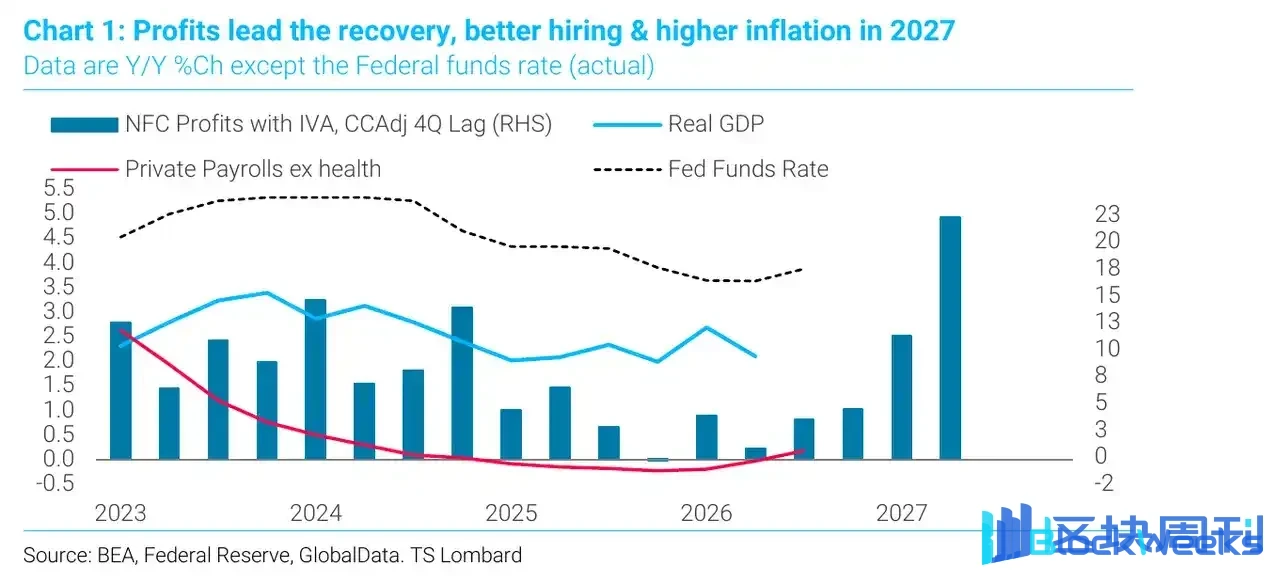
Blitz characterizes 2025 as "the recession that didn't happen." After the yield curve was inverted for about 22 months, private nonfarm payrolls excluding healthcare had been declining, and real economic growth should have contracted, but this situation never materialized.
The reason lies in two points: first, the scale of fiscal expansion was too large; second, the Fed began cutting rates just as corporate profits were rebounding. Tariff policies also played a role in fueling the situation.
Blitz cites two classic Wall Street rules: first, corporate profits lead employment, and employment leads inflation; second, the year with the mildest inflation is often the first year of recovery. This means 2026 is a "good year," and under the impact of tariffs and oil prices, underlying inflation has actually declined. But from now on, if the stock market remains cooperative, high corporate profits will drive faster hiring, thereby pushing up underlying inflation in 2027.
He also points out that the August core PCE data released this week appeared to be "below expectations" only because the actual reading of 0.247% was rounded to 0.2%, and benchmark revisions artificially lowered the entire series. At the same time, super core inflation rose 0.4% month-over-month, the "other services" component saw the largest increase in history, and education costs also climbed to a record. The 10-year US Treasury yield then erased all its gains after the PCE data release.
Swap Spreads: The Market Is Pricing Fiscal Risk
The most distinctive part of Blitz's analysis is his interpretation of swap spreads. He believes that the deep driver of rising yields lies in "excess supply of sovereign debt"—developed-market government debt needs to be rolled over, while fiscal deficits are expanding faster than nominal GDP growth, and central banks are no longer acting as marginal buyers.
The most direct signal comes from swap spreads: investors are increasingly inclined to receive a floating overnight secured rate over a 10-year horizon rather than hold fixed-coupon sovereign bonds.This trend has existed in the United States since 2012, but after the COVID-19 pandemic it has spread globally—UK and French swap spreads have narrowed sharply, and Germany's situation has also moved toward equilibrium.

Blitz emphasizes that this is a "risk appetite issue, not a curve issue." France and Germany share the same central bank, and the Bank of England usually follows the European Central Bank, yet the swap spread trajectories of the two countries have diverged. What the market is pricing is fiscal risk, not the policy rate or the inflation path.
He built a model for the U.S. 10-year swap spread, and the results show that even after stripping out the influence of the yield curve's shape and bank balance sheet regulatory constraints, the market's preference for U.S. Treasuries is still declining year by year.
Why 8%: The Policy Mix and Political Logic
Blitz's core conclusion is: the policy mix of loose money and expansionary fiscal policy will, in each cycle, push up the floor for inflation and yields, until there emerges a genuine political will willing to suppress inflation at the cost of short-term growth.
He summarizes this divide as "Hamilton versus Jackson"—the former representing the path of running the economy through the central bank, the latter representing the path of relying on government policy. And "the populism that will elect the next president leans toward Jackson." He summed up the past decade of American politics in one sentence: "People are conservative on social issues and liberal on fiscal issues."
The nature of the rise in yields is equally critical. Blitz points out that so far, the rise in yields has been driven mainly by real rates, which suppresses the stock market while avoiding a sell-off in the dollar. But if the driver shifts to the inflation expectation premium, "the stock market performs decently, and dollar bears will have their day," at which point "the great dollar bear market everyone has long anticipated will truly begin."
The decisive variable is that the U.S. net savings rate has fallen to zero, and there is "no sign of improvement." It is against this backdrop that Blitz gives his judgment: "Ultimately, we will see the 10-year U.S. Treasury yield reach 8%."
What Will "Break" First
Blitz did not predict the collapse of any specific asset. What he expects to break is a mindset—namely, the market's "firm belief" in inflation returning to 2%, and the reflexive logic that "being long stocks and bonds will always pay off." For a generation of investors who have experienced 40 years of falling rates and grown accustomed to buying the dip, this will be a major cognitive adjustment.
It is worth noting that Blitz is not an isolated case. According to reports, Rich Privorostsky, head of Goldman Sachs' delta hedging business, said this week that the trajectory of interest rates "has become severe enough to be impossible to ignore," even though "the stock market has shown impressive resilience."
In addition, the U.S. Treasury is not without influence over the trajectory of yields. Rabobank previously called the Treasury's expanded Treasury buyback program in August a "light version of yield curve control," and warned that "higher yields worsen the fiscal outlook, which in turn pushes up the term premium, which in turn pushes yields higher again," and that buyback operations "interrupt this loop, but may not break it."
Blitz's judgment is: a government that refuses to accept recession cannot choose a ceiling for yields on its own.