Text | Caineng Circle
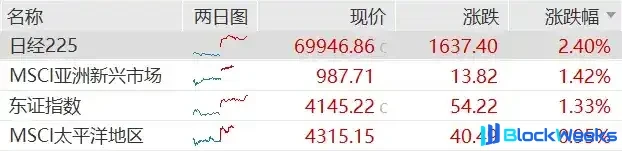
During the National Day holiday, overseas markets rose again. On October 2, the Nikkei index rose nearly 4%, the KOSPI rose 2%, and the Nasdaq hit a record high again that night. But on the same day, the Hang Seng Tech Index opened low and moved lower, hitting a low of 4,111 points during the session, a new low in a year, and closed down 2.26%, down nearly 40% from its high in October last year. Xiaomi Group fell more than 5%, Bilibili, JD Health, and XPeng Group fell more than 4%, and Kuaishou, Li Auto, Baidu, Horizon, Leapmotor, and JD.com all fell more than 3%. Among the constituent stocks, only NIO was in the green.
The A-share queue at the Hong Kong Stock Exchange moved up one spot
Just a few days ago, the Hong Kong Stock Exchange welcomed four new listings at once: PCB leader Jingwang Electronics, photovoltaic automation equipment maker Robotech, photoresist company Tongcheng New Materials, and Benmo Technology, which makes robot actuators. Three of the four are A-share companies coming for secondary listings.
The most closely watched is Jingwang Electronics. Based on 2025 revenue, it is the world's largest automotive electronics PCB supplier, with a 10.6% market share, ranking 11th among global PCB manufacturers, with an overall market share of 2.5%. Its customers are not only automakers; it also provides PCB support for high-speed computing hardware, having cut into the AI infrastructure line.
Before the news of the four new listings had been digested, another name was added on October 2. A-share "AISSD first stock" Dapu Micro announced that it plans to appoint Tianjian International as the auditor for its H-share issuance, and will recently submit an A1 application to the Hong Kong Stock Exchange, with listing expected at the end of 2026 or early 2027. According to IFR, Dapu Micro has already filed confidentially, planning a Hong Kong secondary listing to raise at least US$1 billion, with CITIC Securities, Haitong International, and UBS jointly advancing the deal.
From listing on the ChiNext in April 2026 to launching a Hong Kong IPO in October, Dapu Micro began arranging a secondary listing just half a year after its A-share listing. Driving this pace is the first semi-annual report it delivered after listing: first-half revenue of 4.722 billion yuan, a year-on-year increase of 531%, and net profit attributable to shareholders of 1.334 billion yuan, directly turning around from a loss of 354 million yuan in the same period last year. As of September 30, it was quoted at 339.9 yuan on the A-share market, with a market value of 148.27 billion yuan.
Those going to Hong Kong are all companies in the AI hardware chain
Looking further, Dapu Micro is not an isolated case; it is just the latest in this southbound queue.
The top three in the 2026 Hong Kong IPO fundraising rankings are all A-share hard-tech companies. Zhongji Innolight raised HK$61.422 billion in its initial offering, a figure that broke Hong Kong's fundraising record in nearly seven years; Luxshare Precision raised HK$25.060 billion; Victory Giant Technology raised HK$23.135 billion. Together, the three raised more than HK$110 billion.
The companies in this queue have highly overlapping businesses: Zhongji Innolight makes optical modules, Victory Giant Technology makes AI server PCBs, Luxshare Precision makes connectors and does server manufacturing, Dapu Micro makes enterprise SSDs, Jingwang Electronics makes automotive plus AI PCBs, Robotech makes photovoltaic and semiconductor automation, Tongcheng New Materials makes photoresists, and Benmo Technology makes robot actuators.
They are all links in the AI computing hardware industry chain.
Behind this is a common reality. As the AI arms race continues into 2026, whether optical modules, PCBs, SSDs, or robot actuators, all are expanding production frantically. Expansion requires money—building factories, buying equipment, stockpiling capacity—all involving tens of billions in investment. But the A-share refinancing window has not fully opened for these companies, and valuations are also tightly compressed. Hong Kong has become another pocket for obtaining US dollar funds, and the secondary listing process is relatively quick, while international investors also recognize these companies' positions in the global AI supply chain.
Dapu Micro's first-half revenue rose more than fivefold, and just after turning profitable it rushed to the Hong Kong Stock Exchange, not because it lacked money to survive, but because the money for expansion came faster than the money earned on its books.
Raised 400 billion for the year, but the break-issue rate exceeds 70%
But the absorption capacity on the Hong Kong Stock Exchange side is already sending a warning.
So far in 2026, nearly 120 new stocks have listed in Hong Kong, raising about HK$400 billion in total, a scale that ranks among the top exchanges globally. Zhongji Innolight's single deal alone broke Hong Kong's seven-year fundraising record. On the surface, this is the story of Hong Kong becoming a global financing center again.
But on the other side, the break-issue rate for new stocks has exceeded 70%. Since September, most new stocks have broken issue on their first day of listing. There is a clear divergence between the hot primary market and the weak secondary market.
How to understand this divergence? The primary market relies on cornerstone investors and anchor investors; these institutions lock up their shares before listing and support the issue price. But after listing, once the lock-up period ends and the chips loosen, the secondary market does not have that much receiving capital, and the stock price cannot hold. The people subscribing to new shares and the people taking over are not the same group at all.
This also explains why Hang Seng Tech was falling on October 2. The year's HK$400 billion IPO drain requires the secondary market to continuously provide liquidity to absorb it. As more and more hard-tech companies list, while incremental funds in Hong Kong stocks do not keep pace, the index is pressed down. Xiaomi falling 5% in a day is not because something went wrong with it; it is because the entire sector is being diluted by the supply side.
This wave of consecutive declines in Hang Seng Tech is not entirely due to IPO draining alone. High US Treasury yields are weighing on valuations, some Chinese brokers are restricted from buying by mainland clients, southbound funds are temporarily absent, and several forces are stacking together. But the year's HK$400 billion IPO supply has indeed made this market's absorption capacity more fragile.
This is not Hong Kong stocks' shining moment; it is hard tech looking for money
Putting these things together, the main storyline is actually very clear.
After AI hardware companies finished telling their story in A-shares, they found that the refinancing pocket was not big enough, so they collectively went south to Hong Kong. Zhongji Innolight raised 61.4 billion, Luxshare raised 25 billion, Victory Giant raised 23.1 billion, and Dapu Micro is coming to raise US$1 billion. These companies are not coming to Hong Kong to ring the bell for show; they genuinely need US dollar funds to expand production.
But whether Hong Kong's secondary market buys it is another matter. The 70% break-issue rate shows that international investors are willing to value these AI hardware companies in the primary market, but when it comes to the public market, their hands tighten.
The Nasdaq overseas is still hitting new highs, showing that global funds have not left AI. But this money is now more willing to stay in large-cap US tech stocks rather than chase Hong Kong's new economy chips. The decline in Hang Seng Tech is the most direct reflection of this preference.
What really needs to be watched next is not how much money these companies can raise on the Hong Kong Stock Exchange, but whether, after raising the money and expanding production, their performance can keep up. If demand for AI computing power is still rising, and the capacity these companies build with the raised money can ultimately turn into revenue and profit, then today's wave of southbound listings is worth it. If demand loosens even slightly, the 70% break-issue rate will become a mirror.
After all, listing only gets the money; whether the money can be turned into the next growth is another story.