Original author: Jinshi Data
The minutes of the Federal Reserve's September meeting will be released at 2 a.m. Beijing time this Thursday. This document may attract more attention than usual because it will further reveal why the Federal Reserve raised interest rates by 25 basis points in September, and how officials actually judge how tight the current monetary policy really is.
More critically, the minutes may reveal how many more rate hikes the Federal Reserve is still considering. At the press conference after the September decision, Federal Reserve Chairman Kevin Warsh said it was difficult for him to describe overall financial conditions as "restrictive."
This statement leaves an important question: if current policy has only removed "one dose" of easing, does that mean more rate hikes are still needed ahead?
Which indicators is the Federal Reserve actually looking at?
It is currently unclear which specific financial conditions indicators the Federal Reserve uses to judge whether policy is sufficiently tight, and it is also impossible to determine to what extent the recent rise in market interest rates has already offset previous easing.
The Chicago Fed National Financial Conditions Index shows that since peaking in the fall of 2022, U.S. financial conditions have continued to ease. Although this indicator is not at its loosest level by historical standards, it is still on the looser side of the historical range.
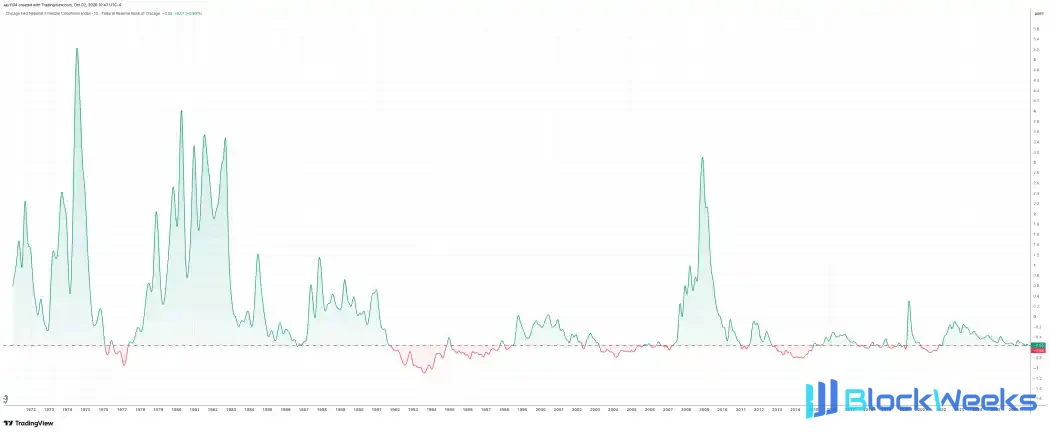
Other indicators also give similar signals. The option-adjusted spread on the ICE BofA U.S. High Yield Index is currently still relatively narrow, and historically there have been only a few periods lower than now.
Michael Kramer, founder of Mott Capital Management, wrote that if the Federal Reserve does indeed focus on these indicators, then the current financial environment may still not be enough to be defined as clearly restrictive policy. This also explains why the September rate hike may only be the beginning, rather than a one-time policy adjustment.
Real interest rates are still significantly below 2006 levels
Inflation is also key to judging whether policy is sufficiently tight.
The U.S. August personal consumption expenditures (PCE) data was released after the September meeting, so it will not appear in the information on which the meeting minutes are based. However, this report includes the Bureau of Economic Analysis's annual revisions and retroactively adjusted data since 2021, providing new context for judging the current inflation environment.
The revised data show that in August, headline PCE rose 3.4% year over year, and core PCE rose 3.0% year over year, both unchanged from July. Except for a brief period in 2024 and 2025, headline PCE has never fallen below 2.5% since early 2021, let alone reached the Federal Reserve's 2% target.
This makes "whether further policy tightening is still needed" even more noteworthy.
The current effective federal funds rate is about 3.9%. Measured by headline PCE, the real federal funds rate is only about 50 basis points; measured by core PCE, it is only about 90 basis points.
This level is clearly different from when Warsh first served as a Federal Reserve governor in 2006.
In mid-2006, U.S. headline PCE rose about 3.3% to 3.5% year over year, roughly comparable to the current level. But at that time, the real federal funds rate was about 1.5% to 2.0%. By October 2006, as inflation fell, the real interest rate rose further to 3.6%.

In other words, at a similar inflation level, the current real interest rate is still more than 300 basis points lower than in the middle of Warsh's 2006 term.
What might the meeting minutes reveal?
Therefore, Kramer believes that what is truly noteworthy in the FOMC meeting minutes to be released this week may not be why rates were raised by 25 basis points in September, a decision that is already clear, but rather how officials discussed financial conditions, real interest rates, and the pace of inflation decline.
The minutes may also reveal how quickly the Federal Reserve wants inflation to return to its 2% target, and whether officials believe current policy is already sufficiently restrictive.
Of course, the meeting minutes may not necessarily provide a clear answer. They may be limited in length, focus on the discussions at the time of the September meeting, and may lack clear forward guidance.
But Kramer believes that if it can present the discussion among Fed officials regarding the degree of policy easing, it may help the market judge: whether this "one dose" of rate hike in September is a one-time adjustment, or the starting point of a new round of tightening cycle.