
Author: marlon
Compiled by: Saoirse, Foresight News
The on-chain options sector is the largest blue ocean in the current crypto market and the most worthwhile opportunity to position for.
If you calculate its potential total addressable market (TAM), it is not hard to see that options becoming a core part of the market is only a matter of time, not a question of whether it will happen. All mature financial markets, as they develop to a later stage, move toward options; and the crypto market is at this turning point.
In traditional financial markets, retail demand for options has already been fully validated. In the on-chain scenario, the current bottleneck is no longer regulation or underlying infrastructure. Market makers' liquidity continues to improve, the request-for-quote (RFQ) mechanism can handle large orders, and there are more and more participants in the sector.
However, this sector is still in its early stage (currently on-chain options volume accounts for only 6.9% of Deribit's options trading volume), and its popularity is rising rapidly. At present, it faces its most core proposition: opening up user distribution channels.
To achieve explosive growth, it must continuously bring in retail (benign buyer) order flow. Looking at history, every options market that has achieved rapid expansion has been driven at its core by retail investors.
How options trading forms economies of scale
In the crypto Twitter community (CT), the most widely circulated yet least defensible statement is: "Retail investors don't understand options, so they will never trade options on-chain."
This claim is completely untenable, and all empirical evidence points to the opposite conclusion. Understanding Greeks and payoff structures does require a learning cost, but the complexity of pricing logic has never suppressed users' strong demand for this type of product.
Retail investors are willing to trade options because its profit potential is easy to understand. No one carefully calculates Theta time decay.
As long as the trading threshold is lowered and the interface is simple and easy to use, retail options trading volume will be considerable. The "convexity" of options is precisely its core appeal; simply put, the upside is unlimited.
In fact, options are the derivative most favored by retail investors. Those who disagree can refer to the following cases:
Case A: Driven by U.S. retail investors, U.S. options contract trading volume has more than tripled since 2017
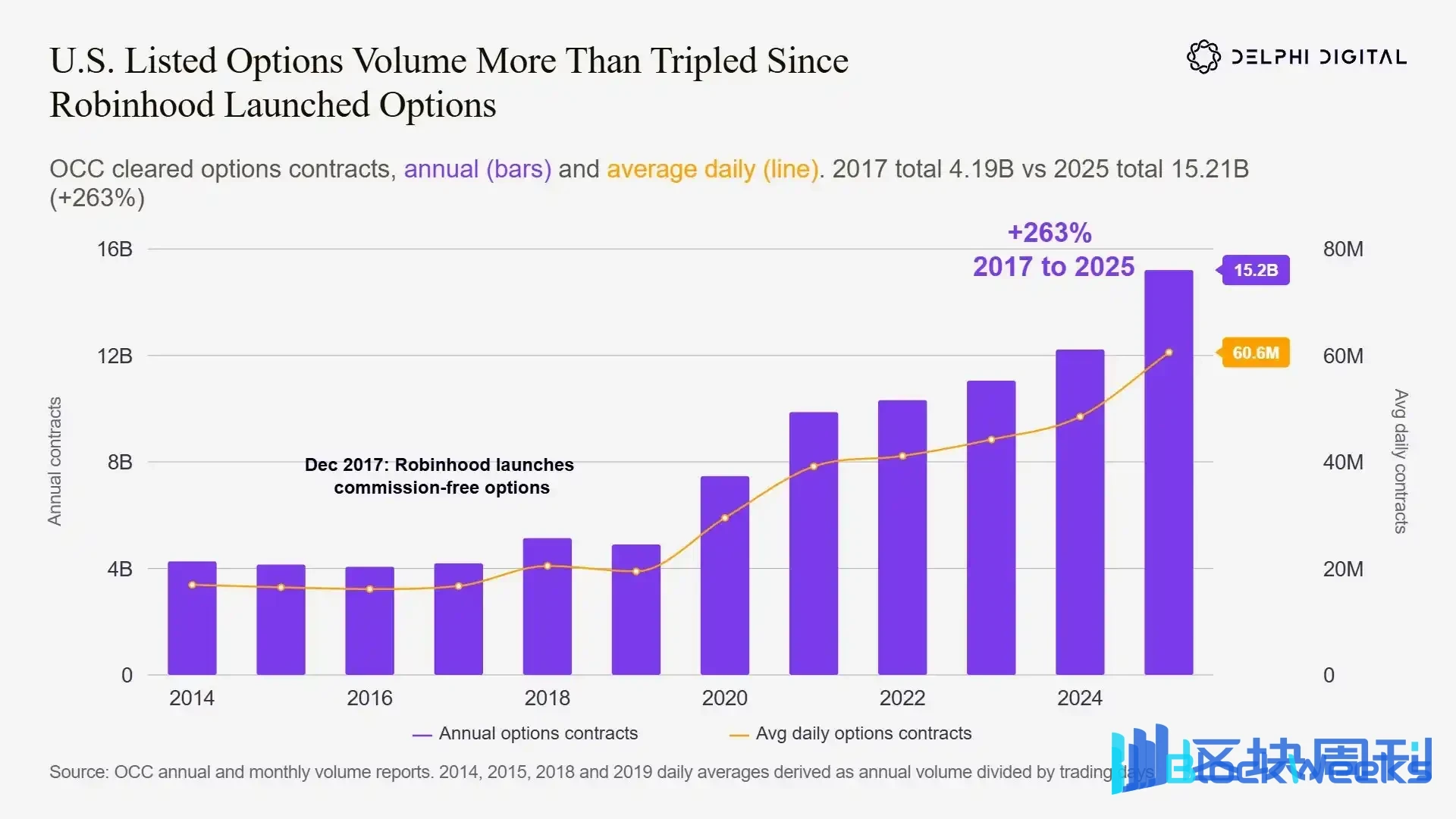
The U.S. market is the best example. Around 2014 to 2017, the options market was dominated by institutions, and growth stagnated, with annual contract volume stable at around 4 billion contracts, while retail participation was almost negligible.
In December 2017, Robinhood launched zero-commission options trading, and many brokerages followed suit. Then the COVID-19 pandemic hit, and multiple conditions resonated together.
At that time, everyone was isolated at home, waiting for the market to return to normal. In the early days of the pandemic, asset prices plunged, and a large number of ordinary investors began to enter the market. Continuous market promotion, combined with the public's ever-growing interest in financial investment, gave rise to this wave. Massive numbers of retail investors poured into financial apps, and options trading volume surged accordingly.
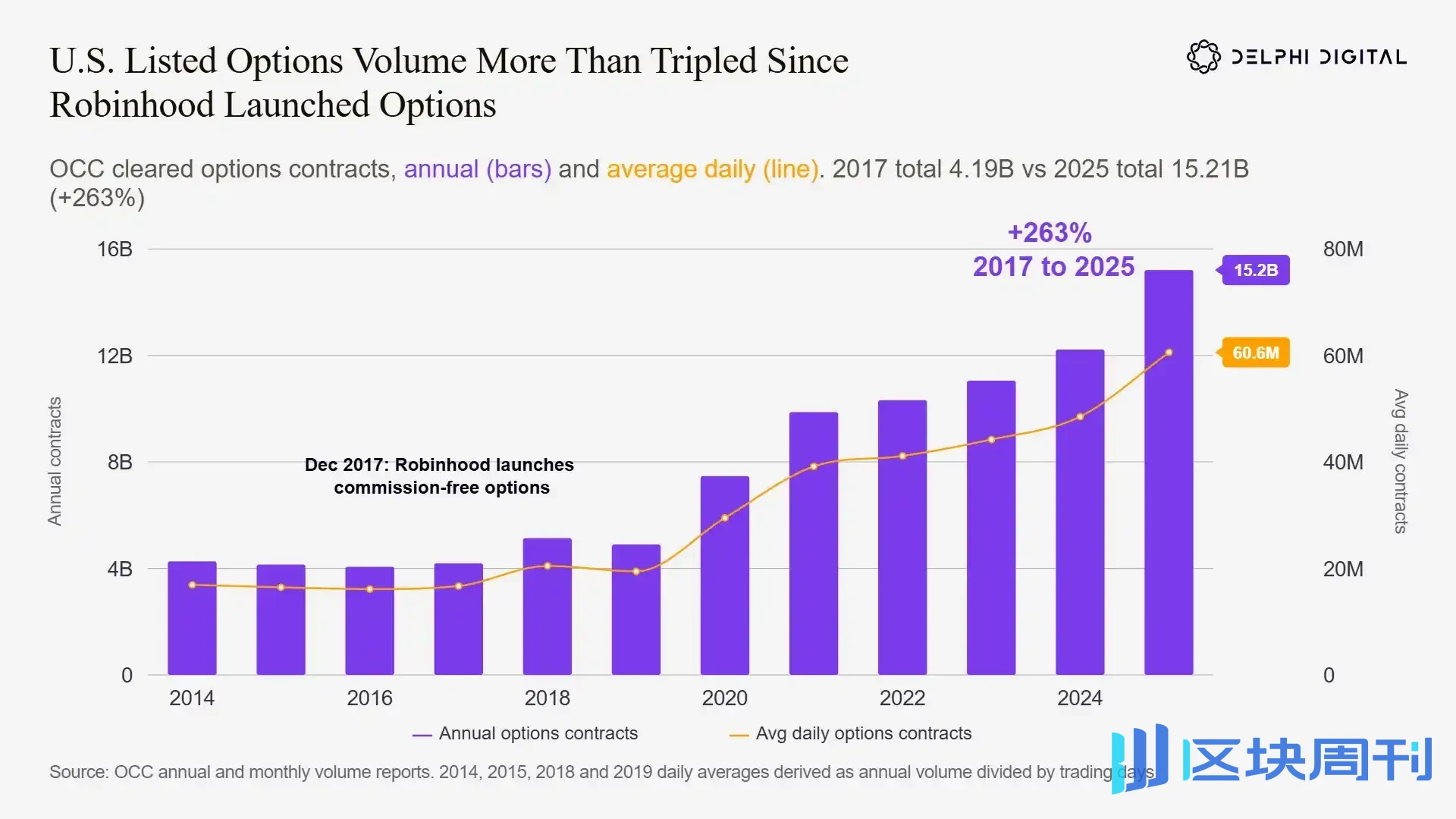
After Robinhood launched commission-free options trading in December 2017, annual U.S. listed options contract volume grew from 4.19 billion to 15.21 billion, an increase of 263%, and average daily volume also rose in tandem.
From 2017 to 2025, annual options contract volume increased by 263%, from 4.19 billion to 15.2 billion contracts. After trading activity increased, institutional volume also rose in tandem, market makers needed more hedging tools, and all market participants were chasing convexity returns. But the core driver of this round of growth was retail investors.
Case B: The share of S&P 500 same-day options increased 12-fold in ten years
The massive entry of retail investors is also reflected in the rise of short-term options trading. Retail investors prefer convexity; the shorter the option's time to expiration, the higher the potential upside when volatility spikes.
The riskiest category in options is 0DTE (zero days to expiration): expiring and ceasing trading before the close of the same trading day. (Note: any option on its last trading day is a 0DTE.)
Over the past decade, retail demand has continued to accelerate, and the supply of same-day options contracts has also continued to increase. Retail trading behavior globally is highly similar: contracts with 0DTE to 3 days to expiration have the highest trading activity.
Institutions rarely participate in this lottery-like speculative trading, so short-term contract volume is a good indicator for observing retail participation.
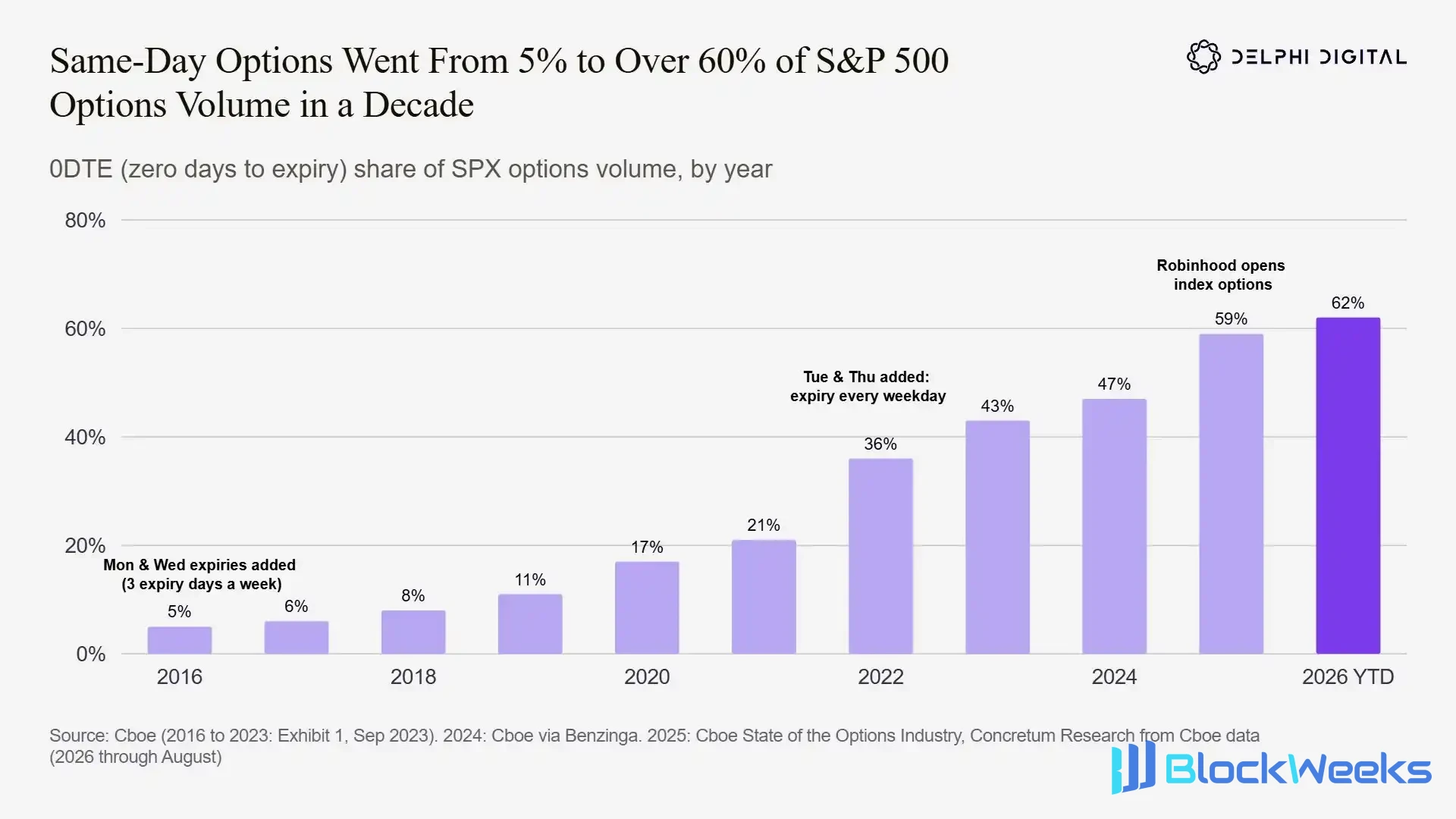
Over ten years, the share of 0DTE same-day expiring options trading volume in the S&P 500 (SPX) soared from 5% to 62%. Exchanges continued to add expiration dates, and Robinhood's opening of index options further fueled this trend.
Over the past decade, S&P 500 (SPX) same-day options trading volume has grown more than 12-fold, and its share of total SPX options volume has climbed from 5% to more than 60%.
SPX options have expired every Friday since 2005. Cboe added Monday and Wednesday expirations in 2016, and then added Tuesday and Thursday expirations in 2022, achieving an options expiration on every trading day.
Every additional supply of expiration contracts further stimulates demand.
In January 2025, Robinhood opened index options trading to all customers. Cboe data showed that the following month, the share of same-day options soared to a then-record 56%. The pattern in global markets is highly consistent: give retail investors low-priced, short-term options contracts, and they will participate in trading on a large scale.
Case C: Short-term options have already come to dominate S&P 500 options trading
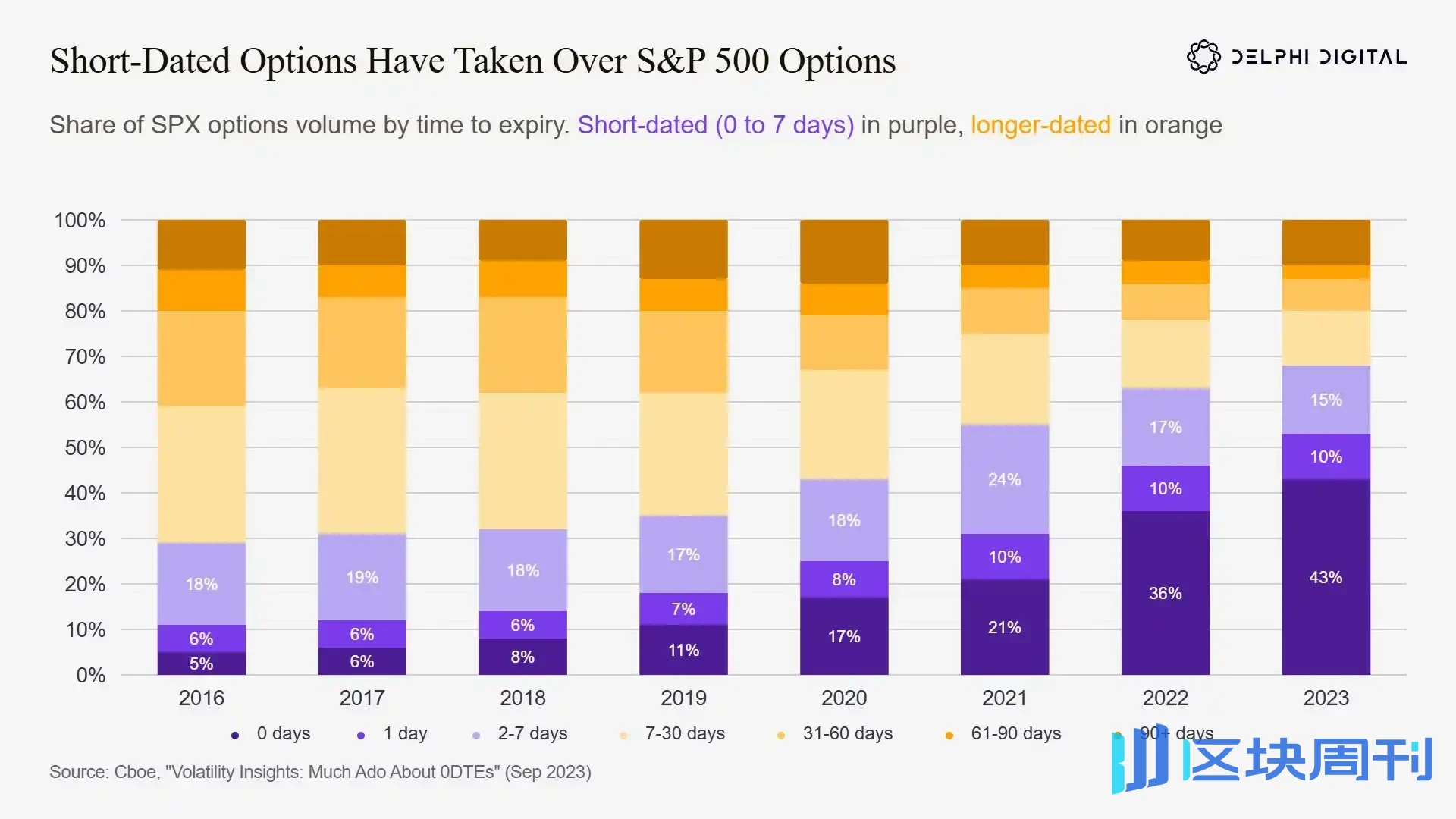
Between 2016 and 2023, the structure of S&P 500 (SPX) options trading completely reversed. The share of ultra-short-term options with 0–7 days to expiration rose sharply, with 0DTE same-day options accounting for 43% of total volume by 2023, while the share of medium- and long-term options continued to shrink.
This change is not limited to same-day options. Across the entire S&P 500 options market, the center of trading is shifting toward ultra-short maturities.
2016 data: options expiring within one week accounted for 29% of SPX volume; one week to one month had the highest share at 30%; more than one month accounted for 41%.
By 2023, the market structure had completely reversed:
- Expiring within one week: 68% of volume, of which same-day options accounted for 43%
- Expiring in one week to one month: fell to 12%
- Expiring in more than one month: fell to 20%
In just seven years, the S&P 500 options market shifted from being dominated by medium- and long-term positions to two-thirds of contracts expiring within just a few days.
Similarly, this round of transformation is led by retail investors. A 2023 SSRN study shows that for retail investors, dated options are almost all they trade —over 75% of the SPX options traded by retail investors are 0DTE.
Case D: Options have always been Robinhood's largest source of trading revenue
Everyone is familiar with Robinhood. The vast majority of retail trading in the United States is done on mobile apps, and Robinhood is a leading platform among them.
The options business is the largest source of Robinhood's trading revenue. Unlike the highly volatile crypto business revenue, options revenue has been stable over the long term and consistently ranks first.
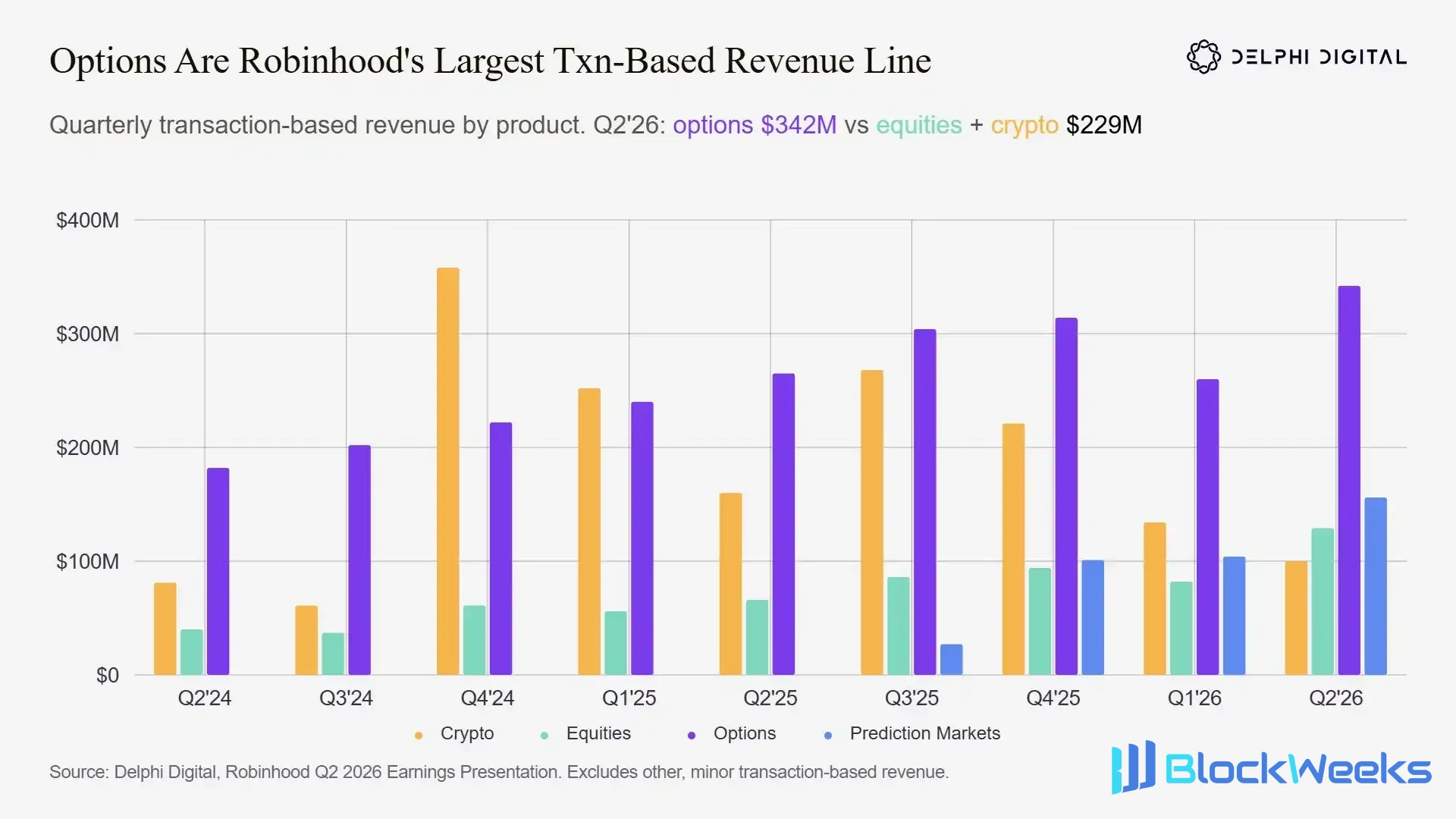
Options have become Robinhood's largest source of trading revenue; in the second quarter of 2026, options trading revenue was $342 million, far exceeding the combined revenue of $229 million from equities and crypto businesses.
The advantage is very prominent: the revenue brought by options trading often exceeds the combined revenue of the equities business and the crypto business.
Taking the latest second quarter of 2026 as an example, options revenue for the single quarter was $342 million, while equities + crypto combined was only $229 million. Revenue growth has been steady, rising from $182 million in the second quarter of 2024 to $342 million in the second quarter of 2026, an increase of 88% over two years.
Case E: Indian retail investors dominate global options trading
No retail group is as enthusiastic about options as Indian traders. Looking globally, Indian retail investors are the main force in options trading and are a research sample of great reference value.
Before starting the analysis, let us first clarify the two core statistical measures of options: premium and notional principal.
- Premium: the cash actually paid by traders to buy options. Spend $200 to buy a call option, and that $200 is the premium. It represents funds that actually change hands and is the most objective indicator for measuring a platform's trading scale.
- Notional value: the face value of the corresponding underlying asset, equal to the contract multiplier × the underlying price. A $200 premium can leverage a risk exposure worth $10,000. Therefore, the notional value is often very large, but the actual funds changing hands are not that much. It is suitable for observing market size, but looking at it alone can easily lead to misjudgment.
Back to the Indian market.
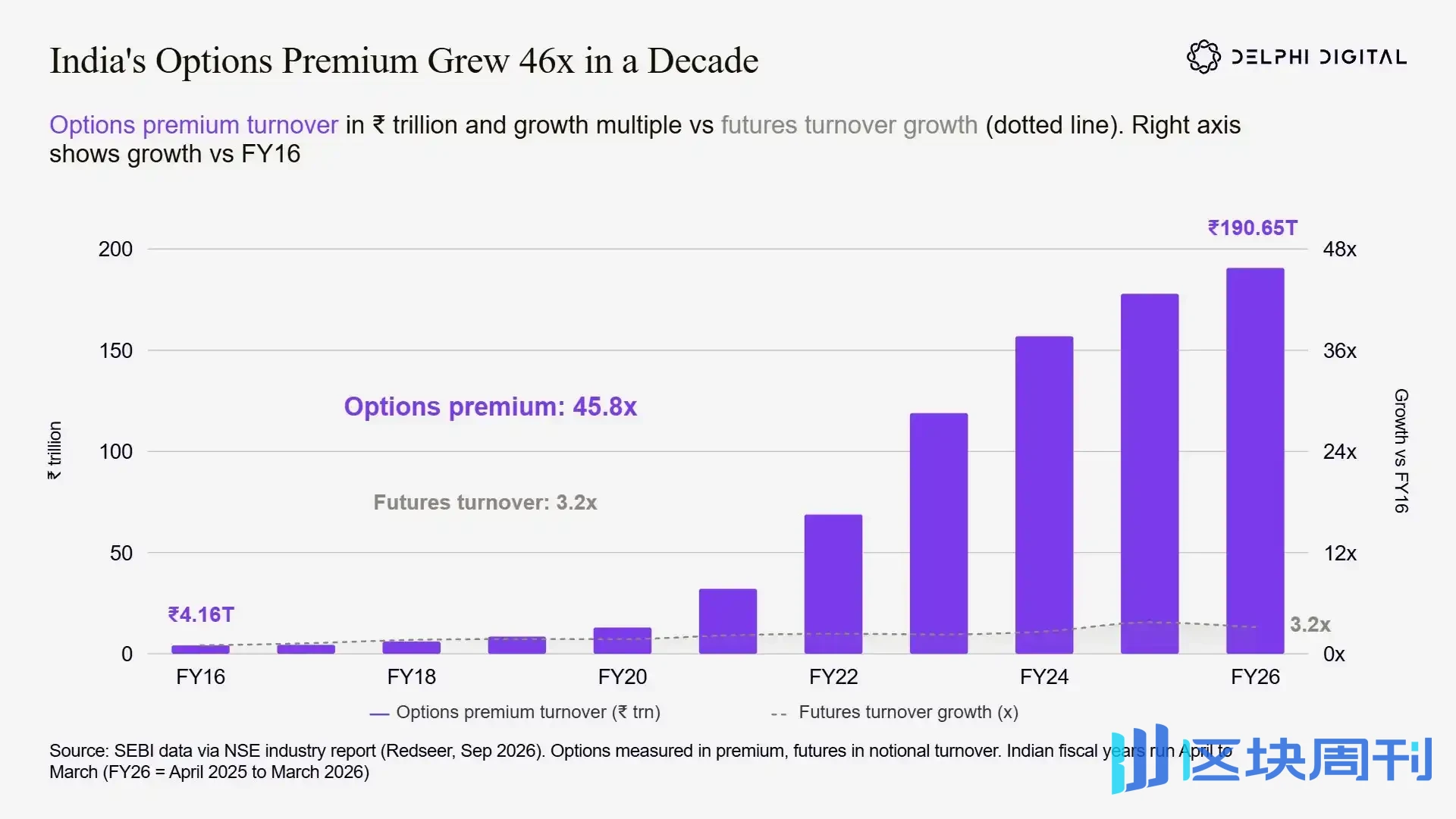
From Indian fiscal year FY16 to FY26, options premium turnover grew 45.8 times (reaching 190.65 trillion rupees), far faster than the only 3.2-fold increase in futures turnover.
In fiscal year 2016 (April 2015–March 2016), Indian traders paid 4.16 trillion rupees in equity options premiums; by fiscal year 2026, premium turnover reached 190.65 trillion rupees, an increase of 45.8 times.
At the end of 2024, the Securities and Exchange Board of India (SEBI) introduced a series of regulatory policies: raising the minimum contract size from 500,000 rupees to 1.5 million rupees (a threefold increase), while requiring exchanges to offer weekly expiry contracts for only one benchmark index.
Even so, the scale of options premiums continued to rise, growing another 7% in fiscal year 2026.
Among Indian retail derivatives traders, options are the absolute first choice. More than 90% of retail investors participating in derivatives trading trade only options. It can be said that for Indian retail investors, derivatives trading is basically equivalent to options trading.
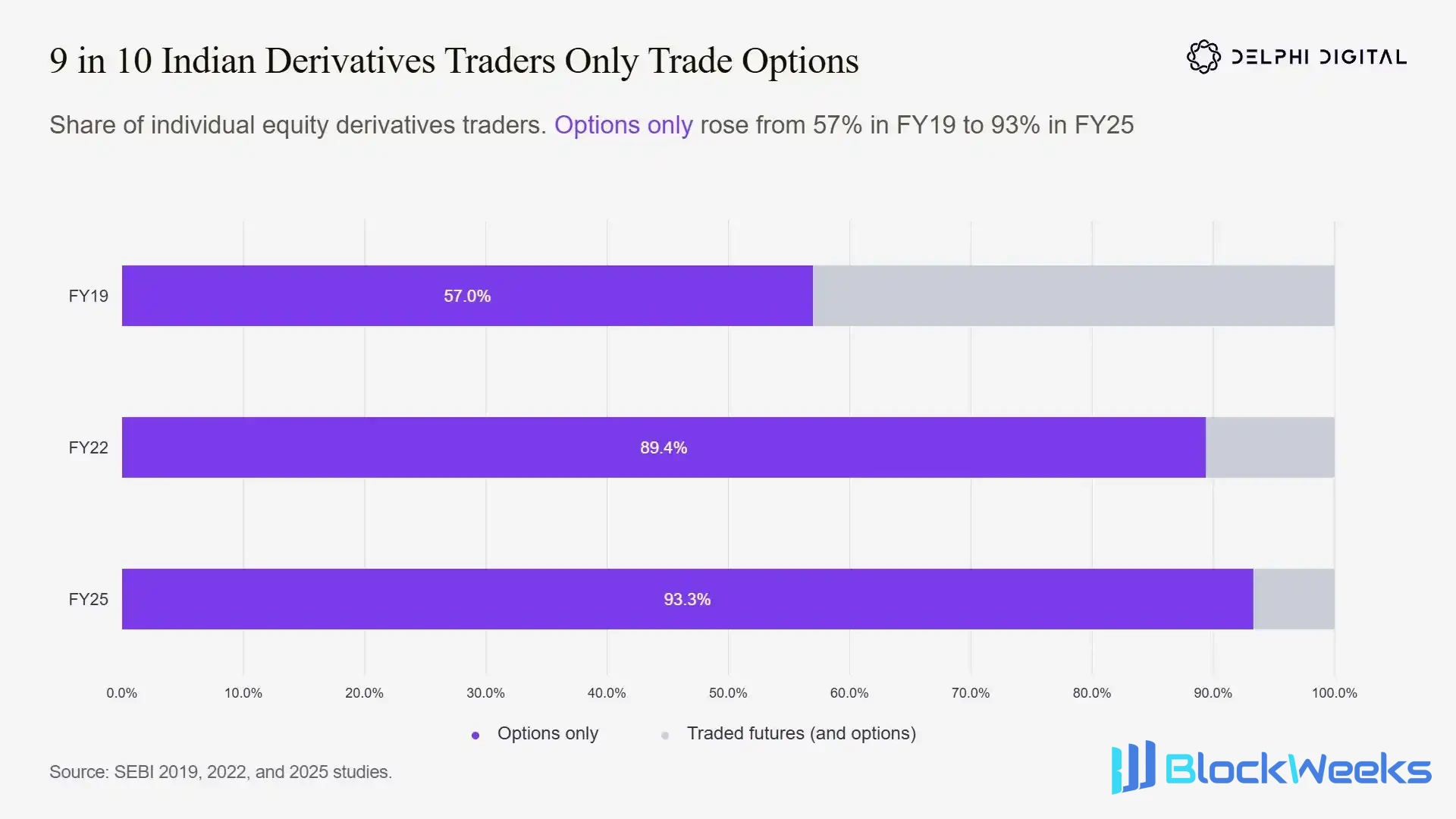
Among individual traders in Indian single-stock derivatives, the share of traders who trade only options and do not touch futures climbed from 57% in FY19 to 93.3% in FY25; the vast majority of retail investors trade only options.
Before making global comparisons, let us first clarify what "dominance" means in the Indian market. In the first half of 2026, Indian exchanges traded 39.3 billion options contracts, 4.5 times the 8.7 billion contracts combined across all US options exchanges.
But the premiums paid by US traders reached $6.3 trillion, nearly 5 times India's $1.3 trillion. Converted, the premium corresponding to a single contract in India is about $33, while a single contract in the United States is as high as $719.
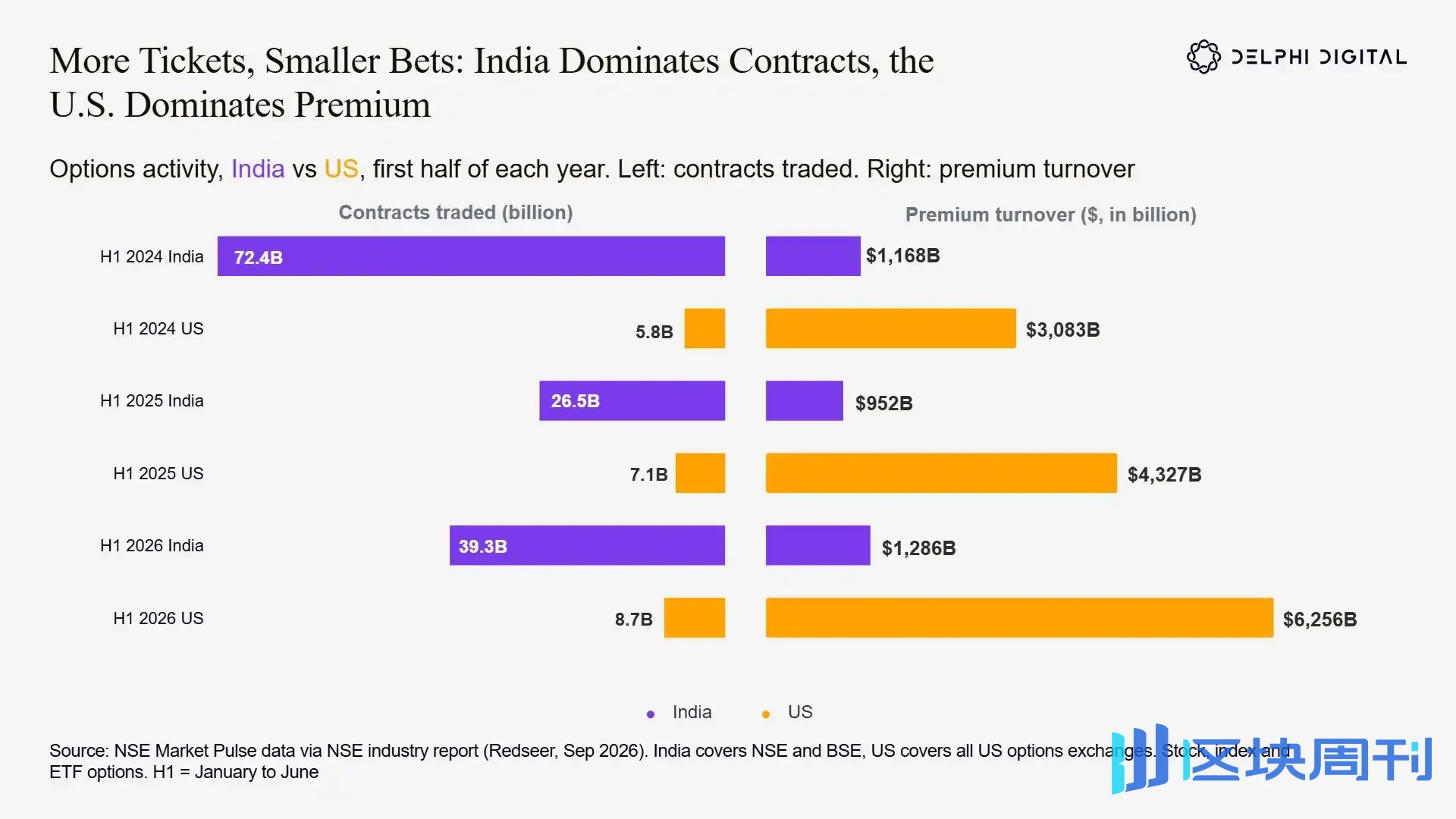
Comparing the Indian and US options markets: India trades far more contracts than the United States, but US options premium turnover is significantly higher, reflecting that Indian retail investors have smaller individual trade sizes and more trades.
The difference mainly comes from two points: India's minimum contract face value is lower, and the trading products are also different. Almost all of India's volume comes from index options, with low contract unit prices, low thresholds, and short tenors; while the US market includes single-stock options, ETF options, and long-term contracts, with much higher premiums per contract.
What Indian retail investors trade is the same type of "lottery-style" options as US retail investors, only with lower unit prices.
This set of data also intuitively shows the impact of SEBI regulation: from the first half of 2024 to the first half of 2025, contract volume fell 63%, but premiums fell only 18%. What declined was mainly large contracts, not traders leaving the market. By the first half of 2026, contract volume rebounded 48%, and premiums rebounded 35%.
With the above background in mind, if we look again at global options contract trading volume, we can clearly see where India stands.
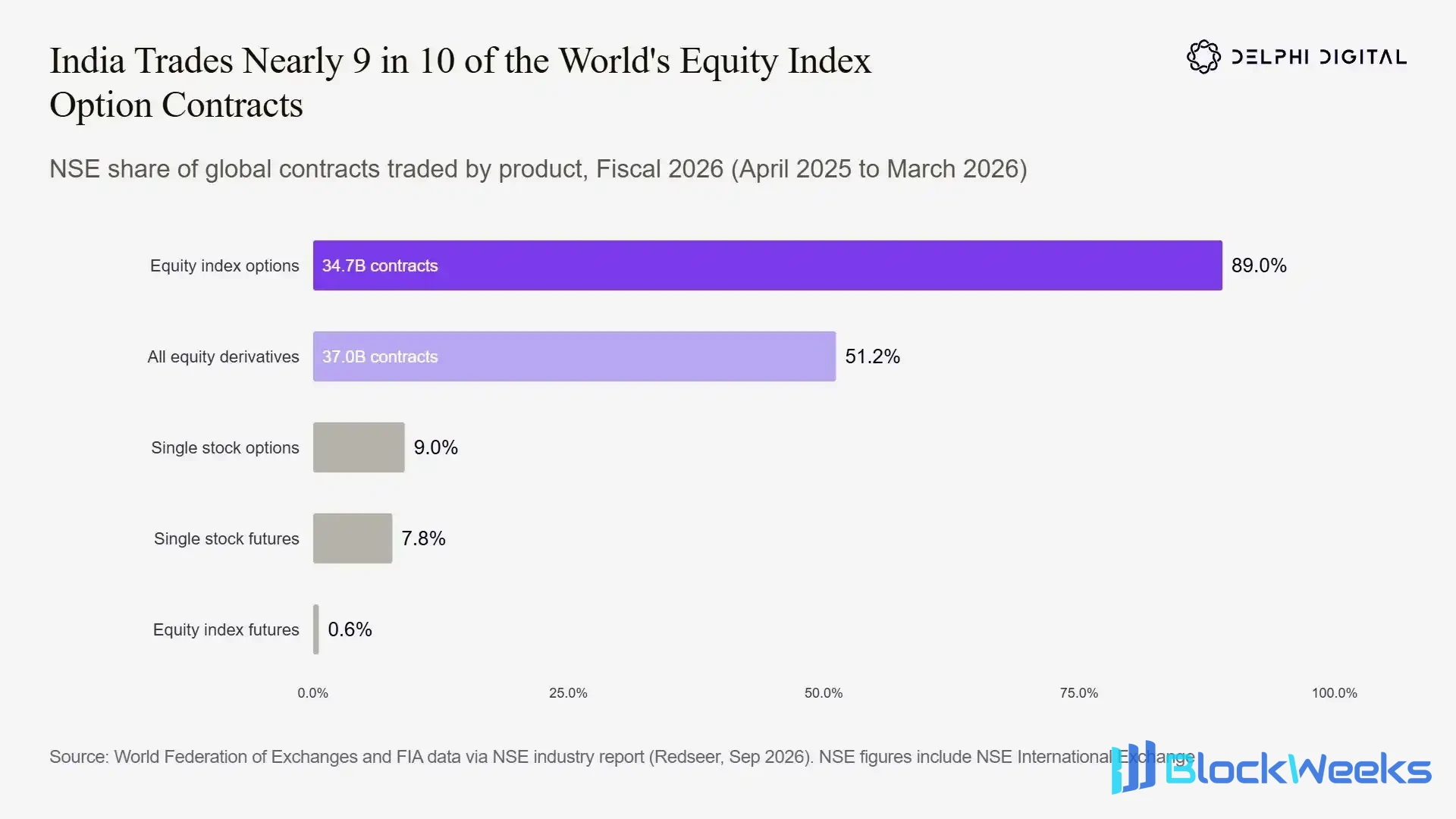
In fiscal year 2026, the trading volume of equity index options on India's NSE accounted for 89% of the total global equity index options contracts, occupying an absolutely dominant position in the global equity index options market.
For reference only: judging by participation heat alone, India dominates global options trading.
In fiscal year 2026, the National Stock Exchange of India (NSE) traded 34.7 billion equity index options contracts, accounting for 89% of the global total and 51% of all global equity derivatives contracts. From the dimension of contract trading volume, it is far ahead of leading Western derivatives exchanges.
For comparison: CME was about 7.1 billion contracts and ICE about 5 billion contracts over the same period. NSE's trading volume was 4.9 times that of CME and 6.9 times that of ICE.
Indian retail investors are not just participating in options—options have become their primary way of participating in the market.
Case F: Korean stock index options, a history of market rise and fall
Long before India, South Korea had already staged a scene: what happens to the market when retail investors can easily buy low-priced index options.
KOSPI 200 options track South Korea's 200 leading listed companies and account for the vast majority of trading volume in stock options on the Korea Exchange (KRX).
In the early 2000s, South Korean domestic retail investors accounted for 70% of total KOSPI options trading volume. As foreign institutions and overseas retail investors entered, combined with continuous tightening by domestic regulators, the share of South Korean retail trading plunged to below 30%, and it has not recovered to this day.
The South Korean stock index options market completed a full rise-and-fall curve: rapid rise, topping the globe, and then abrupt contraction under heavy regulation.
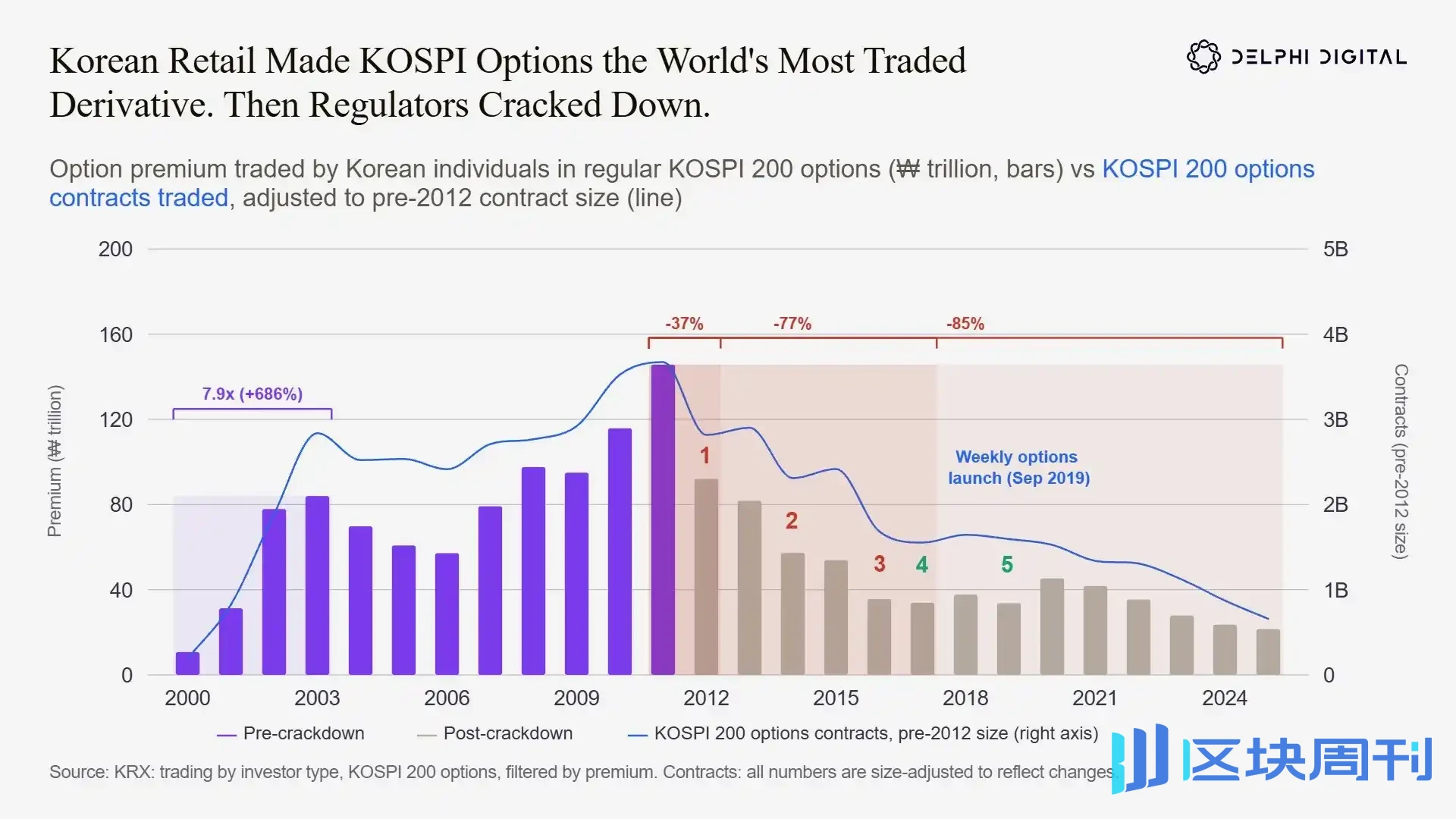
South Korean retail investors once pushed KOSPI200 options to become the world's most traded derivative; after regulators introduced restrictions, trading volume fell sharply, and even the subsequent launch of weekly options failed to bring it back to previous highs.
There are many lessons worth learning from this, and we will look at them in stages:
- Boom period: 2000–2003. Total stock option contracts soared from 194 million in 2000 to 2.84 billion in 2003, a 14.6-fold increase in three years. Over the same period, premiums paid by retail investors surged 7.9-fold. Retail investors were the core of this boom, accounting for 70% of KOSPI 200 options trading volume.
- Global peak period: 2004–2011. In 2004, KRX stock options trading volume accounted for about 28% of global derivatives contract trading volume. For nearly a decade, KOSPI 200 options long ranked first in FIA global contract trading volume, reaching a peak of 3.67 billion contracts in 2011. Retail options premiums peaked at 145.7 trillion Korean won.
- Decline period: 2012–2017. Regulators believed retail speculation was overheated and ultimately introduced strong regulatory measures.
In December 2011, South Korea's Financial Services Commission (FSC) announced that the contract size of KOSPI 200 options would be increased 5-fold, with the multiplier raised from 100,000 Korean won to 500,000 Korean won. Based on the exchange rate at the time of 1 US dollar = 1,327 Korean won, the threshold for a single contract rose from about 75.34 US dollars to 376.71 US dollars.
The new rules were implemented in stages from March to June 2012. Total contract trading volume fell 23% from the peak, and retail premiums fell 37% year-on-year.
In December 2014, regulators tightened again: new traders who wanted to participate in options had to complete a 30-hour course, 50 hours of simulated trading, and deposit 50 million Korean won in margin (equivalent to 37,671 US dollars!!!).
This policy almost cut off the entry point for new retail investors.
In January 2016, a third round of regulation landed: the capital gains tax on KOSPI 200 derivatives was raised from 5% to 10%, and trading volume fell again.
By 2017, after the contract size adjustment, market activity had fallen 57% from the peak; retail options premiums had fallen 77% from the high.
Later, regulators also acknowledged that the policy had been too aggressive. In March 2017, the contract multiplier was halved, falling back to 250,000 Korean won. In 2019, the FSC admitted that the entry threshold had been set too high, lowered the margin to 10–20 million Korean won, and compressed the training to a 1-hour course + 3 hours of simulated trading.
In 2019, the FSC also launched weekly KOSPI 200 options in an attempt to revitalize the market. Conditions warmed somewhat; from 2020 to 2025, adjusted annual contract volume returned to 1.7–2 billion contracts, but it was still half of the 2011 peak.
Regulation did not directly shut down the KOSPI 200 options market, but it severely damaged retail investors' willingness to participate. In 2025, retail options premiums hit a 20-year low of only 21.5 trillion Korean won, down 85% from the 2011 high.
Once the participation enthusiasm of domestic retail investors is damaged, it is almost difficult to repair. As of the fourth quarter of 2026, the retail share was below 27%, while the share of foreign institutions + foreign individuals exceeded 66%.
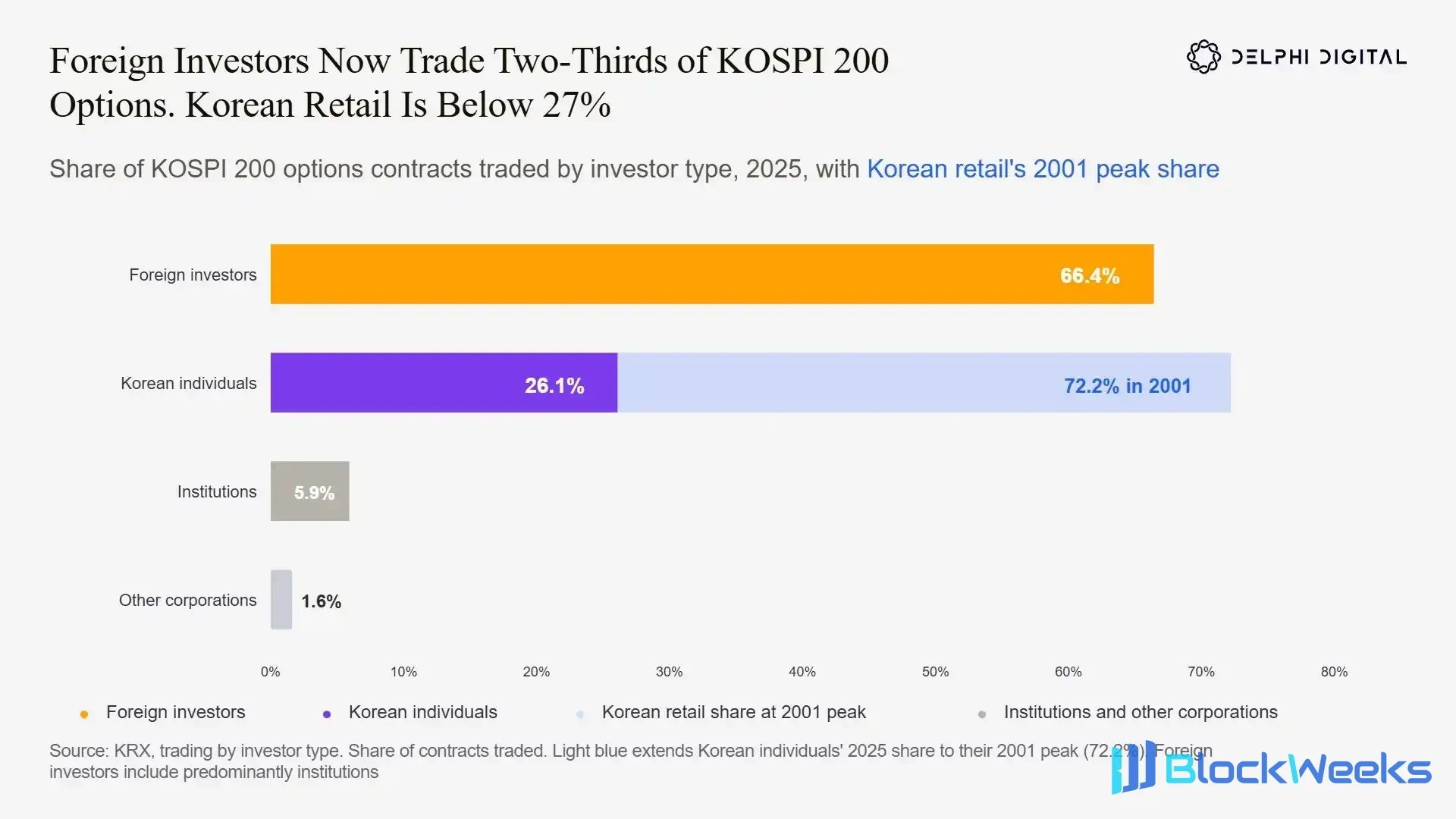
In 2025 KOSPI200 options trading, foreign investors accounted for 66.4%, while South Korean retail investors accounted for only 26.1%, a sharp decline from the peak share of 72.2% for retail investors in 2001.
Many people will think that this kind of "reasonable regulation" achieved its goal, right? Speculation was suppressed, investors were protected, and frenzied trading demand faded...
That is not the case.
In any booming market, if it is overly restricted, demand will only flow overseas.
South Korean traders simply shifted to offshore futures and options trading; market demand for leveraged trading never disappeared.
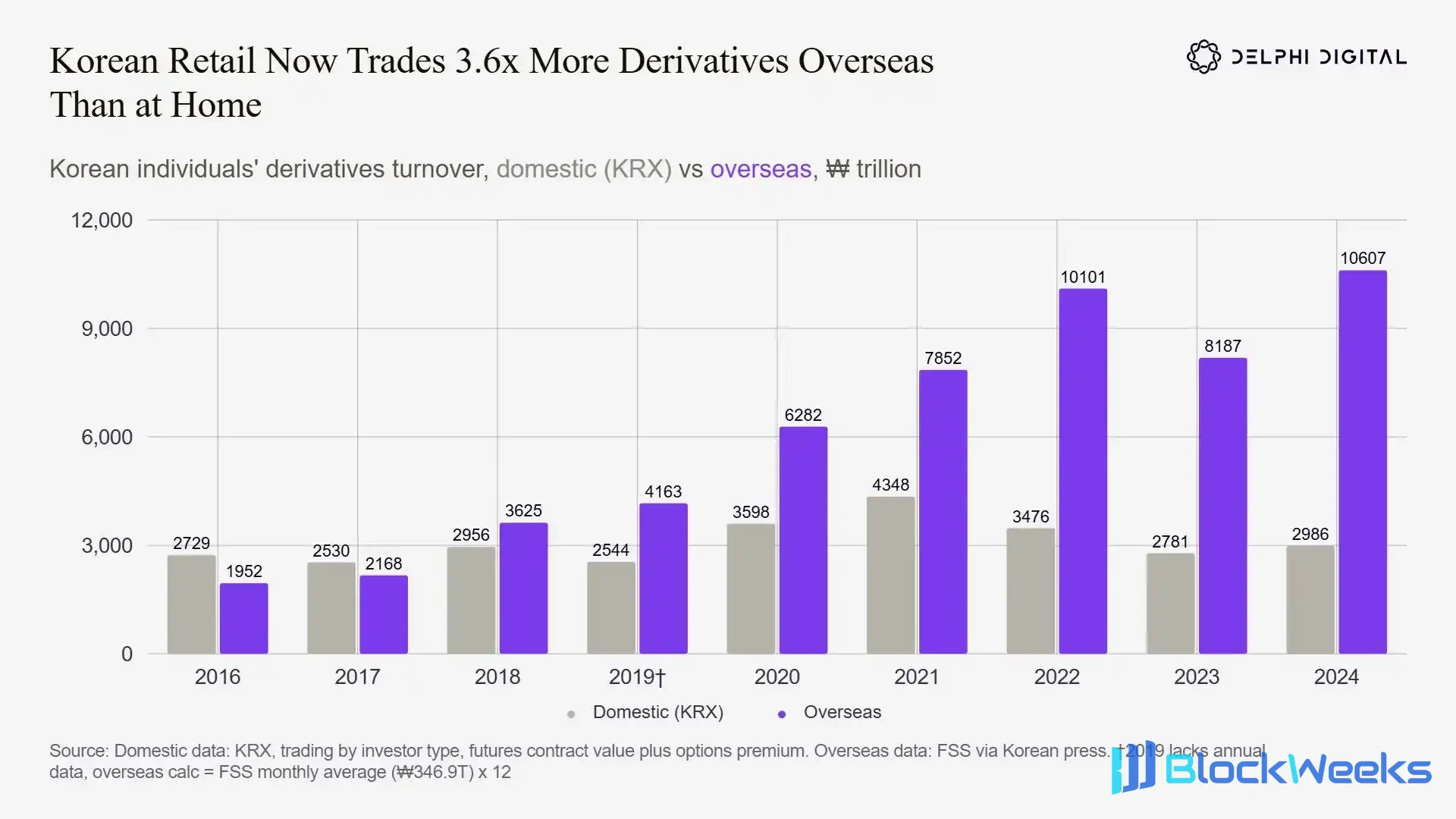
The overseas derivatives trading volume of South Korean retail investors has reached 3.6 times that of the domestic market; after regulatory restrictions on domestic trading, a large amount of trading demand shifted to overseas markets.
(The Financial Supervisory Service (FSS) of South Korea and the Korea Financial Investment Association (KOFIA) did not disclose overseas trading data before 2016, so we compare 2016–2024.)
The derivatives turnover here refers to the total annual derivatives trading volume of South Korean individual investors, including futures and options. For futures, the statistics are the full notional value of positions (index price × multiplier × number of contracts); for options, only the premiums paid are counted, not the notional value of the positions they control.
In 2016, the scale of South Korean retail investors' domestic derivatives trading was still higher than overseas: 2,729 trillion Korean won on KRX exchanges versus 1,952 trillion Korean won on overseas exchanges. In 2018, overseas turnover exceeded the domestic market for the first time.
By 2024, the gap had fully widened: overseas trading was 10,607 trillion Korean won, while domestic trading was only 2,986 trillion Korean won, with the overseas scale being 3.6 times the domestic scale.
Over these eight years, the scale of retail investors' overseas derivatives trading grew 5.4-fold, while domestic trading grew only 9%.
Domestically, new derivatives traders still need to meet a minimum margin of 10 million Korean won + mandatory training; most overseas brokers have no such margin and training thresholds.
As a result, retail investors continued to flee the high-threshold domestic market and turn to overseas platforms with looser regulatory environments. South Korean retail investors mainly trade US stock index futures overseas, among which Nasdaq 100 mini futures have the highest turnover.
History does not simply repeat itself, but it always rhymes
Obviously, retail investors naturally prefer options trading. Breaking down demand patterns around the world is the foundation for understanding the distribution channel problem.
- Throughout history, the core driver of every options market that achieved explosive growth has been retail investors
- Regulation can suppress the trading scale of the domestic market, but it cannot eliminate trading demand
- Among all trading categories, options' appeal to retail investors is far ahead
India and the United States are good positive examples, while South Korea's lesson is especially worth heeding.
When it comes to on-chain options, many people will say: DeFi can never compete with Robinhood in the retail market. I do not fully agree with this view; the key point is: for the on-chain options sector to explode, it does not need to attract US retail investors to enter at all.
Just like Korean traders back then, a large number of traders will turn to offshore platforms to meet their trading needs. As long as the right distribution channels are chosen, any permissionless protocol has a chance to capture this demand.
The current on-chain options volume is still small; by continuing to bring in institutions and native crypto users, trading volume could easily increase tenfold. But judging from the development history of traditional finance, the tipping point for mass adoption will inevitably come from the order flow of ordinary retail investors.