Author: CICC Insight
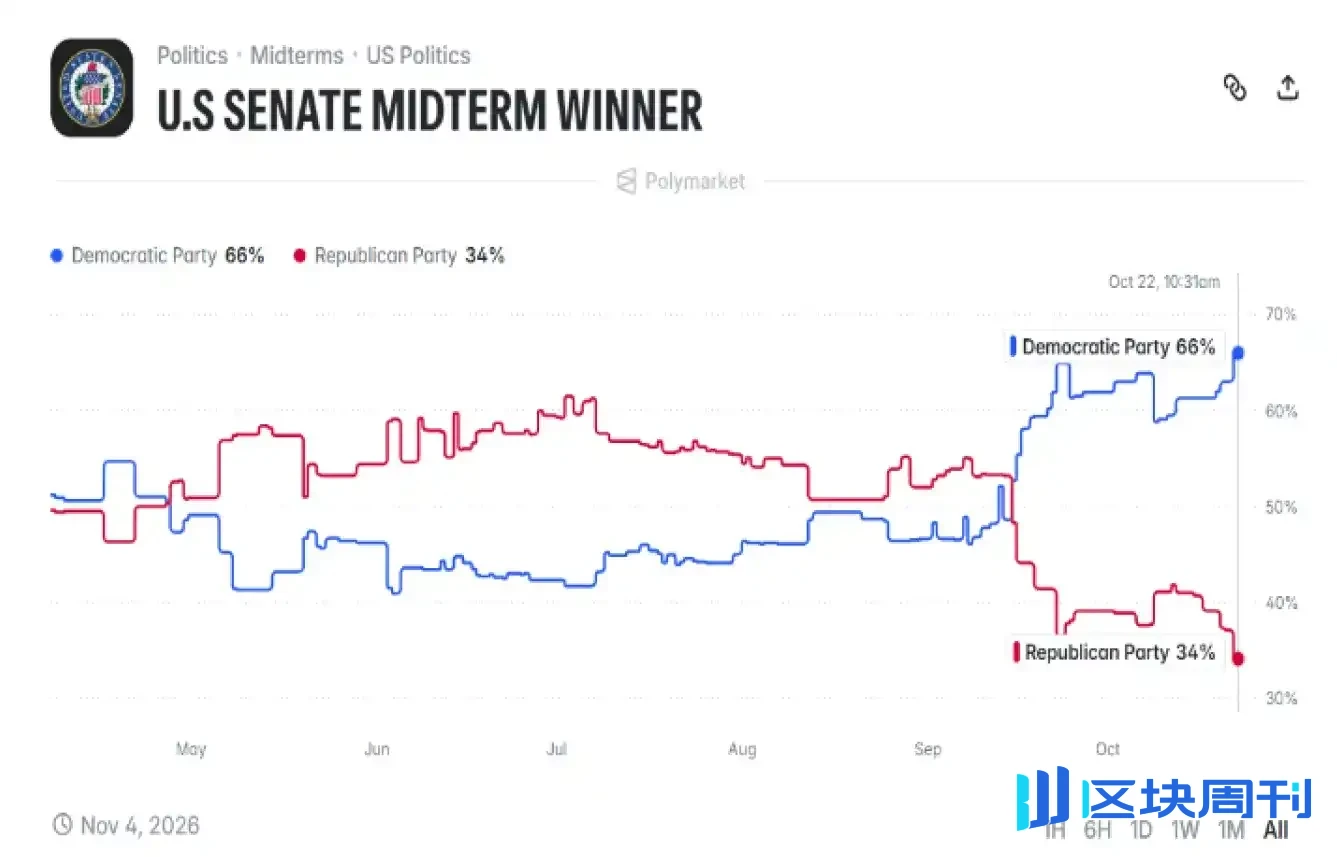
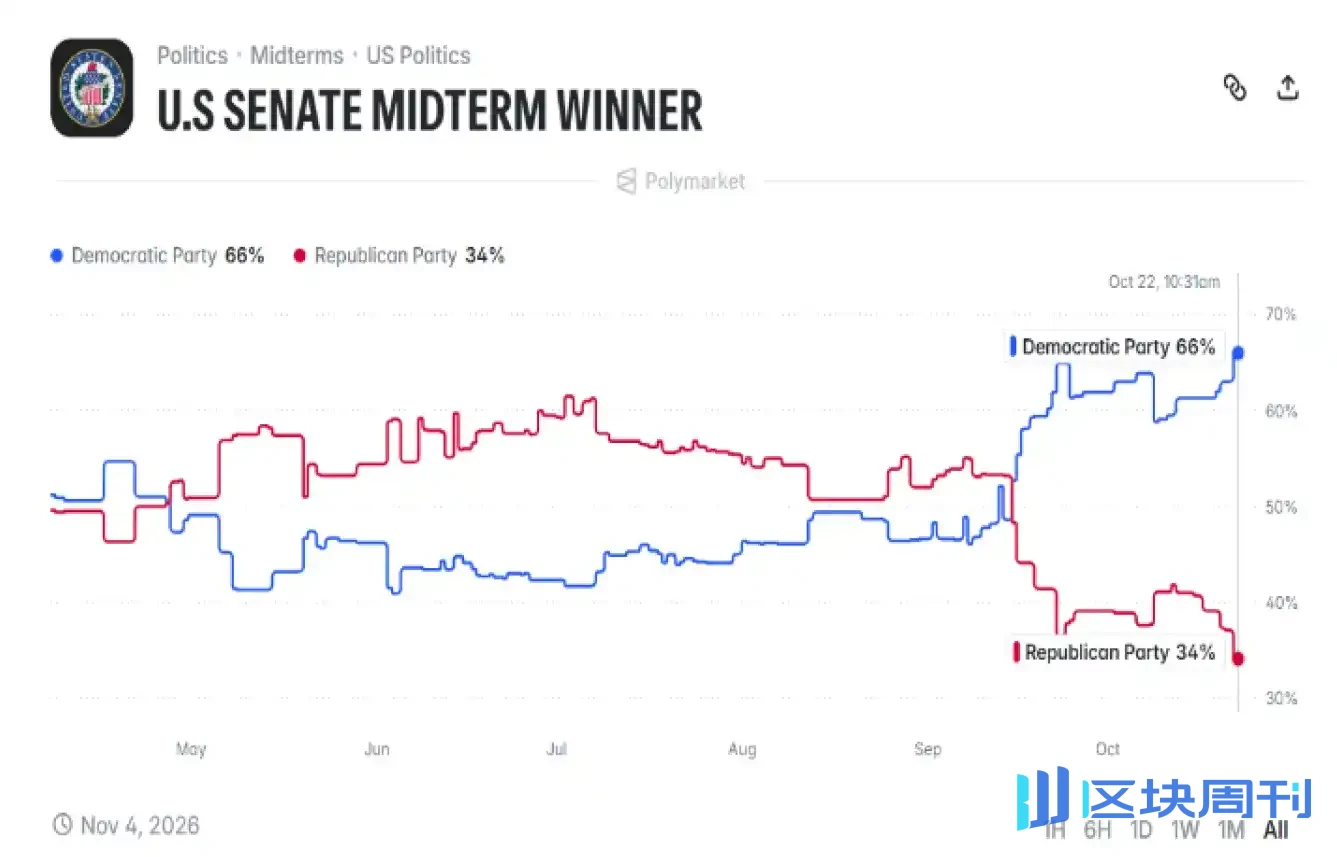
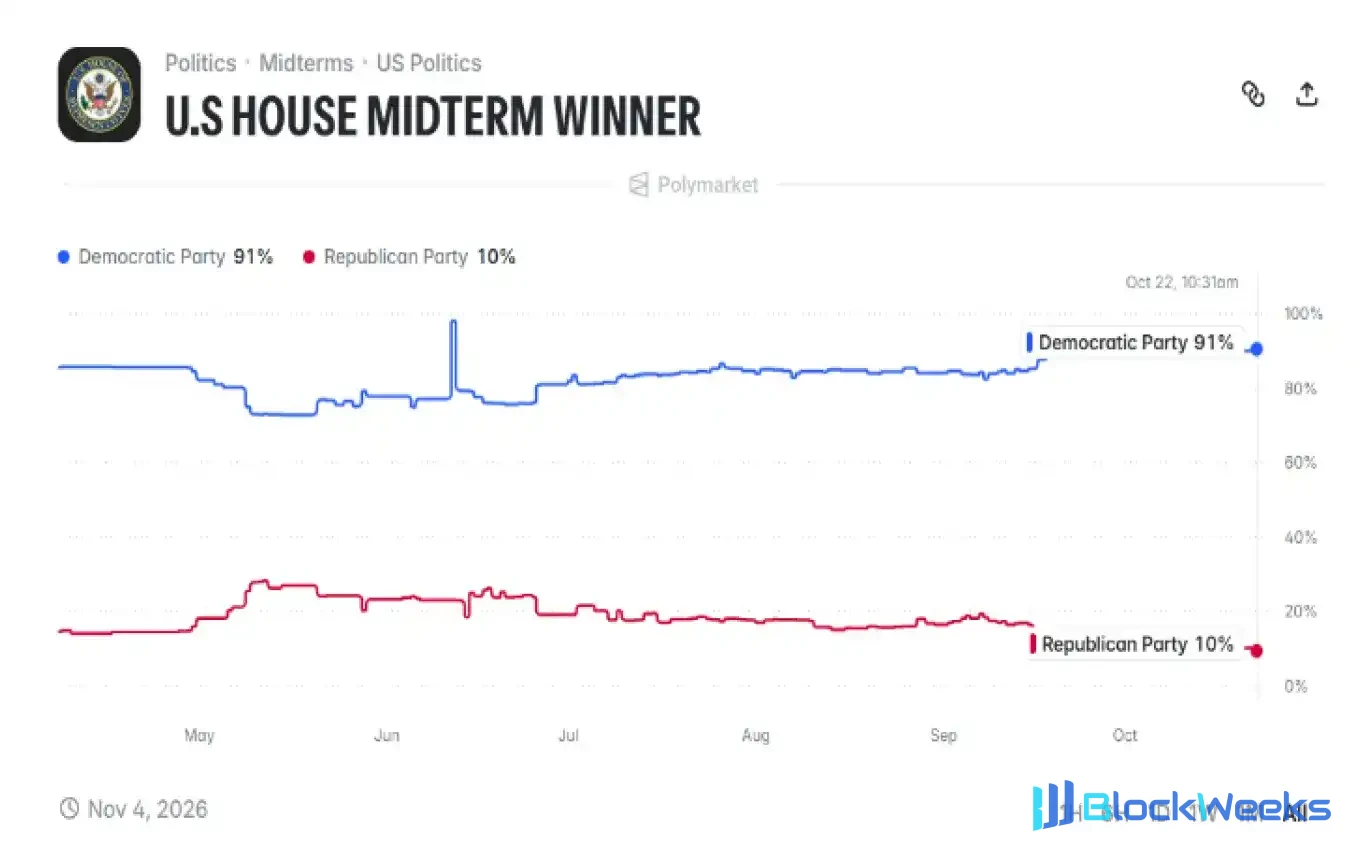
Pricing in betting markets leans toward the Democratic Party. As of October 22, Polymarket shows the probability of Democrats winning the House at about 91% and the Senate at about 64% (Charts 1-2). This means a divided Congress is likely, i.e., Democrats take at least the House, while the probability of Democrats sweeping both chambers (Democrats Sweep) is also rising.
Chart 1: Betting markets show the probability of Democrats winning the Senate rising to 66%
Source: Polymarket, CICC Research Department
Chart 2: Betting markets show the probability of Democrats winning the House as high as 91%
Source: Polymarket, CICC Research Department
Pressure on Republican electoral prospects mainly stems from high living costs. Survey data shows Trump's approval rating has recently fallen to 34%, a new low for his two terms[1]. Voters' continued dissatisfaction with prices has become the core factor dragging down Trump's approval rating and Republican electoral prospects. With just over a week until the midterm elections, the Trump administration appears to have no good way to address energy costs. This month, several Republican lawmakers opposed Trump's relaxation of restrictions on Russian diesel exports[2], indicating that there is very limited room to bypass negotiations with Iran and lower energy costs. At the same time, Democratic voters' enthusiasm for voting is higher than that of Republican voters, which may further amplify the Democrats' electoral advantage[3].
A divided Congress means that legislative leadership over the next two years will be redistributed between the two parties. The House controls appropriations, investigations, and the initiation of impeachment. Once it changes hands, part of the Trump administration's agenda will be obstructed. The scenario of Democrats sweeping both chambers was a low-probability event just a few months ago, but has now become an option considered by the market. We believe that if Democrats gain control of the House, or even further win the Senate, the impact may mainly be reflected in the following aspects.
Congress checks Trump, and constraints on escalation increase
Currently, both chambers of Congress are controlled by Republicans, which generally supports Trump on military action. If Democrats win, whether by controlling the House or sweeping both chambers, constraints on Trump's military actions will strengthen:
1) Power of the purse. The Pentagon previously disclosed the need for about $80 billion in emergency appropriations[4]. But Democratic senators previously said the Senate could not muster the 60 votes needed to pass additional appropriations[5]. At the same time, Trump had requested that $350 billion in defense funding be included through a budget reconciliation bill[6]. If Democrats win the House, they will directly close off this channel to bypass the 60-vote threshold.
2) Checks on military power. Democrats have repeatedly initiated legislation in Congress to restrict Trump's military actions, but all have been resisted by Republicans[7]. If the Democrats win, Congress's constraints on Trump's launching of military operations will be strengthened. And within the Republican Party, some lawmakers may also blame Trump's military policies for the midterm defeat, thereby increasing constraints on the latter.
3) Oversight and investigation. After the Democrats control Congress, they may launch various investigations against Trump, including impeachment[8], leaving Trump with no time to attend to geopolitical conflicts. This also means that in the next two years, Trump's own political life will face challenges, and most of his energy may be used for partisan struggle and responding to Democratic investigations.
However, vigilance is still needed regarding the transition period before the new Congress officially takes office.The new Congress will not take office until January 3, 2027, and for about two months before that, Congress will still be controlled by the Republicans. In theory, Trump could use this period to take further action. But the situation over the past year shows that geopolitical issues cannot be resolved in one or two months, though short-term market disturbances cannot be ignored, and oil prices face the risk of another surge.
Fiscal expansion space is limited, with the main focus shifting to the debt ceiling
Democrats will constrain Trump's fiscal policy.In July 2025, Trump's flagship "One Big Beautiful Bill Act" was passed through the Budget Reconciliation procedure, with all affirmative votes coming from Republicans[9]. Budget reconciliation is a special procedure of the U.S. Congress whose core advantage is that it can bypass the Senate's regular 60-vote threshold and pass with only a simple majority. Once Democrats control Congress, this convenient channel will be difficult for Republicans to use unilaterally again.
In fact, Trump's main fiscal policies have already been implemented through the "One Big Beautiful Bill Act," which means that this administration's fiscal stimulus has already been "front-loaded," and Trump himself currently has no new large-scale fiscal stimulus plans, so the next two years inherently lack incremental policies. This also means that,in the next two years there will basically be no more large-scale partisan tax cuts or spending expansion, and the deficit path will converge toward the CBO baseline.
However, the debt ceiling issue may become a disturbance point.The "One Big Beautiful Bill Act" raised the debt ceiling from $36.104 trillion to $41.104 trillion[10]. As of October 20, 2026, debt subject to the statutory limit had reached about $40.241 trillion, leaving less than $1 trillion in remaining space[11]. Based on forecasts from institutions such as the Congressional Budget Office (CBO) and the Bipartisan Policy Center (BPC), the U.S. federal government may hit the statutory debt ceiling in mid-2027[12]. After hitting the ceiling, the Treasury can still rely on cash balances and extraordinary measures to sustain operations for a period, which does not mean it truly faces a payment crisis, but it may still cause disturbances to economic operations. From October to November 2025, the longest federal government shutdown in history occurred, and it was finally temporarily continued through a Continuing Resolution. During this period, economic data could not be released on time, and GDP growth also slowed.If a divided Congress emerges after the election, it cannot be ruled out that in mid-2027 the two parties may once again engage in fierce bargaining over the debt ceiling, raising the risk of a government shutdown and potentially affecting market liquidity at a阶段性 level.
AI regulatory risk mainly lies in local differences, rather than comprehensive federal tightening
Another issue the market is worried about is strengthened AI regulation.A Brookings report states that 64% of Americans believe that "rapidly building data centers is not a good thing," 77% worry that AI will drive up electricity bills, and only 14% are willing to live near data centers[13]. Regarding views on Trump's handling of AI, only 23% of Americans think Trump is handling it well, while 57% of Americans think he is handling it poorly[14]. A recent study by The Washington Post shows that political candidates' comments on AI data centers have shifted from mostly positive to negative, with Republicans shifting more sharply than Democrats, but both have moved in a negative direction[15].
Is opposition to AI election hype, or genuine public opinion? We believe thatpublic opinion has a genuine component, while politicians' statements carry an element of hype.Public opposition mainly comes from rising electricity prices.From January to July 2026, the average U.S. residential electricity price was nearly 40% higher than in 2019[16]. In data-center-dense areas, wholesale electricity prices rose by more than 200% at most compared with 2020[17]. However, a survey experiment shows that if developers pay energy costs themselves, do not drive up residential electricity prices, and fund infrastructure upgrades, public support would rise[18].
Politicians' statements are driven by the need to win votes, using this to attack campaign opponents[19]. In fact, even if anti-AI candidates win, it will be difficult to form unified anti-AI legislation at the congressional level. On the one hand, there are huge divisions within Congress, and some members of Congress believe that pausing AI is "stupid" and will only let other countries run faster[20]. On the other hand, Trump has long supported the development of AI and data centers, and even if Congress passes relevant restrictive bills, they may face a presidential veto, unless both chambers of Congress override the veto with a two-thirds majority, otherwise the bill will be difficult to take effect.
Therefore, we believe thatit is very difficult to issue an AI moratorium at the federal level, and regulatory risk mainly lies at the state and local government levels.What determines whether a data center project can be implemented is the state public utilities commission and local planning departments. As some states hold gubernatorial elections, different regions will introduce different policies according to their own circumstances, and approval requirements for data center construction may rise. As of early July 2026, about 109 state-level AI laws had taken effect across the United States, with California, New York, Illinois, and other states leading the way[21]. California even signed SB 813 and AB 1405 in September 2026, becoming the first to establish an independent AI evaluation and audit framework[22]. Because local conditions differ, such regulation is regional and decentralized individual policy, not a nationally unified constraint, and is unlikely to pose a systemic threat to the AI industry as a whole.
For the market, we judge that the conclusion of the election may drive a decline in policy uncertainty, constituting an opportunity for risk clearing.In the pre-election phase, the market repeatedly speculated around issues such as the U.S.-Iran conflict, the Russia-Ukraine conflict, and AI regulation, while all parties involved hoped to maximize the value of their own bargaining chips before the election, bringing great policy uncertainty.Once the election results are settled, these games will converge accordingly, and the policy direction will instead become clear: military action is constrained by Congress, fiscal policy turns neutral, and AI regulation is generally restrained. Therefore, the midterm elections are more likely to be an opportunity for risk clearing; after the election, policy uncertainty declines, which may play a positive role for the market as a whole.
Risk warning: The election results exceed expectations, and the Republican Party still controls both chambers.