

This article was compiled and organized by BlockWeeks
On May 12, the total market capitalization of the cryptocurrency market had just hit a record high of more than $2.5 trillion. That evening, Tesla CEO Elon Musk announced in a tweet at 6:06 p.m. Eastern Time that Tesla would suspend accepting Bitcoin for car purchases, citing concerns over the rapidly rising consumption of fossil fuels, especially coal, by Bitcoin mining and transactions. He also stressed that Tesla would not sell any of the Bitcoin it holds. This tweet became the trigger, and one of the most severe corrections since March 12, 2020, immediately unfolded.
More than $1 trillion evaporated in three days: from $2.5 trillion to $1.4 trillion
Measured from the May 12 high, the total market capitalization of the crypto market fell by as much as 42% to $1.4 trillion. During intraday trading on Wednesday, Bitcoin once touched $30,000, a drawdown of 53% from its previous all-time high of $65,000; Ethereum once fell to $1,918, a drawdown of 55% from its high of $4,338. The market then rebounded from Wednesday's low, and as of publication, Bitcoin had recovered to around $39,000 and Ethereum to around $2,600.
On a closing basis, Bitcoin closed Wednesday down 42.5% from its all-time high, a drawdown larger than any correction in the 2016–2017 bull market; Bitcoin then rebounded more than 33% from its $30,000 bottom, returning to the low $40,000 range.
However, despite the stunning decline, Wednesday was not Bitcoin's most volatile day this year, let alone the most volatile day in its history. Bitcoin is inherently a highly volatile asset, and the characteristic of this decline was concentrated and extremely rapid losses, rather than a record single-day amplitude.
What was truly unusual was capital flows. Glassnode data showed that Wednesday saw what was very likely the largest single-day net inflow into exchanges in Bitcoin's history, with exchange BTC balances rising significantly, reversing the net outflow trend that had been regarded as a hallmark of this market cycle.
Who was selling? Short-term holders capitulated, long-term holders bought
The Spent Output Profit Ratio (SOPR)—the realized value (in USD) when coins move on-chain divided by the value (in USD) when they last moved—was significantly below 1 on Wednesday, meaning the market as a whole was selling at a loss. This indicates that Wednesday's scenario was: short-term holders with higher entry costs capitulated in panic, while lower-cost long-term holders continued to hold.
It is worth noting that even after such a severe drawdown, about 75% of Bitcoin's supply remained in profit. Long-term holders instead showed signs of accumulation during the decline. On Wednesday morning, net buying across asset classes was also observed in the market.
Four triggers: a correction was due, but the triggers were concentrated
Before the crash, market structure had already set the stage for a correction: Bitcoin stalled in a range between $42,000 and $65,000, while Ethereum was clearly overheated—ETH rose 340% between March 1 and May 12. Ethereum's rise then drew capital into riskier assets such as DeFi tokens, NFTs, and meme coins, frenzy erupted, and the market as a whole became overheated.
This is a recurring pattern in crypto markets: Bitcoin leads, Ethereum follows, and after Ethereum rises, an "altcoin season" erupts, spawning a large number of overvalued marginal coins, followed by a correction. A pullback under these conditions was not surprising. What actually ignited the decline was several catalysts:
- Inflation concerns triggered a contraction in risk appetite across the broader market, with stocks falling for several consecutive trading days;
- Musk reversed his stance on Bitcoin transactions and posted multiple emotional tweets about the entire crypto ecosystem;
- Growing attention to Bitcoin mining's energy consumption;
- Negative headlines about Tether's reserve composition, China's so-called "ban," and investigations of Binance by the U.S. Department of Justice (DOJ) and the Internal Revenue Service (IRS) sparked panic.
Judging by the market reaction, investors may have overreacted to these headlines—most of them did not bring new information with genuine shock value.
May 19: Leverage collapse and liquidity crunch
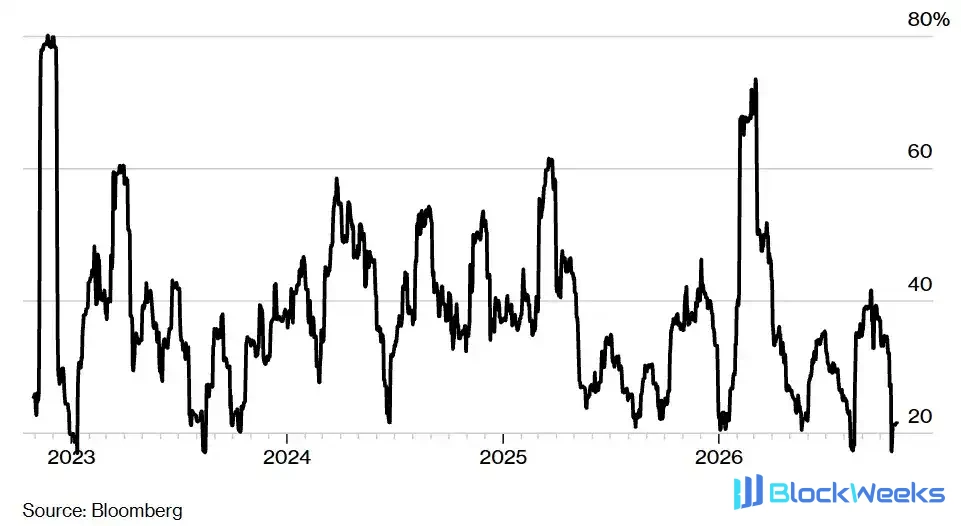
Wednesday's decline turned into a liquidity crisis on May 19. This unprecedented crash occurred against a backdrop of an overall decline in open interest, but was amplified by a surge in volatility. On the scale of the past year, this liquidity crunch appears even more severe.
Perpetual futures funding rates provided interesting clues. Before the sell-off began on May 12, Bitcoin perpetual futures funding rates hovered near 0.0%. Low funding rates combined with the massive existing leverage in the market (evidenced by the scale of futures open interest and its rapid decline during the sell-off) indicated that market participants were adding leverage on both the long and short sides. This corroborated the relatively calm market sentiment in the $50,000 range and institutional capital that continued to enter and conduct spot-futures basis trades. Then, during the capitulation sell-off on May 19, perpetual futures funding rates plunged into deeply negative territory, the most negative level since March 2020.
Ethereum underperformed Bitcoin that day, possibly for several reasons: ETH had experienced a relatively prolonged period of relative strength in the weeks before the sell-off; Ethereum's leverage as a share of market capitalization was higher, and the subsequent deleveraging was also larger.
Why Musk's tweet stunned the market
Musk's statement confused many observers, and it contained several self-contradictions and inaccuracies. The energy consumption of Bitcoin proof-of-work (PoW) mining is not a new issue and has been widely reported for years. Whether Tesla conducted sufficient due diligence before becoming so deeply involved in the asset also became a focus of market questioning. In any case, the tweet pushed a long-standing issue that had previously been obscured by the price narrative back into the spotlight and directly triggered a concentrated cashing out of profits.
Fundamentals unchanged: Ethereum, DeFi, and stablecoins are still growing
The sharp price fluctuations did not change the direction of on-chain fundamentals. Ethereum's transition to a proof-of-stake (PoS) validation mechanism is still progressing, despite uncertainty about the upgrade timeline—some current estimates point to some time in 2022—but expectations for the upgrade will remain a bullish catalyst for Ethereum investors.
Even without considering the existing, ongoing scaling and user experience improvements, Ethereum's position as the largest financial application protocol already looks solid. Some other networks once seen as potentially "killing ETH" instead built bridges to Ethereum and to some extent began functioning like Ethereum sidechains. Even if Ethereum fails to capture all DeFi activity, it will at least remain the central hub for decentralized finance applications for the foreseeable future.
The expansion of stablecoins proves that public blockchains are an extremely efficient and reliable technology for transferring fiat currency across borders. Data shows that stablecoin circulation, holdings, usage, and turnover velocity are all at historic highs. Facebook's Diem project is about to launch in partnership with Silvergate Bank, which will further expand the stablecoin ecosystem. Interest in stablecoins across various use cases such as traditional finance, card payment settlement, and cross-border remittances continues to rise.
The long-term bull market thesis still holds
Last year's Bitcoin rally stemmed from institutional investors viewing its credible monetary policy as a differentiated tool against central bank currency debasement—namely, "digital gold." The Bitcoin properties supporting this thesis have not changed. But the trade became too crowded: when Bitcoin moved sideways between $42,000 and $65,000, many turned their attention to Ethereum, and capital flowed in heavily and drove its price up, with a gain of 340% from March 1 to May 12.
The long-term bullish case remains strong: crypto adoption, usage, holdings, and awareness are all at historic highs; demographic shifts, declining trust in institutions, and an uncertain macroeconomic and monetary policy environment all continue to support the value proposition of decentralized open networks. Major upgrades to Bitcoin and Ethereum will improve usability and scalability and provide catalysts for future growth. Crypto market infrastructure also continues to mature, and its connections with the traditional financial system are steadily improving.
Corrections are normal in crypto markets. There are no circuit breakers here, nor a lender of last resort stepping in during severe market turbulence; interest rates are not artificially suppressed, nor is Bitcoin issuance increased to inject liquidity into the system. The long-term value proposition of decentralized public networks remains solid, and the fact that the market can experience corrections and rebound on its own strength precisely demonstrates that this still-volatile asset class possesses the power of a truly free market.
The crypto adoption story is still in its early stages. The principles of decentralization, self-sovereignty, and trust minimization continue to inspire participants, driven by one of the most revolutionary technological innovations in human history and supported by currency debasement, major demographic shifts, and declining institutional trust. Disruptive innovation is inherently bumpy and sometimes feels like a roller coaster ride.