Original author: Zhang Yaqi
Original source: Wallstreetcn
The artificial intelligence boom is reshaping global capital flows, with the dollar hovering at high levels, but a fragile support structure makes the outlook for a super dollar full of uncertainty.
According to news from the Trading Desk, Deutsche Bank sharply raised its 2027 dollar forecast in its latest foreign exchange outlook report, acknowledging that its previous judgment of a weaker dollar had failed to materialize. The AI boom has pushed up U.S. real interest rates, attracted massive equity capital inflows, reignited inflationary pressures, and prompted the Federal Reserve to turn hawkish, jointly forging the current "AI dollar" landscape. The dollar is already more than 20% above its average over the past four years, and based on three fundamental valuation indicators it ranks among the most expensive currencies in the G10.
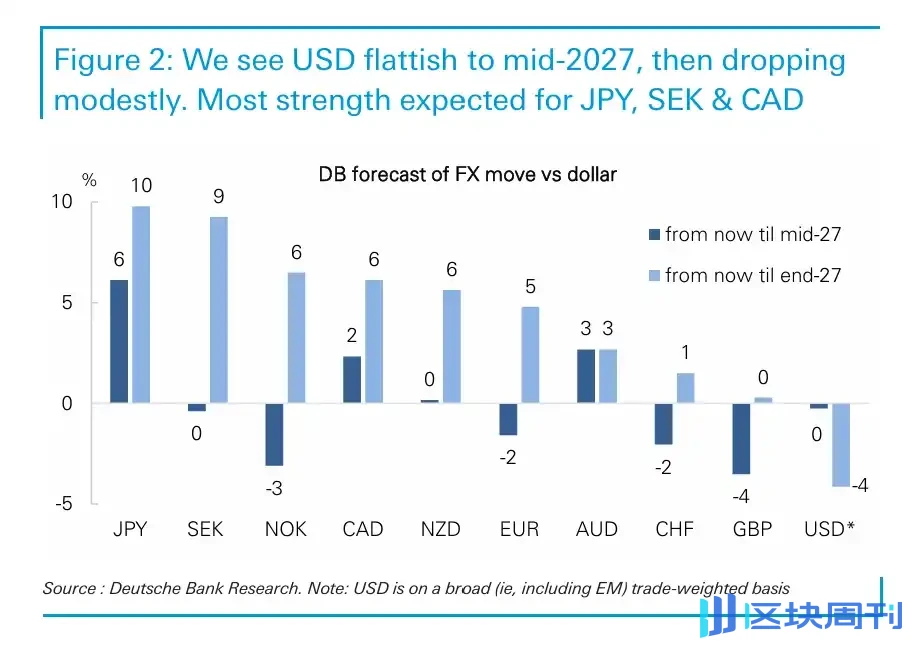
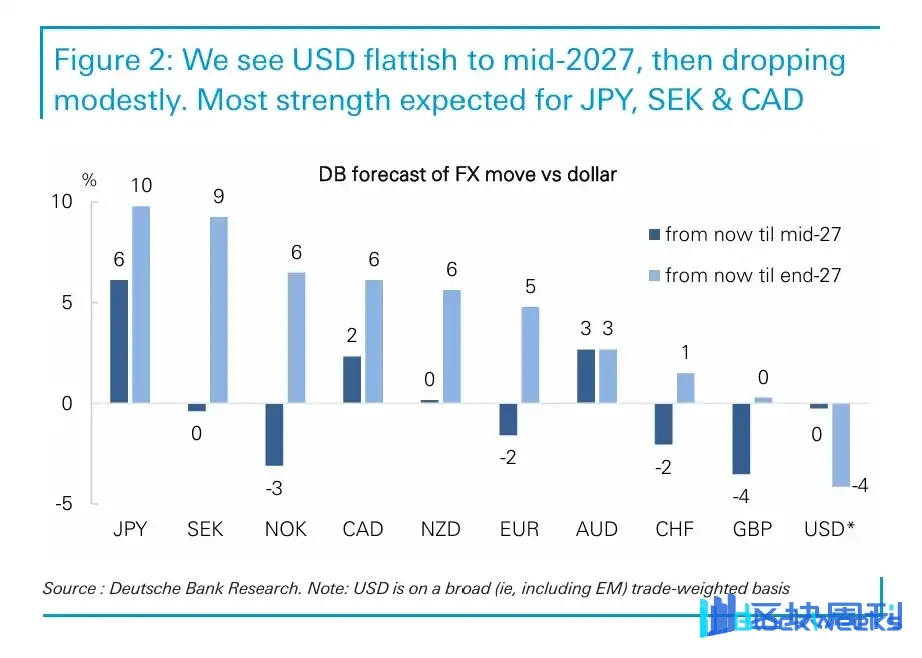
Deutsche Bank expects that the dollar will extend its strength in the first half of 2027, then moderate in the second half, but overall remain at a high level. The report also warns that the dollar's dependence on the AI capital expenditure cycle continues to deepen. Once the market's expectations for AI returns are significantly downgraded, the dollar's two major supporting pillars—U.S. real interest rates and equity capital inflows—will collapse simultaneously, and at that point the dollar faces substantial downside risk.
The AI boom supports "dollar exceptionalism"
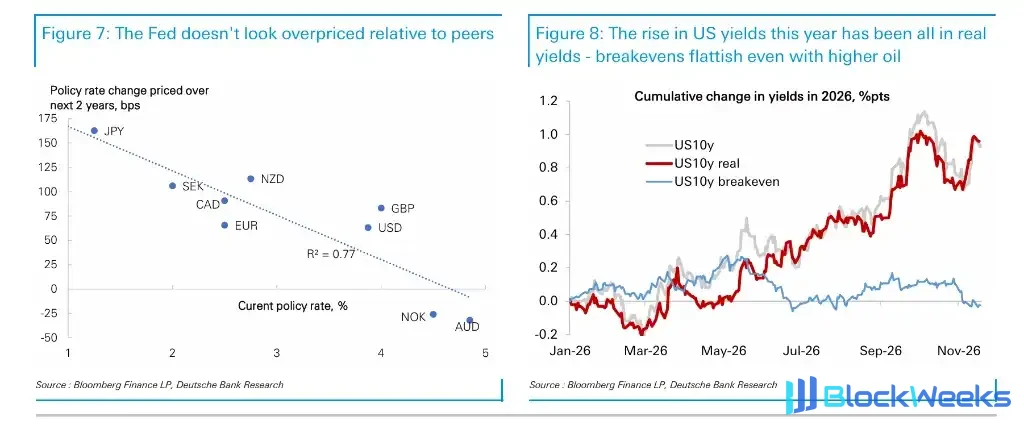
The core driver of dollar strength comes from within the United States, and in the short term there is a possibility that it will continue or even strengthen. Over the past few months, U.S. inflation has reaccelerated, and the core PCE deflator is expected to break through 3%, driving a repricing in interest rate markets and pushing the dollar back into the top three highest-yielding currencies in the G10—a position it had briefly ceded at the end of 2025. Deutsche Bank data show that historically the dollar has rarely entered a downward cycle when offering high yields.
The rise in real yields has simultaneously boosted expectations for the U.S. neutral rate, which has risen by about 50 basis points this year, while the euro area has remained almost unchanged over the same period. At the same time, U.S. GDP growth expectations have returned to the top of the G10, capital expenditure growth is about twice that of other economies, and the AI-driven capacity expansion cycle lays the foundation for productivity gains, providing a positive incentive for the foreign exchange market.

Equity inflows dominate, fixed-income funds show signs of diversion
At the capital flow level, the United States remains the core magnet for global equity investment. Foreign inflows into U.S. stock markets have exceeded $1 trillion per year, becoming the main source of financing for the U.S. external deficit, and such funds usually have lower hedging ratios, making their support for the dollar more direct.
However, the direction of fixed-income fund flows is quietly changing. Data from Deutsche Bank show that inflows into U.S. bonds have slowed, while bond inflows into other G10 markets such as Canada and Japan have rebounded significantly, shaking the "There Is No Alternative" (TINA) market narrative. Foreign exchange reserve management agencies have also continued to increase allocations to other smaller currencies over the past year and a half. This trend is worth watching—if the diversification value of dollar assets continues to decline, upward pressure on hedging ratios will increase accordingly.
High valuations and twin deficits pose medium-term risks
The dollar's medium-term outlook faces multiple structural pressures. The most closely watched is excessive dependence on the AI capital expenditure cycle—related capital expenditure has grown nearly fivefold over the past three years, but the boost to growth from this momentum is expected to gradually fade after 2028. Volatility in technology stocks has so far not transmitted to the dollar, but Deutsche Bank believes that once expectations for AI capital expenditure are more clearly downgraded, the dollar will face a substantial shock.
At the same time, the U.S. fiscal deficit is stable at about 6% of GDP, and the current account deficit is also widening again, approaching 4% of GDP and close to the worst level in the G10. From the perspective of the trade-weighted real exchange rate, the potential trade deficit has shown long-term trend deterioration, which is masked in aggregate data only because the U.S. energy balance has turned from negative to positive. Tariff risk is also a hidden concern—historical experience in recent years shows that tariff threats tend to push the dollar down rather than up.

Asian currencies: North Asian capital reallocation affects the dollar's fate
The movement of North Asian currencies is becoming an increasingly critical variable in the dollar's outlook. The combined weight of the Japanese yen, Korean won, and New Taiwan dollar in the Federal Reserve's dollar index has exceeded that of the euro, and these economies are accumulating the world's largest trade surpluses. How these surpluses are handled—repatriated to the United States, redirected elsewhere, or converted domestically—will have a decisive impact on the dollar's trajectory.
Deutsche Bank defines this phenomenon as the "chip dollar" era: chips account for about 50% of the value of every $1 of data center investment, chip manufacturing is concentrated in Asia, and the resulting trade surpluses then flow back through investment in U.S. capital markets, forming a self-reinforcing cycle that also contains systemic fragility that could collapse once AI is repriced.
Specifically, Deutsche Bank expects the USD/JPY to move toward the 140 range. Bank of Japan rate hikes and government efforts to promote domestic deployment of savings (including the intention to push GPIF to shift more assets domestically) could trigger capital repatriation.
Euro: Suppressed by French Political Risk, but Improvement Is Expected
The euro will remain under pressure in the short term. The French presidential election (with the first round expected in April 2027) and the subsequent parliamentary elections constitute the main source of uncertainty, and are expected to keep EUR/USD facing downside risk below 1.10 over the coming months. Market pricing currently implies more than 60 basis points of ECB rate hikes, far exceeding Deutsche Bank's forecast of 25 basis points, which also adds further drag on the euro.
However, Deutsche Bank believes the French election itself is more likely to be a market-clearing event rather than a risk amplifier. The French political risk premium has already been fully reflected in the market, and French government bond spreads already show a clear premium relative to fundamentals; moreover, apart from the far left, all major French political forces have fiscal consolidation as their platform, and the degree of fragmentation under a stable government scenario is unlikely to exceed the status quo. Improving corporate profit trends and expanding inflows into both equities and bonds both form the basis for a medium-term stabilization of the euro. Deutsche Bank's judgment for the full-year EUR/USD range is approximately 1.07 to 1.15.
Emerging Markets: Carry Space Narrows, Divergence Intensifies
After a strong year, the low-hanging fruit in emerging market foreign exchange is largely gone. Deutsche Bank holds a more cautious attitude toward CEEMEA and Latin American currencies, mainly due to narrowing real rate differentials with the United States, heavy positioning, and rising supply and fiscal risks.
Specifically, the Polish zloty, Czech koruna, and Israeli new shekel face greater pressure from real rate differential compression; the Turkish lira, Egyptian pound, and South African rand are more sensitive to supply shocks. In Latin America, the Brazilian real remains supported by relatively high real interest rates and strong terms of trade, but fiscal risks make the outlook more balanced; the Mexican peso continues to face pressure from weak economic growth and a dovish central bank stance; Andean currencies are relatively favored due to terms-of-trade tailwinds, cheap valuations, and potential reform dividends. Frontier markets remain a bright spot, but Deutsche Bank has somewhat tempered its bullish expectations for the Kazakh tenge and Uzbek sum.
The AI boom is reshaping global capital flows, and the dollar is hovering at high levels, but the fragile support structure makes the outlook for a super dollar full of uncertainty.
According to news from the Zhuifeng Trading Desk, Deutsche Bank sharply raised its 2027 dollar forecast in its latest foreign exchange outlook report, acknowledging that its previous judgment of a weaker dollar did not materialize. The AI boom has pushed up U.S. real interest rates, attracted massive equity inflows, rekindled inflation pressures, and prompted the Federal Reserve to turn hawkish, jointly forging the current "AI dollar" landscape. The dollar is already more than 20% above its average over the past four years and ranks among the most expensive currencies in the G10 based on all three fundamental valuation indicators.

Deutsche Bank expects that the dollar will extend its strength in the first half of 2027 and see a moderate pullback in the second half, but overall remain at high levels. The report also warns that the dollar's dependence on the AI capital expenditure cycle continues to deepen. Once market expectations for AI returns are significantly downgraded, the dollar's two major supporting pillars—U.S. real interest rates and equity inflows—will collapse simultaneously, and the dollar will then face substantial downside risk.

The AI Boom Supports "Dollar Exceptionalism"
The core driver of dollar strength comes from within the United States, and there is a possibility it will continue or even strengthen in the short term. U.S. inflation has reaccelerated in recent months, and the core PCE deflator is expected to break above 3%, driving a repricing in interest rate markets and pushing the dollar back into the top three highest-yielding currencies in the G10—a position it had briefly ceded at the end of 2025. Deutsche Bank data show that historically the dollar has rarely entered a downtrend when offering high yields.
The rise in real yields has simultaneously boosted expectations for the U.S. neutral rate, up about 50 basis points this year, while the euro area has remained almost unchanged over the same period. At the same time, U.S. GDP growth expectations have returned to the top of the G10, capital expenditure growth is about twice that of other economies, and the AI-driven capacity expansion cycle lays the foundation for productivity gains, providing a positive incentive for the foreign exchange market.

Equity Inflows Dominate, Fixed-Income Flows Show Signs of Diversion
At the capital flow level, the United States remains the core magnet for global equity investment. Foreign inflows into U.S. equities have exceeded $1 trillion per year, becoming the main source of financing for the U.S. external deficit, and such funds are usually hedged at a relatively low ratio, making their support for the dollar more direct.
However, fixed-income capital flows are quietly changing. Data from Deutsche Bank show that inflows into U.S. bonds have slowed, while bond inflows into other G10 markets such as Canada and Japan have rebounded significantly, shaking the "There Is No Alternative" (TINA) market narrative. Foreign exchange reserve management agencies have also continued to increase allocations to other smaller currencies over the past year and a half. This trend is worth watching—if the diversification value of dollar assets continues to decline, upward pressure on hedge ratios will increase accordingly.
High Valuations and Twin Deficits Pose Medium-Term Risks
The dollar's medium-term outlook faces multiple structural pressures. The most closely watched is its excessive dependence on the AI capital expenditure cycle—related capital expenditure has grown nearly fivefold over the past three years, but the boost to growth from this momentum is expected to gradually fade after 2028. Volatility in technology stocks has so far not transmitted to the dollar, but Deutsche Bank believes that once expectations for AI capital expenditure are more clearly downgraded, the dollar will face a substantial shock.
At the same time, the U.S. fiscal deficit is stable at about 6% of GDP, and the current account deficit is also widening again, approaching 4% of GDP and close to the worst level in the G10. From the perspective of the trade-weighted real exchange rate, the potential trade deficit has shown long-term structural deterioration, masked in aggregate data only because the U.S. energy balance has turned from negative to positive. Tariff risk is also a hidden concern—historical experience in recent years shows that tariff threats tend to push the dollar lower rather than higher.

Asian Currencies: North Asian Capital Reallocation Weighs on the Dollar's Fate
The trajectory of North Asian currencies is becoming an increasingly critical variable in the dollar's outlook. The combined weight of the Japanese yen, Korean won and New Taiwan dollar in the Federal Reserve's dollar index now exceeds that of the euro, and these economies are accumulating the world's largest trade surpluses. How these surpluses are handled—repatriated to the United States, redirected elsewhere, or converted domestically—will have a decisive impact on the dollar's trajectory.
Deutsche Bank defines this phenomenon as the era of the "chip dollar": chips account for roughly 50% of the value of every $1 of data center investment, chip manufacturing is concentrated in Asia, and the resulting trade surpluses are then recycled back through investment in U.S. capital markets, forming a self-reinforcing loop that nonetheless carries systemic fragility that could collapse once AI is repriced.
Specifically, Deutsche Bank expects USD/JPY to move toward the 140 range. Bank of Japan rate hikes and government efforts to promote domestic deployment of savings (including a deliberate push for GPIF to shift more assets domestically) could trigger capital repatriation.
Euro: Weighed Down by French Political Risk, but Improvement Is Possible
The euro will remain under pressure in the near term. The French presidential election (with the first round expected in April 2027) and the subsequent parliamentary elections constitute the main source of uncertainty, and are expected to keep EUR/USD facing downside risk slightly below 1.10 over the coming months. Market pricing currently implies more than 60 basis points of ECB rate hikes, far exceeding Deutsche Bank's forecast of 25 basis points, which also adds further drag on the euro.
However, Deutsche Bank believes the French election itself is more likely to be a market-clearing event than a risk amplifier. The French political risk premium is already fully reflected in the market, and French government bond spreads already show a clear premium relative to fundamentals; moreover, apart from the far left, all major French political forces have fiscal consolidation as their platform, and the degree of fragmentation under a stable government scenario is unlikely to exceed the status quo. Improving corporate profit trends and expanding inflows into both equities and bonds both form the basis for a medium-term stabilization of the euro. Deutsche Bank's judgment for the full-year EUR/USD range is approximately 1.07 to 1.15.
Emerging Markets: Carry Room Narrows, Divergence Intensifies
After a strong year, the low-hanging fruit in emerging market foreign exchange is largely gone. Deutsche Bank takes a more cautious stance on CEEMEA and Latin American FX, mainly due to narrowing real rate differentials with the United States, heavy positioning, and rising supply and fiscal risks.
Specifically, the Polish zloty, Czech koruna and Israeli new shekel face greater pressure from real rate differential compression; the Turkish lira, Egyptian pound and South African rand are more sensitive to supply shocks. In Latin America, the Brazilian real remains supported by relatively high real interest rates and strong terms of trade, but fiscal risks are balancing the outlook; the Mexican peso continues to face pressure from weak economic growth and a dovish central bank stance; Andean currencies are relatively favored due to terms-of-trade tailwinds, cheap valuations and potential reform dividends. Frontier markets remain a bright spot, but Deutsche Bank has somewhat tempered its bullish expectations for the Kazakh tenge and Uzbek sum.