
Author: Nancy, PANews
Concerns about USDT depegging are almost an "old plot" in bear markets.
Recently, from cryptocurrencies to AI stocks and then to traditional financial assets, global asset markets have entered a "battle royale." The bottom is not yet clear, market sentiment is fragile, and any slight disturbance may be rapidly amplified.
As Bitcoin and gold prices plunged sharply, because Tether's reserves include related assets, concerns have once again been raised about the safety of its reserves and USDT's peg capability.
Gold and Bitcoin Both Slump, USDT Reserve Buffer Faces a Test
Tether once made huge profits from the rise of gold and Bitcoin, and now that the market has turned, it has also begun to "take a beating."
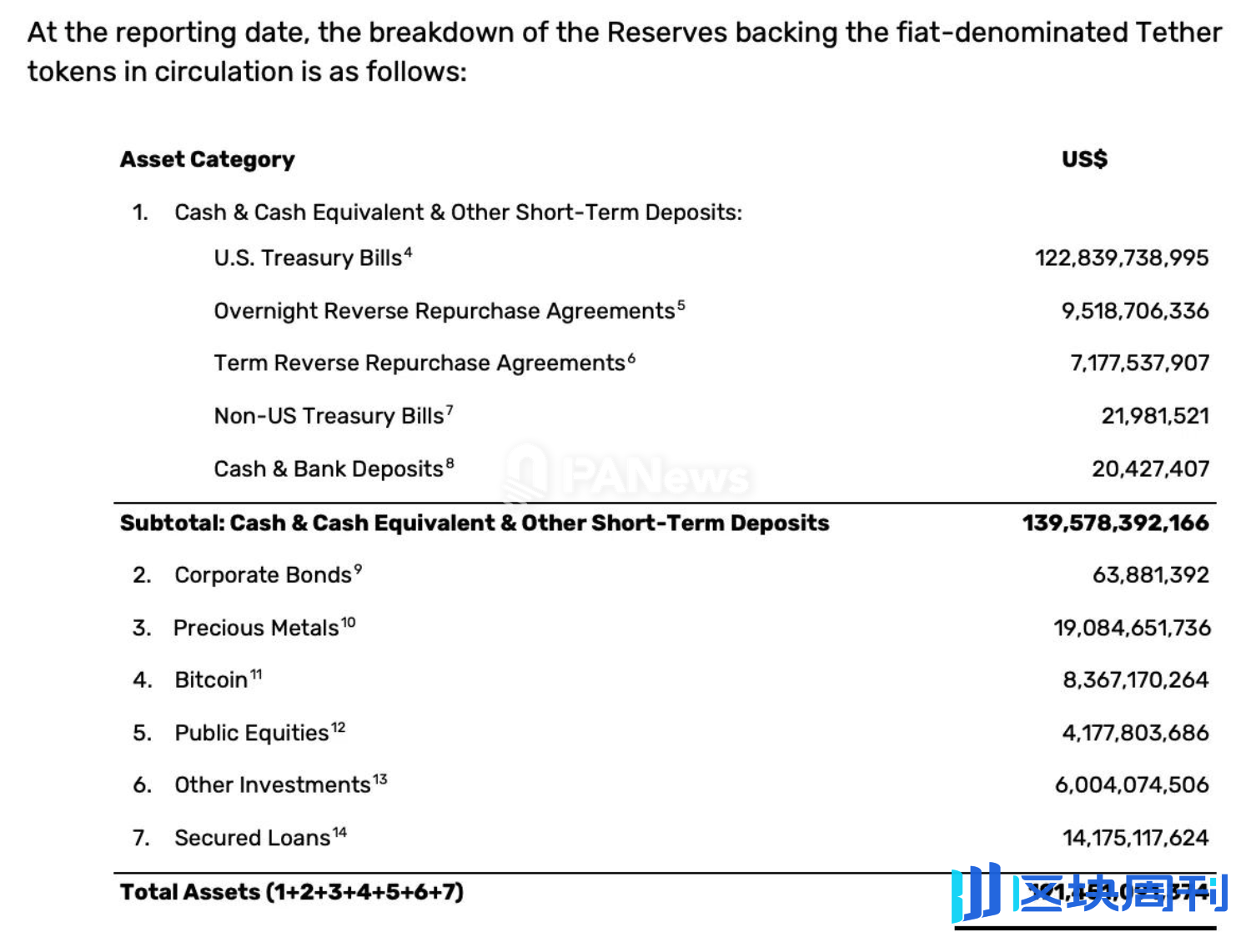
Over the past year, outside the crypto market, Tether has gained another rather special label: a "gold whale." As the world's largest private holder of gold, Tether has become the world's fifth-largest net buyer of gold since 2023, hoarding gold even faster than most central banks. By the end of the third quarter, its gold reserves were worth about $19.08 billion.
At the same time, Tether is also one of the major buyers of Bitcoin. Its third-quarter reserve report showed that the Bitcoin it holds is worth about $8.367 billion, and CEO Paolo Ardoino recently revealed that the company's Bitcoin holdings have exceeded 150,000 coins.
On one side is a traditional safe-haven asset, and on the other is a core asset of the crypto market. Both rose successively in the past rally, bringing Tether huge profits and adding extra appreciation space to its reserves. However, as Bitcoin and gold have now undergone significant corrections one after another, this may instead become a risk exposure that erodes the reserve buffer.
Such concerns are not unfounded.
Recently, crypto analyst @fozzydiablo pointed out that Tether's non-cash reserves are undergoing value revaluation. If gold, Bitcoin, U.S. stocks and other related assets continue to fall, USDT may face a situation of insufficient collateralization.
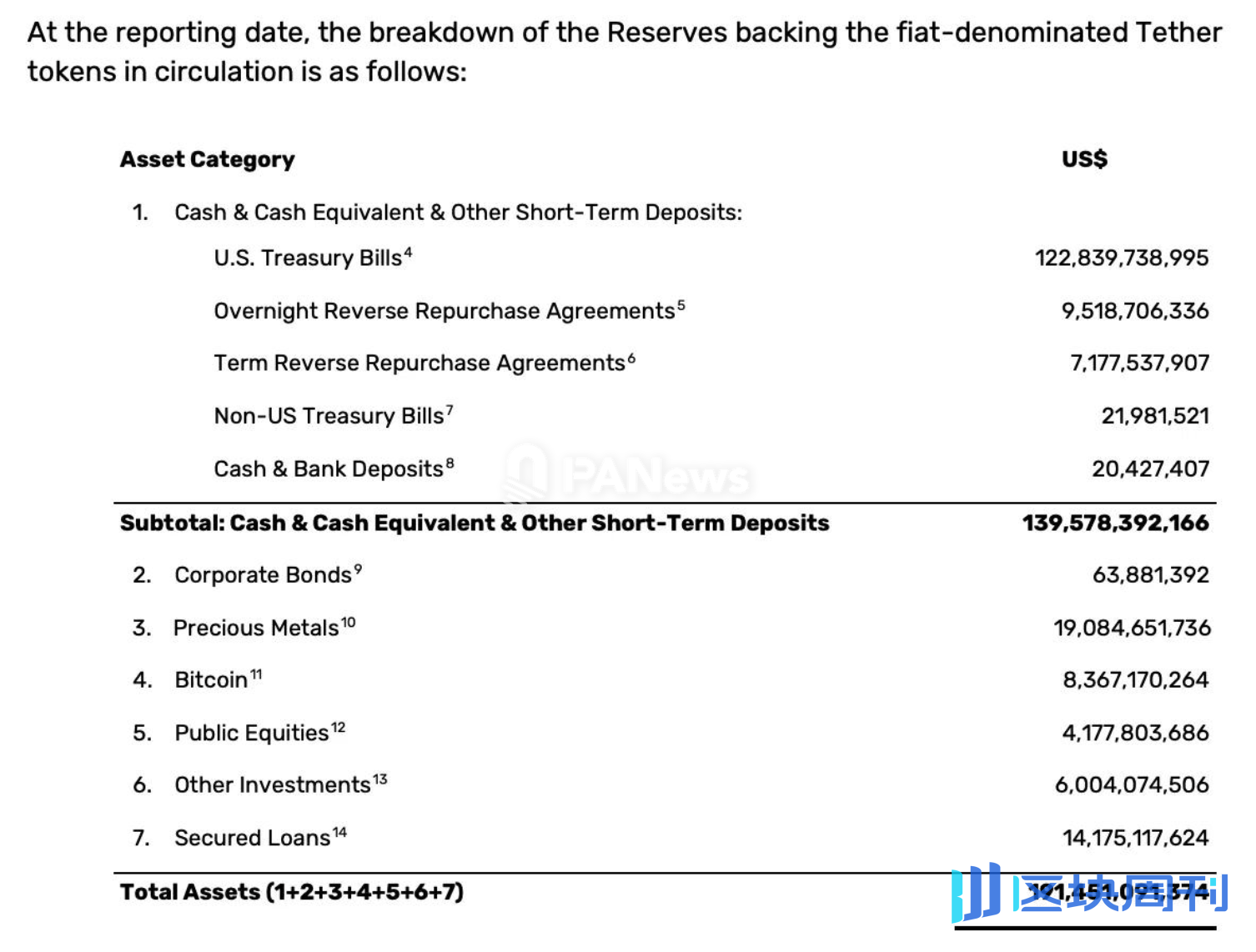
According to the third-quarter reserve report, Tether's total assets are about $191.45 billion and liabilities about $183.5 billion, leaving only a $7.95 billion excess reserve buffer between the two. At the same time, about $52 billion, or 27% of total assets, of its asset portfolio consists of non-cash assets, including about $19.1 billion in gold, $8.4 billion in Bitcoin, $4.2 billion in stocks, and $14.2 billion in secured loans.
fozzydiablo pointed out that based on current market declines, BTC has fallen more than 30% and gold about 15%, and the market value of non-cash assets has shrunk significantly. The decline in gold and Bitcoin alone has already consumed most of the buffer. If a discount of about 15-20% is further applied to assets such as loans, Tether would be close to insolvency.
Recently, S&P Global Ratings assessed Tether's ability to maintain its dollar peg as 5, the lowest level on its five-point scale. S&P believes that the proportion of risk assets in Tether's reserves has risen, and there are still gaps in information disclosure. As of September 30, risk assets had risen to 28% of USDT's circulating supply, up from 24% a year earlier, mainly driven by increased gold holdings and a new $4.2 billion exposure to publicly traded stocks. Other risk assets also include secured loans, corporate bonds, and investments with limited credit status disclosure.
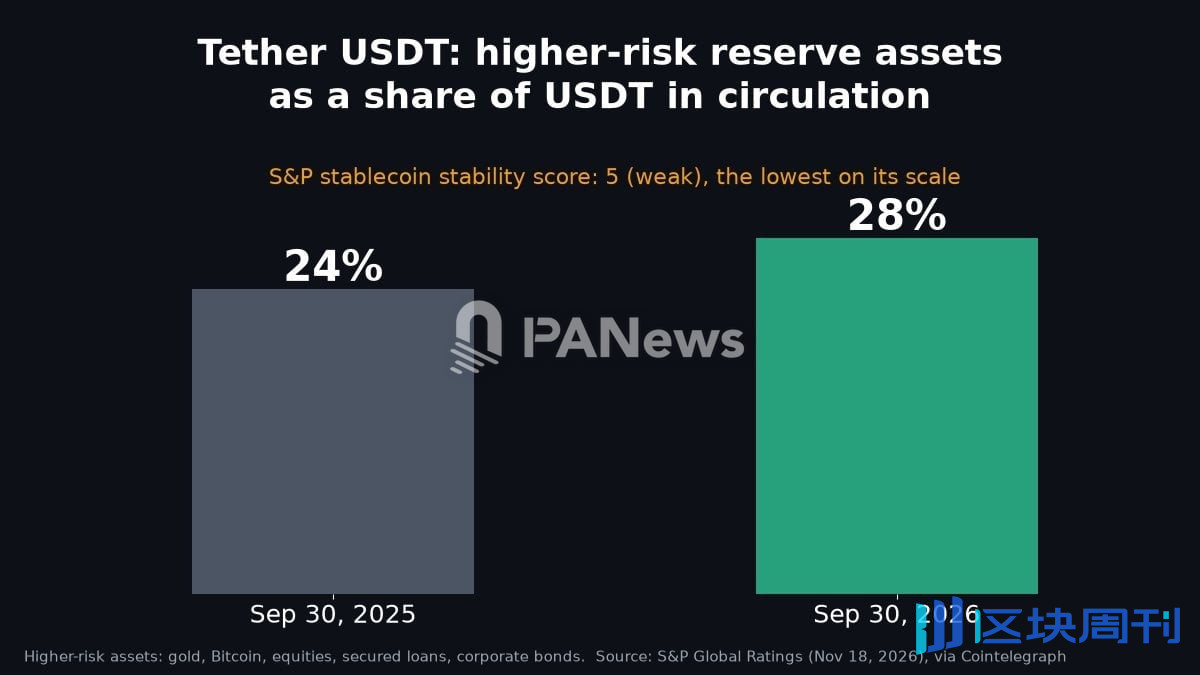
S&P warned that if the prices of the above high-risk assets fall sharply, the excess buffer may be rapidly consumed, and in extreme cases, insufficient collateralization may occur.
In response to outside doubts, Tether said, "The problem lies in S&P's evaluation framework, not our reserves. Their own history illustrates where the fundamental problem lies." At the same time, Tether also cited the film "The Big Short," which depicts the 2008 financial crisis, pointing the finger at rating agencies' evaluation frameworks.
Redemption Risk Is Generally Controllable, Tether Reportedly Needs to Examine Industry Responsibility
Recently, large-scale redemptions of USDT have also intensified market concerns about the safety of its reserves.

On-chain data monitoring shows that Tether has destroyed 8 billion USDT in the past 20 days. However, the destroyed tokens actually belong to unissued inventory in Tether's treasury, rather than USDT held by users. Since these tokens have not yet been officially issued to customers, the destruction process does not require Tether to pay dollars to users, nor does it directly cause actual cash outflows.
However, the sharp decline in risk asset prices is indeed weakening Tether's excess reserve buffer, and reserve risk has risen somewhat. But it needs to be clear that pressure on reserve assets does not mean a redemption crisis has already occurred.
From the perspective of asset structure, about 73% of Tether's reserves consist of highly liquid assets such as short-term U.S. Treasury bills and repurchase agreements, which can provide important support for it to meet daily redemption needs.
At the same time, Tether has strong profitability. In the first three quarters of 2026 alone, its net operating profit cumulatively reached $4.5 billion. This means that Tether could theoretically gradually replenish its reserve buffer through continued operating profits.
Binance market data shows that the USDC/USDT trading pair reached a high of $1.006 on November 20 and is currently quoted at 1.00121 USDT, with the premium having narrowed.
In the view of crypto researcher CM, if the asset portfolio composed of gold and Bitcoin falls further, Tether may still face the risk of insufficient collateralization. However, considering its current strong profitability, including more than $1 billion in revenue from U.S. Treasury bills each quarter, the possibility of a company-level solvency crisis in the short term is relatively limited.
But this does not mean that USDT can completely rule out depegging risk. He pointed out that Tether's market size is enormous. Once concerns about insufficient reserve collateralization are widely spread, market sentiment may rapidly deteriorate and trigger FUD. Even if Tether has the ability to handle large-scale redemptions, market panic may first be reflected on-chain, and some holders, out of risk aversion, will exchange USDT for other stablecoins, causing periodic depegging risk.
Faced with price fluctuations in reserve assets, Tether also appears to have slowed the pace of asset allocation. The third-quarter reserve report showed that its gold holdings decreased by about 3 tons from about 168 tons at the end of the second quarter, ending its previous streak of several consecutive quarters of increasing gold holdings. Despite the limited scale of the reduction, Tether remains an important player in the gold market. Moreover, because the holdings data at the end of the third quarter has a certain lag, it is currently impossible to rule out the possibility that it further adjusted its allocation to assets such as gold and Bitcoin afterward.
The controversy surrounding Tether is not limited to reserve safety itself. Dashan, founder of Waterdrop Capital, pointed out that since Tether began using part of its profits to buy gold rather than Bitcoin, he has been worried about its strategic direction. He believes that with greater power comes greater responsibility. If industry leaders do not consider the long-term future of the industry, the ultimate result is either that they give up their leading position, or that the ship sinks together, with the leaders perhaps sinking a little more slowly.
As the world's largest stablecoin issuer, Tether's influence has long exceeded the scope of its own business. Its asset allocation decisions not only concern the safety of its own reserves but also affect the liquidity and market confidence of the entire crypto market. As its scale and industry influence continue to expand, it is becoming increasingly difficult for Tether to stay outside the long-term interests of industry development.