

Author: David, Shenchao TechFlow
Shenchao Introduction:
Solana trader Ansem's associated wallet concentratedly sold off a token of the same name, exchanging for about 17,600 SOL, worth about $1.25 million at the price at the time of reporting. Lookonchain subsequently reported that the relevant address transferred about 2.15 million USDC to Arbitrum, involving funds from the sale of multiple Meme coins, which cannot be directly equated with the proceeds from selling the single ANSEM token. The community is fiercely debating whether "he stole from himself or was truly hacked," while a question from Frank DeGods pushed this micro-drama further: "What if this happened to Satoshi Nakamoto?"
From the loss of control over 70 million shitcoin holdings, to the early Bitcoin and quantum shadow presumed to belong to Satoshi Nakamoto, the most fragile assumption in the crypto market is the belief that dormant holdings will never wake up. This means that, before the cold-blooded matching engine and the abyss of liquidity, whether a hacker exists does not matter; betrayal and natural disaster have never been different on the same dumping bill.
Ansem and Satoshi Nakamoto are obviously two different kinds of people. But the massive holdings they left on-chain actually face the same possibility of being pulled toward the abyss by gravity.
One is a modern speculator active in the spotlight, playing the game of attention and liquidity through Twitter shilling; the other is a pioneer who retired after success and completely faded his back into the fog of cryptography.
By any reasonable standard, they should not be discussed together in any serious context.
But the abnormal wallet sell-off that just occurred, combined with the crypto industry's discussion of quantum computing risks, makes the barrier between dimensions seem less obvious.
According to on-chain monitoring reports, Ansem's associated wallet sold about 70.8 million ANSEM in batches, exchanging for about 17,600 SOL, worth about $1.25 million at the price at the time of reporting. Lookonchain subsequently stated that the relevant Meme coin sale funds were transferred to an address on Arbitrum starting with 0xAC33, with a transfer amount of about 2.15 million USDC. The approximately $1.25 million corresponds to the proceeds from selling the single ANSEM token, while the 2.15 million USDC is the relevant transfer amount in the monitoring report; the two cover different scopes of funds. ANSEM dropped sharply during the sell-off, with early monitoring saying it fell about 60% in one hour; these are records from the time of the incident.
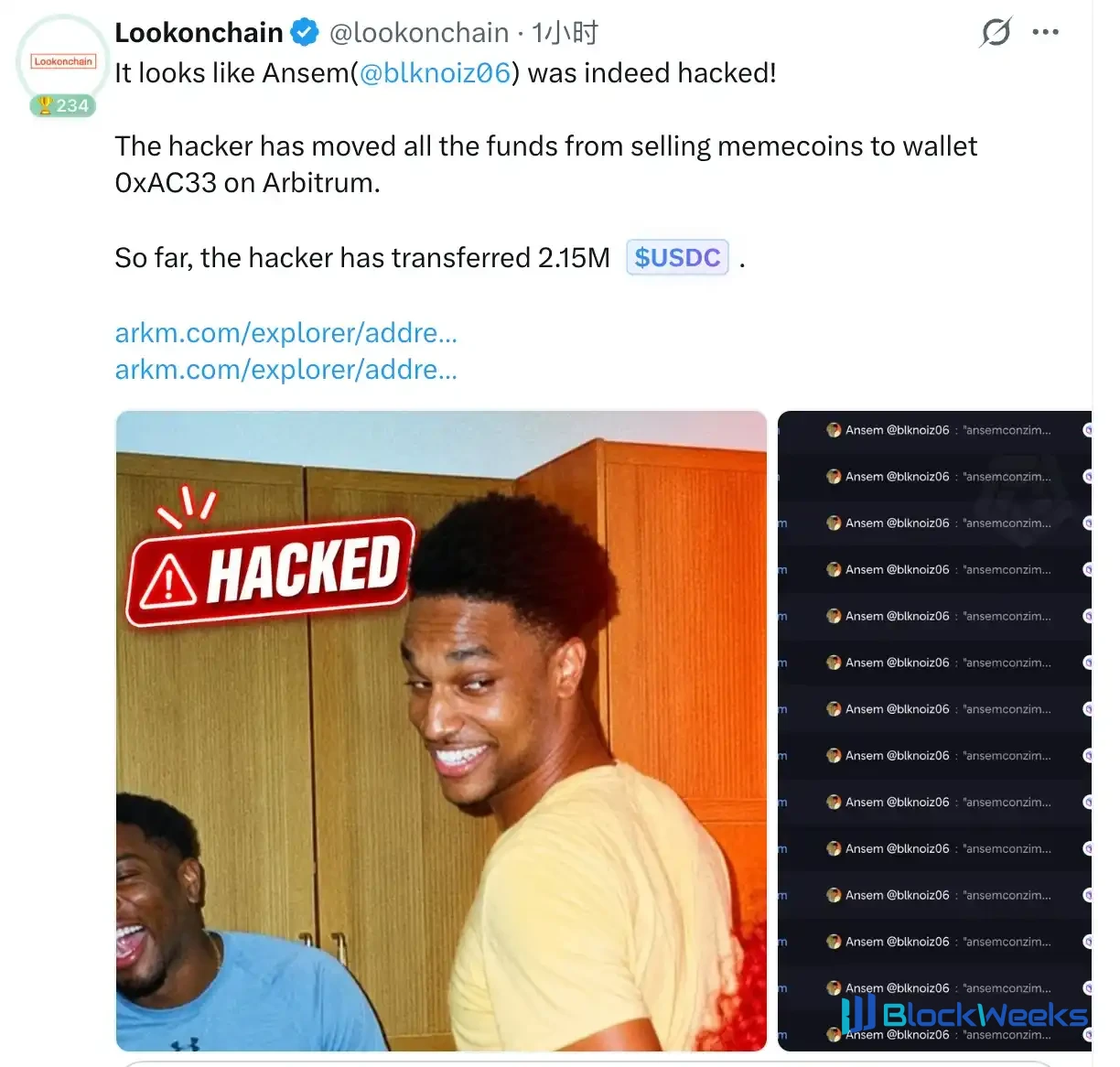
Afterward, the familiar drama unfolded step by step.
Ansem subsequently stated that his Pump wallet had been attacked, initially suspecting it was related to unauthorized access to a Bullpen account, which had previously imported a Solana private key; the specific attack path has not yet been confirmed. On-chain analyst MLM offered the opposite judgment, saying that about an hour before the sell-off began, an old wallet he had previously tagged as Ansem had transferred funds to the address that received the funds. The wallet still retained about 16.7 million ANSEM, which also became a detail in the community debate.
At present, English crypto Twitter is still arguing over "whether it was a hacker theft or Ansem himself staging a self-theft," and a post by Frank DeGods made the author think of a deeper question:
"Now, imagine if they did the same thing to Satoshi Nakamoto?"

In recent years, holders have seen too many incidents that began with abnormal wallet transfers.
So from the perspective of results, whether a coin was stolen by a hacker, or whether it was a self-directed performance to cover up selling, or whether Satoshi Nakamoto's BTC was truly broken by quantum computing, the dumping is ultimately indiscriminate.
Self-theft and being stolen are equivalent on the chart
After buying too many coins, holders in despair often fall into a kind of moral obsession.
For example, if I hold ANSEM, then I urgently want to find out whether Ansem is truly innocent, as if, if this really were an external hacker attack, the 75% shrinkage of assets in my account could receive some kind of sacred comfort; and if this were the person himself staging it, then this loss would become an unforgivable fraud.
But the pools of automated market makers have never had a sense of morality.
Deep in the matching of all order books, there is no field used to record what kind of state of mind the holder of the private key that signed this transaction was in. It does not care whether the person operating the keyboard is a hacker, does not care whether this is a premeditated cash-out, and cares even less whether retail investors are being kept in the dark.
However, the angry accusations in the community are by no means fabricated out of thin air.
On-chain analyst MLM (@mlmabc) pointed out that about an hour before the sell-off began, a wallet he had tagged as Ansem a year earlier had transferred funds to the address that later received the funds, so he suspected this was not a hacker attack. MLM's judgment conflicts with Ansem's account, but this fund transfer before the sell-off makes it hard for the community not to be suspicious.
What is even more puzzling is that after this wallet sold about 70.8 million ANSEM in three waves and exchanged for about 17,600 SOL, it happened to leave about 16.7 million ANSEM untouched. Transferring to the receiving address before the sell-off and leaving a remaining position after the sell-off make these operations even harder for the community to accept the explanation of "being hacked."

Before more evidence emerges, self-selling and private key theft remain competing explanations.
Because we have seen too many cases of self-theft under the guise of "hacker intrusion" or "private key leak." Dumping chips at any cost onto believers, then turning around and typing "I got hacked" on Twitter—this can both launder profits into a safe pocket and attempt to preserve a shred of victim's dignity in the court of public opinion. This is already a well-practiced golden cicada shell escape script for many KOLs.
But the problem is that, in many cases, self-theft and external theft are already hard to distinguish from the outcome.
The plate is smashed through, the SOL in the pool is drained, and on the Memecoin wasteland where there is neither a legal contract nor a recovery mechanism, it is very hard for any institution to accept victims' refund claims. Go to him to defend rights and get a refund? That is another long and arduous task.
On the physical level, whether it is acting or hacking, the destruction caused to every coin holder is completely equivalent.
Satoshi Nakamoto's public key in the sunlight, the quantum ghost in the shadows
I am not trying to exonerate Ansem, nor do I think those hackers hiding in the dark should go unpunished.
But if we follow Frank's rhetorical question and move our gaze away from this Solana token controversy to think about a more distant and harder-to-deal-with scenario:
Satoshi Nakamoto, and the quantum computing hanging over Bitcoin's head.
In Ansem's case, the reason everyone is arguing so fiercely is that he is a living person. He has greed, private desires, and the motive to cash out at any time to improve his life, so people can confidently pour all their losses and anger into the moral judgment of "he stole from himself."
But what about Satoshi Nakamoto?
If in the future quantum computing really can reverse-derive private keys from early exposed public keys, causing those bitcoins believed to belong to Satoshi Nakamoto and dormant for many years to begin flowing into the market in large batches one morning, coin holders will still face a dump.
At that time, surely no one will say this was staged by Satoshi Nakamoto himself, right?
So, when you hold Meme, you automatically acquire a deterrent of "acting hacked and dumping," and when you hold BTC, you automatically acquire a deterrent of "long-term quantum computing FUD."
Both of these Debuffs are swords of Damocles hanging overhead; this is the risk coin holders must bear.

Original illustration: schematic of quantum risk timeline distribution. The figure does not indicate the research source or starting year, and is not a basis for predicting cracking time.
Since every ultimate threat objectively exists, are you going to stop holding coins at this time? Will you leave the market today just because you are afraid quantum computing will break Bitcoin?
Obviously not.
When Justin Sun talked about this topic in an interview some time ago, his attitude was quite interesting. He admitted that because of the evolution of AI algorithms and the risk of quantum computing, his long-term view of Bitcoin had turned cautious or even slightly bearish, and he raised a risk scenario:
In the interview, he worried that some early bitcoins that have long been dormant and cannot actively migrate to new security solutions may create selling pressure in the future when cryptography is challenged. This is his risk deduction, and it cannot be used to conclude that these private keys have already been cracked.
But interestingly, he also said bluntly in the interview that he had not sold a single coin of his base position in Bitcoin.
Views are views, holdings are holdings.
The reason the vast majority of people have not fled in panic is not that they deny the existence of risk, but that they understand the most simple investment principle: in the face of this kind of system-level long-cycle risk, blindly panic-selling and cutting losses is just as extremely inadvisable as burying one's head in the sand and pretending not to see it.
Step out of the gossip noise and enter "Bunker Mode"
Bring your gaze back to the present, and you will find how attention-consuming it is to continue arguing over whether Ansem stole from himself or was hacked.
Today, with AI rapidly evolving, social engineering attacks commonplace, and North Korea's Lazarus hackers even repeatedly breaching top centralized institutions, a hot wallet private key leak or an influencer's suspected self-staged sell-off is no longer the highest priority in the crypto industry's security hierarchy.
What truly mature coin holders should care about is another matter:
When the worst extreme scenario occurs, do your own assets and positions actually have a set of the strongest defensive measures?
Ethereum researcher Justin Drake once called on the industry to calmly begin planning "Bunker Mode," proposing an orderly migration to new addresses whose public keys remain hidden behind hashes. This suggestion has specific technical prerequisites and does not mean all new addresses have the same protection.
For every coin holder who is really fighting in the market with real money, "Bunker Mode" is not an empty phrase; it corresponds to concrete operating rules.

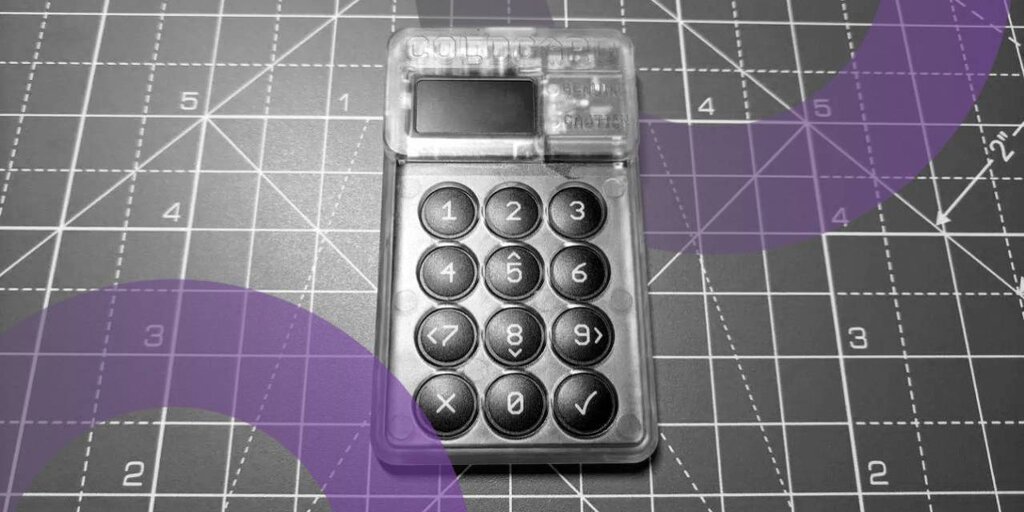
First, completely abandon wishful thinking and, where conditions permit, implement physical-level cold isolation.
According to Ansem's public statement, he initially suspected the attack was related to a Bullpen account into which a Solana private key had been imported; this is the judgment of the person involved, and the specific attack path remains to be confirmed.
Large long-term assets should not share the same set of hot wallet private keys with browser plugins and daily interactions. Offline key storage, checking transaction information on hardware wallets, and reasonably designing multi-signature permissions can reduce some operational and single-point theft risks; these measures themselves will not give existing signature algorithms quantum resistance.
Second, distinguish address types and reduce unnecessary public key exposure.
For P2PKH and P2WPKH addresses whose public keys have not been disclosed elsewhere, when funds are unspent, the chain usually shows only the public key hash, and the public key is disclosed only when spending. However, early P2PK outputs directly contain the public key, and Taproot (P2TR) outputs also publicly disclose the output public key, so one cannot judge everything by "it has never been transferred out." For specific structures, see Bitcoin's BIP 141 and BIP 341.
Avoiding address reuse helps reduce public key exposure for some address types, but "changing to a new address" is not a universal quantum-resistant solution. Google Quantum AI's research also distinguishes reducing address exposure from migrating to post-quantum cryptographic schemes. Hash protection can reduce certain attack opportunities, but it does not mean future quantum computing will be absolutely powerless against it.
Third, prepare for the worst in position allocation.
Never bet your life savings on the moral self-discipline of any single centralized entity, single founder, or even single smart contract. For Memecoins that rely on a single individual's reputation for support, gamble with spare money that can go to zero at any time; for core assets like Bitcoin that carry macro consensus, leave enough fiat cash flow buffer to cope with extreme volatility and systemic black swans.
True crypto faith is obviously not closing your eyes and praying that hackers and the quantum crisis will never happen.
It means you clearly see through human greed and the possible flaws of technology, yet still choose to sit at the table; but at the same time, you have already built the high walls of a bunker for your assets with your own hands, and fitted them with new locks that have never been exposed.
Don't gamble on anyone's morality, and don't turn a blind eye to any potential threat. In this era full of uncertainty, only those who have prepared for the worst have a chance to enjoy that future which is ultimately delivered.