



This article comes from: Kairos Research
Compiled by Odaily Planet Daily (@OdailyChina); Translator | Azuma (@azuma_eth)

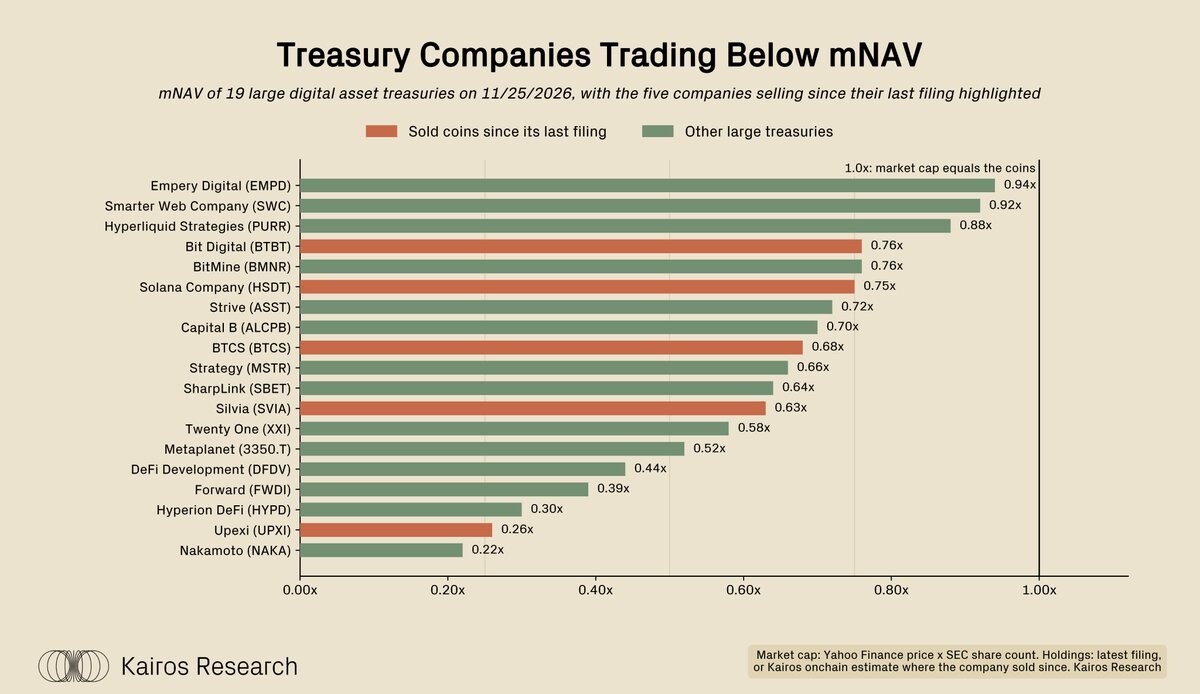
Some digital asset treasury companies appear to have begun selling their crypto holdings to help their mNAV (market cap to net asset value ratio) return to around 1.
Over the past few weeks, Silvia (SVIA, formerly ProCap Financial), Bit Digital (BTBT), BTCS (BTCS), Upexi (UPXI), and Solana Company (HSDT) appear to have collectively sold approximately 410 BTC, 57,300 ETH, and 986,000 SOL. Based on the prices on the days the tokens were transferred, these assets were worth approximately $203 million in total.
What these five companies have in common is that their current stock market valuations are significantly below their net asset values (mNAV less than 1). This makes it difficult for them to continue using the financing strategies that previously drove business growth, namely issuing more shares or taking on debt to buy more underlying crypto assets. The reason is simple — when a company issues shares at a price below the value of the assets it holds, the amount of assets corresponding to each share actually decreases rather than increases.
Analysis Method: On-Chain Tracing, Cross-Checking Against Past Records
Of the five companies, two have publicly acknowledged the relevant sales.
BTCS disclosed in an 8-K filing submitted on November 23 that the company sold approximately 27,300 ETH on November 20 to repay a $43.8 million loan on Aave.
Bit Digital disclosed in an 8-K filing submitted late at night on November 24 that the company sold 29,825 ETH between November 15 and 23, cashing out approximately $50 million and halving its loan size with Galaxy. By the time this announcement was published, we had already completed on-chain tracing of its sales activity.
The sales by the other three companies came from our own on-chain tracing. Our analysis method is to match each company's treasury wallets with its historical regulatory filings. Before classifying any recent fund transfer as a sale, we check whether the same wallets and sale paths can reproduce the company's previously disclosed transaction records.
This method has yielded good validation results:
- Silvia's third-quarter sales volume: on-chain tracing result was 320 BTC, exactly matching the 320 disclosed by the company.
- Bit Digital's third-quarter sales volume: on-chain tracing result was 1,625 ETH, exactly matching the 1,625 disclosed by the company.
- Solana Company's first-quarter sales amount: on-chain tracing result was $5.459 million, basically consistent with the $5.452 million disclosed by the company.
- Upexi: calculated by quarterly net sales volume, the discrepancy between the on-chain tracing result and the company's disclosed data is approximately 4,000 SOL.
It is precisely the consistency of these historical data that gives us reason to have high confidence in the fund flows of the same set of wallets after the most recent financial report disclosure.
Bit Digital's announcement was the first real-time test of this method. We had already discovered the relevant transactions through on-chain data before the company disclosed the sales, and the results were basically consistent.
Using on-chain data alone, we found that between November 15 and 21, 24,793 ETH were transferred out via Galaxy, accounting for approximately 83% of the 29,825 ETH later disclosed by the company. We estimated Bit Digital's remaining holdings at approximately 138,900 ETH-equivalent assets, while the company's latest disclosed figure was 134,532. In addition, we correctly identified the LsETH the company transferred to Galaxy in November: these assets were actually collateral provided for the loan. The collateral amount we traced was 69,088 LsETH, almost exactly matching the 69,089 disclosed in the company's announcement.

The Five DATs' Selling Scales Vary
Judging from the treasury sizes of each company, the impact of these sales varies considerably across companies:
- BTCS: sold nearly half of the ETH holdings it disclosed at the end of September.
- Solana Company: transferred approximately one quarter of its SOL to brokers and trading accounts, and none of the assets have returned to date.
- Bit Digital: sold approximately 18% of its ETH holdings.
- Upexi: sold approximately 15% of its SOL holdings.
- Silvia: sold 410 BTC, the lowest proportion of its holdings at approximately 8%. However, its selling behavior was the most regular — transferred out in nine batches of 35 to 80 BTC each, all paid to the same address, which had previously received all of Silvia's sale batches, and only Silvia's wallets had ever transferred to it.

It is worth noting that none of these companies sold assets directly through exchange order books. The relevant tokens were all transferred out via custodians, prime brokers' hot wallets, and over-the-counter (OTC) platforms, so these transactions did not leave obvious block trade records on public exchanges.
The specific paths are as follows:
- Silvia: One batch of assets was included in a 1,000 BTC transfer to a Cumberland DRW wallet.
- Upexi: On Sunday, November 15, it transferred 329,499 SOL into BitGo's shared hot wallet. Within the following 36 hours, that wallet sent out 352,530 SOL to trading firms and exchanges, including Wintermute, Kraken, Coinbase Prime, FalconX, Binance, and LMAX. That wallet typically holds only about 198,000 SOL, yet during these three days, Upexi provided 96% of all inflows into that wallet. In addition, none of these funds flowed to BitGo or any other lender, so these outflows could not have been completed without the participation of Upexi's assets, nor were they loan collateral.
- Solana Company: A large transfer of 465,976 SOL flowed to FalconX, and within one day an equivalent amount of assets entered deposit addresses at OKX and Kraken.
- Bit Digital: Galaxy Digital transferred out approximately 24,800 ETH through its hot wallet and moved it into Coinbase deposit addresses within three and a half days. Bit Digital has since confirmed that it sold this batch of ETH.


Main Reason for Selling: Balance Sheet Pressure
Judging from the timing of the transactions, these sales look more like the result of balance sheet pressure than a change in the companies' long-term views on the relevant crypto assets.
Specifically:
- BTCS: Sold assets when ETH fell to about $1,561 to reduce its borrowing on Aave.
- Solana Company: The day it began unstaking SOL coincided with the expiry of 390,000 SOL put options it had previously sold, which ended up deeply in the money, with an expected loss of about $12 million.
- Upexi: When it sold SOL, the SOL price had fallen to about $70, already close to the $67 level we estimated. At that price, the collateral ratio on its $57.3 million BitGo loan would hit 150%, at which point the lender could initiate a margin call. And the amount of SOL it actually sold was less than 1% away from the amount needed to restore that loan's 200% collateral ratio.
- Bit Digital: Began transferring out assets when the value of the ETH collateral for its $100 million Galaxy loan fell to about 131% of the loan amount. The company has now confirmed that the sale proceeds were used to repay half of the loan.
When a treasury company's stock price is below the value of the assets it holds, its own crypto assets become the most readily available source of cash. This is exactly the reality after the model of relying on equity issuance financing to continuously expand crypto asset holdings has run its course.
What Is More Worthy of Attention Is the Lag in Information Disclosure
For investors, what is truly worth paying attention to is the time gap between these transactions and the companies' public disclosures.
Silvia, Solana Company, and Upexi all filed their third-quarter 10-Q documents in November. These reports all included explanations of material events after the end of the quarter. Among them, Silvia and Solana Company disclosed information in the relevant explanations about share buybacks, new loans, and executive departures, yet neither mentioned the crypto asset sales that had already occurred before the filing; Upexi began selling assets two days after releasing its earnings report and has so far made no statement about it.
Bit Digital's disclosure approach provides a reference. The company's 10-Q filed on November 12 predated its sale, so on the day after the final batch of assets was transferred out, it disclosed the relevant transactions through an 8-K filing. This is also the standard that the other three companies have not yet met.
Taking Silvia as an example, its announcement disclosed that the company repurchased 6.1 million shares between October 1 and November 10, spending $24.4 million, but did not disclose that about 375 BTC had been transferred out of its treasury during the same period to fund the buyback.
Holdings data on public tracking platforms also shows similar lag. At present, these platforms still show that Silvia holds 4,965 BTC, while the actual holdings we tracked are about 4,625; the situation is similar for Phoenix Group, where public platforms show it holds 559 BTC, but its third-quarter financial report disclosed holdings of only 331.
Selling Coins to Buy Back Stock Is Not as Cost-Effective as It Seems
Buying back stock by selling crypto assets may improve mNAV far less than it appears on the surface. There is an unsettling math problem behind this. Let us analyze Silvia as an example.
- First, BTC holdings per share barely improved. The company sold BTC and canceled shares in almost the same proportion. As a result, its BTC holdings per million shares actually declined slightly, from about 62.2 at the end of September to about 61.8 on November 10.
- Second, the buyback price was actually close to net asset value, with no obvious discount. After deducting $99.6 million in convertible bonds, Silvia's cost of repurchasing shares was about 1 times its net asset value.
- Third, the mNAV discount the market sees may be overstated. Under the same debt-adjusted basis, Silvia's actual mNAV is about 0.98 times, not the 0.63 times shown in the first chart. This means the value space that share buybacks can create is far smaller than the surface data suggests.
- Fourth, there is less freely available BTC than it appears. According to the terms of its bonds, pledged BTC is valued at only half of its actual value. At current prices, of Silvia's approximately 4,625 BTC, about 3,420 must continue to serve as collateral. In addition, bondholders have the right in June 2027 to require the company to repay all $99.6 million of bonds at face value.
The Market Seems Not to Have Noticed These Sales
The stocks of these companies did not show obvious abnormal trading during the period when the sales occurred, which is consistent with the fact that the relevant transactions had not yet been publicly disclosed at the time.
Trading volume on the days of the sales was mostly at normal levels, or even below average. Since September 30, four of the five companies' stock prices have fallen significantly more than the crypto assets they hold, while Solana Company's stock price has basically tracked SOL. Therefore, these sales did not provide obvious support to the relevant stocks.
The only time window with an obvious abnormal stock price move was Bit Digital — during the process in which Galaxy transferred ETH to Coinbase, Bit Digital's stock price fell 15%, while ETH fell only 4% over the same period, and its performance was also noticeably weaker than its closest peers.
This Is Not an Isolated Case: About 25 Treasury Companies and Miners Have Disclosed Sales
Since mid-October, about 25 treasury companies and mining companies have disclosed crypto asset sales in filings submitted to the SEC, including:
- Complete liquidation: KULR, Hyperscale Data, and Rumble have sold all of their BTC holdings; GameSquare sold most of its ETH to repay ETH-collateralized bonds.
- Huge losses: Empery Digital sold 3,170 BTC this year, realizing a loss of $160 million.
- Miner sell-offs: MARA sold 13,597 BTC after the end of the third quarter to repay a $750 million Bitcoin-collateralized loan; Riot has sold 20,264 BTC this year.
What distinguishes the above five companies from the others is that sales by Silvia, Upexi, and Solana Company after September 30 may not appear in public documents until months later. This is because all five companies are non-accelerated filers and can use the longest financial disclosure deadline permitted by the SEC.
The key upcoming disclosure time points are expected to be as follows:
- Bit Digital: Mid-December. The company will release its November holdings update at that time. This is a company announcement rather than a regulatory filing, and it will confirm whether it continues selling beyond the 134,532 ETH-equivalent holdings disclosed on November 23.
- Upexi: Around February 10, 2027 (deadline February 16). The company's first filing that must disclose the relevant transactions will be its 10-Q for the period ending December 31, at which point it will report sale proceeds and year-end SOL holdings.
- Silvia: Around mid-February 2027 (deadline March 31). The company filed its 10-K annual report on February 18 last year.
- Bit Digital, BTCS and Solana Company: Late March 2027 (deadline March 31). Solana Company has previously used a 15-day extension, so its 10-K annual report may be delayed to around April 15.

However, before these disclosure dates arrive, on-chain fund flows are likely to change further.
On November 24, Solana Company began unstaking 218,539 SOL, worth about $14.5 million, from the Anchorage margin vault. This is exactly the same operation it took four days before its previous large SOL transfer to FalconX.
Meanwhile, Upexi still has 139,870 unstaked SOL in one wallet, and another 30,000 SOL has been held at BitGo since November 20.
The next batch of sellers may be companies facing loan liquidation pressure
The next most likely sellers of crypto assets are those treasury companies whose lenders can force them to make a decision.
Once a crypto-backed loan triggers a margin call, it creates a price threshold at which selling assets shifts from an option to a necessity. At the same time, a lower mNAV closes off the channel of obtaining cheaper financing by issuing more shares.
Companies worth watching currently include:
- Nakamoto (NAKA): It borrowed 165 million USDT from Kraken using 3,030 BTC as collateral. At current prices, this BTC covers the loan by only about 1.07x, of which 105 million USDT matures on June 30, 2027.
- Upexi: As of the end of September, the company owed BitGo $57.3 million. This loan can be recalled with 30 days' notice and triggers a margin call when the collateral ratio falls to 150%. In addition, the company's $150 million bond matures on July 16, 2027, at which point it must deliver 962,955 SOL to holders.
- Solana Company: The company signed a new loan agreement with Maple on November 11, which includes margin and liquidation clauses. Meanwhile, as of the end of September, the company had only about $1.1 million in cash, and its options trading had already generated losses.
- Forward Industries (FWDI): On November 16, the company borrowed $50 million from Erebor Bank using SOL held at BitGo as collateral, in addition to a loan from Galaxy.
- Metaplanet: As of the end of September, its borrowings were equivalent to 17.7% of its BTC holdings, exceeding the company's own 10% guideline. In the third quarter, the company sold 10,000 BTC while repurchasing 11,000 BTC to demonstrate that it could obtain cash through financing comparable to the scale of the sale.
On-chain tracking still has limitations, and actual sale scale may be larger
Of course, this research still has some parts that cannot be fully confirmed.
First is the roughly $33 million in assets transferred out by Solana Company. This SOL transferred through FalconX could theoretically still be collateral or SOL lending rather than a direct sale. But the company's own 10-Q filing shows that its options margin and the collateral for its new loan with Maple are held in custody accounts opened in the company's own name, rather than transferred directly to counterparties. In addition, within eight days after the funds were transferred out, no assets returned. Therefore, we classify it as a probable sale with medium-high confidence.
Second is BitGo's shared hot wallet. This wallet serves all BitGo customers, so our judgment about Upexi's selling behavior is an inference rather than a transaction that can be directly tagged. However, the relevant data shows that no other customer deposited more than about 14,000 SOL into that wallet over that weekend, and it would also have been impossible for the wallet to complete the actual transfer without Upexi's assets being involved. In the ten days thereafter, no related assets returned.
Finally, sales within custodians cannot be directly observed through on-chain data. Therefore, the total sales we tracked can only be regarded as a lower bound, and the actual scale may be higher.
In addition, these actions do not necessarily mean the companies violated relevant regulations. Whether selling part of treasury assets constitutes a material event beyond the company's ordinary course of business and thus requires an 8-K filing is itself a matter requiring case-by-case judgment. But this data at least shows one thing — for these companies, on-chain tracking can now reveal asset changes weeks or even months earlier than regulatory filings.
We will continue to track these wallets in real time and continue to publish research results when relevant token transfers occur and the companies have not yet issued formal disclosures.