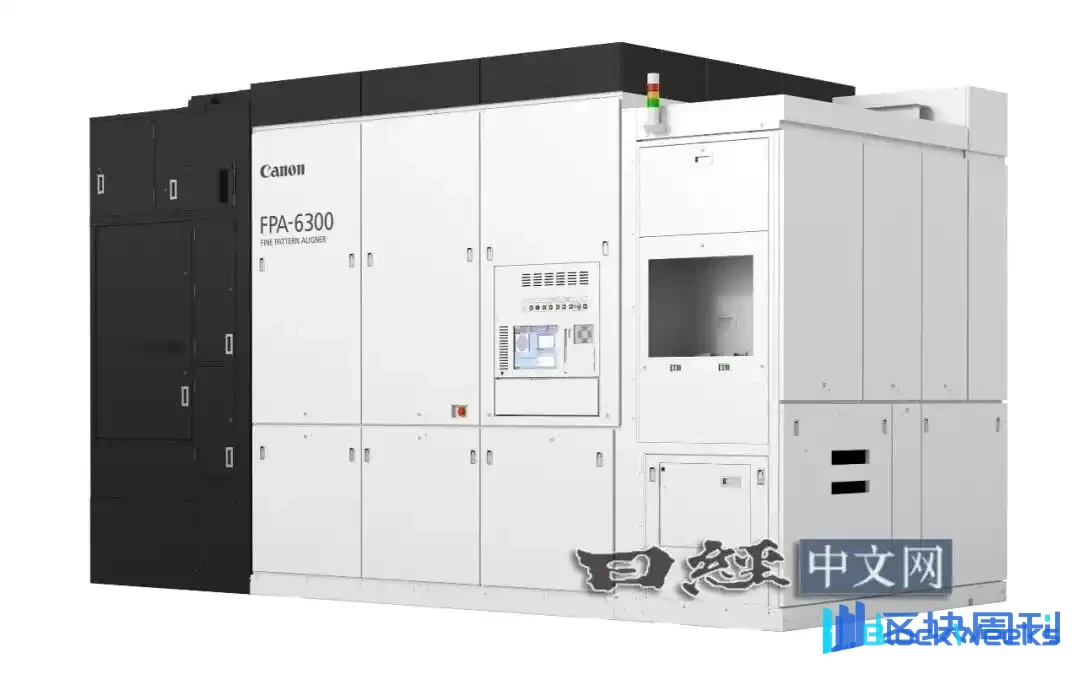

Canon announced on November 24 that it will re-enter the market for "ArF (argon fluoride) lithography machines" used for forming semiconductor circuits. The new product is the first in 24 years since 2002. Supply and demand for equipment from the largest manufacturer, Netherlands-based ASML Holding, is tight, and Canon is also seeing a business opportunity.

It will begin accepting orders for ArF dry lithography machines in early December. The equipment can support circuit formation with a minimum line width of about 65 nanometers (one nanometer is one billionth of a meter), and can be used for mass production of some memory manufacturing processes, power semiconductors, and sensors. The equipment will be produced at Canon's Utsunomiya Plant.
Canon had previously lost out in sales competition with ASML and stopped accepting orders for ArF lithography machines in 2007. Since then, the company has been engaged in the business of "KrF (krypton fluoride) lithography machines" and "i-line lithography machines," which are earlier technology generations than ArF.
Based on its existing KrF equipment, Canon developed ArF equipment that uses a light source with a shorter wavelength. The company says that the new equipment has an operating method similar to existing equipment and has advantages in operating rate and cost competitiveness.
Canon and Nikon once held high market shares in the lithography machine field. However, after entering the 2000s, ASML surpassed Japanese companies in the development of advanced equipment. According to data from Japan's Ministry of Economy, Trade and Industry, ASML holds a global share of more than 90% in the lithography machine market.
Currently, demand for semiconductors for artificial intelligence (AI) data centers is continuously expanding, and ASML's pace of increasing production capacity is difficult to keep up. ASML Chief Financial Officer (CFO) Roger Dasse said in October that it cannot fully meet customer demand.
ASML's tight supply and demand will become an opportunity for Canon to win customers. Canon will use equipment price and operating cost advantages as selling points and strive to regain market share.
Canon said that in view of existing customers' requests for high-performance equipment, it decided to bring the product to market.
Canon plans to increase sales in its "Industry" division, which serves semiconductor and display equipment, to 600 billion yen (approximately RMB 25.215 billion) by the fiscal year ending December 2030, 1.6 times that of the fiscal year 2025. The company launched "nanoimprint equipment" in 2023, which forms circuits by using a circuit master like a stamp, and is also targeting demand for advanced semiconductors.
U.S. media outlet The Information reported that Chinese companies have also begun producing lithography machines with certain performance. If Chinese companies' independent production capacity continues to expand, they may become strong competitors to Canon.
This article is from the WeChat public account "Nikkei Chinese Website" (ID: rijingzhongwenwang), author: Nikkei Chinese Website