
Key Points
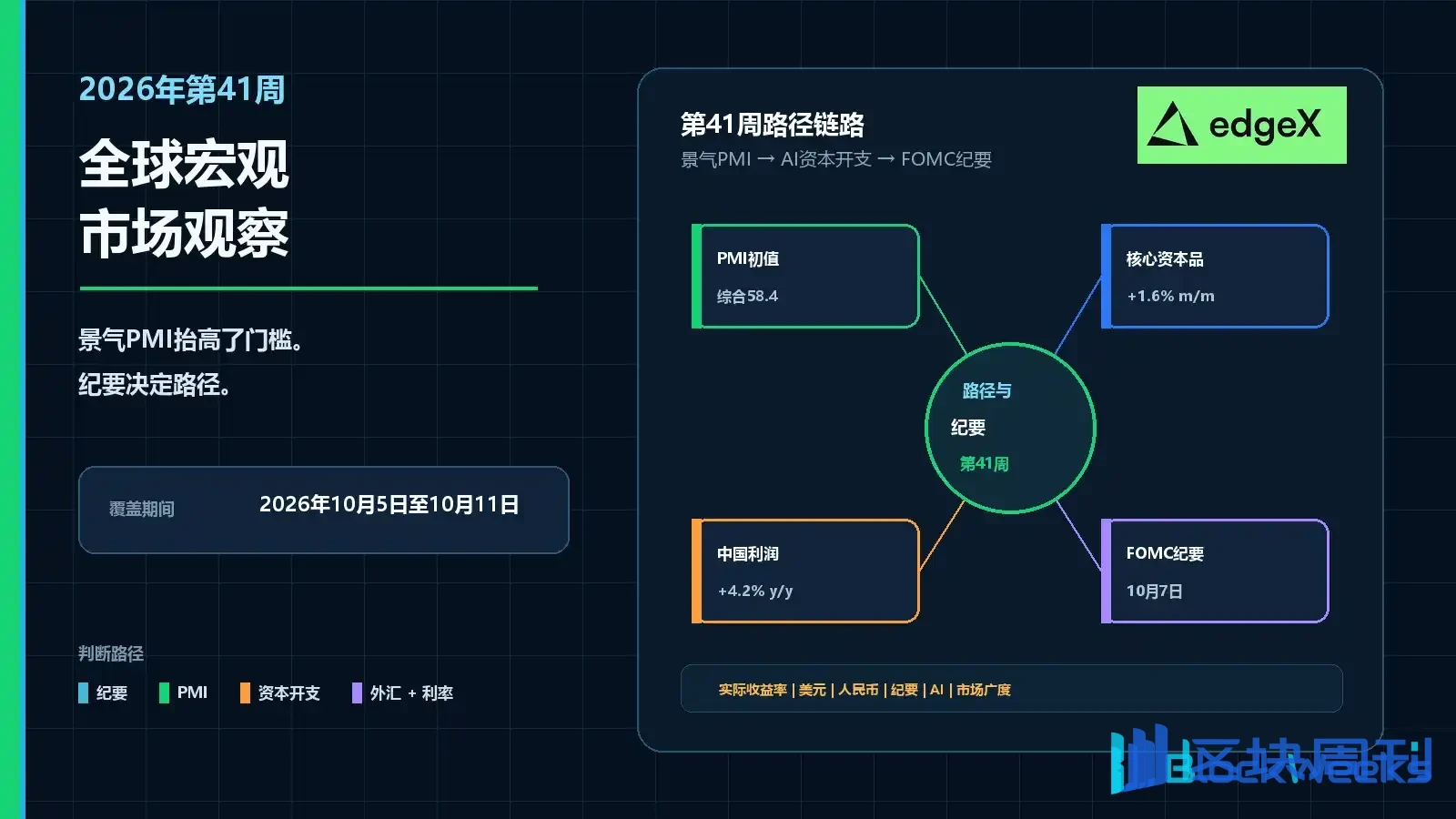
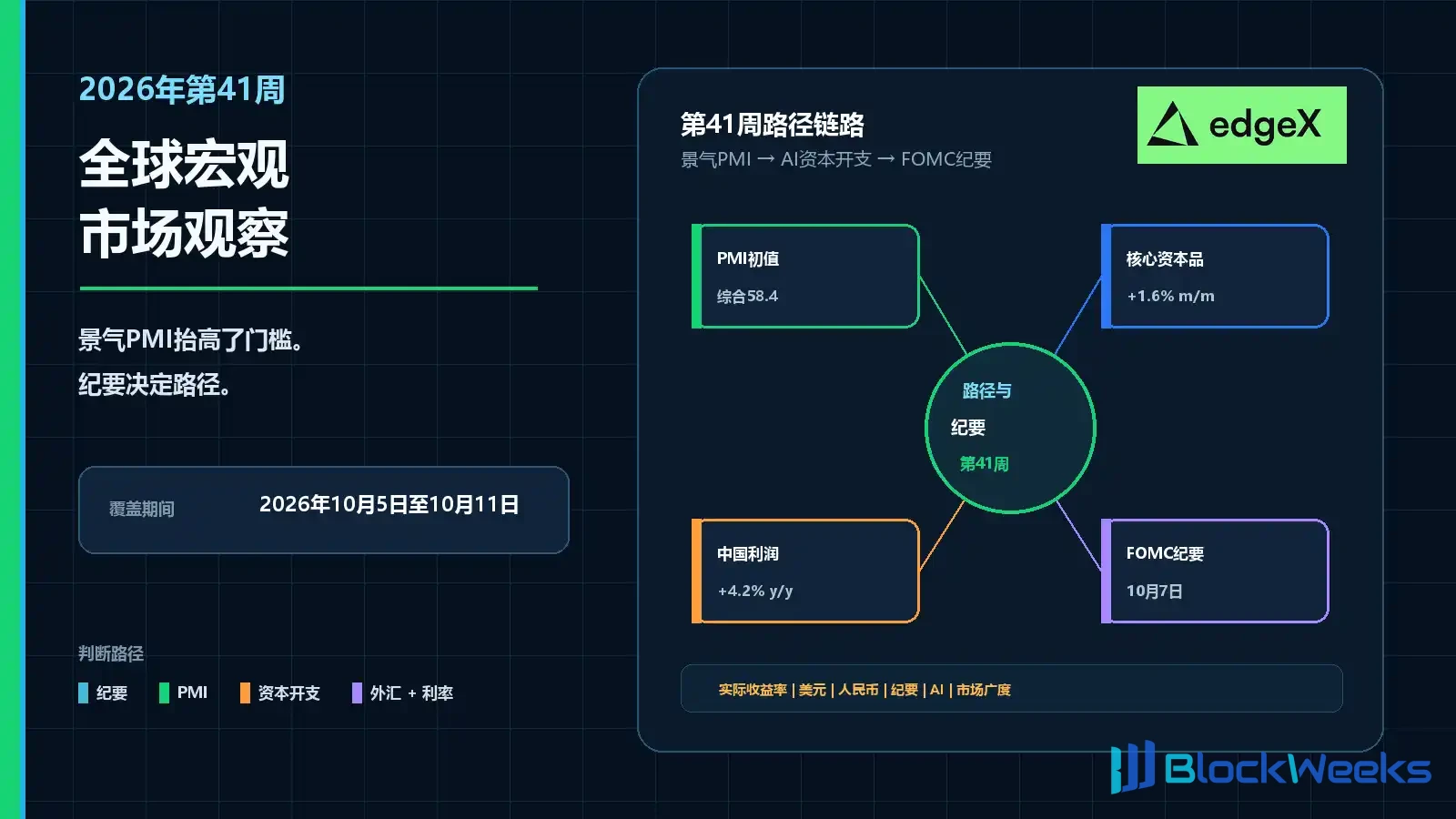
· Week 41 covers October 5 to 11, 2026. The core U.S. data point is the minutes of the September 15-16 FOMC meeting released on October 7; that meeting was the Fed's first rate hike in more than three years. The same week also includes euro area retail sales and import price data, Japan demand and regional economic reports, and clues on production chain price pressures in China.
· Week 39 left a stronger demand and bottleneck baseline for the minutes release window. The S&P Global U.S. composite PMI preliminary reading jumped to 58.4, manufacturing PMI rose to 57.0, new orders rose to 58.2, and the input price paid index climbed to 66.4 as delivery delays spread. The euro area composite PMI also strengthened to about 53.1.
· August durable goods orders were flat, but core capital goods orders excluding aircraft jumped 1.6% month over month and 10.6% year over year. This is exactly the AI equipment boom. At the same time, the University of Michigan consumer sentiment index fell to 48.1, and one-year inflation expectations rose to 4.6%.
· BEA data showed that the second-quarter current account deficit widened to $246 billion. At the start of Week 40, China's August industrial enterprise profits growth slowed to 4.2% year over year from 11.2% in July.
· As of the September 28 production cutoff, Week 40 JOLTS, August PCE, the third estimate of second-quarter GDP, China's official PMI, and September nonfarm payrolls were still incomplete. Week 41 should test whether the minutes will lock in another rate hike into the late-October dense G3 policy period, rather than treating the unfinished Week 40 data as established fact.
· Real yields, the dollar, EUR, JPY, CNH, AI-related equities, industrial metals, and front-end rate hike probabilities may all see path noise. Do not bet on a clear one-way trend unfolding based only on the U.S. meeting minutes.
Quick Conclusion
Week 41 is a global policy path week, not a U.S.-only observation. Week 39 delivered multi-year high U.S. PMI preliminary readings, an improvement in the euro area composite PMI to about 53.1, hotter corporate price pressures, and another round of AI-heavy capital goods rebound. If the October 7 minutes treat this "boom plus bottleneck" combination as a reason to continue tightening, real yields, the dollar, and late-October rate hike probabilities will remain firm, while EUR, JPY, and CNH will trade around spillover effects. Conversely, if the minutes emphasize two-sided risks after flat overall durable goods, a widening current account deficit, and slowing Chinese industrial enterprise profits, the market will gain more room to digest as long as the unfinished Week 40 PCE, employment, and China PMI data do not overheat. When assessing Europe's October 5 retail sales and import price data and Japan's October 7-8 demand reports, they should be placed alongside the U.S. meeting minutes, not viewed only after the minutes.
Why Week 41 Is a Test of the Minutes and the Policy Path
Week 38 brought the Fed's first rate hike in more than three years, and that action itself already pushed the market from a discussion of "whether to turn to tightening" toward a pricing framework of "how far tightening will go." Then Week 39 answered the market's questions about policy digestion capacity in a more hawkish way: private-sector activity was not cooling, but accelerating; supply chains were not easing, but tightening again; AI-related equipment orders remained firm, showing that a portion of corporate capital expenditure demand is still quite resilient even as consumer confidence weakens and anxiety rises. Week 40 was supposed to be the first relatively clear dual test of inflation and the labor market, using clues such as JOLTS, August PCE, the third estimate of second-quarter GDP, China's official PMI, and September nonfarm payrolls to calibrate the real restraining effect after the rate hike, but as of the September 28 cutoff, these key data had still not fully landed, and the market could not directly confirm with a new data set whether policy was already tight enough. Week 41 therefore does not wait for the next rate decision to give direction, but instead compresses the question in advance into a more direct path test: after evidence of PMI boom, renewed input prices, and still-present capacity constraints, will the September meeting minutes push the policy discussion toward another rate hike path and make late-October risk part of the baseline scenario again?
It is necessary to trade in stages rather than concentrating all reactions on the same event. A rate decision can quickly reprice front-end yields in one afternoon because it changes the current policy rate level and the immediate probability of the next move in the short-end curve; but a more durable policy stance must be confirmed by the minutes, because the minutes show how officials interpret the data, how they weigh risks, and whether they view one rate hike as a one-off adjustment or as the starting point for reopening a longer policy path. The key is not only that officials saw strong demand and rebounding price pressures, but whether they treat demand and upstream price pressures as a nearly one-sided inflation problem; if so, the market needs to continue leaving a more hawkish premium for front-end yields and USD. Conversely, if the minutes still give sufficient weight to China's profit margin pressure, factory risks, and external balances, indicating that policymakers have not completely ignored cracks in global demand and downside transmission in the manufacturing chain, the rate path may depend more on subsequent data confirmation. Week 41 is here precisely to test this second stage: not to re-judge what the Fed has already done, but to judge whether officials' narrative is enough to extend one rate hike into a policy route for the next rate hike.
The Week 39 Boom Raises the Bar Again
The preliminary PMI combination released on September 23, reported in a Reuters summary published via KELO, appeared after the Fed had already raised the federal funds rate range to 3.75% to 4.00%, so its significance to the market is not simply proving that the economy is still okay, but testing whether demand has really been suppressed after the rate hike. The composite PMI at 58.4, manufacturing PMI at 57.0, and input prices at 66.4 together left the market with three still-effective messages: first, demand still matters, and the pace of private activity expansion is enough to make policymakers worry that aggregate demand has not been sufficiently constrained by rates; second, capacity constraints are taking effect, and tightening supply chains will transmit order strength more quickly to delivery, inventories, and costs; third, corporate inflation risk has reappeared, and higher input prices mean price pressures may first accumulate in the production chain and then transmit to profit margins, final prices, and inflation expectations. Precisely because this evidence occurred after the rate hike, the bar for Week 41 has been raised again: the market must judge whether the minutes will interpret this combination as a green light for another rate hike before late October, or merely as a strong data sample requiring continued observation. For investors, the difference lies in whether front-end yields continue to be revised upward, whether USD retains policy spread support, and whether risk assets need to re-digest the combined pressure of "growth still strong but rates also higher."
Week 41 Global Macro Calendar
Date | Region | Scheduled Event | Why the Market Cares |
October 5 | Eurozone | August 2026 industrial import prices and retail trade | Testing whether European goods and store demand still support the Week 39 PMI rebound. |
October 5 to 11 | United States | Weekly initial jobless claims and secondary high-frequency data | Continuing to track the labor market and demand between nonfarm payrolls and CPI. |
October 7 | United States | FOMC minutes of the September 15-16 meeting | After the PMI boom and AI capital spending, providing the first full written record of the first rate hike in more than three years. |
October 7 | Japan | BOJ consumption activity index | Providing clues on Japanese demand on the same day the U.S. minutes reset the rate hike path. |
October 8 | Japan | BOJ Regional Economic Report | Testing whether Japan's regional demand picture still supports the yen trend after the rate hike. |
October 9 | China | National Bureau of Statistics late-September producer goods price report | After the early reference from industrial enterprise profits released around September 28, providing an early check on price pressures in China's production chain. |
October 14 | United States / China | U.S. CPI; China September 2026 CPI and PPI | Adjacent inflation checkpoints in Week 42 after the minutes set the path debate. |
October 15 | United States | September 2026 retail sales and PPI | Testing whether consumer demand and upstream price pressures still support the Week 39 boom. |
October 28 to 30 | United States / Eurozone / Japan | FOMC rate decision; ECB monetary policy meeting; BOJ monetary policy meeting | The next G3 live policy-intensive period after the minutes window. |
FOMC Minutes Reset the Post-Hike Reaction Function
The Federal Reserve FOMC calendar, the October 2026 U.S. data release calendar, and the minutes release schedule tool all point to the same moment: the minutes of the September 15-16 FOMC meeting will be released at 2 p.m. Eastern Time on October 7. For Week 41, the significance of this release time is not just a routine calendar disclosure, but the cleanest and most direct policy catalyst the market can get after the sudden strengthening of demand momentum in Week 39 and before the intensive G3 central bank decision period in late October. In other words, the minutes will help investors recalibrate the post-hike reaction function: whether officials view the latest demand resilience as an inflation risk that needs to be further suppressed, or still believe policy is sufficiently restrictive and subsequent judgments must wait for more data confirmation. This week's macro clues are also not only about the United States. Eurostat will release eurozone retail trade and import prices on October 5, which will affect the market's judgment on eurozone domestic demand, imported price pressures, and ECB policy constraints; the BOJ schedule shows that Japan's consumption activity index will be released on October 7 and the Regional Economic Report on October 8, and the related information will enter the pricing of the JPY rate curve and BOJ policy expectations; China's National Bureau of Statistics calendar schedules the late-September producer goods price report for October 9, which will provide a supplement for the market to observe China's price transmission, the absorption capacity of the industrial chain, and the impact on external commodity demand. Therefore, although these minutes come from the Federal Reserve, they will be interpreted within a cross-market framework composed of the dollar, the G3 policy rhythm, eurozone price signals, Japanese domestic demand observations, and Chinese producer goods prices.
The reason the meeting minutes matter is that after the rate hike, the data landscape no longer remains in the state it was on the day of the meeting. By the time officials completed the tightening, Week 39 had not yet delivered a set of subsequent signals: stronger preliminary PMI readings, rising corporate price pressures, and another jump in core capital goods orders. These data changed the market's marginal assessment of demand, capacity, and the resilience of corporate investment, and also forced investors to re-examine how the FOMC weighed growth against inflation at the meeting. If the minutes show that officials' discussions were clearly hawkish and based their policy judgments more on capacity tightness, upside demand risks, and the possibility that price pressures could persist, then the transmission path is relatively clear: the market will tend to believe that restrictive rates need to be maintained for longer, the front end and real yields will more easily find support, and the USD will strengthen due to repricing of interest rate differentials and safe-haven attributes. Conversely, if the minutes' tone is more balanced, even while still acknowledging that inflation risks have not been resolved, and also emphasizes two-way risks surrounding the factory sector, external balance, and China's absorption capacity, then the policy implication is not simply adding a hawkish premium, but pushing the October 28 decision back into a data-dependent framework. The key here is not whether the minutes repeat phrases like "risks remain," but how it arranges the evidence, how it describes policy lags, and how it explains the trade-off between strong demand and potential slowdown. For investors, the minutes will affect not just the immediate reaction of the day, but the policy path probabilities on which front-end rates, real yields, USD, and risk asset valuations jointly depend; if the text confirms that the FOMC is more worried about overheating than downside, the market will more easily accept a higher real discount rate; if the text retains more two-way risks, trading will place more emphasis on whether subsequent CPI, PPI, PCE, and employment data can continue to support hawkish pricing.
The meeting minutes will be interpreted together with the not-yet-completed Week 40 confirmation data
By the time the meeting minutes are released, the market should have already received the Week 40 set of confirmation data that is not yet complete but sufficient to change the interpretive context: JOLTS, the August PCE on the BEA release schedule, the third estimate of Q2 GDP, China's official PMI, and the September nonfarm payrolls on the BLS calendar. Using September 28 as the cutoff, these cannot yet be written as completed Week 40 retrospective facts; but at the trading level, they will enter prices before the minutes and determine the reference frame when the market reads the minutes. If August PCE is hotter, or if September nonfarm payrolls show labor demand still overheating, traders will more easily interpret hawkish language in the minutes as effective confirmation of the subsequent policy path, and front-end yields and USD will more easily rise in tandem. If the labor market softens, job openings or wage-related signals cool, or core PCE shows price pressures easing, then the same hawkish minutes would require stronger textual evidence to push the market to continue adding to tightening expectations. The third estimate of Q2 GDP will help calibrate the growth backdrop, while China's official PMI will affect judgments on external demand, the manufacturing chain, and China's absorption capacity, all of which will feed back into how the market understands the FOMC's statements on the factory sector and external balance risks. Therefore, the minutes cannot be traded in isolation as a single event, let alone by looking only at the direction of the US stock market at the open. A more prudent approach is to observe the minutes together with front-end yields, real rates, and the dollar on the same chart: if the text is hawkish and yields and USD confirm in sync, it indicates that policy path repricing is occurring; if the text is hawkish but front-end yield reaction is limited, or the dollar fails to extend its strength, it indicates that Week 40 data has already weakened the marginal impact of the minutes. For stocks and risk assets, what truly needs to be tracked is how this policy signal transmits through discount rates, earnings cycle expectations, and global dollar liquidity, rather than compressing attention to a single stock market open.
PMI boom and AI capital expenditure sustain demand vitality
The survey and order data already completed in Week 39 explain why the focus of Week 41 cannot be simply viewed as a technical US meeting minutes event. The key message from the S&P Global US preliminary PMI combination is that the private sector did not cool down after the rate hike, but instead showed accelerating activity. New orders rose to 58.2, indicating that demand is still expanding, and the expansion is strong enough to change the market's assessment of the impact of tightening; input prices reached 66.4, indicating that cost pressures and supply bottlenecks have not simultaneously subsided. In other words, the post-hike discussion is no longer just "whether policy has already suppressed growth," but has become a combined problem of still-strong demand, still-present bottlenecks, and price pressures that could still be re-amplified. The euro area composite PMI also strengthened to about 53.1, making this round of developed-economy rebound not just a US-only story; even though the US still leads, the improvement in European data makes it harder for investors to dismiss global demand resilience as local noise.
The Census durable goods report and the Reuters capital goods summary published via KELO subsequently made factory data show finer differentiation, rather than giving a one-directional recession signal. Overall durable goods orders were about $338.6 billion, unchanged after July's increase was revised to 0.9%, indicating that headline goods orders did not continue to rise across the board, but also did not show a cliff-like decline. More importantly, core capital goods orders excluding aircraft jumped 1.6% month-on-month and 10.6% year-on-year, with computers and communications equipment still strong. This means that within the flat overall goods data, there is still a capital expenditure mainline driven by AI-related investment and equipment purchases. In other words, the manufacturing signal is not a broad factory collapse, but a surface-level flattening of the total with an internal structure clearly skewed toward tech equipment and corporate investment. For the market, this combination will weaken the narrative that "high rates have already quickly crushed real demand," and will also cause rates, the dollar, and equity valuations to reprice around growth resilience and inflation stickiness. The October 5 euro area retail trade and import price data in Week 41 therefore have a validating role: they will test whether European demand clues are still sufficient to support a broader PMI rebound; meanwhile, the FOMC meeting minutes will set the policy tone for the dollar path, determining whether strong demand and price pressures are interpreted by the market as support for a soft landing or as a reason for more hawkish rate expectations.
Confidence weakens while inflation expectations rise
The University of Michigan's final September consumer sentiment index fell from 51.7 to 48.1, showing that households' feelings about the economic outlook and their own financial situation have clearly weakened. At the same time, one-year inflation expectations rose from 4.0% to 4.6%, indicating that consumers are not only more anxious but also raising their judgments of short-term price pressures. This combination forms a sharp contrast with corporate surveys: businesses report booming orders, especially with support from AI and equipment-related investment; households appear more cautious amid rising inflation expectations. In terms of market transmission, this divergence is crucial because it allows capital expenditure and tech investment to continue supporting growth expectations, while also increasing policymakers' sensitivity to inflation expectations becoming unanchored again. If the FOMC meeting minutes have a hawkish tone, investors may on the one hand continue to acknowledge the resilience of AI-related investment, while on the other hand repricing the policy rate path tighter. Combined with the not-yet-completed Week 40 labor data that has not eliminated slowdown risks, the market will face two pulling clues simultaneously: one is that orders and capital expenditure support demand, the other is that weakening household confidence and employment uncertainty keep growth fears active.
External balance and China's profit margins still weaken the simple boom narrative
The BEA international transactions release showed that the US current account deficit widened by $33.4 billion in Q2, an increase of 15.7%, to $246 billion. On timing alone, this is not a catalyst that can immediately change the trading direction in Week 41, because the market's more direct focus remains on the US policy signal itself. But this data cannot be simply set aside: when the meeting minutes reopen the discussion of the rate hike path, the widening current account gap will re-enter the core of dollar pricing and the "twin deficits" debate. Its implication is not only that US external financing needs have risen somewhat further, but also that if rate expectations are revised further upward, the tension between capital inflows, dollar interest rate differential support, and fiscal and external imbalances will be simultaneously brought to the table. In other words, it will not trigger Week 41 market action on its own, but after the FOMC minutes bring the possibility of a rate hike back into the main line, it will become an important background variable explaining dollar resilience, risk asset valuation pressure, and a macro narrative that is not clean enough.
China is another part of the global boom story that remains incomplete. At the start of Week 40, the National Bureau of Statistics industrial enterprise profit data package, combined with the NBS 2026 release calendar, showed that August industrial enterprise profits rose only 4.2% year-on-year, significantly below July's 11.2%; cumulative growth from January to August also slowed from 17.6% to 15.7%. This does not overturn the fact that profits in tech manufacturing remain extremely strong, but it shows that the earnings recovery has not spread evenly to the broader corporate sector. In contrast, consumption-related categories continue to lag, meaning there is still a disconnect between the factory side, the tech chain, and household demand. For global macro trading, the issue is not whether Chinese data is completely weak, but that the structure of "strong manufacturing, weak consumption" will weaken a smooth global reacceleration narrative: if end demand cannot keep pace, the transmission of improved industrial profits to imports, metals demand, Asian equities, and CNH sentiment will be more conditional and more sector-selective. Therefore, this data set is better viewed as an early adjacent baseline near the start of Week 40, rather than a completed Week 40 retrospective. The September 30 official PMI was still not fully available at the cutoff, and it will need to be put back into the same factory-versus-household divergence framework to test whether production-side resilience is confirmed by demand, or continues to show imbalance among profits, orders, and consumption.
Transmission still runs through EUR, JPY, CNH, metals, and AI cyclical stocks
If the meeting minutes push the market to more firmly lock in a path of further rate hikes, while China's profit margin signal is simultaneously soft, CNH, copper, and Asia-related equities will hardly be upgraded in risk appetite together as in a pure US boom scenario; they are more likely to enter selective pricing. The key to the transmission chain is: upward revision of US rate expectations will support USD and real rate pressure, while insufficient profit diffusion in China will weaken demand confirmation for industrial metals, regional export chains, and cyclical stocks. Combined, investors will place more emphasis on which assets truly benefit from AI capital expenditure, tech manufacturing profits, and external orders, rather than broadly chasing Asia or cyclical exposure. Japan's same-week release of consumption activity indices and regional economic reports will therefore also affect JPY trading before the October 29-30 BOJ meeting, because they relate to whether Japan's domestic demand and regional business conditions can provide more basis for policy normalization expectations. Europe's October 5 retail and import price data are equally important: the former relates to whether EUR can gain support from the demand side, the latter relates to price pressures and the real income backdrop, and also to whether there is real goods demand behind the Week 39 euro area PMI rebound, rather than just a temporary survey-level repair. Week 41 does not need any single region to overwhelmingly dominate all markets; what is truly needed is that around the October 7 US policy release, Europe, Japan, and China all exist as real-time risk filters, used to judge whether the US rate hike narrative will spill over into a globally synchronized expansion trade, or will form a more differentiated market reaction within CNH, JPY, EUR, metals, and AI cyclical stocks.
Week 39 review: activity boom, tightening bottlenecks, capital expenditure still skewed toward AI
Week 39, from September 21 to 27, is the latest complete weekly observation window that can be included in the September 28 production cutoff. The core message from that week is not complicated, but it is not mild for market pricing: the digestion period after the previous rate hike did not push demand into a clearly cooling state. Instead, private sector activity continued to accelerate, indicating that corporate orders, production, and service demand remain resilient; at the same time, price pressures in the survey measures reaccumulated, meaning the chain between strong demand, tight capacity, and cost pass-through has not broken. AI-related equipment orders remained firm, continuing to support the most dynamic part of capital expenditure; but consumer sentiment weakened, again signaling that households are more fragile in their feelings about inflation, interest rates, and income prospects. Therefore, this is not a simple growth-improvement signal, but a combination of "hotter activity, tighter bottlenecks, and policy harder to turn dovish quickly."
这一周的中心是9月23日。S&P Global美国综合PMI初值从56.0升至58.4,为2021年7月以来最高,显示私营部门扩张速度不仅没有回落,反而重新加快。制造业PMI从53.9升至57.0,说明改善并非只来自服务业,工厂端也在同步走强。新订单跃升至58.2,进一步表明需求端仍在向企业生产计划施压;供应商延迟达到2022年7月以来最广泛程度,则把这种需求强度转化为供给侧摩擦和交付瓶颈。投入价格支付指数飙升至66.4,为2022年10月以来最高,意味着企业面对的成本压力已从单纯的活动改善,推进到更明确的价格再加速信号。S&P Global把产能紧张和交付延迟部分归因于中东冲突,并显示价格压力正通过商业调查渠道重新积聚:冲突扰动、运输和交付延迟先影响供应链效率,再通过投入成本和企业报价预期进入通胀风险。欧元区综合PMI也走强至约53.1,因此即便美国仍然领先,发达经济体扩张也在变宽;这让全球增长图景更有支撑,但也削弱了市场押注需求自然降温、通胀压力自动回落的简单逻辑。
9月24日至25日补充了外部收支和工厂细节。BEA报告称,第二季度经常账户赤字在扩大334亿美元后达到2460亿美元,显示美国外部融资需求和贸易、收入收支缺口仍是宏观组合中的拖累项。Census耐用品订单持平,表面上看工厂订单并未全面扩张,但更能反映企业设备投资意愿的剔除飞机核心资本品订单跃升1.6%,同比增长10.6%,把信号从总量平淡转向结构性强劲。计算机和通信设备仍然承载AI投资叙事,说明AI相关资本开支并未因利率高企或周期不确定而明显退潮,而是在设备投资中继续提供支撑。与企业端形成反差的是,密歇根大学消费者信心指数降至48.1,一年期通胀预期升至4.6%,使家庭比企业更焦虑;居民对价格和前景的担忧上升,会限制风险偏好,也会让政策制定者更难忽视通胀预期的再抬头。围绕近期再次加息概率约68.6%的市场定价,仍是同一周政策背景的一部分,因为强PMI、价格调查回升和核心资本品坚挺共同提高了市场对进一步紧缩风险的敏感度。
截至9月28日截止点,已经完成的第39周记录以及第40周开局前后公布的中国工业企业利润这一早期参考留下四条仍在生效的信息:美国私人需求正在繁荣,瓶颈和企业价格压力重新出现,AI相关资本开支仍在支撑设备投资,中国利润率压力与更宽的美国外部赤字使全球组合难以显得干净。换言之,增长端的强劲并没有自动转化为对风险资产完全友好的背景,因为同一组数据也意味着通胀黏性和政策利率路径存在上行风险。PMI繁荣和坚挺的核心资本品,提高了任何由会议纪要引发、需要简单暂停叙事来支撑的宽慰性反弹的门槛:如果投资者要押注政策很快停止收紧,就必须解释为什么企业活动升温、供应延迟扩散和投入价格再上行不会重新压迫FOMC的反应函数。整体耐用品持平、消费者信心走弱以及中国利润放缓,则在尚未完成的第40周PCE或就业数据令人失望时,继续打开双向风险通道;一边是强需求和价格压力可能推高收益率与USD,另一边是家庭信心、外部赤字和中国利润压力可能放大增长担忧,使市场在增长韧性与政策风险之间保持拉扯。
跨资产决策图
第41周组合 | 加密货币 | 股票 | 大宗商品 | 外汇和利率 |
PMI繁荣且核心PCE/就业坚挺后,会议纪要偏鹰 | 实际收益率上升和流动性收紧,压制杠杆型加密货币头寸。 | 久期较长和高贝塔股票表现落后;AI龙头仍可能分化。 | 黄金面临收益率阻力;工业金属消化利率风险。 | 实际收益率和USD上升;10月28日前端加息概率走强。 |
会议纪要均衡,尚未完成的第40周通胀/劳动力数据降温 | 路径噪音下降,在现货需求确认时可支撑BTC和ETH。 | 如果周期股参与超越AI巨头,市场广度可能改善。 | 工业金属受益于消化过程;黄金取决于实际收益率。 | USD选择性走软;前端波动消退。 |
会议纪要仍偏鹰,同时中国利润率/PMI恶化 | 即便美国AI仍坚挺,亚洲避险也可能打击高贝塔加密货币。 | 对中国敏感的跨国公司和工业出口商落后。 | 铜及相关金属因吸收风险走弱;能源维持双向。 | CNH走软;商品货币分化;避险USD需求可能延续。 |
PMI繁荣后劳动力转软,且会议纪要仍显示双向风险 | 利率路径缓和只有在去杠杆不占主导时才有帮助。 | 盈利修正和利润率风险成为核心;防御板块可跑赢周期板块。 | 黄金可跑赢工业大宗商品。 | 曲线可能扭曲;USD和JPY中的政策路径不确定性仍然偏高。 |
什么能确认第41周信号?
基准情形仍应被理解为路径噪音,而不是一条干净、单向、可以线性外推的趋势。第41周若要得到确认,不能只看某一个数据点或某一类资产的即时反应,而应体现在10月7日会议纪要、欧元区零售与进口价格、日本需求报告、前端收益率、美元、EUR、JPY、尚未完成的第40周PCE和非农就业、CNH以及工业金属之间是否出现相互印证的联合变动。换言之,政策记录若强化了对美国利率路径的再定价,市场还需要看到这种再定价如何传导到短端利率、美元方向、欧洲与日本需求预期、亚洲外汇压力以及周期品定价,而不是停留在美国股债自身的波动上。一个只推动美国资产的会议纪要行情,说明冲击范围仍偏局部,持续性也更容易受随后PCE、就业或海外数据修正;相比之下,若全球资产同步调整,并且这种调整能够挺过10月初政策记录的检验,才更接近第41周信号真正被确认的状态。
中国需要自己的检查清单,因为中国线索对全球周期资产的意义不只是方向判断,还在于它会影响市场如何评估供给、需求与利润率之间的压力是否缓和。应把9月28日前后公布的工业企业利润这一早期参考,与10月9日生产资料价格报告、尚未完成的9月30日官方PMI以及此前的工厂与家庭分化放在一起看,而不是孤立解读其中任何一项。若中国信号稳定或进一步走强,含义是需求、价格和企业利润之间的约束没有继续恶化,这将有助于在美国偏鹰路径周围形成一定缓冲,使市场不必把所有压力都定价为全球风险资产的单边下修。反过来,如果利润率或PMI再次受到挤压,说明工厂端与家庭端的分化仍可能延续,供需失衡也更容易重新主导叙事;在这种情况下,即便AI资本开支保持强劲,亚洲资产也仍会偏选择性,资金更可能区分结构性受益板块和对周期、汇率、外需更敏感的资产。一个可持续的风险偏好结果,需要美国通胀和劳动力确认不过热,需要会议纪要不触发立刻第二次加息的恐慌,需要欧洲需求不掉头下滑,需要日本需求在10月下旬BOJ会议前保持有序,也需要中国信号阻止供需失衡主导全球周期资产。第39周已经设定了这一门槛,因此第41周的任务不是寻找单一利多或利空,而是验证这些证据链能否同时成立,并最终转化为更稳定的跨市场定价。
常见问题
第41周全球宏观中最大的事件是什么?
影响最大的催化剂是10月7日发布的9月15日至16日FOMC会议纪要。市场仍会在全球周背景下解读这份纪要:第39周美国和欧元区PMI反弹、AI相关资本品走强、尚未完成的第40周PCE、JOLTS、非农就业和中国PMI确认,再加上日本同周需求报告以及中国10月9日生产链价格压力检查。
Why review Week 39 instead of Week 40?
Production ended on September 28, while Week 40 is still ongoing. JOLTS, August PCE, the third estimate of Q2 GDP, China's official PMI, and September nonfarm payrolls had not yet been completed as full weekly results at that time. Week 39, namely September 21 to 27, is the latest complete weekly window and has been clearly marked.
After the first rate hike, why does the PMI boom matter?
After the Federal Reserve had already tightened rates to 3.75% to 4.00%, the S&P Global U.S. Composite PMI preliminary reading rose to 58.4, and the Manufacturing PMI rose to 57.0. New orders and input prices also jumped, shifting the post-hike debate from a simple cooling narrative to a demand-plus-bottleneck problem.
How do the October 7 meeting minutes change the path to October 28?
If the meeting minutes are hawkish, emphasizing capacity tightness and upside inflation risks, real yields and rate hike probabilities may remain elevated before the next FOMC. More balanced meeting minutes would make the October 28 decision more dependent on the still-incomplete Week 40 combination of inflation and labor data.
How does Week 39 change the Week 41 outlook?
Week 39 delivered multi-year-high U.S. preliminary PMI readings, hotter corporate price pressures, headline durable goods unchanged but core capital goods surging 1.6%, weakening consumer confidence, and a widening Q2 current account deficit. This combination raised the bar for the market to comfortably bet on a pause and made Week 41 confirmation dependent on the meeting minutes and the still-incomplete Week 40 data path.
What is the constructive scenario for Week 41?
The constructive combination includes: meeting minutes that do not trigger panic about an immediate second rate hike, still-incomplete Week 40 inflation and labor data that remain firm but not overheated, European demand that does not turn down, Japanese demand that remains orderly, and Chinese signals that prevent the factory-versus-household divergence from dominating the market. Confirmation signals should be reflected in controlled front-end volatility, selective performance in the dollar/EUR/JPY/CNH, and more stable industrial commodities around an AI-led stock market rally.