



Original | Odaily Planet Daily (@OdailyChina)
Author|Azuma (@azuma_eth)

A giant whale that once contributed tens of billions of dollars in trading volume on Hyperliquid has chosen to leave the stage.
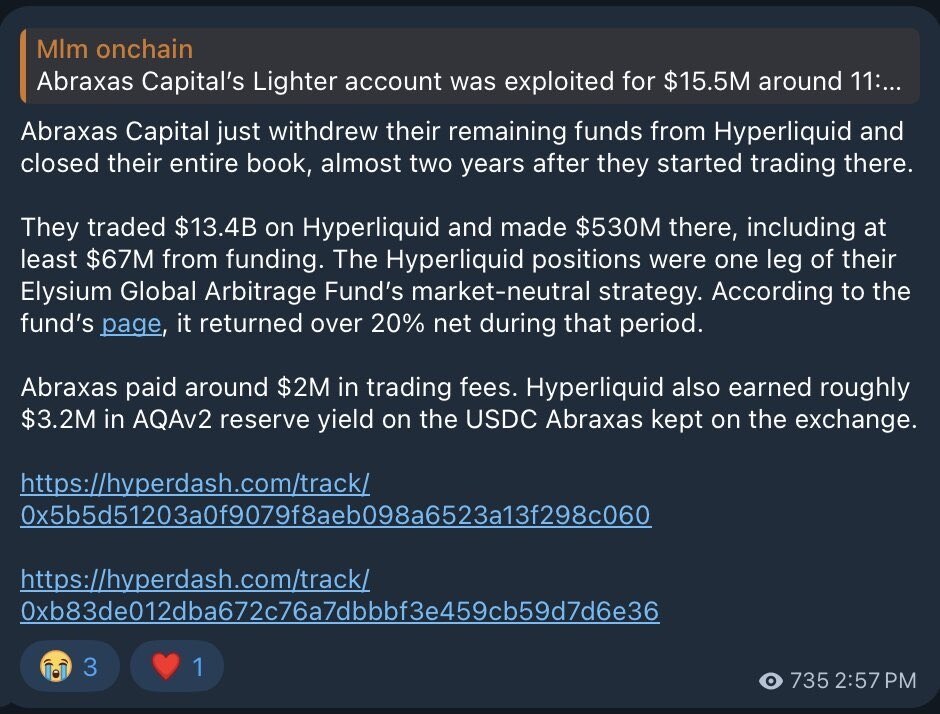
On November 25, on-chain data analysis firm MLM monitored and stated that hedge fund Abraxas Capital has closed all positions on Hyperliquid, withdrawn the remaining funds, and ended nearly two years of trading activity on the platform.
Abraxas's decisive exit this time even included all of its HYPE tokens. On-chain analyst Yu Jin monitored and stated that the 219,000 HYPE (about $13.25 million) that Abraxas had previously applied to unstake has also arrived today and was subsequently transferred to Binance. It is worth noting that Abraxas then withdrew 4,230 ETH from Binance, worth about $7.09 million. Based on this, Yu Jin speculated that Abraxas has very likely sold all of its HYPE.
Interestingly, this was not a forced retreat after a loss. MLM monitoring data shows that during nearly two years of trading, Abraxas's cumulative trading volume on Hyperliquid reached $13.4 billion, and it achieved about $530 million in profit on this single platform (excluding hedging performance on other platforms), of which at least $67 million came from funding rate income.
Why would an institution that steadily made $500 million on Hyperliquid suddenly decide to liquidate and leave? Peeling back the on-chain data and the recent undercurrents in the market, the direct trigger for this evacuation may be security concerns surrounding Perp DEXs, while at the same time there is also another extreme hypothesis that must be guarded against.
Behind Abraxas stands Tether
According to its official website, Abraxas was founded in 2002 and is an investment management company headquartered in London. The institution was initially active in traditional markets and entered the cryptocurrency market in 2017. It is now one of the most active institutional arbitrage traders in the industry.
One of the core funds managed by Abraxas is the "Elysium Global Arbitrage Fund" (its trading activity on Hyperliquid is part of this fund's strategy). The fund was established in 2018 and mainly adopts a market-neutral strategy, aiming to earn returns through price spread arbitrage across different trading platforms, thereby minimizing the risk brought by cryptocurrency price volatility.
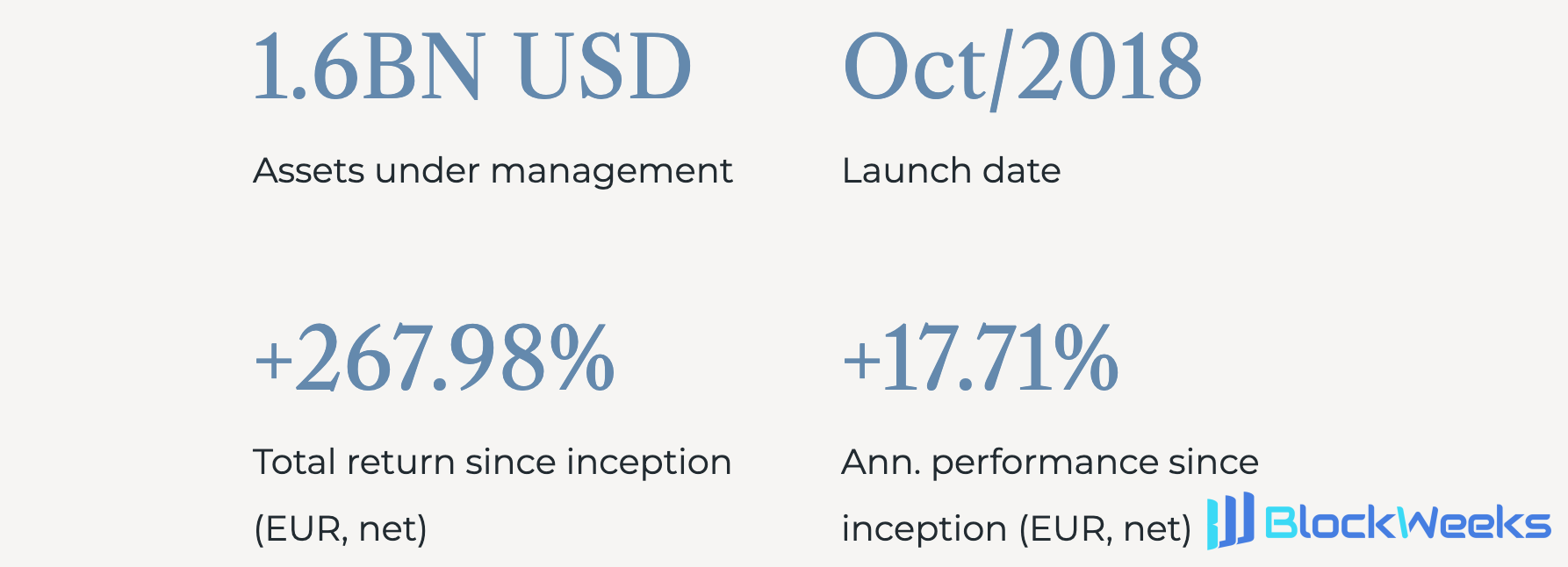
According to disclosure on the fund's official website, the Elysium Fund currently manages assets of about $1.6 billion, with total returns of 267.98% since inception and annualized performance of 17.71%.
What truly deserves attention about Abraxas is the relationship between this institution and Tether.
In July of this year, The Block, citing arbitration materials between Circle and Heka Funds (materials show it is the Investment Manager of the Elysium Fund), disclosed that Tether had invested as much as $800 million in the Elysium Fund, accounting for about 75% of the fund's total assets. This means Tether was not only an important funding provider to the fund, but at one point even its largest contributor. The relevant arbitration materials also showed that Tether had provided Heka with an exemption from USDT minting fees.
It should be clarified that Abraxas is not a subsidiary of Tether, nor can it simply be regarded as Tether's proprietary trading department. However, considering Tether's massive investment in Elysium, Abraxas's capital allocation and trading strategy are clearly worth observing from the perspective of Tether's capital allocation.
The $530 million profit is not the fund's net return
Before its exit, Abraxas was one of the most representative institutional "money printers" on Hyperliquid.
According to statistics from on-chain data institutions such as MLM, over the past nearly two years, Abraxas-related wallet addresses (core addresses include 0x5b5d51203a0f9079f8aeb098a6523a13f298c060 and 0xb83de012dba672c76a7dbbbf3e459cb59d7d6e36) have cumulatively generated as much as $13.4 billion in trading volume on Hyperliquid, with fee expenses alone exceeding $2 million.
As for the $530 million in total profit on a single platform, considering that the Elysium Fund generally adopts a neutral strategy—usually manifested as establishing large-scale short positions on Hyperliquid to hedge spot or other platform exposure and steadily earn funding rates—it cannot be regarded as actual return. However, according to the monthly performance disclosed officially by the Elysium Fund, it can be known that the fund's net return during the same period when it was active on Hyperliquid was about 20%.

For Hyperliquid, Abraxas was likewise a quite valuable client. In addition to million-level trading fee income, the USDC it kept on the platform also brought Hyperliquid about $3.2 million in income through the AQAv2 reserve yield mechanism. In addition, Abraxas's trading activity on the platform was itself a boost to Hyperliquid's liquidity.
From the results, this seems to have been a win-win situation, but precisely because of this, Abraxas's resolute exit appears even more abrupt.
Was the Trigger Lighter?
From the timeline, Lighter's recent API key leak incident was very likely the direct trigger for this large-scale withdrawal.
On November 16, Lighter suffered a security incident in which an attacker exploited an API key leak from a certain trading account to move funds through abnormal public liquidity pool share operations. Afterwards, the outside world estimated through on-chain tracing that two market-making accounts were affected by a total of about $15.5 million, and linked the affected accounts to Abraxas (not officially confirmed).
Lighter subsequently explained in a post-incident report that the problem stemmed from the external signing software used by the account reusing a nonce, which led to the API key leak, and that it was not the official SDK, protocol, or smart contract that was compromised. The platform said it had recovered about $5 million in USDC and restored normal deposits and withdrawals.
But for Abraxas, this incident may have already affected the institution's risk assessment system.
Around November 18, Abraxas began closing about $200 million in positions on Hyperliquid, transferred about $109 million in USDC margin to Binance, and applied to unstake all HYPE. From the Lighter security incident, to the large-scale closing of positions on Hyperliquid, to today's formal withdrawal of all remaining funds, the timeline is quite coherent.
However, the problem with this hypothesis is that Lighter and Hyperliquid are two independent platforms, and the former's API key incident does not mean that the latter has the same security vulnerability. Therefore, this withdrawal may also mean that Abraxas is undergoing a broader risk contraction — reassessing the counterparty risk of on-chain trading platforms, the risk of fund custody, and the necessity of holding large amounts of on-chain collateral when market volatility intensifies.
Extreme Hypothesis: Is Tether Facing Funding Pressure?
Compared with mere on-chain security concerns, what is more noteworthy is Tether, which stands behind Abraxas.
On Monday we published an article titled "If Gold Falls Another 17%, Could USDT Really Blow Up", and Tether's reserve safety cushion is currently facing considerable pressure. The reserve report as of September 30 shows that Tether's total assets were about $191.45 billion, liabilities about $183.5 billion, and excess reserves about $7.95 billion.
From the perspective of the reserve structure, as of September 30, Tether held about $139.6 billion in cash-like and short-term deposit assets, accounting for 72.9% of total reserve assets, with the remainder including gold, Bitcoin, secured loans, stocks, and other investments. Among these, gold and Bitcoin alone accounted for 14.4% of total assets, and price fluctuations may directly affect its excess reserve space. Affected by the recent synchronized market crash, the excess reserve portion of Tether has already shrunk significantly — if the market (especially gold) continues to decline sharply, there is an extreme possibility that assets will be unable to fully cover liabilities.
Against this backdrop, does Tether have the incentive to re-examine the capital allocation of its affiliated funds, or even reduce part of its on-chain risk exposure? This is obviously a question worth being vigilant about.
However, this speculation is still a hypothesis about an extreme situation. There is currently no evidence proving that Abraxas's withdrawal was actively requested by Tether, nor is there evidence showing that its funds have flowed back to Tether. The on-chain trading accounts of Abraxas and the fund's investors cannot be directly equated either.
But one fact is that Tether once provided enormous funding support to the Elysium fund, and that fund's investment portfolio is managed by Abraxas. Now Abraxas is withdrawing from the most important on-chain trading platform. Whether there is some deeper motive behind this is worth continuing to observe from various angles of possible connection.