
Written by: Ma He, Foresight News
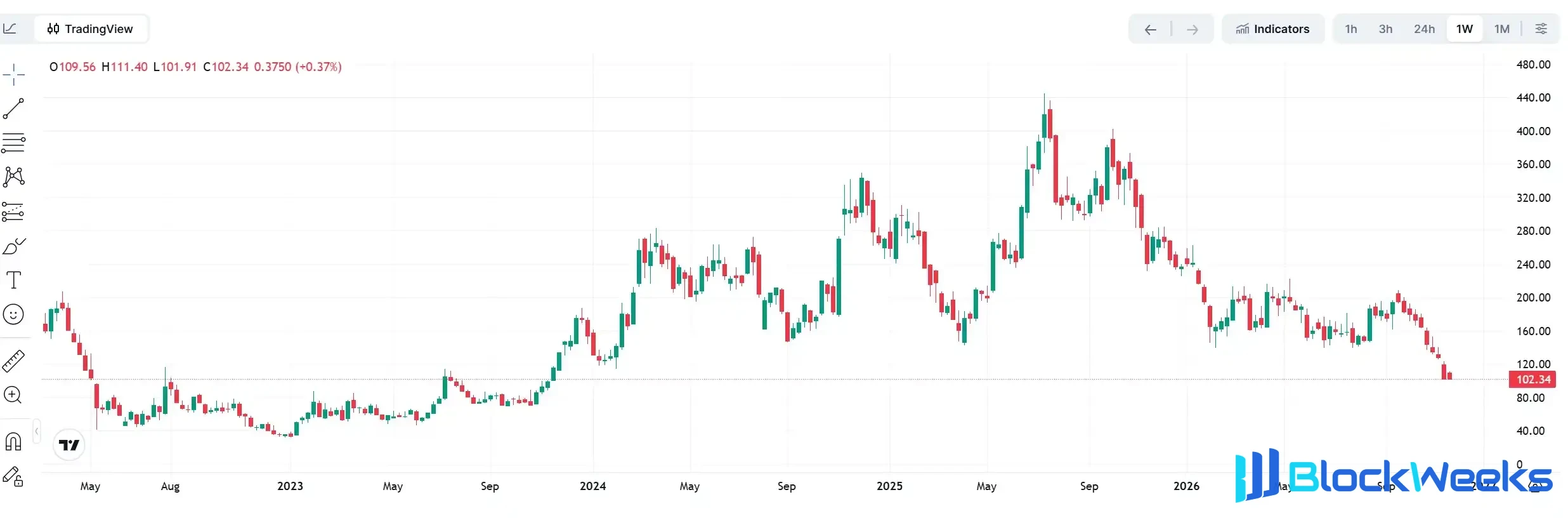
On November 25, Coinbase's stock price briefly plunged below $102, down more than 60% from its intra-year high of $263, and compared with its all-time high of $444.6, the decline has now widened to 77%. Its stock performance has completely torn apart the respectability of this year's Q3 financial report.
On the surface, this year's Q3 book net profit reached $719 million, but $715 million of that came from unrealized gains on investment crypto assets, accounting for as much as 99.5%. After squeezing out the water, net trading revenue plunged 44% year-on-year, and adjusted net profit plummeted 82% to $77.7 million, with the cumulative figure for the first nine months still in a state of net loss.
What makes the market even more uneasy is that at the start of Q4, as of October 25, trading revenue was only about $165 million, while single-quarter adjusted expenses are expected to rebound from $975 million in Q3 to above $1 billion.
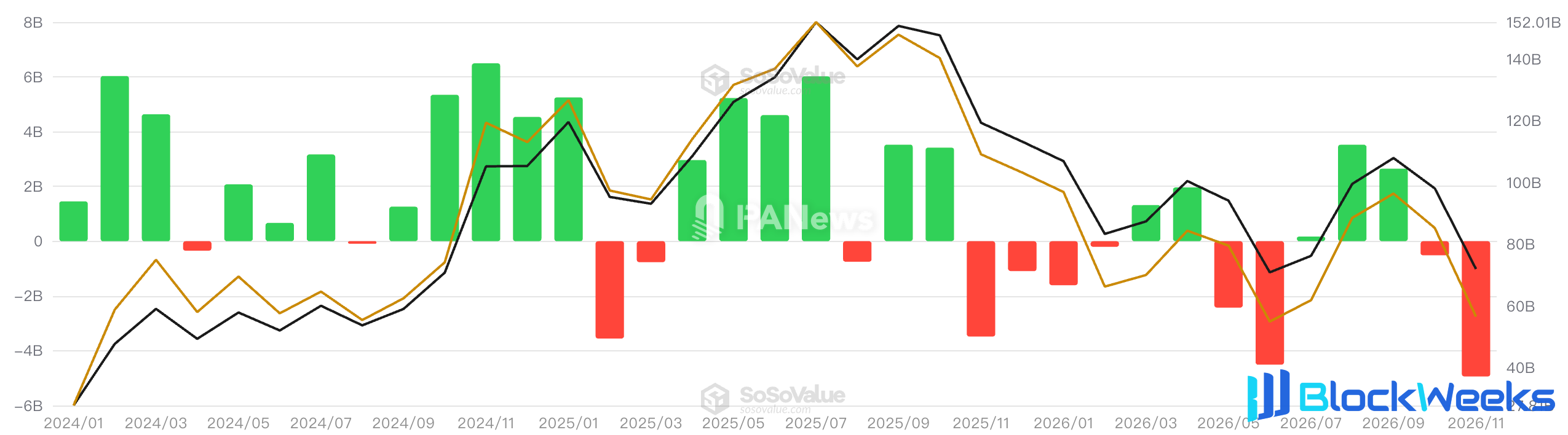
The crypto industry as a whole has fallen into a downturn, with Bitcoin's price posting a rare seven consecutive weekly declines and still struggling below $60,000.
The old engine has stalled and there is no way back. Throughout November, Coinbase intensively played four self-rescue cards.
$2 Billion Buyback: Supporting the Stock or Taking Over Internal Dilution?
On November 25, CEO Brian Armstrong personally stepped in on the X platform to confirm that the company had been repurchasing COIN shares within the authorized amount throughout the quarter, on the grounds that crypto and AI are reshaping financial services and the current market dislocation is precisely a window to deploy capital.

The statement was tough, but the books are a bit painful. According to the SEC filings it disclosed, in the third quarter of 2026, Coinbase had repurchased about 38,000 shares at an average price of $139.91, spending only about $5.316 million, and had cumulatively repurchased about 10.17 million shares for about $2 billion. Against the current stock price of $102, it has long been in unrealized loss.
What is even more intriguing is the change in share capital.
Dragged down by high stock-based compensation, even after burning $2 billion in real money over the past period, it only offset more than 85% of the issuance since Q4 2024, and the company's total share capital actually rose slightly from 263 million shares in Q1 this year to 265 million shares in Q3.
On one side, executives are methodically reducing holdings and cashing out under 10b5-1 plans; on the other side, the company is using shareholders' money to support the stock halfway down the mountain and hedge dilution. This buyback is less a value bottom-fishing move than a painkiller to stabilize market confidence.
Heavy Push into Derivatives and Pro Relaunch
Spot fees can no longer hold up. In November this year, Coinbase focused on derivatives and professional trading.
In October this year, after Coinbase completed the integration of INTX and Deribit (the company had warned that trading volume would fluctuate in the short term during the migration period), a global compliant derivatives architecture covering U.S. and non-U.S. clients began to take shape: on November 19, non-U.S. eligible users were the first to gain access to BTC and ETH options based on Deribit liquidity, U.S. institutions access through Coinbase Prime, and U.S. retail users still need to wait in line.
Spot leverage followed in tandem. Coinbase Advanced opened spot margin, with mainstream assets supporting up to 10x leverage (about 5x for others), supporting more than ten types of collateral and sharing margin with derivatives; however, the threshold for U.S. individual users is extremely high, requiring meeting the "eligible contract participant" standard of $10 million in discretionary investment assets, and being subject to state and usage restrictions. Before the end of 2026, Coinbase will also relaunch Coinbase Pro, packing spot, futures, perpetuals, options, and stocks into a unified account.
The moves are ruthless, and the cost is equally direct.
Over the past year, Coinbase's global crypto trading market share has nearly doubled to 10.7%, yet revenue has moved in the opposite direction. The fatal weakness is that the most profitable U.S. retail spot trading volume has collapsed by nearly 60% year-on-year. Now, in order to compete with offshore major exchanges and on-chain DEXs, whether it is Coinbase One with zero spot fees or the low-fee derivatives and Pro, every additional bit of traffic captured is personally tearing down the high-fee moat it once relied on to win effortlessly.
Launching Proprietary Prediction Market in 2027
If derivatives are defense, then the prediction market is the fastest spear in Coinbase's hand.
This business's annualized net revenue has exceeded $200 million, but during the off-season for sports events, the activity of the prediction market still relies heavily on periodic contracts such as crypto volatility to stay alive.
What is truly worth watching is the "burning the bridge after crossing it" that Coinbase is about to stage.
At present, the product mainly relies on Kalshi to supply contracts, but the revenue-sharing cost is too painful: in Q3, the company's trading expense ratio unexpectedly soared to 16.8% of net revenue, and the reason points directly to the external exchange revenue sharing brought by the growth of the prediction market.
Since Kalshi has already helped it prove the business model, Coinbase has decided to take the whole stack back.
Relying on The Clearing Company acquired in 2025 and the Coinbase Clearing registration qualification obtained in September 2026, according to Bloomberg, the company plans to launch a proprietary prediction market to U.S. retail and institutional clients in the first half of 2027.
An even more ruthless calculation is written into the roadmap—building a "USDC-native, internally cleared" architecture. Once implemented, the margin deposited by users' bets will all remain on the platform and become USDC, allowing Coinbase to earn prediction fees with one hand and U.S. Treasury interest with the other, getting two benefits from one fish.
However, the only variable at present is still the regulatory tug-of-war between states and the federal government, as well as the spillover risks that may arise from Kalshi-related litigation.
Base: Adding On-Chain Leverage to Wall Street Assets
The calculation on the on-chain battlefield is much shrewder than it looks on the surface.
According to DefiLlama data, Base chain's current TVL is $4.95 billion, still maintaining a high level.

According to official data, Base tokenized stocks have accumulated trading volume exceeding $1 billion since launch, and in November added U.S. stock targets such as Coca-Cola and Walmart. U.S. stocks have long been zero-commission on Robinhood; Coinbase's real killer move lies in composability—at present, a considerable proportion of tokenized U.S. stocks have been deposited into protocols such as Aave as collateral.
Base transforms stocks that cannot circulate while Wall Street is closed into on-chain collateral operating 24/7, which both feeds its own on-chain lending pool and, in conjunction with Base App, enables access to perpetuals, prediction markets, payments, and AI Agent automated settlement scenarios, directly competing with Robinhood for the pricing power of a "full-asset exchange."
On November 22, Base lead Jesse Pollak said in an interview that Base is still exploring the possibility of issuing a token, but is in no rush to push it forward at present, as the team hopes to avoid being distracted by it and affecting platform growth.
Right now, Brian Armstrong has signaled externally that he will shift more energy toward customers and products, and has pointed to 2027 as the key delivery period. This looks more like a grace-period check he is asking Wall Street for during a period of stalling performance.
A share price of $102 has already pronounced a death sentence on the old story; over the next few quarters, the key question is whether Coinbase can, before the retail spot cash cow completely dries up, fill the profit abyss with these new licenses, proprietary contracts, and on-chain assets.