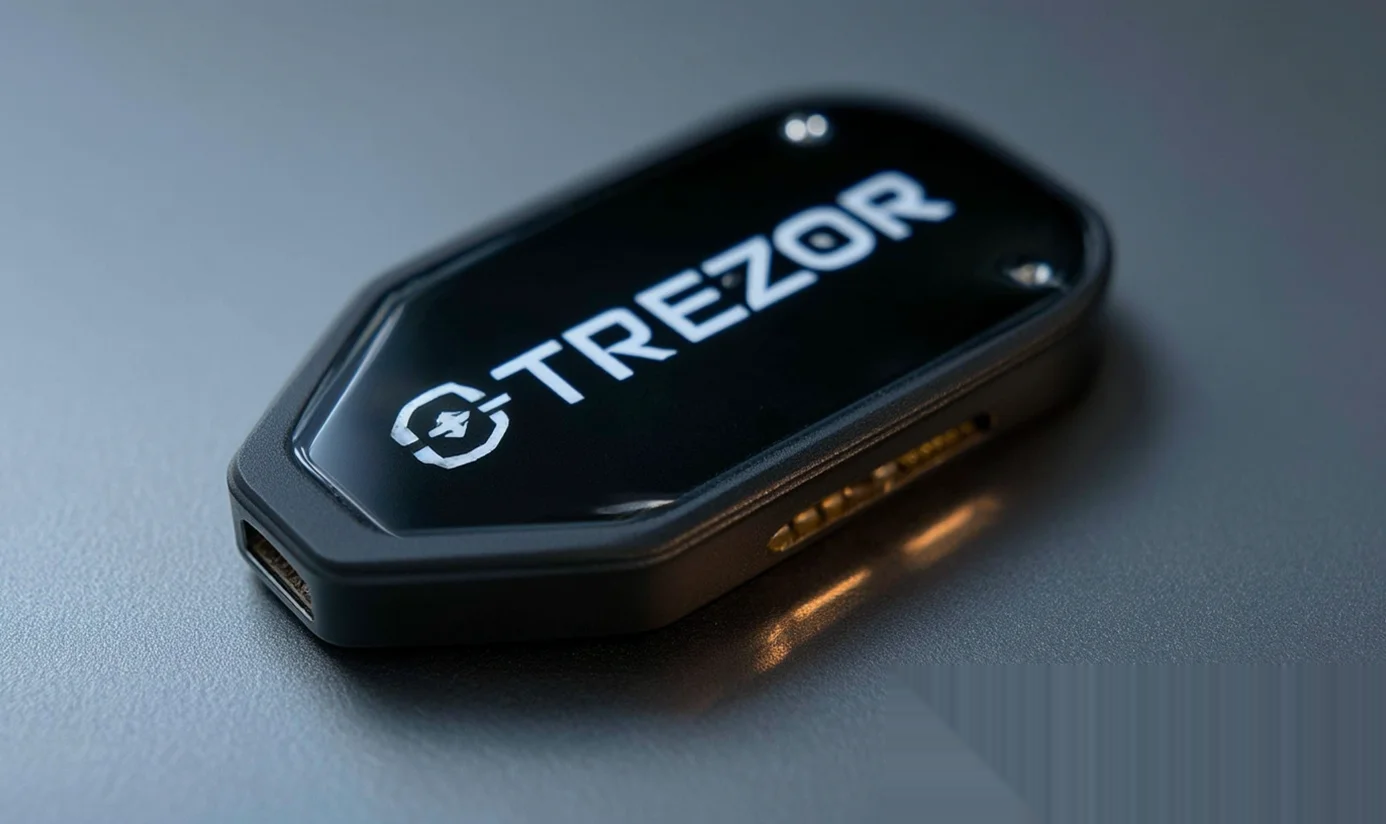
Ledger’s confirmed implant findings and Trezor’s subsequent warning concern devices bought through the same reseller. The investigations put the route from manufacturer to customer alongside the security of the chip inside the wallet.
Summary
- Trezor disclosed a suspected implant in 1 Safe 5 bought through CryptoBilis in August.
- Its October 30 notice said the reported device had not yet reached its laboratory.
- Ledger’s October 13 findings described an implant capturing 24-word recovery phrases through the screen connection.
- Bitquery’s October 16 investigation counted $102 million across 335 wallets on 6 blockchains.
- Trezor’s precautionary replacement offer covers CryptoBilis purchases from March 2026 onwards.
Trezor has warned customers about a suspected implant in 1 Safe 5 sold through CryptoBilis, extending the hardware wallet investigation beyond the Ledger devices previously linked to thefts.
Trezor’s October 30 notice says the company received photographs and interviewed the buyer by video, but had not received the device for laboratory examination. It treated the account as credible enough to warn other customers before completing that work.
The company said no CryptoBilis buyer had reported losing funds to it. Its precautionary advice applies to every Trezor model bought through the reseller from March 2026 onwards, including devices supplied to other shops.
Ledger had already confirmed that a component fitted inside an affected device could capture the recovery phrase displayed during setup. Its technical findings described an attack that left the original security chip, operating system and normal signing functions unchanged.
The two cases have different evidentiary positions: a confirmed Ledger implant and a reported Trezor implant awaiting examination. Neither manufacturer has established publicly that the same attackers modified both brands.
Trezor’s warning concerns a device bought through an authorised reseller
The Safe 5 report came from a customer in Indonesia who bought the wallet through CryptoBilis on Tokopedia in August. He submitted the disclosure on October 28 after finding an additional circuit board inside the case.
According to Trezor, the buyer had already moved his cryptocurrency away from the device before discovering the suspected implant. The company said its self-custody model does not give it visibility into every customer’s balance.
CryptoBilis had been an authorised reseller for Trezor and Ledger in Southeast Asia. Trezor removed it from its network on October 9, when Ledger began investigating complaints from customers who had bought devices through the seller.
The removal preceded the new Safe 5 disclosure by 19 days. Trezor had started inspecting customer devices during that interval and had not found tampering in the first 4 units examined, according to its published account.
The first inspected units comprised 2 Safe 5 devices, a Safe 7 and a Safe 3. The wallet subsequently reported by the Indonesian customer was a different unit.
The first clean samples and the later suspicious device therefore do not describe contradictory results from the same examination. They concern separate pieces of hardware obtained from customers at different points in the investigation.
Trezor said it had no reports involving another reseller in the October 30 notice. Its warning covers the CryptoBilis supply route and does not establish that every unit sold through it was modified.
Ledger’s implant captured words without changing normal signatures
Ledger’s October 13 technical findings described a microcontroller reading the information sent to the device’s screen. When the screen displayed the recovery phrase, the component decoded the words and transmitted them through an LTE connection using an eSIM.
A recovery phrase allows a compatible wallet to recreate the private keys associated with the original setup. An attacker who obtains the required backup can authorise transfers from another device without taking the customer’s signer.
Normal transaction signing on the original wallet can continue throughout that period. The customer may therefore use a genuine device without seeing an altered transaction or a request for an unusual approval.
As crypto.news previously reported, Ledger said the component operated separately from its Secure Element and operating system. The company did not describe an exploit that extracted keys by breaking the security chip’s protections.
Ledger had confirmed an unauthorised implant in an affected device after opening its investigation on October 9. Its initial confirmation did not identify the full population of modified devices or establish the total loss.
The subsequent technical description explained a route by which the recovery phrase could leave the wallet during setup. It did not prove that every suspicious onchain transfer attributed to the incident came from a device containing that component.
Trezor’s reported Safe 5 contained a board between the main board and screen, with a cellular module and antenna, according to its customer’s description. The manufacturer has said the account appears credible but has reserved a technical conclusion until its own examination.
A component observing the display connection does not need the customer to type the backup into a phishing website. The exposure described in the Ledger findings occurs when the genuine setup process shows the words the owner needs to record.
Device authentication and physical inspection check different things
Trezor’s authentication documentation describes certificates installed during manufacturing. Trezor Suite checks cryptographic responses against the manufacturer’s public keys to establish the authenticity of the device’s security components.
A genuine certificate demonstrates something about the component holding it. The reported CryptoBilis attack instead involves additional hardware placed alongside genuine electronics after manufacture.
Ledger’s findings say the original chip and software remained unchanged in the affected device. The presence of those genuine components did not prevent the separate implant from observing recovery words when they reached the screen.
The manufacturers have not described the case as proof that cryptographic authentication is useless. Their investigations concern a physical addition that can leave the parts being authenticated in place.
Trezor’s Secure Element explanation sets out the chip’s roles in enforcing PIN access, contributing randomness and helping verify authenticity. Safe 3 and Safe 5 use an OPTIGA Trust M component, while Safe 7 has a different architecture with additional hardware layers.
The company says PIN enforcement helps resist attempts to obtain secrets from a stolen device. An attack that copies the backup while its owner is legitimately setting up the wallet follows a different route.
A chip’s assurance certification concerns the evaluated component and its protections. Trezor’s documentation does not describe that certification as an inspection of every circuit board later placed inside every retail unit.
Trezor’s October 30 notice contains no laboratory conclusion for the reported Safe 5. Its behaviour, the origin of the additional component and its relationship to the Ledger attack remain questions for the investigators.
A replacement device needs a different recovery phrase
Trezor’s advice to affected customers calls for a newly created wallet with a new backup. Restoring the existing phrase on a new device would recreate access to the same keys.
If an attacker already has those keys, replacing the hardware alone does not remove that access. Cryptocurrency must be transferred to addresses controlled by the new wallet to leave the old key set behind.
The manufacturer distinguishes customers who already use the device from buyers who have not set it up. Its notice tells the latter group not to initialise it and not to enter an existing backup into it.
Entering a previously secure phrase into a suspicious device could expose assets unrelated to the wallet that would otherwise have been created during setup. The warning consequently covers restoration as well as first-time wallet creation.
PIN protection has another purpose. Trezor says its Secure Element releases a secret used in protecting private keys only when the correct PIN is supplied, with a reset after the permitted number of failed attempts.
An attacker who restores a stolen recovery phrase elsewhere does not have to pass the old device’s PIN check. The backup supplies a recovery route intended to survive loss or damage to that device.
Trezor’s passphrase guidance describes an optional additional secret that creates a separate wallet when combined with the backup. Access to such a wallet requires both the correct backup and the exact passphrase.
The guidance warns that an incorrect passphrase opens a different wallet and that a lost passphrase cannot be recovered by the manufacturer. Trezor has not presented the feature as a substitute for its migration advice to CryptoBilis customers.
Neither company has published enough evidence to describe a passphrase as a guaranteed defence against the specific implants under investigation. The information a modified device might observe depends on its design and how the owner enters or uses the secret.
Changing a backup format does not revoke an exposed backup
Trezor’s backup-format guide distinguishes BIP39 backups of 12 or 24 words from SLIP39 backups using 20-word shares. Its current documentation lists a 20-word single-share backup as the Safe 5 default, with other supported formats available during setup.
The 24 words described in Ledger’s findings should therefore not be used as a claim about the format chosen by the owner of the reported Trezor. The manufacturers’ devices and backup arrangements differ.
In a multi-share setup, the owner specifies how many shares exist and the threshold required to recover the wallet. Trezor gives an example in which any 3 of 5 shares are sufficient, while fewer than the threshold do not reveal the underlying secret on their own.
Its upgrade documentation makes a further distinction: creating a new multi-share backup for an existing compatible wallet does not invalidate the original single-share backup. Both remain routes to the same wallet.
The manufacturer expressly warns that funds remain exposed if that original backup is compromised. A new arrangement for storing recovery information does not itself change the private keys controlling the assets.
Trezor’s migration guidance for the CryptoBilis incident consequently calls for a newly created wallet, not merely additional shares for the existing wallet. The company has not published a finding about which backup format the Safe 5 reporter used or what information the suspected component actually captured.
Blockchain loss estimates count addresses, not inspected devices
Onchain researchers have published several totals for the Ledger-linked thefts. Their datasets describe transactions and addresses, while the physical investigation concerns devices, sellers and the recovery phrases used to create wallets.
Arkham’s October 29 tracing put suspected thefts at $95.35 million involving 1,486 addresses. The dated fund-tracing account said the attacker had continued moving cryptocurrency, including $13.84 million over the preceding 48 hours.
Bitquery’s October 16 investigation update counted $102 million from 335 victim wallets across Bitcoin, Ethereum, Tron, Solana, BNB Chain and Polygon. Its report described a larger dataset than the initial public address lists.
A wallet backup can control addresses on several networks, and a person may operate more than 1 wallet. An address count cannot therefore be converted directly into a count of buyers or tampered devices.
The $95.35 million and $102 million estimates cannot be added together as separate losses. They are overlapping analyses of suspected thefts using different datasets, dates and attribution methods.
Ledger has not verified either research total as the final amount attributable to modified hardware. Trezor’s separate notice said no affected customer had reported a loss to it.
Bitquery’s report records corrections as its tracing developed. On October 12, it identified a group of Tron wallets previously described as an OTC-style group as THORChain vaults and removed a lead involving unrelated customers’ Binance transfers.
The correction changed the explanation of the route taken by funds. It did not establish that the users of the intermediary service were involved in modifying or selling wallets.
Bitquery’s transaction chronology records 25 Tron wallets signing the same approval across 2 blocks separated by 3 seconds. It says the authorised address then pulled roughly $29 million in USDT within seconds of the first approvals.
The analysis identifies a different mechanism in 30 other Tron wallets: their account permissions were changed to give a new key sufficient authority to move the funds. The original owners’ keys were left without enough weight to act alone, according to the researcher.
An approval allowing a token transfer and a change to a Tron account’s controlling permissions are different actions. Bitquery records the two mechanisms separately in its transaction timeline.
On Bitcoin, its chronology describes 111 wallets being emptied in a single block at approximately 05:54 UTC on October 9. The researcher links the timing and similar fee treatment to coordinated access to the wallets’ keys.
The firm considered whether a phishing campaign collecting signed requests could explain the activity. It judged that explanation unlikely based on the permission changes and the sequence it reconstructed, while stating that blockchain records cannot show where the keys originally leaked.
The distinction leaves a role for the physical examinations. A series of valid signatures can demonstrate control of keys without recording the hardware through which the attacker obtained the underlying recovery information.
Bitquery’s chronology places small preparatory transactions on Tron and Ethereum between September 26 and October 7. The researcher attributes those wallets to the operation, without dating when a particular retail device was opened or modified.
Researchers can follow a movement from an address without identifying the person who installed a component. Trezor has explicitly said it does not know who is behind the suspected Safe 5 modification.
Freezing stolen tokens is different from returning them
Arkham’s dated account said roughly $10 million in USDT had been frozen in the Ledger-linked investigation. Bitquery independently described $10 million of frozen USDT in its own tracing.
A freeze prevents the affected tokens from moving under the issuer’s controls. It does not by itself identify every rightful owner or complete a transfer back to the victims.
Bitquery’s investigation describes the attacker exchanging assets across networks and services, including movements through THORChain and Tornado Cash. It says some funds were converted into assets or routes outside the control of the issuer that could have frozen the original token.
The report distinguishes resources still held in identified wallets from funds deposited with an intermediary or passed through a privacy service. Its dated balances are observations at the stated time, not a current recovery account for every victim.
Researchers identified USDC balances they believed could be frozen, then recorded their movement before such action occurred. Bitquery’s updates say a flagged 2.38 million USDC moved on October 14 and 15.
The report’s account does not establish why no freeze occurred or whether the issuer had sufficient information and authority to act at a particular moment. It records the transfers observed by the researcher.
A total described as stolen, an amount frozen and a balance still traceable measure different stages of the case. None can be substituted for a verified amount repaid to customers.
Manufacturers’ replacement offers concern hardware. They do not establish a reimbursement programme for all losses attributed by blockchain researchers to the Ledger-linked drain.
Ledger and Trezor have taken precautions beyond the reported units
Ledger asked CryptoBilis to stop sales and shipments after the complaints. The company’s technical investigation continued through its Donjon security team, while it warned users not to initialise potentially affected devices.
A separate German retail suspension involved MediaMarkt Saturn stores and online sales following a report concerning a customer in Germany. Ledger said no customer funds had been lost in that reported case.
The company had not established a connection between the German report and the CryptoBilis devices. Treating the suspension as confirmation of a single attacker operating across both distribution networks would go beyond its findings.
Ledger’s published response says it examined store and warehouse samples without finding modified units. It has described the confirmed attack as taking place in the distribution channel after genuine devices left its control.
The company says returned devices must never be resold, even if they appear unopened. Its response describes tighter stock-handling rules and asks authorised sellers to report unusual products promptly.
Trezor removed CryptoBilis from its reseller network before receiving the Safe 5 report and has said it limited its authorised sales network as a precaution. It has been working with Ledger and the Security Alliance’s SEAL 911 emergency service.
The manufacturers’ response provides evidence against a claim that every device made by either company is affected. Trezor had 4 clean customer samples in its first examinations, while Ledger reported clean units in its own stock and store checks.
Sample inspections do not establish how many unexamined units might have been modified. Neither company has published a denominator that would support calculating an affected percentage across the reseller’s inventory.
Trezor has offered new hardware without asking customers to surrender their backup
The coverage extends beyond CryptoBilis’s own Tokopedia store to other sellers that obtained their units through it. Trezor says the guidance applies to every model supplied through that route, although the reported implant concerns a Safe 5.
The company advises customers against opening or weighing a device to decide whether it is safe. It says small weight differences have other possible causes and cannot reliably confirm or rule out tampering.
The person who reported the Safe 5 noticed a weight difference, but Trezor has not adopted that observation as a screening method. Its precautionary response uses the purchase route and period, not a home measurement.
The company warns that criminals may exploit the incident with fraudulent emails, letters and phone calls. A request to disclose a recovery phrase would create another route to the same keys the hardware is intended to protect.
Trezor says its support staff will never ask for that phrase. It has asked affected buyers to retain their devices while arranging replacements through its official support service.
What to watch
Laboratory findings: Trezor’s examination of the reported Safe 5 and any published technical result.
Affected inventory: Purchase periods, serial or batch information and any changes to the identified sales routes.
Loss attribution: Manufacturer-confirmed cases distinguished from researchers’ address-based estimates.
Recovery: Verified returns to victims, separately from issuer freezes and balances still being traced.
Retail controls: Published replacement terms and changes to the handling of returned or displayed stock.
FAQ
Has Trezor confirmed an implant in the Safe 5?
Its October 30 notice described a credible customer report, photographs and a video interview. The company had not yet received the reported device for laboratory examination.
Did Trezor customers lose funds in this incident?
Trezor said no CryptoBilis buyer had reported losses to it. The customer who reported the suspected implant had moved his funds before discovering it.
What did Ledger confirm?
Ledger confirmed an implant in an affected device and described how it captured 24-word recovery phrases from the screen connection. It said the component did not alter the Secure Element, operating system or signatures.
Does an authentic security chip prove that a wallet has no implant?
Authentication establishes the validity of the components being checked. Ledger’s findings describe separate hardware fitted alongside genuine components that remained intact.
Does moving the same recovery phrase to a new device help?
It recreates access to the same keys. Trezor’s precautionary advice calls for a newly created wallet with a new backup and a transfer of the funds.
How much was stolen from CryptoBilis buyers?
There is no manufacturer-confirmed final total. Arkham’s October 29 estimate was $95.35 million, while Bitquery’s October 16 dataset counted $102 million; the overlapping estimates must not be added.
Should affected owners weigh or open their devices?
Trezor says weighing cannot reliably establish tampering and advises against home inspection. Its guidance identifies purchases supplied by CryptoBilis from March 2026 onwards.
What replacement has Trezor offered?
Eligible buyers can obtain a directly shipped replacement or a voucher covering a new device. The offer concerns hardware and does not establish reimbursement for every researcher-attributed loss.