



The latest U.S. inflation data, which the market had been eagerly awaiting, brought an unexpected boost to cryptocurrency derivatives markets. The August report on the core personal consumption expenditures (PCE) index showed that price pressures in the U.S. economy remain persistent: prices for more than half of the components in the PCE basket are still rising faster than the target rate.
However, despite stubborn inflation and a tough macroeconomic backdrop, Bitcoin and the largest altcoins triggered a powerful wave of buying activity that completely overwhelmed sellers.
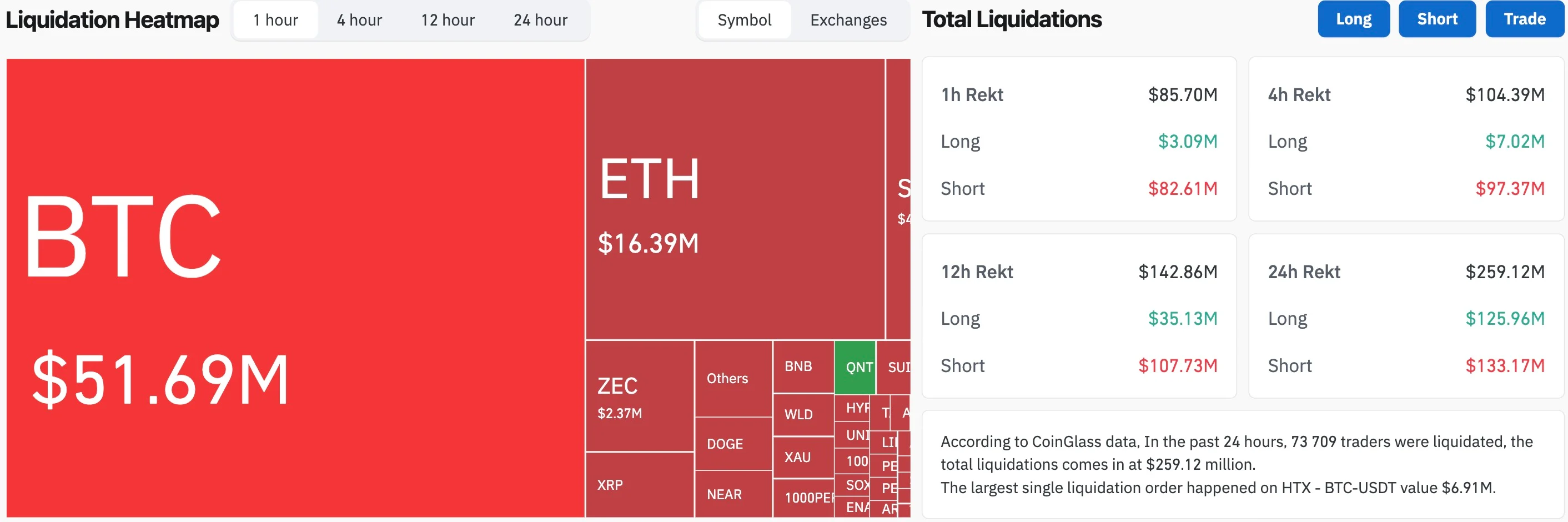
Even though prices for more than half of the components in the PCE basket are still rising faster than the target rate, short sellers instantly found themselves trapped. The market interpreted cooling inflation as a green light for risk assets, triggering a cascade of forced liquidations of leveraged positions.
According to analytics platform CoinGlass, the market steamrolled 73,709 traders over 24 hours, wiping out $259.12 million in positions. The epicenter of the catastrophe was an extreme one-hour imbalance: when the data was released, short liquidations surged to $82.61 million, while longs lost a mere $3.09 million. This 2,633% imbalance turned an ordinary price move into a classic macroeconomic short squeeze.
Plenty of reasons to sell, zero actual sellers. What is happening with crypto right now.
The main drivers of the rally, absorbing most of the sellers' liquidity, were three key assets: Bitcoin, Ether, and XRP.
Bitcoin, which maintains a firm hold on nearly 59% of the entire crypto market, reached $83,825.17 at the peak of the move. Bitcoin short sellers accounted for more than $51.69 million in losses over 24 hours. The hardest hit came on the HTX exchange, where a single BTC-USDT position was forcibly liquidated for $6.91 million.
Ether, the second-largest cryptocurrency, contributed a substantial $16.39 million to total liquidations despite an intraday dip to $2,679.29. XRP then fell into the grip of the short squeeze: after settling at $1.4975, Ripple's token accounted for a share of triggered stop orders alongside the most volatile altcoins.
This short squeeze exposed the central paradox of the current market: Bitcoin has plenty of reasons to fall. U.S. stocks have stopped rising, oil is insanely expensive, the yield on 10-year U.S. Treasury bonds is hovering around 5.2%, and the CLARITY Act's failure in the Senate should have sent crypto plunging. But after a brief move lower, Bitcoin held firm and returned to its previous levels.
The asset's resilience in the face of bad news shows that institutionalization has already taken place through ETFs, major banks, and funds that have entered the market for the long term and are developing the sector regardless of Congress's decisions. There appear to be regulatory and macroeconomic reasons to sell, but there are simply no actual sellers in the market, and year-end is approaching — the time when funds will start allocating fresh money to strategies for 2027.