

Bitcoin (BTC) price has traded near $83,538 on October 14 after approaching $83,900 during Asian trading, as investors assessed fresh Federal Reserve comments ahead of the U.S. inflation report.
Summary
- Bitcoin price traded near $83,538 after briefly approaching $83,900 during Wednesday’s Asian trading session.
- Analyst Ali Martinez identified $84,000 as resistance, with $93,000 representing a conditional target.
- New York Fed President John Williams suggested another rate increase this year but none during 2027.
- CryptoQuant observed increased activity among older Bitcoin holdings, without confirming that their owners were selling.
- September’s U.S. inflation report is scheduled for October 14, with producer price figures following Thursday.
CoinGecko shows Bitcoin trading around $83,500, with approximately $982 billion in reported 24-hour trading volume and a market capitalization near $1.68 trillion. The cryptocurrency remained nearly unchanged over the previous day, while analysts identified $84,000 as the next important price level.
New York Fed President John Williams’ latest remarks on interest rates provided another development for traders monitoring U.S. monetary policy.
Bitcoin price faces resistance near $84,000
During Wednesday’s Asian trading session, Bitcoin briefly approached $83,900 before retreating toward $83,500. The movement followed another unsuccessful attempt to establish a sustained recovery above $84,000, a level that has repeatedly attracted selling pressure.
Crypto analyst Ali Martinez identified $84,000 as a potential breakout threshold on Bitcoin’s four-hour chart. His analysis compared the current trading structure with an earlier recovery in which Bitcoin rebounded from the lower boundary of an ascending channel.
In the previous setup, the 200-period simple moving average provided support, while a four-hour close above the 50-period moving average helped confirm the upward move. Martinez said the current pattern resembled that earlier recovery, with the 50-period average now positioned near $84,000.
The analyst suggested that a confirmed four-hour close above the threshold could open a path toward $93,000. His target remains conditional, depending on Bitcoin breaking resistance and maintaining its upward movement.
Meanwhile, analyst Daan Crypto Trades pointed to $83,000 as an important level on Bitcoin’s daily and weekly charts. He noted that the cryptocurrency had formed a higher low before recovering from its latest decline.
Daan said much of the visible market liquidity remained above Bitcoin’s trading price. He suggested that softer U.S. inflation figures could encourage a move toward those liquidity concentrations, although the outcome depends on the actual economic data and subsequent trading activity.
Bitcoin traders await U.S. inflation data after Fed comments
New York Federal Reserve President John Williams said on October 13 that another interest rate increase could be appropriate before the end of 2026, while current economic conditions did not indicate a need for further increases in 2027.
His comments followed the Federal Reserve’s September decision to raise its benchmark interest rate by 25 basis points to a range of 3.75%–4.00%. Williams described inflation as an ongoing concern but suggested that price pressures could ease as energy markets stabilize and the effects of tariffs diminish.
The U.S. dollar weakened following the remarks, while Treasury yields declined. Investors reduced some expectations for further monetary tightening, although Williams made clear that incoming economic information could change his assessment.
Across Asian markets, stock indexes recorded modest gains on Wednesday as technology shares recovered from recent selling. South Korea’s KOSPI climbed approximately 1.8%, while Japan’s Nikkei gained around 0.2%.
Energy prices continued to create uncertainty. Brent crude traded around $106 per barrel amid concerns about attacks in the Middle East and the movement of oil shipments through the Persian Gulf.
The next scheduled economic release is the U.S. Consumer Price Index for September, due Wednesday, October 14, at 8:30 a.m. Eastern Time.
The Bureau of Labor Statistics reported annual inflation of 3.4% in August, with monthly consumer prices increasing 0.4%. September’s figures will provide an updated measure of inflation before the Federal Reserve’s next monetary policy decision.
Producer Price Index data is scheduled for Thursday, October 15. Both releases provide information about price pressures facing consumers and businesses, although their effects on Bitcoin and other financial assets cannot be established before publication.
Bitcoin technical indicators show weaker momentum
On the supplied daily chart, Bitcoin traded near $83,462 after reaching an intraday high of $83,880. Price remained below resistance at $85,000, where earlier recovery attempts had encountered selling pressure.
Bitcoin has traded largely between $81,000 and $86,000 following its recovery from August lows. The chart placed immediate support around 81,000–82,000, with stronger resistance extending from $86,000 to $88,000.
A sustained break above $86,000 would bring the 88,000–90,000 region into focus under the supplied technical scenario. Conversely, a decline below $81,000 would expose the 78,000–80,000 support area.
The Moving Average Convergence Divergence indicator showed weakening momentum. Its MACD line stood at 592, below the signal line of 1,040, while the histogram registered negative 448.
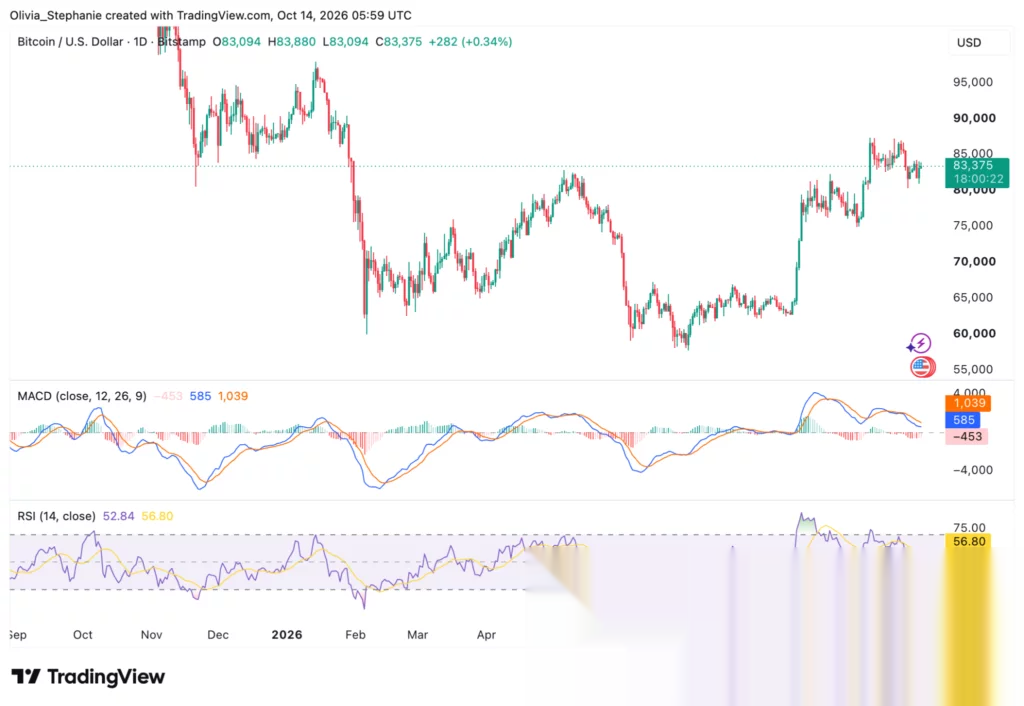
Both lines remained above zero, but the negative histogram and bearish crossover indicated that the latest recovery had lost momentum. A return of the MACD line above its signal line would be needed to improve that indicator’s short-term reading.
Meanwhile, the Relative Strength Index stood at 53.13, below its moving average of 56.82. The reading placed Bitcoin in neutral territory, with neither overbought nor oversold conditions evident.
The RSI’s decline from recent highs showed buying pressure had eased, leaving Bitcoin trading between nearby support and resistance ahead of the inflation release.
Older Bitcoin holdings show increased movement
Separate blockchain data showed activity increasing among Bitcoin holdings that had remained inactive for extended periods.
CryptoQuant analyst nocoffeenobrain reported that coins held for one to three years and those held for more than three years had begun moving more frequently in late September.
The activity increased while Bitcoin recovered from the mid-$70,000 range toward the mid-$80,000 range. The analyst identified similar increases earlier in 2026, including during January and February and again between late July and mid-August.
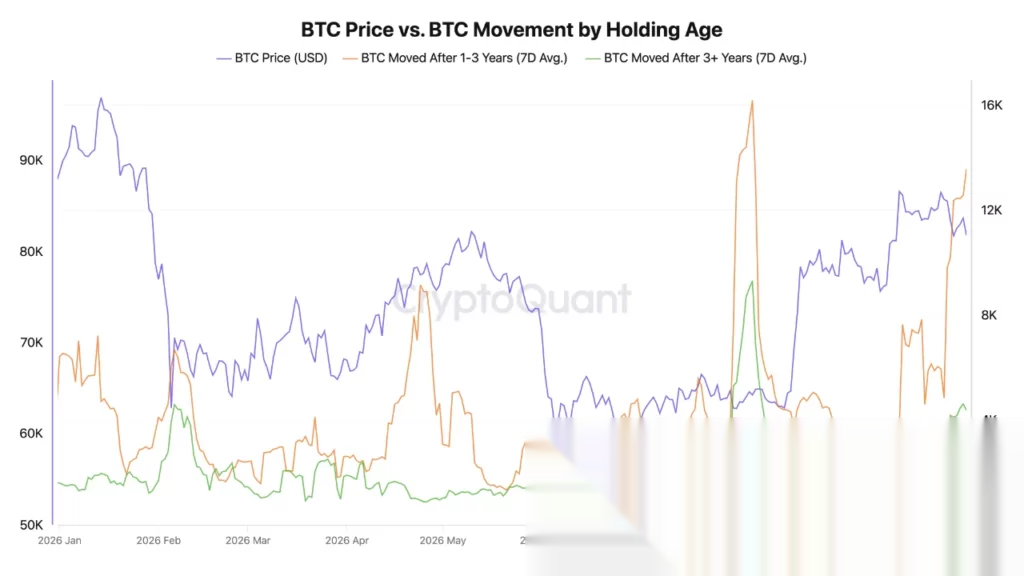
However, the analysis cautioned that increased movement does not necessarily establish that long-term holders are selling their Bitcoin. Wallet transfers can involve custody changes, security measures or transactions between addresses controlled by the same owner.
The analyst suggested that the recent Ledger hardware wallet security incident could encourage further transfers as affected users move cryptocurrency into new wallets with fresh recovery phrases.
Ledger recently confirmed that an unauthorized hardware implant had been discovered inside a device sold through Southeast Asian reseller CryptoBilis. Its investigators found that the component could capture recovery phrases displayed during wallet setup and transmit them through a cellular connection.
The manufacturer advised potentially affected customers to use newly initialized devices and new recovery phrases. Simply restoring an existing recovery phrase would not protect funds if the original phrase had already been exposed.
CryptoQuant expects the seven-day moving averages of older-coin activity to increase as some wallet owners take protective action. The analyst did not provide a verified figure for how much of the recent movement resulted directly from Ledger-related migrations.