

Cardano price has recovered nearly 3% to $0.2235 on Wednesday, October 21, although a bearish SuperTrend signal has raised concerns that ADA could fall toward $0.17 if key support fails.
Summary
- Cardano gained 3% to trade around $0.2235 on October 21, despite bearish technical signals.
- Analyst Ali Martinez warned that ADA could drop toward $0.17 if daily support at $0.21 breaks.
- The SuperTrend indicator has turned bearish, following a comparable May signal that preceded a 46% correction.
- Wallets holding between 100 million and 1 billion ADA showed little change over the past 10 days.
- Resistance at $0.2255 and $0.2394 remains important as ADA attempts to recover.
According to crypto analyst Ali Martinez, the cryptocurrency’s recent technical weakness has not yet produced a confirmed breakdown, while large Cardano holders have shown little change in their positions over the past 10 days.
Cardano price faces $0.17 downside risk as SuperTrend turns bearish
Martinez identified a new sell signal on Cardano’s chart after the SuperTrend indicator turned bearish. The analyst compared the development with a similar signal recorded on May 22, which was followed by a 46% price correction.
In his October 20 commentary, Martinez warned that the indicator deserved attention but did not predict another decline of the same magnitude.
The latest reading comes after ADA retreated from its October highs and moved closer to the lower boundary of an ascending price channel. Martinez placed that boundary at approximately $0.21.
A daily close below $0.21 would confirm a break beneath the channel in his analysis, potentially sending Cardano toward $0.17. From the October 21 price of $0.2235, that target represents a decline of approximately 24%.
“The sell signal is here, but the breakdown isn’t,” Martinez wrote.
His warning follows a previous analysis published on October 8, when Cardano traded around $0.232 after being rejected near the upper boundary of its ascending channel.
At that time, an ascending channel analysis identified the $0.21–$0.215 area as the next possible downside test. ADA has since moved closer to that region without establishing a confirmed daily close beneath it.
The channel’s lower trendline slopes upward, meaning its precise value can change over time. Martinez’s $0.21 level serves as the reference point for his latest bearish scenario.
Cardano whales remain inactive despite recent selling
Whale holdings have become another focus of Martinez’s assessment, particularly wallets controlling between 100 million and 1 billion ADA.
Using Santiment Intelligence data, the analyst found that this group had maintained relatively stable balances during the previous 10 days. He said changes in their holdings had historically coincided with substantial movements in Cardano’s price.
The latest readings showed no clear preference for accumulation or distribution among the tracked investors.
The flat balances follow a period of reported selling by major Cardano holders. On October 13, crypto.news reported significant whale selling after Martinez identified more than 110 million ADA in reductions over five days.
At the time, the reported decline in whale holdings coincided with weaker network activity. Santiment figures cited by the analyst showed daily active addresses falling from 27,248 to 15,977, a decline of 41.36%.
The latest 10-day reading covers a different observation window and a specified wallet-size group. It does not establish that all large investors have stopped selling.
Martinez is watching for renewed reductions in whale balances alongside a daily close below $0.21. His assessment identifies those developments as possible confirmation of additional selling pressure.
The absence of substantial changes in the tracked holdings leaves the bearish technical signal without corresponding evidence of fresh distribution from that particular group.
ADA price analysis shows resistance at $0.2255 and $0.2394
ADA traded around $0.22 on the daily chart, recording a modest session gain despite remaining below its short-term moving averages.
The 9-day moving average stood at $0.2255, while the 21-day moving average was positioned higher at $0.2394. With the shorter average below the longer one, the readings indicated that sellers retained control of the prevailing trend.
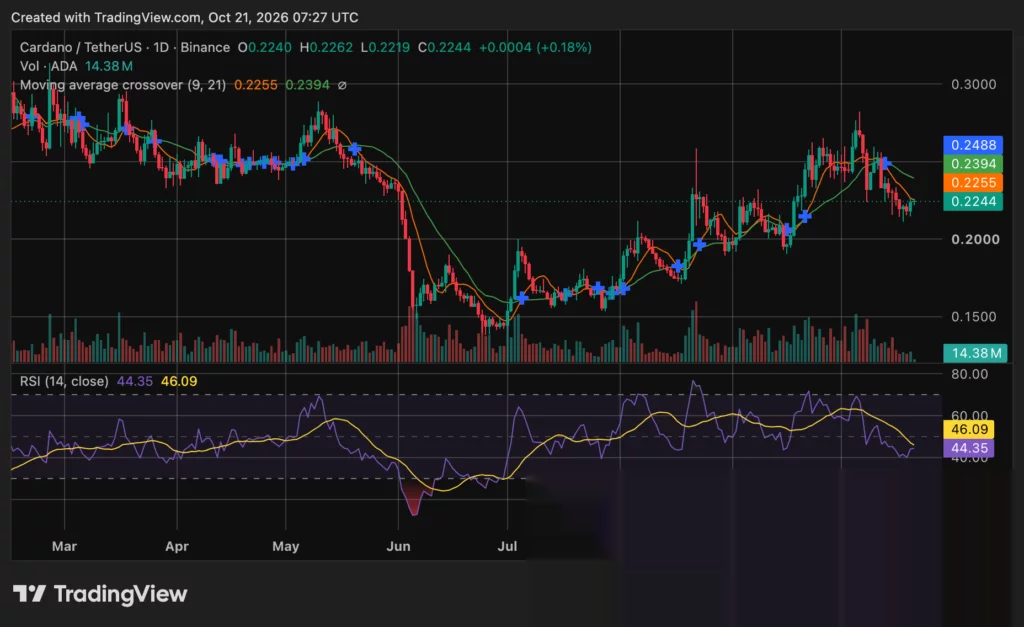
A recovery above $0.2255 would put Cardano back over its nearest moving-average resistance. The next level to watch is $0.2394, followed by $0.2488 if buying strengthens.
Support remains near $0.2200, followed by $0.2100. A sustained break beneath those levels would expose the $0.2000 psychological threshold before Martinez’s lower target at $0.17.
The Relative Strength Index stood at 44.35, below its signal average of 46.09 and the neutral level of 50. The indicator showed relatively weak momentum, although ADA had not reached oversold territory.
Another October 17 price assessment identified $0.21–$0.22 as an important support area. Analyst Nehal outlined a conditional recovery toward $0.30–$0.36, with a move below $0.21 invalidating that bullish scenario.
Market data placed ADA’s trading volume around $254 million, with the token changing hands between $0.21468 and $0.226044 during the preceding 24 hours.
Cardano remained 4.99% lower over seven days despite Wednesday’s recovery, with its market capitalization near $8.4 billion.
Cardano Foundation submits response to EU MiCA review
Outside the market, the Cardano Foundation published its MiCA consultation response on October 21, following its September 30 submission to the European Commission.
The Foundation opposed introducing separate regulatory regimes for decentralized finance and staking, recommending clearer application of existing financial rules.
Its response distinguished direct protocol-level staking from custodial services managed by intermediaries. The organization argued that regulations should depend on the activities performed and the risks involved.
The consultation covers DeFi, staking, lending, stablecoins and tokenized assets, although no legislative changes have been adopted through the review.