News Center


Global Payments Weekly | 2026 W45
 USDCHong Kong tokenized depositsCircleNigeria regulation






Emerging Crypto to Watch: ConConAI ($CON) Surges Over 100% Since Its $0.01 Uniswap Listing
This sponsored article covers ConConAI ($CON), which has more than doubled since launching on Uniswap v4 at $0.01 on November 6, trading around $0.02194 as of November 10 according to CoinGecko. It notes that two token burns have cut effective supply to 60 million and highlights the project's AI-commerce network and payment utility model for business partners. Readers are also advised to watch trading volume, liquidity depth, holder distribution, and roadmap execution, with the content not constituting investment advice.
 CONUniswap listingemerging cryptoAI Commerce
8 hours ago

Polymarket launches Nex sandbox, aims for 10x trading capacity
Polymarket has opened sandbox testing for Nex, its Rust-rewritten trading system. The engineering team says Nex can handle 100,000 commands per second, with short bursts up to 150,000—roughly 10x the capacity of its existing central limit order book (CLOB). In internal tests, p99 order latency dropped from 1.55 seconds to 3.76 milliseconds, and startup time fell from 5 minutes to 15 seconds. The team plans a four-week shadow run before deciding whether to deploy officially in mid-December. Existing request and response formats will remain compatible.
9 hours ago

South Korea's Upbit Halts Osmosis (OSMO) Transfers After Network Failure
Upbit, South Korea's largest crypto exchange, suspended Osmosis (OSMO) deposits and withdrawals on the Osmosis chain on November 13, 2026, after the blockchain stopped producing blocks and could no longer confirm transactions. Upbit cited the enforcement decree of South Korea's Virtual Asset User Protection Act as its legal basis, though OSMO spot trading continued as normal. Blockchain infrastructure provider QuickNode confirmed that Osmosis halted block production at height 74,955,152, and both Bithumb and Coinbase also reported transfer issues on the network. Despite the outage, OSMO was still up nearly 14% over the previous 24 hours.
 OSMOOsmosisUpbit
19 hours ago
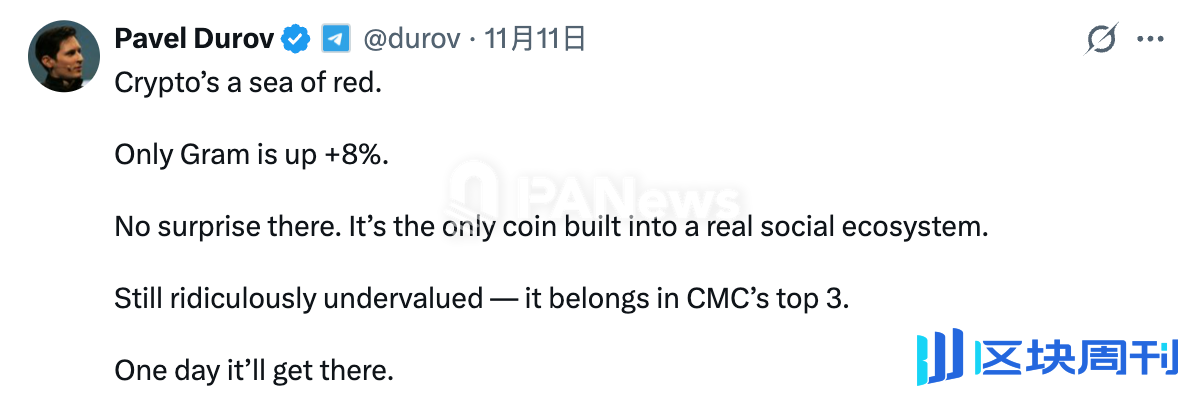
GRAM Defies the Downtrend as Durov Cries Undervalued — Can the Ecosystem Fundamentals Keep Up?
This article examines GRAM (TON)'s recent rally against the broader market and Telegram CEO Durov's claim that its market cap is severely undervalued. Durov argues GRAM deserves a top-three crypto ranking and has taken over TON again with an MTGA strategy. Yet despite Gram wallets surging to 3.53 million, daily active addresses sit at just ~1.5%, with roughly 188,000 actual holding addresses — real adoption remains limited. TON's ecosystem TVL is only about $45.74 million, far below its historical peak, with liquidity highly concentrated. Annual token inflation has risen to around 4%, adding supply pressure. The article concludes that TON still faces many challenges in moving from traffic funneling to genuine adoption.
 GRAMTelegramDurovUndervalued Market Cap
2026-11-13

Hyperliquid Burns $1.53M in HYPE Tokens in 24 Hours as Price Slips
Hyperliquid, the decentralized exchange, bought back and burned 21,200 HYPE tokens worth roughly $1.53 million over the past 24 hours at an average price of $72.31. Since launch, a total of 50.47 million HYPE—5.05% of supply, valued at about $3.51 billion—has been burned, mainly through the Assistance Fund, which automatically captures 97–99% of perpetual and spot trading fees. The AQAv2 upgrade now directs roughly 90% of yield on the platform's USDC reserves toward buybacks, and Hyperliquid has earned $1.41 billion in cumulative revenue since December 2024. HYPE has since fallen to $69.52, down from above $90 in the fall.
 HYPEHyperliquidDEX
2026-11-12

Hyperliquid Whale Keeps $9.35M Nvidia Long After Huang's Exit
A Hyperliquid whale is still holding a $9.35 million long position in Nvidia perpetual futures after CEO Jensen Huang's resignation sent the stock down about 10% premarket. The trader has also placed a $3.04 million limit order to add 20,000 units between $150.24 and $154.20. The position uses 20x cross margin and is sitting on roughly $200,000 in unrealized losses. The whale also holds a $30.69 million long in Micron, the larger of the two stock positions. The article cites Lookonchain and Hypurrscan screenshots and notes that Nvidia perpetual futures on Hyperliquid once hit $1.37 billion in daily volume.
HYPEPerpetual FuturesStock TradingHyperliquid2026-11-12

Nvidia Trader Liquidated for $1.54M After Jensen Huang Resignation
A trader on Hyperliquid had 1,599 NVDA long contracts worth $1.54 million fully liquidated after Nvidia CEO Jensen Huang's resignation sent the stock tumbling. Another trader holding roughly $31.14 million in NVDA perpetuals faces $2.17 million in unrealized losses. NVDA perpetual open interest on Hyperliquid stands at $535 million, with bullish positions carrying about $14.6 million in unrealized losses. Wall Street analysts are voicing concerns over Nvidia's leadership transition, though some believe its AI chip pipeline can still support near-term revenue.
HYPEPerpetual FuturesJensen HuangLiquidation2026-11-12

Ripple Brings Bank-Style Lending to XRPL: What It Means for XRP Holders
A lending protocol amendment on the XRP Ledger, LendingProtocolV1_1, is nearing approval with 22 of 35 validators (62.86%) on board. It needs 7 more votes and two straight weeks at 80% to pass. The related SingleAssetVault amendment XLS-65 has 23 votes. Together, XLS-65 and XLS-66 remove overcollateralization and instant liquidation, letting businesses take out fixed-term unsecured loans on XRPL much like traditional bank credit. XRP holders can deposit XRP or stablecoins such as RLUSD into single-asset vaults for shares and interest, but they take on borrower default risk.
 XRPUncollateralized Lendinglending protocolAmendment Vote
2026-11-12
Inside the XRP Ledger's Lending Plan, Where Borrowers Post No Collateral
The article examines a proposed uncollateralized lending system on the XRP Ledger: borrowers could obtain fixed-term loans without pledging crypto assets, with funds coming from shared vault depositors and off-chain loan brokers assessing borrowers and providing first-loss capital. A Nov. 10 validator vote snapshot showed 22 of 35 validators backing lending and 23 backing single-asset vaults, short of the activation threshold. It also explains vault shares, liquidity, first-loss capital release parameters, and the differences between XRP and issued tokens in freeze and clawback permissions.
XRPUncollateralized Lendingsingle-asset vaultfirst-loss capital2026-11-12

Aave Founder Kulechov Issues Stark Warning: Immutable DeFi Code Is a Hidden Danger — Lending Protocols Need Circuit Breakers
At DAS London, Aave founder Stani Kulechov warned that lending protocols relying too heavily on immutable code are dangerously exposed: if an oracle fails, the fallout could take years to unwind, making circuit breakers essential. The article revisits two 2026 stress tests for Aave — a March CAPO misconfiguration that triggered roughly $27 million in liquidations, and an April KelpDAO bridge exploit that sparked an $8.45 billion bank run. Aave V4 will adopt a hub-and-spoke architecture emphasizing modular risk isolation and the ability to freeze specific collateral. The piece also examines the governance trade-offs circuit breakers introduce.
 AAVEDeFi lendingOracle RiskImmutable Code
2026-11-12