Author: imToken
If in the past decade the core responsibility of crypto wallets was managing private keys, signing transactions, and displaying assets, then going forward, wallets may need to take on more.
Users no longer want to pay Gas separately for every transaction, want to complete multi-step operations with a single signature, want to pay fees with stablecoins, and even want to escape absolute dependence on a single private key through social recovery, session keys, and flexible permission management.
Behind these demands, they all point to the same technical direction: Account Abstraction (AA).
With the development of solutions such as EIP-7702 and ERC-4337, Ethereum accounts are gradually moving from the relatively fixed transaction execution model of the past toward a more flexible, programmable account system.
But problems follow.
When an account can not only receive assets and sign transactions, but also execute complex smart contract logic, manage different levels of authorization, and even have third parties pay Gas on its behalf, are users actually gaining more control, or are they introducing more security risks they cannot understand?
From EOA to AA: Why do Ethereum accounts need to become "programmable"?
To understand account abstraction, one must first return to Ethereum's most basic account model.
For a long time, ordinary users have mainly used EOAs (Externally Owned Accounts), which are controlled by private keys. Users sign transactions with private keys; the overall account structure is simple, the permission relationships are clear, and the transaction execution path is relatively easy to understand.
But this design also has some limitations in experience.
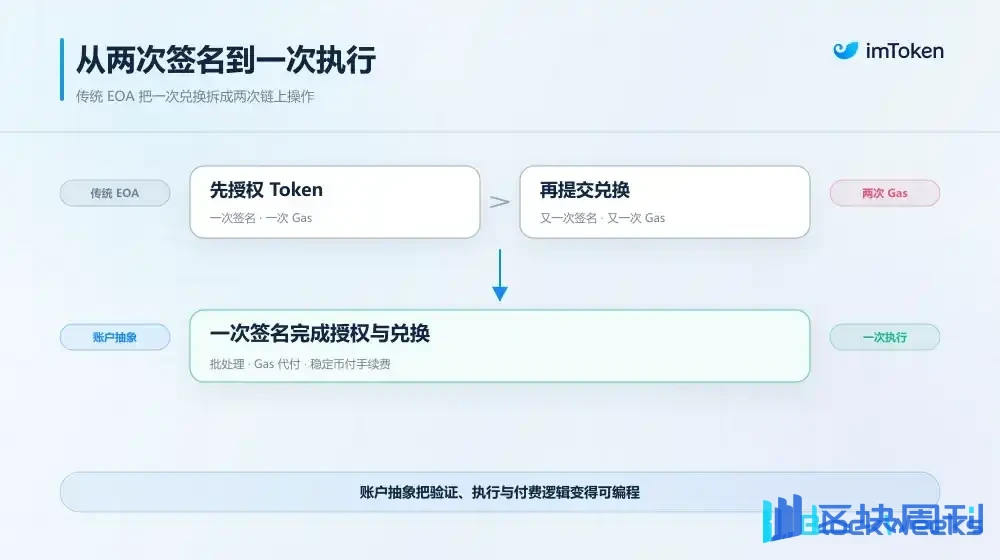
For example, if a user wants to complete a token swap on Uniswap, they often need to first approve the ERC-20 Token and then submit the swap transaction, which means two independent on-chain operations, two signatures, and two Gas payments.
If a user wants to pay Gas with USDT, or have an application bear the transaction fees for them, a traditional EOA also cannot directly accomplish these things through the account's own verification logic.
More importantly, whoever holds the private key basically holds full control of the account. It is difficult for users to directly set daily spending limits at the account level, restrict application permissions, or configure different signing rules for different usage scenarios.
What AA tries to change is precisely these limitations.
Its core idea is to make the account's verification, execution, and fee payment logic programmable, so that users no longer have to rely only on a fixed set of private key signing rules, but can define as needed how the account verifies identity, executes operations, and pays fees (Further reading: "The $3.35 Billion 'Account Tax': When EOA Becomes a Systemic Cost, What Can AA Bring to Web3?")
In the end, the greatest value of account abstraction is that it enables wallets to perform operations that were difficult to achieve in the past, but from a security perspective, this is exactly where the problem also appears.
After all, in the past users only needed to focus on whether they were signing a correct transaction and whether the signature was maliciously exploited; whereas in a smart account system, an ordinary-looking authorization may involve account execution code, permission modules, third-party payment services, and collaboration among multiple different roles.
What the user sees may be just one confirmation, but what actually happens may be a change in the entire account control logic.
From this dialectical perspective, traditional EOA accounts do seem cumbersome in experience, but they have long provided the entire crypto world with a security dividend that is easily underestimated: the relative certainty of account control relationships and verification rules.
Users hold private keys and directly sign to authorize transactions. Although private key leakage, malicious approvals, and phishing risks always exist, the account itself does not need to load complex smart contract logic to adjudicate the verification and execution of every transaction.
AA breaks this single structure.
The Other Side of AA Convenience: When Accounts Lose "Certainty"
When accounts have stronger programmability and batch execution capabilities, what users mistakenly sign may no longer be just an approval for a certain token, but may also involve account delegation, execution modules, and broader operational permissions. Once these permissions lack clear boundaries, risk will quickly spread from a single transaction to the entire account.
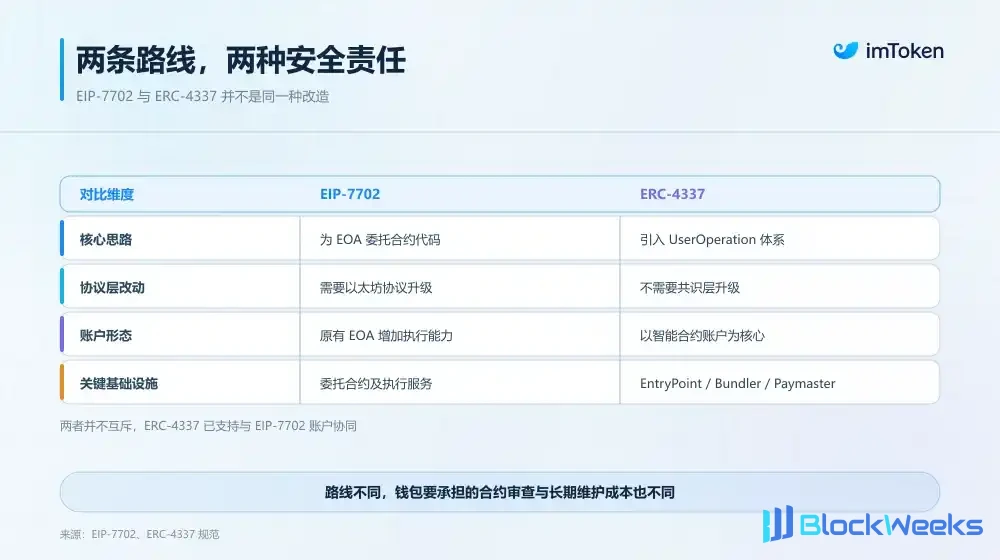
This is also why, under the AA route, although EIP-7702 and ERC-4337 both improve account experience, the risk exposure they reveal at the wallet security level is completely different. It should be noted that the two are not completely mutually exclusive solutions; the latter has already incorporated compatibility support for the former. They are discussed separately here mainly to understand their respective typical account implementation methods and the different challenges they face at the product security level.

EIP-7702: One Authorization May Change the Entire Account's Behavioral Boundary
The security proposition most worth vigilance in EIP-7702 lies in account delegation.
By signing an authorization message, an EOA with originally fixed rules can delegate itself to a deployed smart contract address and directly run according to that contract's code.
A fully audited contract with strict permissions can indeed grant existing accounts capabilities such as batch transactions and Gas sponsorship at low cost; but once it is mistakenly delegated to a malicious contract or a contract with serious vulnerabilities, the risk will directly penetrate to the account assets.
This is clearly different from regular DApp interaction. In DeFi applications, mistakenly signing a malicious approval usually puts risk first within the permission scope defined by the specific Token, approval amount, and target contract; but if the user grants an unlimited amount, the loss can likewise be very serious.
In the delegation scenario of EIP-7702, however, the authorized code runs directly in the account context. If the delegated code has unrestricted asset transfer or contract call capabilities, the risk may expand from a specific token approval to the entire account, affecting ETH, different ERC-20 assets, and subsequent transaction operations.
However, EIP-7702 does not deprive the original private key of control over the EOA. Even if the user delegates the account to a contract with multisig logic, the original private key can still directly control the account, bypassing some signing policies set by the delegated contract.
In other words, adding smart contract execution capability to an EOA does not equate to automatically tightening the permission constraints on the underlying private key. Likewise, although users can revoke a delegation by re-authorizing an empty address, the revocation action cannot roll back asset transfers and on-chain state changes that have already occurred.
This also determines that wallets must never simply regard EIP-7702 as a new signing method; they must reconstruct an entire security defense line around the authorization interface, contract identification, permission display, delegation revocation, and risk control prompts.

ERC-4337: Risks Are Not Only in the Account Contract
Unlike retrofitting existing EOAs, ERC-4337 splits account verification, transaction execution, and Gas payment into independent modules, giving developers room for flexible combination, but also burdening wallets with more complex component management costs.
From creation to being recorded on-chain, a UserOperation typically goes through an entire collaborative chain: the wallet generates the operation and completes signing → the Bundler receives the UserOperation and performs off-chain checks through the EntryPoint's simulated verification logic → the Bundler packages the operations that pass verification and submits them to the on-chain EntryPoint → the EntryPoint executes the account and payer verification logic again, and after passing, executes the actual operation.
If fee sponsorship is involved, a Paymaster is also needed to participate in verification and fee settlement; if a new smart account needs to be created, it may involve the deployment and initialization of a Factory contract.
As the number of components surges, wallets must simultaneously address more complex compatibility, operational reliability, and security review challenges. In addition, because a smart account is not simply a feature switch installed on an existing EOA, its contract implementation, signature verification method, module configuration, EntryPoint version, and supporting facilities will all profoundly affect its future evolution path.
As Ethereum gradually moves toward Native AA, how existing accounts remain compatible with the new protocol, how existing permissions are migrated, and how account addresses and assets maintain continuity all need to be taken into consideration in advance.
Ultimately, for wallets, the real cost of integrating a technology today has never been just development and launch, but also the continuous maintenance and backstopping over the coming years.

From Application-Layer AA to Native AA: Restraint and Trade-offs in the Technical Roadmap
After clearly seeing the security complexity and maintenance costs behind the two roadmaps, how wallet products should choose has actually become increasingly clear: whether to adopt a technology cannot depend only on how many features it can enable, but must also weigh technical maturity, user cognitive thresholds, and the sustainability of the long-term architecture.
Taking imToken's practice in account abstraction as an example, after evaluating multiple roadmaps, the team made a clear trade-off: maintaining a cautious wait-and-see attitude toward EIP-7702, while stopping new productization investment in ERC-4337, and gradually shifting its research focus toward Ethereum native account abstraction (Native AA).
First, regarding EIP-7702, its technical capability is worthy of recognition, but there is no rush to fully productize it.
To be realistic, EIP-7702, which has already entered the Ethereum mainnet, can enable traditional accounts to gain capabilities such as batch transactions and Gas sponsorship, and its engineering design and experience improvements are evident to all.
However, before it is truly opened to ordinary users on a large scale, several core prerequisites are still not fully mature: Can users intuitively understand the difference between "account delegation" and regular signatures? Has the industry formed a reliable consensus on security review, permission display standards, and emergency rescue for delegated contracts?
These issues are especially important in the EIP-7702 scenario. If an ordinary user cannot clearly understand what the authorization they sign means, then even if the technology itself can implement complex security policies, it may not truly improve the user's security level.
Therefore, imToken chooses a cautious wait-and-see approach toward EIP-7702, and for the time being is not in a hurry to fully introduce it into its product system, slowly waiting for the relevant implementations, permission management mechanisms, and industry practices to undergo longer-term testing. This is also out of the hope of establishing a more reliable security boundary between technical capability and users' actual ability to understand.
By contrast, ERC-4337 has already proven the feasibility of smart accounts through extensive production practice, accumulating valuable experience for the industry.
But viewed from a longer technology cycle, when Ethereum's development direction gradually points clearly toward native support at the protocol layer, continuing to expand productization investment around the application-layer account abstraction architecture requires re-weighing the continuous maintenance costs of peripheral infrastructure, as well as the compatibility and migration costs that may arise when connecting with native protocol capabilities in the future.
Therefore, imToken's decision to stop new ERC-4337 productization investment and gradually shift its research focus to Native AA is not a denial of ERC-4337's technical value. Rather, it is out of the hope of avoiding continuously stacking complexity onto the existing architecture, and instead putting limited engineering and security research resources more into the direction of native account abstraction, which has long-term development potential.
This choice also echoes Ethereum's own protocol evolution direction.
In February 2026, when updating its protocol development priorities, the Ethereum Foundation explicitly listed Native AA as one of the core efforts in the "Improve UX" direction. Its long-term goal is to make smart contract wallets the default account form, while reducing dependence on peripheral infrastructure such as Bundlers and Relayers, as well as the additional Gas overhead arising therefrom.
Among specific technical proposals, EIP-8141 (Frame Transactions) is currently one of the representative directions worth watching. It attempts to split transaction verification, fee payment authorization, and actual operation execution into different stages, allowing accounts to define verification rules and payment methods through their own logic, providing a new implementation path for protocol-layer native support of smart accounts.
Of course, EIP-8141 is still in the Draft stage, and there is still a long way to go before formal deployment and large-scale application. Native AA also does not mean that security risks will automatically disappear. Account verification code still requires rigorous auditing, and the new transaction verification and fee payment mechanisms likewise need to undergo sufficient testing.
But from the perspective of long-term architecture, compared with continuously adding features on the existing intermediate layer and maintaining complex compatibility relationships, laying out the security architecture in advance on a more native and unified protocol foundation is clearly more in line with imToken's consideration of long-term wallet security.
Closing Remarks
From the earliest private key signatures to today's batch transactions, Gas sponsorship, session keys, and smart accounts, account abstraction is continuously broadening the capability boundaries of crypto wallets.
But no matter how the technical form evolves, the most essential value of a wallet has never changed: it must not only enable users to complete more operations, but also ensure that in every interaction, users always clearly know what they have authorized and who actually controls their assets.
Returning to specific product practice, this is also the underlying logic behind imToken's recent clear trade-off on the account abstraction technical roadmap: maintaining a cautious wait-and-see attitude toward EIP-7702, waiting for a more long-term stable protocol and security paradigm; at the same time stopping new productization investment in ERC-4337, and gradually shifting its research focus to Native AA.
This is not abandoning account abstraction innovation. On the contrary, it is a pragmatic choice made based on user asset security, technical maturity, and long-term architecture evolution, so as not to prematurely translate the complexity of protocols still in a transitional period into asset risks and migration costs for ordinary users.
Ethereum's account evolution is a long-distance race. On the path toward native account abstraction, carefully evaluating technical maturity and security risks may be more important than pursuing rapid feature rollout.