Overview
Goldman Sachs is making its Financial Square Treasury Instruments Fund, known by the institutional share-class ticker FTIXX, available to qualified U.S. participants through Lynq, a real-time settlement and treasury-management network used by digital-asset institutions. The integration gives crypto-native trading firms a new way to place idle cash into an established Treasury money market fund between transactions while retaining access to capital when it is needed again. FTIXX had approximately $105 billion in net assets at the end of August 2026, making the connection notable for the scale and institutional maturity of the underlying product.
The most important point is what the FTIXX Lynq integration does not do: Goldman Sachs has not tokenized the fund. FTIXX remains a conventional money market fund, and access is facilitated through Lynq with transactions handled by SEC-registered broker-dealer tZERO Securities. The fund becomes the first outside investment fund offered through Lynq, but its existing legal structure, ownership framework and fund administration remain intact.
That makes the integration strategically different from tokenized Treasury products such as BlackRock's BUIDL or Franklin Templeton's blockchain-based fund shares. Goldman is showing that traditional assets can enter digital-asset workflows without first becoming blockchain-native securities. The development therefore raises a broader RWA question: institutional crypto markets may not need every traditional asset to be tokenized if established products can be connected efficiently to modern settlement and treasury infrastructure.
Key Takeaways
- FTIXX is now accessible to qualified U.S. participants through Lynq.
- The Goldman Sachs Treasury fund had about $105 billion in net assets at the end of August 2026.
- FTIXX remains a conventional money market fund and has not been tokenized.
- tZERO Securities provides the regulated broker-dealer layer for transactions.
- The integration gives institutional crypto firms another option for earning Treasury yield on idle cash between trades.
- The broader RWA lesson is that integration with digital rails can matter even without tokenization.
What Does the FTIXX Lynq Integration Actually Do?
FTIXX Remains a Traditional Fund Inside a Digital-Asset Workflow
The FTIXX Lynq arrangement adds a distribution and access layer rather than changing the legal form of the underlying investment product. Qualified U.S. institutional participants using Lynq can access Goldman Sachs' Financial Square Treasury Instruments Fund through tZERO Securities, allowing cash that would otherwise remain idle between digital-asset transactions to be invested in a Treasury-focused money market vehicle.
This distinction matters because headlines describing a $100 billion Goldman fund “going onchain” can easily create the impression that $100 billion of fund shares have been issued as blockchain tokens. That is not what has happened. FTIXX continues to operate within its existing fund structure, while Lynq provides the settlement and treasury-management environment through which eligible digital-asset firms can reach the product.
The $100 billion-plus figure also refers to the approximate total size of FTIXX, not capital committed to Lynq. Lynq clients represent only one additional distribution channel for the fund. The integration is therefore significant because of the product being connected to crypto infrastructure, not because the entire fund has migrated into digital-asset markets.
Why Would Crypto Institutions Want Access to FTIXX?
Institutional crypto firms routinely maintain large pools of operational cash. Market makers need liquidity to settle trades, OTC desks hold balances between client transactions, and trading firms may wait for attractive deployment opportunities while keeping substantial capital readily available. Holding that cash entirely uninvested creates an opportunity cost when short-term Treasury yields are positive.
FTIXX gives those firms a way to place capital into a traditional Treasury money market strategy when it is not immediately required for trading. When liquidity is needed again, the position can be redeemed and the cash redeployed into digital-asset markets. This is conceptually similar to traditional institutional treasury management, where short-duration government instruments are used to generate yield while preserving liquidity.
The strategic value of Lynq is therefore not simply access to another investment product. It is the ability to incorporate conventional cash-management tools into the same broader operating environment used by digital-asset firms.
What Is Goldman Sachs FTIXX?
The Fund Is Designed Around Treasury Liquidity Rather Than Crypto Exposure
FTIXX is an institutional share class of the Goldman Sachs Financial Square Treasury Instruments Fund, a money market fund focused on U.S. Treasury securities. Its investment objective centers on preserving capital, maintaining liquidity and generating current income rather than taking directional exposure to risk assets.
This is important because FTIXX serves a very different function from Bitcoin, stablecoins or tokenized private credit. It is closer to a treasury-management instrument used for short-term liquidity than to a speculative investment. For institutional digital-asset firms, that makes the fund potentially useful as a parking place for operating balances that need to remain relatively liquid.
As with any money market fund, the risk is low relative to many other assets but not zero. Goldman Sachs' own disclosures note that an investor can lose money and that shares are not bank deposits and are not FDIC insured or guaranteed by another government agency. The fund seeks to preserve a stable share price, but that objective should not be described as a guarantee.
Why Does a $100B Traditional Fund Matter for Crypto Markets?
The Scale Signals Institutional Convergence, Not $100B of Crypto Inflows
FTIXX had approximately $105 billion in net assets at the end of August 2026, but none of that figure should be interpreted as new money moving into crypto. The fund existed long before the Lynq integration, and the overwhelming majority of its assets remain part of traditional money-market activity.
The significance lies in the opposite direction: digital-asset firms are being given a direct route into a mature traditional financial product. Instead of forcing crypto institutions to choose between remaining entirely inside digital assets or moving funds through a separate legacy workflow, Lynq is trying to place both environments within a more unified treasury-management process.
That is an important form of institutional convergence because it lowers the operational distance between TradFi liquidity products and crypto trading infrastructure. A digital-asset firm can potentially move from trading activity into a Treasury fund and back into market liquidity without requiring the underlying Treasury exposure itself to become a blockchain token.
This suggests that institutional crypto adoption may develop through infrastructure integration as much as through direct asset tokenization.
Does Every RWA Need to Be Tokenized?
FTIXX Lynq Shows a Second Path for TradFi–Crypto Integration
The FTIXX Lynq model offers a useful contrast with tokenized Treasury funds. Products such as BUIDL or blockchain-recorded money market shares place the fund interest itself onto distributed-ledger infrastructure. FTIXX instead preserves the conventional fund and adds a digital-asset-oriented access and settlement layer around it.
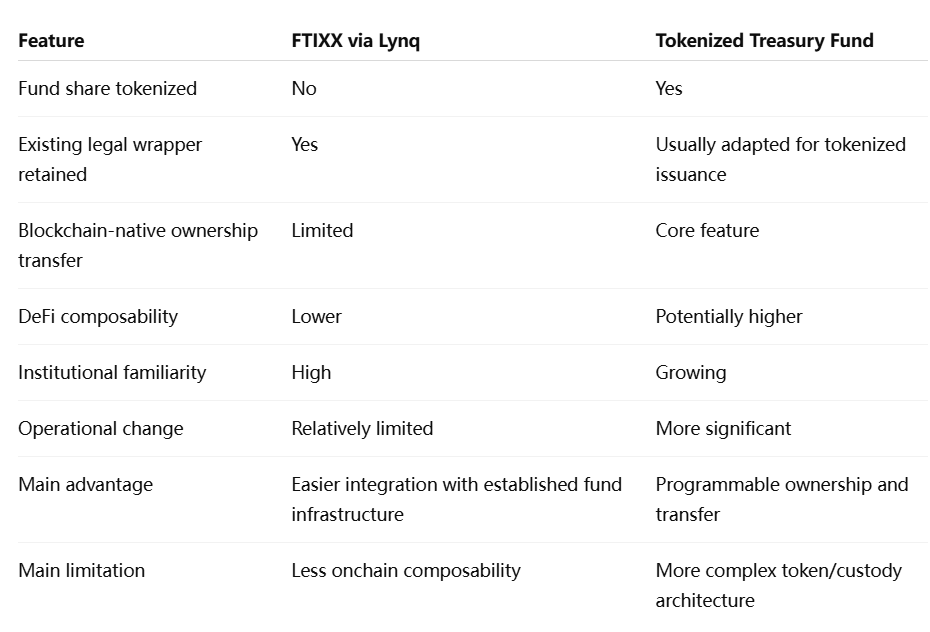
Neither model is inherently superior. Tokenization can enable programmable ownership, self-contained settlement and potential integration with lending or other smart contracts. However, it also introduces additional questions around wallet custody, token transfer restrictions, blockchain compatibility and integration with existing securities law.
The FTIXX model sacrifices some of that composability in exchange for keeping a mature fund structure intact. For institutions that primarily want Treasury exposure and efficient cash management rather than DeFi functionality, that trade-off may be entirely acceptable.
The market may therefore evolve through both approaches. Some assets will benefit from being fully tokenized because programmability is central to their use case. Others may achieve faster institutional adoption simply by being connected to digital-asset infrastructure without altering their underlying legal form.
Why Is Cash Management Becoming Important for Crypto Institutions?
Yield on Idle Cash Is Becoming Part of Trading Infrastructure
As digital-asset markets institutionalize, treasury management is becoming more important. Professional trading firms do not evaluate capital only by potential crypto returns; they also care about counterparty exposure, settlement speed, idle-cash yield and how quickly funds can be redeployed.
During periods of high volatility, firms may need to keep substantial cash balances available to support margin, settlement or client transactions. Holding all of that capital in zero-yield operational accounts creates a meaningful cost. Access to Treasury money market funds can improve the economics of holding liquidity between trades.
This is especially relevant as risk management becomes more conservative across institutional crypto markets. After multiple cycles of counterparty failures, firms increasingly differentiate between assets used for directional investment and reserves used for operations. A traditional Treasury fund accessed through a digital-asset settlement network fits naturally into the latter category.
The integration therefore reflects a broader change in institutional crypto infrastructure: the industry is no longer focused only on executing trades. It is increasingly building the cash, collateral and settlement systems required to manage capital between those trades.
How Does Lynq Fit Into the Institutional Stack?
Lynq Acts as a Settlement and Treasury Layer Rather Than an Asset Issuer
Lynq describes itself as a broker-dealer-operated real-time settlement and treasury-management solution for institutional digital-asset clients. The platform is designed to address issues such as market fragmentation, counterparty risk and the need to earn interest on liquidity that remains between transactions.
The addition of FTIXX broadens that role because Lynq can now connect participants to an external Goldman Sachs fund alongside its existing investment functionality. tZERO Securities provides the regulated broker-dealer capability required to support access for qualified U.S. participants.
This structure is important because Lynq is not replacing Goldman Sachs as fund manager or transforming FTIXX into a new digital security. It is acting as connective infrastructure between institutional crypto firms and established financial products.
That model may become increasingly common as digital-asset market infrastructure matures. Instead of every financial institution issuing a new token, specialized networks can connect regulated products, brokers and settlement systems into workflows that feel more native to crypto firms.
What Are the Main Limitations?
FTIXX Is Not a Blockchain-Native Asset
The most obvious limitation is also the model's defining feature: FTIXX itself is not tokenized. Its shares cannot simply move permissionlessly between wallets or plug directly into DeFi protocols as collateral in the same way a blockchain-native fund token potentially could.
This reduces composability. If a crypto institution wants to use Treasury exposure inside a lending protocol, automated market maker or smart-contract strategy, the conventional FTIXX structure may be less flexible than a tokenized Treasury fund.
There are also eligibility and onboarding requirements. Access is intended for qualified U.S. participants who establish the required relationship with tZERO Securities and satisfy compliance checks. The integration is therefore an institutional service rather than an open DeFi product.
Finally, liquidity is not identical to holding cash. Money market fund redemptions, operational cut-offs and settlement arrangements still matter. Institutions need to understand how quickly capital can be returned to active trading under different market conditions rather than assuming the fund behaves exactly like an onchain stablecoin.
MEXC View: The Next RWA Wave May Be Integration, Not Tokenization
The institutional bridge between traditional finance and crypto may not require every asset to be issued onchain. In some cases, connecting mature investment products to digital-asset workflows can deliver practical benefits faster and with less structural change than rebuilding the asset itself as a token.
FTIXX Lynq illustrates that distinction. The fund remains a traditional Goldman Sachs money market product, while the access layer moves closer to the operational environment used by digital-asset institutions. For firms primarily concerned with Treasury yield, liquidity and counterparty management, that may be more important than whether the fund share itself exists as an ERC-20 token.
This suggests that RWA adoption should not be measured only by tokenized asset value. Another important metric will be how much traditional financial infrastructure becomes usable within digital-asset settlement, collateral and treasury workflows. Tokenization is one route to convergence, but interoperability and distribution can produce similar economic integration through a different architecture.
FTIXX Shows TradFi Can Enter Crypto Without Tokenizing Everything
The FTIXX Lynq integration is significant precisely because Goldman Sachs has not transformed its roughly $100 billion Treasury fund into a blockchain token. FTIXX remains a conventional money market fund, while Lynq and tZERO provide qualified digital-asset institutions with a new way to access it inside a modern settlement and treasury-management environment.
That distinction prevents the headline from being overstated. The fund's approximately $105 billion in assets did not move onto Lynq, and the integration should not be described as $100 billion of new crypto capital. What changed is the distribution architecture: institutional crypto firms can now place idle liquidity into an established Treasury product and redeploy that capital when needed.
The model also expands the RWA discussion beyond tokenization. Fully tokenized funds can offer stronger programmability and DeFi composability, while conventional funds connected to digital rails may provide regulatory familiarity and faster institutional adoption. Both approaches solve different problems.
For institutional markets, the most important outcome may be whether digital-asset firms can manage cash, collateral and settlement with the same sophistication as traditional financial institutions. FTIXX Lynq suggests that the bridge between the two systems does not always require replacing existing assets. Sometimes the more practical step is to connect them.
Sources
https://www.tzero.com/news/goldman-sachs-ftixx-comes-to-lynq-powered-by-tzero
https://www.goldmansachs.com/pressroom/press-releases/2021/loop-capital-and-goldman-sachs
Risk Disclaimer: This article is for reference only and does not constitute investment advice. The cryptocurrency market is highly volatile. Please make decisions cautiously based on your individual circumstances.