
Original | Odaily Planet Daily (@OdailyChina)
Author|jk
The testnet launch of Ethereum's next hard fork, Glamsterdam, has been indefinitely postponed, and the core dispute is that two of its gas repricing proposals, EIP-8037 and EIP-8038, may render a large number of already-deployed contracts unusable. Analysis says that about 200,000 deployed contracts are affected. Currently, neither the mainnet nor the Hoodi testnet has an activation date, and developers are weighing two paths: delay and revise the specification, or remove EIP-8037, while application-layer projects have already begun to withdraw early.
How it happened: Hoodi testnet upgrade has been paused, mainnet date undecided
Glamsterdam was activated on the Sepolia testnet on October 6. The activation originally scheduled for the Hoodi testnet on October 26 was postponed at the ACDE #248 meeting on October 22, only four days before the originally planned activation date. The Ethereum Foundation's stated reason was the need to further investigate the interaction between EIP-8037 and mainnet smart contracts.
The plan originally scheduled for the same period to raise the Hoodi block gas limit to 200 million was also canceled.
In plain terms, the original sequence was:
- Developers repeatedly trial-ran on multiple rounds of internal development testnets, and this step has been completed.
- Official launch on the Sepolia testnet, completed on October 6.
- A final large rehearsal on the Hoodi testnet, originally scheduled for October 26; this step has been postponed and there is currently no new date.
- After the rehearsal goes smoothly, then set the mainnet activation date. The original plan was the fourth quarter of 2026, and there is no specific date yet.
That is to say, what has been postponed is step 3. Step 4 has not yet begun, so mainnet users are currently unaffected. The reason it stopped at step 3 is that testing found that the new gas (which can be understood as the fee for on-chain operations) rules may cause a batch of contracts already running on-chain to malfunction, and developers need to first decide whether to change the rules or continue pushing forward.
On November 6, the Ethereum Foundation further stated: before these issues are resolved, it will not execute the fork on Hoodi. Currently, neither Hoodi nor the mainnet has an activation date. According to the official roadmap, Glamsterdam's previous goal was to launch on the mainnet in the fourth quarter of 2026. Multiple media outlets believe that this goal can no longer be achieved.
After the new proposal takes effect, 200,000 contracts will be affected
Any operation on Ethereum requires paying gas. EIP-8037's new rules raise the fee for opening a new storage slot on-chain to about 5 times, because such data will be carried long-term by all network nodes and is a heavy burden. The new rules can make gas pricing closer to the real workload of operations and control state growth while the gas limit continues to increase.
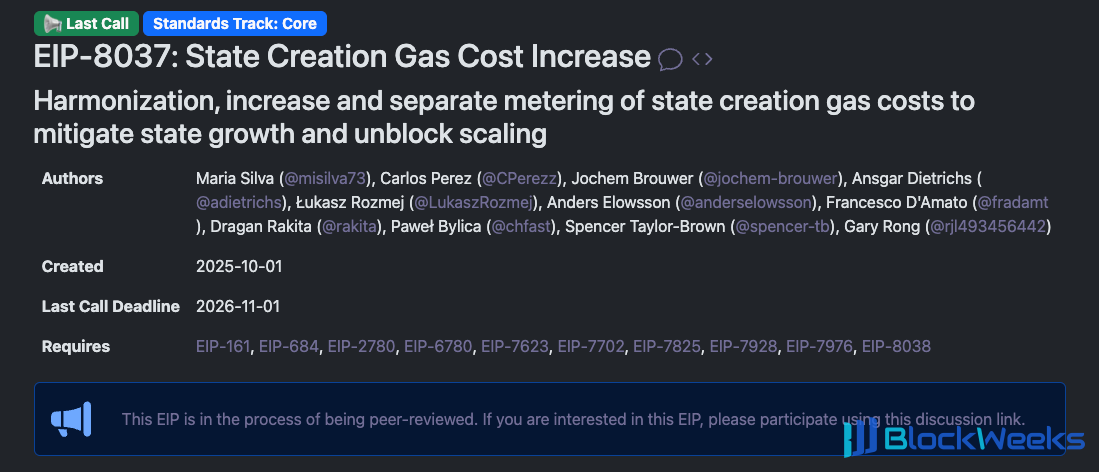
EIP 8037, source: official website
The trouble is that many contracts already running on-chain have hardcoded in their code approximately how much fee this step should cost, or rely on how much fee remains to determine whether the next step should be executed. Once the fee rises, the amount that was originally sufficient may no longer be enough, and judgments originally based on the fee as a condition may also fail. This is like water and electricity prices rising while the budget cap for automatic deductions has not been changed accordingly, resulting in failed deductions; if there are other programmatic judgments related to water and electricity fees, they will also run into problems together.
Once a contract is deployed, it is difficult to modify, which is why developers first need to determine how many contracts will malfunction.
On August 24, the Ethereum Foundation conducted a preliminary assessment. At that time, the result of replaying historical mainnet transactions was that only a small number of contracts were affected, and many could be fixed by raising the gas limit. Now the Foundation has jointly reviewed with ChainSecurity and Dedaub, and the resulting analysis says that about 200,000 deployed contracts are affected.
November 19 developer meeting: two paths, either way means another delay
Ethereum upgrades are not decided by a single company, but jointly by several client teams. Each team writes a set of software for running Ethereum nodes, with the common ones being Geth and Besu. These teams hold regular meetings to discuss, and the one on November 19 was the 249th. At this meeting, the focus of discussion had shifted from whether to delay to how long to delay.
Before the meeting, the Besu team submitted a written position on the developers' public collaboration page: in their view, there are now only two paths, and both require delay.
- Path one: delay the upgrade, make the rule causing the problem (EIP-8037) smaller, and then launch. The cost is abandoning the Sepolia testnet, which was already unmaintained.
- Path two: proceed with the upgrade as usual, but remove this rule entirely and leave it for the next upgrade, Hegotá. The problem is that other features depend on it, so it must be rechecked for safety, and one of the flagship features of this upgrade, BAL (used to improve node processing efficiency), will be weakened.
Besu favors path one and opposes launching with changes that would break old contracts.
The Geth team raised two objections on the spot. First, there is actually a third path, which is to change nothing and launch directly as things stand; second, path one can only save a small number of contracts, while most contracts have problems because they hardcoded fee values, and as long as the fee rules change they cannot avoid it, and most old contracts will still be broken.
Besu's response was: both paths require delay and both require abandoning Sepolia, and the only difference is how much more testing is needed. They also clarified their bottom line: losses caused by hardcoded fees are acceptable; but if the fallback pattern in contracts when errors occur (try/catch) fails, or if new problems arise because the fee cap is raised, that is unacceptable.
External reports estimated the new timeline: if the rules are not changed, the mainnet will launch at the earliest in mid-January 2027; if a plan is not decided until January, it will be pushed to late February to early March; if the decision is to change the rules, then it will be April–May 2027. There is currently no conclusion.
Alternative proposals and affected applications
To prevent old contracts from being broken by the new fee rules, developer Leo Glisic proposed an approach called EIP-8488, which is currently only a draft. The idea is that old and new contracts each use their own rules. Old contracts already on-chain before the upgrade continue to run under the original fee rules and are unaffected. New contracts deployed only after the upgrade use a new set of instructions (called the V2 version) and are charged under the new, more expensive rules. This can both advance the new rules and prevent existing contracts from malfunctioning overnight.
Another developer, Giulio Rebuffo, also submitted a competing proposal with the same goal of preventing existing contracts from having problems. EIP-8488 is still in the discussion stage and has not entered the formal agenda of the developer meeting, so it is still some distance from being adopted.
1inch reminded users participating in resolver delegated staking that they need to claim 1INCH rewards and undelegate before November 27, or the rewards may be lost after the deadline. The project said the reason is that Glamsterdam's new gas rules make the relevant contracts no longer safe to use.
The Foundation, ChainSecurity, and Dedaub have collectively contacted at least 50 affected companies. Among them, 3 projects were listed as high-impact, and fixes have been completed or are expected to be completed by mid-December.
In addition, after this upgrade there is another upgrade, Hegotá, planned to be launched in 2027. The developers stated that its preparations are still being pushed forward at full speed and are not affected by this postponement.