Original | Odaily Planet Daily (@OdailyChina)
Author|Azuma (@azuma_eth)
Last night, the decentralized perpetual contract exchange Lighter (LIT) held its third-quarter investor call via webcast. As a rare project in the industry that discloses information according to standards similar to those of listed companies, Lighter's call last night gave investors an opportunity to further understand Lighter's current specific progress in compliance, products, ecosystem partnerships, and other aspects.
Driven by the positive news disclosed during the call, LIT surged overnight to around $4, and as of publication it is temporarily at $3.65, a 24-hour increase of 7.23%.
The following are the core information from the call compiled by Odaily Planet Daily based on the video. The live call lasted about 41 minutes, of which the first 26 minutes consisted of Lighter founder and CEO Vladimir Novakovski alone presenting project information disclosure, and the last 15 minutes consisted of Vladimir answering various topics of concern to the community.
CEO Information Disclosure
I. Overview of Q3 Core Data
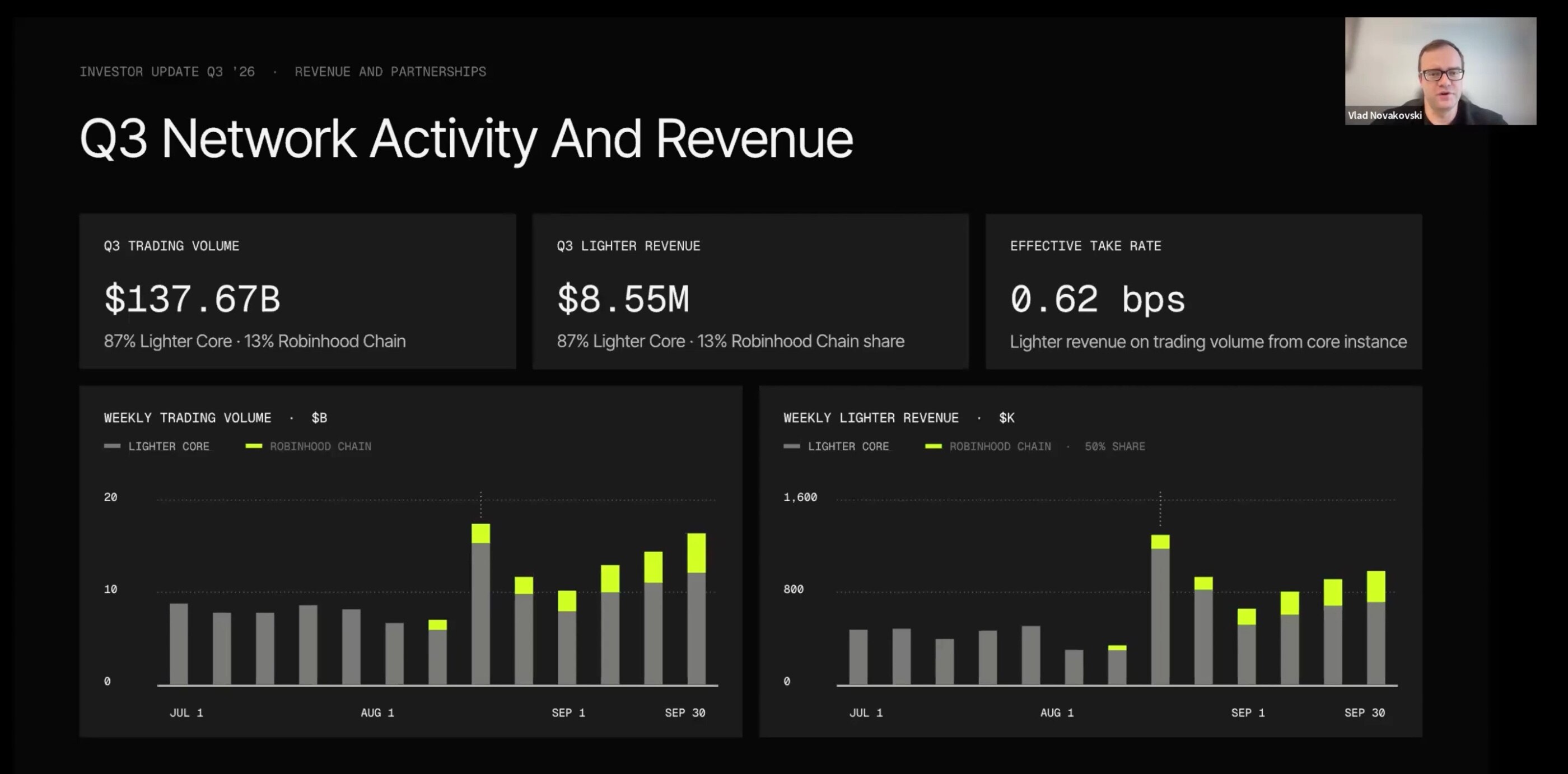
In the third quarter, Lighter's total trading volume reached $137.67 billion; open interest also grew substantially, roughly doubling compared with the previous quarter — as of September 30, total open interest on Lighter Core and Lighter Robinhood exceeded $1.64 billion.
On the token side, in the third quarter we repurchased 2.45 million LIT, and these LIT have already been burned on Ethereum.
The total number of accounts on Lighter Core has surpassed the 1 million mark; as of the end of Q3, Lighter Robinhood also had nearly 40,000 accounts. It is worth noting that nearly 70% of the open interest on the Robinhood instance is concentrated in RWA. Therefore we can see that Lighter Core continues to attract a higher proportion of crypto-native traders, while Lighter Robinhood attracts a higher proportion of RWA traders.
In the third quarter, Lighter's total revenue was $8.55 million. Compared with the previous quarter, Lighter's effective take rate increased — it was around 0.5 basis points (bps) last quarter and is now around 0.62 basis points, which means stronger revenue capability.Special mention should be made of Lighter Robinhood, which was launched just one quarter ago. As of the end of the third quarter, open interest on Lighter Robinhood had reached nearly $500 million ($454.1 million), and after the 50/50 split, the trading fees attributable to Lighter had already exceeded $1.1 million.
In the third quarter, we also did a lot of work to expand revenue sources. Although standard trading remains free, Lighter is doing more to serve "prosumer"-type traders. For example, Lighter has launched advanced order types, and now charges a fee of 1 basis point (1 bp) for these advanced order types; at the same time, for traders who place great importance on lower latency, Lighter has also added additional membership tiers (Plus and Premium), which directly drove an increase in the premium taker share — from 13.1% at the end of Q2 to more than 18.2% at the end of Q3.
II. Partner Expansion
Building on the progress made in Q3, we will reach partnerships with more partners in Q4. We will announce these partnerships one by one when they officially launch, but today we can give a general introduction to the main types of these partnerships:


- The first type of partner is crypto wallets: These users are themselves crypto-native users who are already using a certain wallet product and want to trade perpetual contracts at low cost, low latency, and with all the high-quality features Lighter offers. Through integration, they can complete trades directly within the wallet product. Several such integrations went live in Q3, and some larger same-type partnerships will go live in Q4.
- The second type is centralized exchanges: The potential market is not limited to wallets; broadening the view a bit further brings us to centralized exchanges. We recently spent a few weeks in Asia and met with many partners in this category. Essentially, centralized exchanges want to provide their customers with better liquidity and open up perpetual contract and other derivatives trading in a cost-effective and easy-to-integrate way. Several such partnerships are currently in progress, and there will be more in the future.
- The third type is US financial apps: Going further, once our US version of the Lighter product (US instance) officially launches, Lighter can integrate not only with crypto-native wallets or centralized-exchange-type products, but also cover a broader market. For example, people who want to trade Pre-IPO perpetual contracts, or people who want to trade 7×24 on-chain options, can actually do so through "US local financial apps" that have integrated licensed exchanges. Although all the above market opportunities are important, the third direction is a goal Lighter has been working toward for a long time, covering our infrastructure, technology, and regulatory strategy.
In addition, Lighter's go-to-market team has also grown considerably, enabling us to work in parallel across all these verticals.
III. Buybacks and Unlocks
Lighter began executing its buyback plan at the beginning of this year, using 100% of trading revenue to repurchase LIT.As of the end of Q3, Lighter had cumulatively repurchased more than 18.09 million LIT, of which 2.45 million were repurchased in Q3; we also recently announced that the number of tokens burned through buybacks has exceeded 7% of the initial 250 million circulating supply.
At the same time, 109.8 million LIT are currently staked, accounting for 47.3% of the remaining circulating supply, which is also a fairly considerable proportion.
Another key event is the token unlock. Lighter had already announced the specific unlock rules at the time of the TGE (Token Generation Event), so let me recap them for everyone here — Lighter has no cliff unlocks (No cliff unlocks); all unlocks will be completed linearly over 36 months.

The first unlock will occur on January 29, 2027. Over the past few months, we have been actively communicating with existing equity/token cap table investors on this matter, so we are very clear about everyone's position. The vast majority of existing investors are highly long-term-oriented investors, and their asset allocation thinking will not be affected by these unlocks. At the same time, however, a very good opportunity has also emerged to bring in new strategic investors (such as some of the large partners mentioned earlier) — in the process of working with Lighter, they very much hope to allocate LIT tokens on a large scale, with demand far exceeding the scale they can buy directly in the secondary liquid market. Therefore, we can use the intention of a very small portion of existing investors to participate in order to bring in these strategic investors, and we are currently advancing this process. I think this will be a win-win outcome, allowing us to bring in strategic investors while also reaching large business partnerships.
IV. Technical Progress
On the technical side, this quarter Lighter made very significant progress in reducing zero-knowledge proof (Proving) costs. Since the beginning of this year, Lighter has reduced overall proof costs by more than 50%, among which the efficiency of internally built circuits and business logic improved by 3 to 4 times; another very important metric is that the average block proof time (Average block proof time) has been shortened from more than 5 minutes to about 1 minute, equivalent to an 81% reduction in time.
Lighter has also invested more in open source, especially that we have open-sourced a client foundation library for building on Lighter, which to a large extent contributed to the rapid launch of many partners recently.
LighterEVM has also made great progress. We expanded the architecture design of LighterEVM so that synchronous reads (Synchronous reads) can now be performed from Lighter Core, asynchronous transfers and order management can be carried out, and fully on-chain vaults (Vaults), requests for quote (RFQs), fiat onramps (Onramps), and trading applications are supported. At the same time, all standard EVM tools can be used directly and settled on Ethereum through zero-knowledge proofs (ZK).

We plan to launch the LighterEVM mainnet before the end of this year, and we are very satisfied with our cooperation with Axiom in this regard. In the early testnet Beta version, we collected a large amount of feedback, and the synchronization performance is now stronger, enabling more types of applications to run smoothly on LighterEVM. Launching the mainnet before the end of the year is one of the key priorities for our core engineering team in Q4.
V. Options Products and Unified Margin
Another top priority for us is options (Options). I believe many people have seen that we just launched binary options (Binary Options) this week. Binary options are only a starting point; currently they support price-based contracts.
What we are developing next are vanilla options (Vanilla Options), that is, calls (Calls) and puts (Puts), which are very important in traditional finance (TradFi), namely European-style options. Recently we have recruited several key talents in this field — of course I myself also traded options many years ago, but now we have dedicated team members fully advancing this work on the technical, liquidity, and product sides. Our timeline is to launch vanilla options before the end of this year.
Related to options, we have been building a unified risk engine (Risk Engine) that allows spot, perpetual contracts, and options to calculate margin on a combined basis. This feature will be launched together with vanilla options by the end of this quarter.
Let me briefly explain this feature. Currently, although collateral is shared within the account, the margin requirement for each position is calculated independently; after introducing portfolio margin (Portfolio Margin), Lighter will evaluate spot, perpetual contracts, and options under the same asset together and calculate what the worst realistic loss (Worst realistic loss) would be if the market fluctuates sharply. If a user holds positions that hedge each other — for example, being long one call option while being short one perpetual contract — this should reasonably be more capital efficient than holding these two independent positions separately. Because the worst-case loss becomes smaller, the margin that needs to be posted is also less.
This will bring significant capital efficiency improvements and is also the standard way professional trading institutions run options books. Since all these trading instruments run on top of Lighter, the entire portfolio can operate without transferring collateral back and forth. This not only improves capital efficiency for ordinary users, but also for market makers — when market makers' capital efficiency improves, they can quote tighter spreads (Tighter spreads) and deeper order books (Deeper books), which in turn benefits retail users.
VI. Regulatory Progress
Now turning to the regulatory side. Our communications with the U.S. Commodity Futures Trading Commission (CFTC) are continuing to move forward.
In August of this year, I was honored to attend the first meeting of the CFTC Innovation Advisory Committee (Innovation Advisory Committee). During the meeting, we also continued to advance communications directly with the CFTC Chairman's Office and various relevant departments to discuss our licensing application path. This licensing path will actually cover both perpetual contracts (Perps) and options (Options), because both are regulated by the CFTC.
Why are we doing this? Why is it so important? Because in the United States — the world's largest financial market — expanding retail and institutional participation will open up huge market opportunities for Lighter and on-chain trading. Therefore, our team has invested a great deal of time in this area, insisting on "going in through the front door" (Going in through the front door) and spending time going through the rules item by item with various CFTC departments.

Our current goal is to obtain DCM (Designated Contract Market) and DCO (Derivatives Clearing Organization) licenses.
- DCM is the license that allows you to operate a trading market; functions such as order book management (Order book management) fall under the DCM category;
- DCO is the license used for market clearing; for example, how the clearing mechanism (Liquidations) operates, how auto-deleveraging (ADL) operates, and so on all fall under the DCO category.
We have spent a lot of time going through the core principles item by item with CFTC staff — there are 23 core principles for DCM and 18 core principles for DCO. Many of these principles, under the existing regulatory framework, can already be mapped very clearly to how Lighter implements them on-chain; for some other principles, our approach is a "novel implementation" (Novel implementation), which is new to regulators, but they have now spent a lot of time communicating with us to understand how it works.
This is the "pre-engagement" (Pre-engagement) work we have been doing. The next plan is that we will formally submit the application documents for these licenses next month (November 2026). After submission, regulators have a statutory period of up to 180 days to conduct review. Because we have already completed all this preliminary preparation work, we expect the subsequent review process to go very smoothly. We are very excited about obtaining these licenses in the United States and fully opening up to retail and institutional users in the U.S. market. This is currently a very important priority for our team.
Investor Q&A Session
Prior to this conference call, Lighter had already solicited questions from investors via a public link. At the meeting, Trevor King, Lighter's Head of Investor Relations, on behalf of investors, posed the questions with the highest vote counts to Vladimir, as well as questions mentioned in investor comments during the livestream.
Q1: How do you address AI-driven hacker attacks and security assurance?
Vladimir: Yes, this is a very important question. By the way, security and AI are also topics we discussed extensively at the CFTC advisory committee meetings and across the industry.I think we are in a very favorable position on security because we adopt a security-in-layers approach. As an Ethereum L2, this security structure was embedded into our architecture from the very beginning of its design.
- Multiple cross-verification (Swiss cheese model): Every state change on Lighter is first executed by the Sequencer, then proven by ZK circuits, and finally verified by our smart contracts on Ethereum, with Guardians also providing checks in between. This means the sequencer and the circuits enforce the same rules through two independent code implementations, forming a cross-check with each other. We call this the "Swiss cheese model," with a large amount of redundant protection built into the architecture.
- Internal and external security audits and AI formal verification: On top of that, we continuously conduct security reviews and testing together with internal teams and external security teams. As everyone knows, before founding Lighter, our team itself was doing AI development, so we are very familiar with various AI tools and have a deep network in this field. We are currently using AI tools very actively — from basic testing to formal verification, using these tools to formally verify our most core components.
- Settlement time window buffer: Finally, our architecture also provides a natural security time window. Because there is a certain amount of time between trade execution and finalization on Ethereum, if any abnormal situation really occurs, we have ample time to monitor abnormal activity and respond before funds actually move on Ethereum.
Of course, there is always a great deal of work to be done in the security field, and it is also our top priority, but I think that by virtue of the underlying architecture with which we built Lighter, combined with our past experience in AI, the two together provide us with a very solid security guarantee.
Q2: How does the joint settlement between Lighter Core and LighterEVM work?
Trevor: We actually received several questions about the EVM as well. One of them asked: "Very curious about the joint settlement between Core and LighterEVM. How exactly does merging the two into one proof help in terms of interoperability, cost, or security?"
Vladimir: Okay, let me explain in detail how it works. Every EVM block points to the latest available Core state version. Async transfers and orders work in such a way that Core executes them in its own sequence, while EVM calls do not need to wait for their results and do not block other Core transactions.
Once both sides have submitted data to their respective Inbox and Outbox, we have a component called the aggregation circuit, which enforces that the data on both sides are exactly equal. Therefore, ultimately only one zero-knowledge proof is needed to settle the states of both Lighter Core and LighterEVM to Ethereum simultaneously.
This brings enormous efficiency gains — no need for a cross-chain bridge; no need to introduce new trust assumptions; only one verification on Ethereum L1 instead of two. This design not only significantly reduces costs but also reduces latency between the two.
Q3: Distribution channels in the U.S. market and the current status of the Robinhood partnership
Trevor: We also have many questions about the U.S. market. Some people asked, besides Robinhood, what will Lighter's distribution channels in the U.S. look like? Perhaps this is a good opportunity to talk a bit more about the Robinhood partnership and its current progress.
Vladimir: Obviously, the U.S. market is extremely large. Even among the "crypto-native wallets" we just mentioned, some are operated by U.S. companies, and we are currently actively advancing partnerships with them.
As for Robinhood Wallet, we are its exclusive partner for perpetual contracts. Back in 2013, I was Robinhood's first advisor, so I have first-hand deep understanding of this — they are extremely cautious about regulatory compliance and will never do anything in a gray area; instead, they want to make sure they "go through the front door" and strictly comply with all core regulatory principles.Therefore, once our U.S. licenses are in place, as long as it fits their product logic, we will be able to integrate into different product lines of their U.S. domestic business — whether perpetual contracts or options. Of course, as is always Robinhood's operating principle, all of this depends on the approval of U.S. licenses.
In addition, if you look at the CFTC's regulatory system architecture, at the bottom there are the DCO (clearing) and DCM (trading market) I just mentioned, and above them are FCMs (Futures Commission Merchants). FCMs are like brokers that route orders to exchanges.Once we obtain the DCM and DCO licenses, we can carry out such integrations with a large number of FCMs.
Ultimately, our view is that building technology in a verifiable, decentralized way not only means better technology, but also a better experience for customers, while also bringing a superior cost structure. Among these potential partners, some place great importance on how the underlying system is built, while others are purely attracted because they see this as the solution with the lowest latency, lowest cost, and extremely strong emphasis on regulatory compliance. We currently have a series of such partnerships in progress — some on the wallet side, some on the centralized exchange side, and some that are more traditional finance (TradFi)-type applications.
Q4: Is the CFTC approval process public? Can approval be obtained earlier than within 180 days?
Trevor: Several users want to learn more about the CFTC approval and application process. They asked: "When we submit the application, will it be public? Or do we need to share it only afterward?"
Vladimir: These processes are transparent, and I think they should be. We are going through all these core principles one by one and mapping them to how Lighter's technology operates — and Lighter's technology itself is open source and verifiable. So we very much welcome this transparency, which is also the approach favored by the CFTC.
Trevor: Understood, a very good answer. Following up on that question, people keep submitting related questions: "Considering that we have already done so much pre-engagement work, do you expect the license to be approved earlier than the CFTC's statutory 180-day review window?"
Vladimir: Yes, we certainly hope that all the communication work done in advance — including working with regulators to map out how DeFi corresponds to DCM requirements, and more importantly DCO requirements (such as understanding how auto-deleveraging, ADL, maps to the core principles) — will make the subsequent formal review process much smoother.
As for the exact timeline, obviously it is difficult for us to give a precise date. Although we know we are an important player in the ecosystem, the CFTC obviously has many other matters to handle.However, we know that the team at the CFTC is a very fast-moving one, and our experience working with them so far has been very good, so we expect the whole process to go smoothly.
Q5: How does the go-to-market (GTM) team allocate its efforts?
Trevor: Regarding go-to-market, how does the team allocate its efforts? How is it divided between crypto-native teams and institutional partners (such as partners at the level of Robinhood)?
Vladimir:Currently our go-to-market team already has more than 10 people, so we are fully capable of "walking and chewing gum at the same time" (meaning advancing multiple lines in parallel).
I think our current allocation of efforts is quite balanced. As I said, options are a new vertical, and we also have a new team member dedicated to this area; 2 team members focus more on institutional-level partnerships; and 3 team members focus more on partnerships with crypto-native ones.
We are a highly collaborative team, and there are absolutely no departmental silos or people working in isolation. In addition, we are also very strong in developer relations and forward-deployed engineering — when advancing each partnership, we never simply hand over an API (anyone who wants to use our open-source API directly is always welcome); for partners who want deeper integration and bespoke solutions for their customers, our forward-deployed engineers will go directly to the front lines to assist with implementation.
Q6: (Follow-up) What new developments lie ahead in the Robinhood partnership?
Trevor: Okay, the last question — people in the background are still constantly leaving questions. The last question is still about Robinhood: will there be more new developments in this partnership with Robinhood in the future? We have seen you hint at some things on different podcast programs, and everyone is curious about what will happen next? If you are comfortable disclosing it.
Vladimir: Okay. As I just said, for Robinhood, the most important thing is compliance. Therefore, once our U.S. compliant product (US instance) is launched, it will open up several different entry points in their product matrix — whether perpetual contracts or options, Lighter can be an excellent complement to their product offerings.
We have already completed the integration in Robinhood Wallet, which is a great starting point because they have already seen firsthand how well this system works. Therefore, we expect that over time, we will carry out deeper integrations across several different parts of their tech stack.
But again, to move this forward, the most important thing we can do right now is to push full steam ahead on the license application work. Once we obtain the DCM and DCO licenses, we also don't want to be limited to a single perspective — at that point, a large number of FCMs (Futures Commission Merchants) will be able to route order flow to us. Of course, we very much love working with the Robinhood team, but I want to make it clear that after the licenses are approved, we will have the potential to establish all kinds of broad partnerships in the U.S. market.