
Overview
Chainlink is helping financial institutions connect their existing banking systems and key-signing infrastructure to Swift’s blockchain-based ledger, adding an interoperability layer to one of the most consequential tokenized-deposit initiatives in global banking. Swift has already identified 17 banks across six continents for its initial live transaction pilots, including Citi, HSBC, Standard Chartered, UBS, Wells Fargo, DBS, BNY, MUFG and UOB. The objective is to support 24/7 cross-border payments using tokenized commercial bank deposits without forcing participating institutions to abandon their own balance sheets, ledgers or settlement infrastructure.
The architecture is more important than the headline. SWIFT tokenized deposits do not mean 17 banks are moving customer deposits onto one shared blockchain. Bank-issued tokenized deposits remain on bank-owned ledgers, while Swift’s blockchain ledger coordinates payment commitments between institutions. Chainlink Runtime Environment, or CRE, provides workflow orchestration and connectivity, while banks retain control over the keys used to authorize transactions.
Final settlement also remains connected to existing mechanisms such as real-time gross settlement systems. The model is therefore an incremental redesign of institutional payments rather than a wholesale replacement of correspondent banking. Its significance lies in making regulated commercial bank money programmable and interoperable across institutions while preserving the legal and operational frameworks banks already use.
Key Takeaways
- Swift has 17 banks preparing initial live transaction pilots involving tokenized deposits.
- Chainlink CRE connects bank systems, signing infrastructure and Swift’s blockchain ledger without taking control of transaction authorization keys.
- Tokenized deposits remain on each bank’s own ledger and balance sheet.
- Swift’s ledger coordinates cross-bank payment commitments before final settlement through established mechanisms.
- The strategic opportunity is interoperability between different forms of regulated bank money rather than forcing institutions onto one universal blockchain.
How Do SWIFT Tokenized Deposits Actually Work?
The 17 Banks Are Not Moving Deposits Onto One Blockchain
The most important structural point is that Swift’s model does not create a single global blockchain on which every participating bank issues deposits. Tokenized deposits remain liabilities of the commercial bank that issued them and continue to live on bank-owned ledgers. Swift introduces a shared orchestration layer that allows institutions to coordinate these separate forms of digital commercial bank money across a common payment workflow.
This is a fundamentally different architecture from a public stablecoin network. In a stablecoin model, multiple users interact with one token issued under one reserve and redemption structure. In a tokenized-deposit model, Citi money remains a Citi liability, HSBC money remains an HSBC liability and each institution retains its own governance and balance-sheet relationship with customers. Swift’s job is to make those independently issued forms of bank money interoperable enough to support cross-border transfers.
That model also explains why the participation of 17 banks matters. Tokenized deposits have limited cross-border value if each institution operates an isolated digital-money system. The network effect emerges only when separate banks can coordinate obligations reliably. Swift said the first group spans six continents, making the pilot as much an interoperability test as a blockchain test.
For a broader overview of the pilot and the institutions involved, see the MEXC On-Chain Daily Report: Chainlink Connects 17 Banks for SWIFT Tokenized Deposit Pilot.
What Does Chainlink CRE Actually Do?
Chainlink’s role is primarily orchestration and connectivity rather than custody. Its Runtime Environment is designed to connect a financial institution’s internal systems and key-signing infrastructure with Swift’s ledger and with the smart contracts involved in the tokenized-deposit workflow. Crucially, participating institutions retain control of the private keys used to authorize transactions.
That separation is important for regulated banks. Moving institutional payment workflows onto blockchain infrastructure does not mean a bank can outsource authorization or governance to an external protocol. Existing approval hierarchies, security controls and operational policies still need to apply. CRE is designed to coordinate the workflow around those controls rather than replace them.
In practical terms, a bank could maintain tokenized deposits on its own ledger, authorize a transaction using its existing signing infrastructure and use Chainlink-supported workflows to communicate with Swift’s orchestration layer. Swift can then synchronize the interbank obligation before final settlement occurs through the agreed banking mechanism.
This architecture is closer to middleware for programmable finance than to a crypto wallet. The value is not that Chainlink holds the bank’s money; it is that different systems can communicate without requiring each institution to rebuild its payment stack from scratch.
Why Does Swift Need a Blockchain Ledger?
Shared State Is More Important Than Simply Sending Messages Faster
Swift already operates a highly efficient global financial messaging network, so the case for blockchain cannot be reduced to “traditional Swift is slow.” Swift has previously reported that a large majority of payment messages reach beneficiary banks within minutes. The more difficult problem lies in coordinating the money and obligations behind those messages across institutions, time zones and operating windows.
A shared ledger adds a different capability: synchronized state. Instead of each bank maintaining only its own view of a cross-border payment and reconciling the transaction through multiple systems, participating institutions can reference a common orchestration layer that records and coordinates payment commitments.
That becomes particularly valuable when tokenized deposits are available around the clock. A payment initiated on a weekend can be represented and coordinated digitally even when parts of traditional banking infrastructure are operating under reduced schedules. The ledger can also help institutions determine whether required funds are available before an obligation proceeds, improving liquidity visibility.
The potential efficiency gain therefore comes from combining messaging with programmable, shared transaction state. Blockchain is useful here not because every banking function benefits from decentralization, but because multiple institutions need a synchronized environment in which independent forms of digital money can interact.
Why 24/7 Payments Change Liquidity Management
Cross-border banking is heavily influenced by time. Treasury teams manage funding around market cut-offs, central-bank operating hours and correspondent-bank availability. When obligations cannot settle immediately, institutions may need to maintain larger liquidity buffers or pre-position cash across jurisdictions.
SWIFT tokenized deposits could reduce some of that timing friction. If banks can coordinate tokenized commercial bank money overnight and on weekends, treasury teams gain greater flexibility over when payment obligations are created and managed. The benefit is not merely faster consumer transfers; it can also reduce the amount of capital trapped in operational waiting periods.
However, the liquidity benefit should not be overstated. A blockchain ledger can operate continuously, but final settlement mechanisms, central-bank money and local regulatory processes may still have defined operating constraints. Always-on coordination does not automatically produce fully atomic 24/7 settlement across every currency and jurisdiction.
The real innovation is therefore progressive extension of banking hours rather than the immediate elimination of all settlement windows.
SWIFT Tokenized Deposits vs Stablecoins
Both Put Money on Digital Rails, but the Liability Is Different
Tokenized deposits and stablecoins can look similar from a user-interface perspective because both may represent digital units denominated in fiat currency. Economically and legally, however, they can be very different instruments.
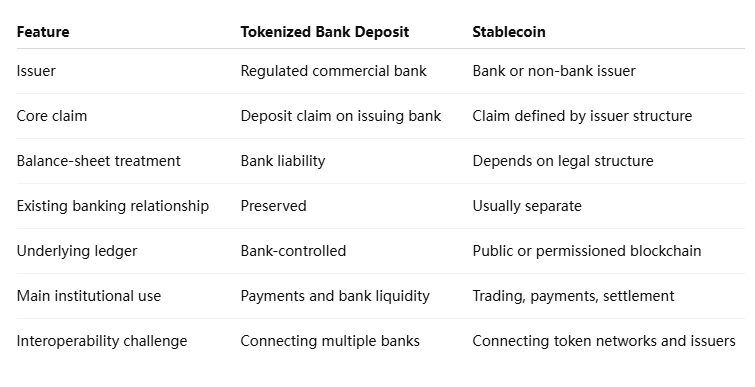
A tokenized deposit upgrades the technological representation of commercial bank money without necessarily changing the underlying debtor-creditor relationship. That familiarity is attractive to banks because capital treatment, compliance processes and customer relationships can remain closer to existing banking models.
Stablecoins may offer broader portability across crypto markets, while tokenized deposits can fit more naturally into regulated bank balance sheets. The two models are therefore more likely to coexist than for one to eliminate the other.
Is Swift Replacing Existing Settlement Systems?
The Ledger Coordinates Payment Commitments Before Final Settlement
No. Swift and Chainlink both describe the blockchain ledger as an orchestration layer operating before final settlement. The ultimate transfer of central-bank or agreed settlement money can still occur through existing mechanisms such as real-time gross settlement systems.
This distinction is crucial because it reveals how large financial systems usually adopt new technology. Banks rarely replace their entire payment infrastructure at once. A more realistic approach is to insert programmable components where they solve specific inefficiencies while preserving systems that already provide legal finality and regulatory certainty.
Under this model, a bank can obtain some benefits of blockchain—shared state, programmability and continuous coordination—without requiring central banks to immediately place every settlement asset on the same ledger.
Over time, that boundary could move. More settlement assets may become tokenized and central-bank systems could develop greater interoperability with distributed ledgers. But the current Swift architecture should be understood as a hybrid model rather than a full migration of global payments onto blockchain.
Why Do 17 Global Banks Matter?
The value of a cross-border payment network depends heavily on network effects. A tokenized-deposit system connecting two banks can demonstrate technical feasibility, but it cannot solve global interoperability. Swift’s initial group includes institutions from North America, Europe, Asia, the Middle East, Africa and Latin America, creating a much broader test of how commercial bank money can move between jurisdictions.
This diversity also increases complexity. Each bank has different internal systems, security controls, regulatory obligations and balance-sheet structures. A successful pilot therefore needs to prove not merely that tokenized deposits can transfer technically, but that institutions can integrate them without breaking their existing compliance and operating models.
Participation should not be confused with full production adoption. The 17 institutions are early participants, and transaction scale, currency coverage and commercial usage remain to be demonstrated. What the group provides is a sufficiently diverse environment to test whether a common orchestration layer can work across fundamentally different banking systems.
What Are the Main Risks and Limits?
Interoperability remains the largest challenge. If banks implement tokenized deposits differently, common standards must handle differences in smart contracts, identity systems, compliance rules and transaction logic. Adding more ledgers can actually increase complexity if the orchestration layer is unable to standardize those differences.
Legal recognition also matters. A tokenized deposit may clearly represent a bank liability in one jurisdiction while receiving different regulatory treatment elsewhere. Cross-border programmability is useful only when the underlying claim remains legally enforceable through the entire payment chain.
Operational dependencies are another consideration. Swift, bank-owned ledgers, Chainlink workflows, signing infrastructure and final settlement systems all form part of the transaction path. The architecture can reduce certain frictions while simultaneously creating new integration points that need to be secured and monitored.
Finally, pilots do not establish economics. Banks will eventually need to determine whether 24/7 tokenized payments reduce liquidity costs, settlement risk and operational expense enough to justify widespread deployment.
MEXC View: Interoperability May Matter More Than One Global Chain
The most important implication of the Swift model is that institutional blockchain adoption may not converge on a single universal settlement network. Banks already possess deeply embedded ledgers, compliance systems and liquidity arrangements, and replacing all of them with one blockchain would create enormous operational and legal disruption.
A more scalable model may be interoperability: each institution maintains its own trusted environment while common infrastructure synchronizes value across those environments. Chainlink CRE and Swift’s ledger illustrate how that model can work. One provides workflow connectivity, while the other provides shared coordination across the banking network.
For institutional digital finance, this changes the competitive question. The winner may not be the blockchain that attracts every bank onto one ledger, but the infrastructure capable of connecting banks, tokenized deposits, stablecoins and future settlement assets without forcing institutions to abandon the systems they already trust.
SWIFT Tokenized Deposits Could Modernize Banking Without Replacing It
SWIFT tokenized deposits represent a different vision of blockchain adoption from the crypto-native idea of moving the entire financial system onto one permissionless ledger. The participating banks keep their own deposit liabilities, balance sheets and operational controls. Swift provides a shared coordination layer, while Chainlink enables institutions to connect internal systems and signing infrastructure to that environment.
This makes the initiative less dramatic than a complete replacement of correspondent banking, but potentially more realistic. Large institutions can adopt programmable payment infrastructure incrementally while preserving the legal and regulatory architecture already supporting commercial bank money.
The critical test will be whether the model can move from pilot transactions into sustained cross-border volume. That requires interoperability across currencies, jurisdictions and banking systems, as well as demonstrable improvements in liquidity efficiency and operational reliability.
If those conditions are met, the long-term significance may not be that banks “went onchain.” It may be that blockchain quietly became part of the coordination layer of global banking while customers continued holding familiar commercial bank deposits. For SWIFT tokenized deposits, that hybrid outcome could ultimately be more important than a complete migration to a new financial system.
Sources
MEXC internal link used:
https://www.mexc.com/crypto-pulse/article/mexc-on-chain-daily-report-160877
Chainlink official announcement:
https://chain.link/press-releases/chainlink-is-enabling-financial-institutions-to-connect-to-swifts-blockchain-ledger
Chainlink tokenized deposits overview:
https://chain.link/article/tokenized-deposits
Swift 17-bank pilot announcement:
https://www.swift.com/news-events/press-releases/swifts-blockchain-ledger-ready-use-17-banks-set-pioneer-tokenised-cross-border-payments-trusted-global-infrastructure
Swift blockchain ledger overview:
https://www.swift.com/payments/payment-innovation/blockchain-based-ledger
Risk Disclaimer: This article is for reference only and does not constitute investment advice. The cryptocurrency market is highly volatile. Please make decisions cautiously based on your individual circumstances.