Issue 22 closed on a buyer that had sat out a rally and a curve that had flattened for three windows running, and asked whether either would continue. Neither did — and the first of the two was already untrue when Issue 22 wrote it [1][2].
The single most useful fact in this issue is a correction. The filing that covers Issue 22's own window, September 14 to 20, records 950 bitcoin bought for $75.7m at an average of $79,670 [1]. Issue 22's section 6 was titled for the rally the disclosed buyer sat out; it had read the filing for the week before its window as if that filing described the window. The filing that did describe it was accepted on the first day of this window, after Issue 22's data cut. Section 5 puts the correction on the record, and from this issue on every Strategy figure is labelled with the period it covers rather than the window in which it was read.
The Treasury curve stopped flattening, and the long end did the moving. Against the prior close the two-year added 5 basis points, the ten-year 16 and the thirty-year 15 [2]. All fourteen maturities in the par yield table closed at their highest level of 2026 on September 24 or 25 [2]. The 2s30s spread printed its low of the year, 53 basis points, on Monday — 3 above the line Issue 22 drew — and closed Friday at 68 [2]. The window contained no FOMC meeting and no CPI, employment, GDP or PCE release [13][14][15].
Bitcoin's window was one session long. September 21 closed +6.70% and printed both the window's high, 87,385.10, and its low, 80,819.40 [3]. The six sessions after it gave back 2.48% between them, and the window ended +4.05% at 84,432.90 [3]. What left afterwards was leverage: Binance open interest ended the window 12.20% lower and fell 7.70% across a single session, and both venues printed negative funding settlements for the first time since September 5 [4][5][6][7].
The disclosed buyer is now spending a balance rather than raising one. No shares have been sold under its at-the-market programme in three consecutive filings, and everything it has spent since on bitcoin and on buying back its own preferred has come out of an account the company calls USD Cash, which stood at $1.05bn on September 20 [1][8][9]. Section 6 is about that account.
Week of September 21 to September 27, 2026
Bitbase Research · September 28, 2026
The one chart that matters
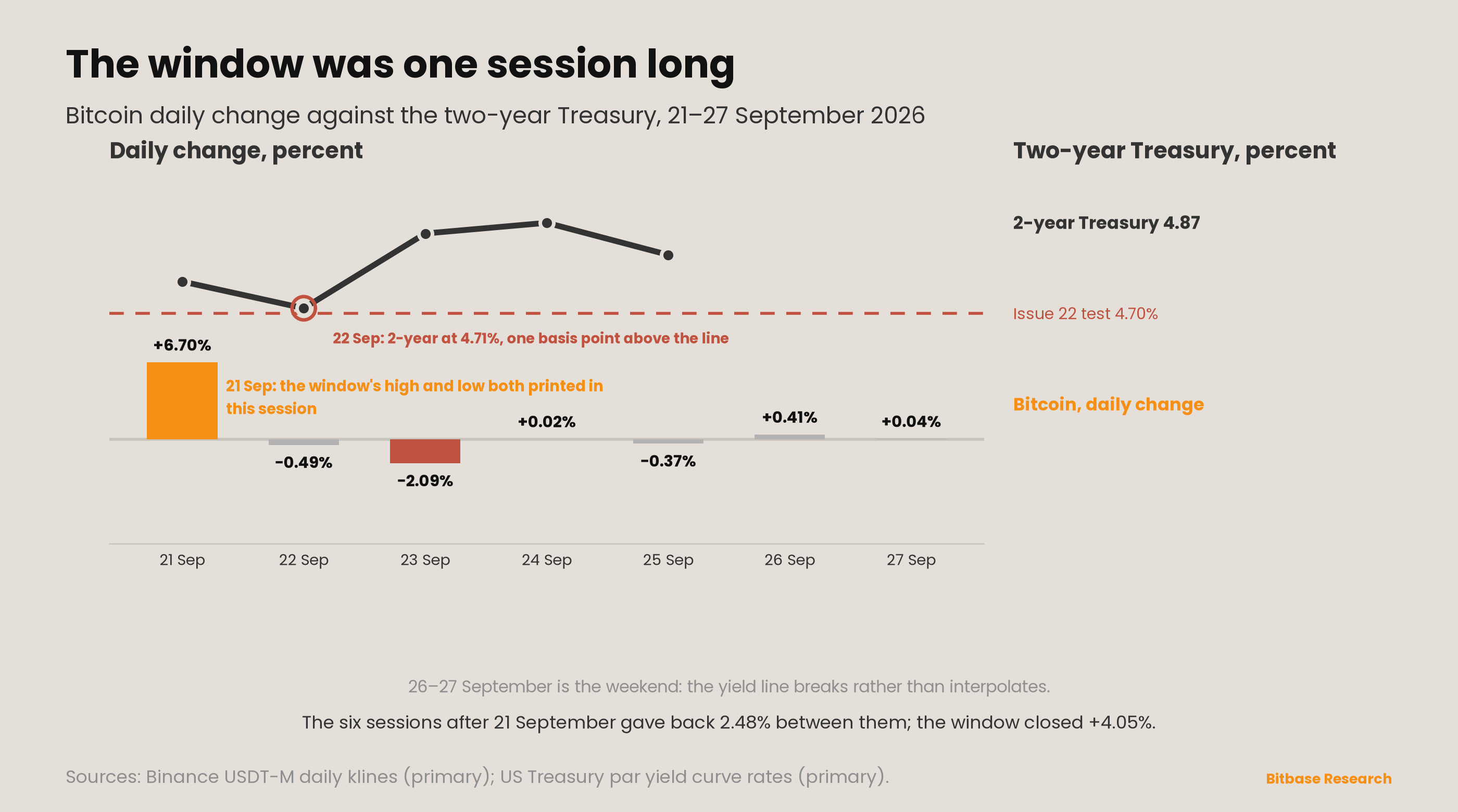
Daily closes for BTCUSDT perpetuals, USDT-margined futures, UTC, with the two-year Treasury par yield on the right axis and Issue 22's 4.70% line marked [2][3]:
| Date (UTC) | Close | Session | 2Y par yield |
|---|---|---|---|
| September 20 (prior close) | 81,143.90 | −0.10% | — |
| September 21 | 86,578.70 | +6.70% | 4.76 |
| September 22 | 86,158.60 | −0.49% | 4.71 |
| September 23 | 84,355.10 | −2.09% | 4.85 |
| September 24 | 84,370.00 | +0.02% | 4.87 |
| September 25 | 84,056.00 | −0.37% | 4.81 |
| September 26 | 84,403.30 | +0.41% | — |
| September 27 | 84,432.90 | +0.04% | — |
The whole range of the window printed on its first day [3]. The low of 80,819.40 came in the 01:00 UTC hour of September 21 and the high of 87,385.10 in its 20:00 UTC hour; no later session traded outside those two prices. The +6.70% close is the largest single-session gain since August 21 [3]. The six sessions that followed moved between −2.09% and +0.41% and gave back 2.48% between them — one move, then six sessions of keeping most of it.
The session did not wait for the filing that section 5 turns on [1][3]. Strategy's 8-K was accepted by EDGAR at 12:00 UTC on September 21. The hourly record shows the move beginning in the 08:00 UTC hour, and by the open of the 12:00 UTC hour the contract stood at 84,849.90 — on our arithmetic, 68.2% of the session's open-to-close gain was already in. This issue does not attribute the session to the filing, and the timing is one reason not to; section 7 gives the reason the timing is not enough on its own.
The right-hand axis moved on different days. On September 21, when bitcoin added 6.70%, the two-year closed unchanged at 4.76% [2]. On September 23 and 24, when the ten-year added 22 basis points between them, bitcoin closed −2.09% and +0.02% [2][3]. The two markets did not share a large session in this window, which is an observation about timing and not a claim that they are unrelated. The two-year's lowest reading, 4.71% on September 22, was one basis point above the line Issue 22 set; section 5 settles that test.
This week's structural signal
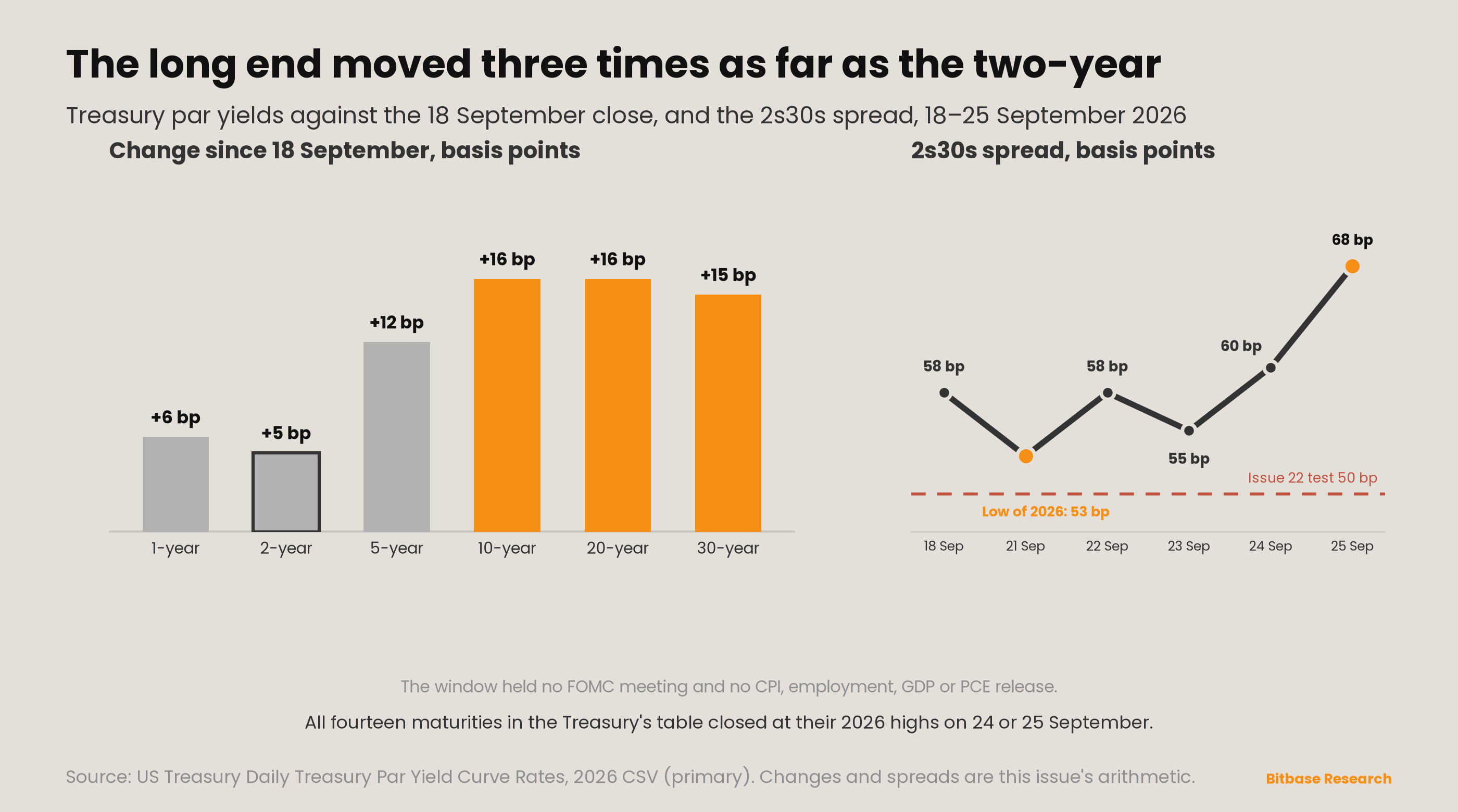
Change against the prior close of September 18, in basis points [2]:
| 1Y | 2Y | 5Y | 10Y | 20Y | 30Y |
|---|---|---|---|---|---|
| +6 | +5 | +12 | +16 | +16 | +15 |
For three windows the front end led; in this one the long end did [2]. Issue 22 counted three consecutive windows in which the front end moved further than the back, and across them the 2s30s spread closed at 87, 72 and 58 basis points. This window reversed the order: the ten-year and the twenty-year added 16 basis points, the thirty-year 15 and the two-year 5.
| 09-18 (prior close) | 09-21 | 09-22 | 09-23 | 09-24 | 09-25 | |
|---|---|---|---|---|---|---|
| 2Y | 4.76 | 4.76 | 4.71 | 4.85 | 4.87 | 4.81 |
| 10Y | 5.01 | 4.96 | 4.96 | 5.11 | 5.18 | 5.17 |
| 30Y | 5.34 | 5.29 | 5.29 | 5.40 | 5.47 | 5.49 |
| 2s10s | 25bp | 20bp | 25bp | 26bp | 31bp | 36bp |
| 2s30s | 58bp | 53bp | 58bp | 55bp | 60bp | 68bp |
The flattening ended at its low, and the low came first. On September 21 the 2s30s spread closed at 53 basis points — the lowest reading in the 185 sessions of 2026 in the Treasury's table, and 3 basis points short of the 50 that Issue 22 named as the test of its structural claim [2]. Four sessions later it was 68. The threshold was not crossed because the flattening stopped, not because it slowed.
Every maturity moved to its high of the year, so this is not a long-end story alone [2]. The one-month bill closed at 4.04% on September 25, the highest reading in its 2026 column; the two-year reached 4.87% on September 24. The two-year rose too; the long end rose three times as much. A curve that steepens while every yield on it rises is a bear steepening, and that is the most this issue will say about its shape.
What the week did not contain is part of the reading [13][14][15]. There was no FOMC meeting. The Bureau of Labor Statistics schedule has no CPI or employment release between September 21 and 25, and the Bureau of Economic Analysis has its GDP estimate and the August personal income and outlays report, which carries PCE inflation, both on September 30. Every yield on the curve reached its high of the year in a week with nothing on the top tier of the calendar. What this issue cannot see is the auction calendar: Treasury's auction results are published on the host that section 5 records as unverifiable from this machine, so this issue does not know whether a coupon auction fell in the window or how one cleared.
The structural reading is narrow, and it replaces Issue 22's rather than extending it. Issue 22 read an unchanged thirty-year against a higher projected policy path as the long end declining to extend the projection. In the week after, without a meeting, the thirty-year added 15 basis points. Whether that is the long end catching up with the September projections, a larger premium for holding duration, or supply, the data here separate none of them — the sentence Issue 22 wrote about the flattening applies to the steepening, and section 7 repeats it.
Dual-track scoreboard
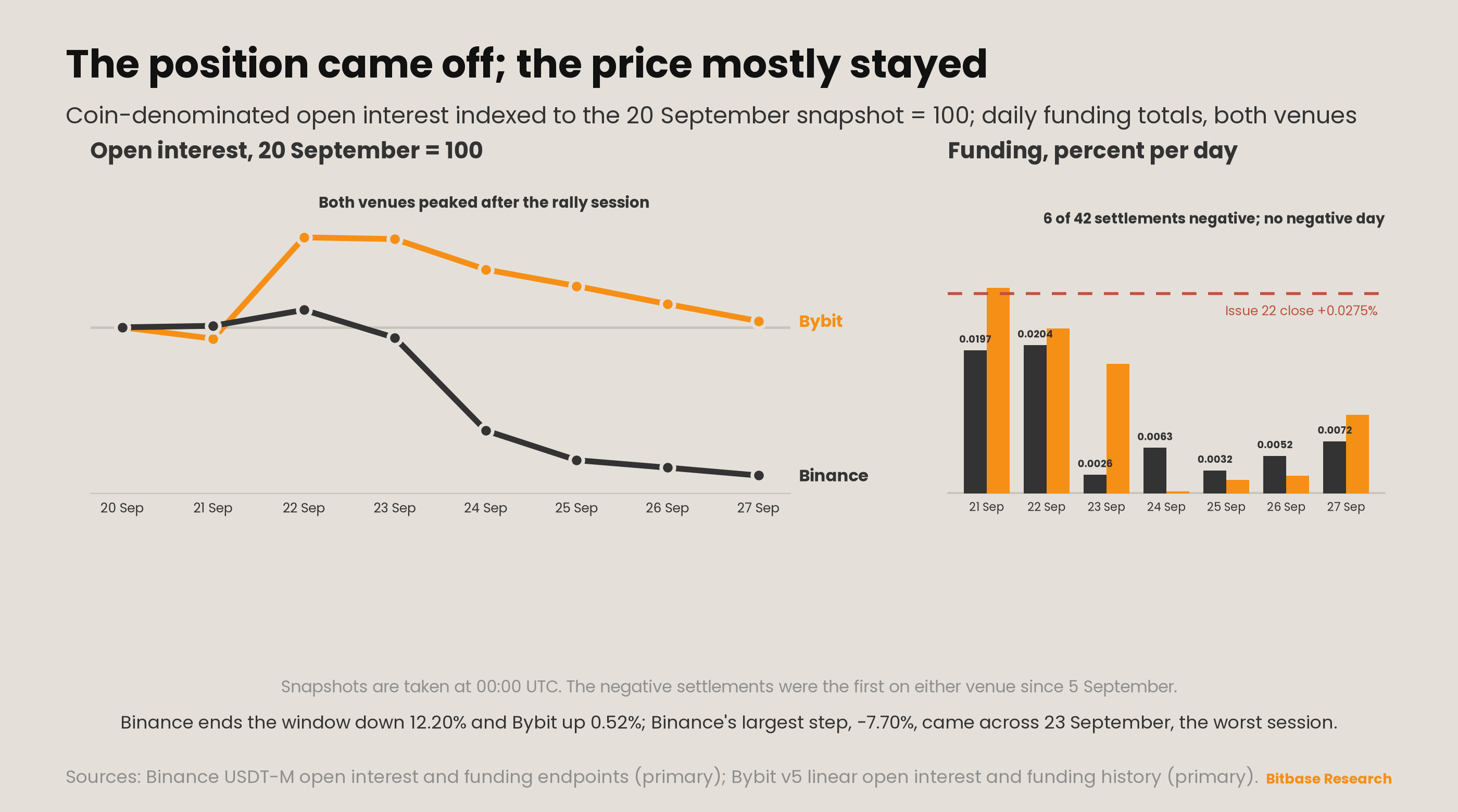
Coin-denominated open interest in BTCUSDT perpetuals, daily snapshots at 00:00 UTC [4][6]:
| Snapshot (00:00 UTC) | Binance (BTC) | Bybit (BTC) |
|---|---|---|
| September 20 (prior close) | 107,646 | 56,678 |
| September 21 | 107,778 | 56,150 |
| September 22 | 109,189 | 60,874 |
| September 23 | 106,720 | 60,797 |
| September 24 | 98,503 | 59,376 |
| September 25 | 95,873 | 58,603 |
| September 26 | 95,211 | 57,762 |
| September 27 | 94,518 | 56,970 |
Binance ends the window down 12.20%; Bybit up 0.52% [4][6]. Both venues added position across the rally session — the snapshot that follows it is the peak on both — and both shed it afterwards, Binance 13.44% from that peak and Bybit 6.41%. After two consecutive windows in which the venues shared a sign, the sign split again, and it split on size rather than direction: both fell from the same peak, and only one fell below where it started.
The largest single step came across the worst session. Between the snapshots either side of September 23, the session bitcoin closed −2.09%, Binance open interest fell 7.70% [3][4]. Because it is measured in coins rather than dollars, the fall is a count of contracts closed, not a revaluation — and it says nothing about which side closed them.
Funding, summed across the three eight-hour settlements in each UTC day; window totals are summed from the unrounded settlements [5][7]:
| Date | Binance | Bybit |
|---|---|---|
| September 21 | +0.0197% | +0.0283% |
| September 22 | +0.0204% | +0.0227% |
| September 23 | +0.0026% | +0.0178% |
| September 24 | +0.0063% | +0.0003% |
| September 25 | +0.0032% | +0.0019% |
| September 26 | +0.0052% | +0.0025% |
| September 27 | +0.0072% | +0.0108% |
| Window total | +0.0646% | +0.0842% |
Six of the forty-two settlements were negative — two on Binance, four on Bybit — the first negative settlements on either venue since September 5 [5][7]. Every daily total stayed positive, the smallest being Bybit's +0.0003% on September 24. On our arithmetic the window totals were about 43% of Issue 22's on Binance and 68% on Bybit. Longs were still paying on balance; they were paying far less, and in six settlements, spread across four eight-hour intervals, they were being paid.
On Binance the collapse in funding arrived with the collapse in position. Its daily total fell from +0.0204% on September 22 to +0.0026% on September 23, the session across which its open interest fell 7.70% [4][5]. Bybit's total held up for one more day and then went to almost nothing on September 24 [7].
What is absent from this scoreboard, and named rather than omitted: spot ETF daily flows, for the same reason recorded in Issues 21 and 22 — this series has no primary retrieval path for them and does not source them second-hand.
On the radar—week of September 28 to October 4
First, what does the filing covering this window fund, and from which account? As of this issue's cut the filing does not exist: the most recent Form 8-K on the company's EDGAR index is the September 25 filing on preferred dividends [11]. The last four purchase disclosures read 4,603 bitcoin, zero, zero, 950 — the first funded by share sales and the last by USD Cash [1][8][9][10]. The next one either continues the cash-funded pattern, returns to the at-the-market programme, or buys nothing.
Second, does USD Cash fall below $1.00bn? It stood at $1.05bn on September 20, down from $1.44bn two filings earlier [1][9]. Each of the last three filings drew more from the account than the $50m that now separates it from that line, and $1.00bn is chosen because it is the next round number below the current reading, not because it carries meaning.
Third, does the thirty-year close above 5.50%? It closed the window at 5.49%, its high of the year [2]. The next window carries the calendar this one lacked — the August personal income and outlays report with PCE and the GDP estimate on September 30, the employment report on October 2 [14][15] — so a long end that moved on an empty calendar now meets a full one. The threshold is the next round number above the current reading.
Fourth, does either venue print a negative daily funding total? This window produced six negative settlements and no negative day [5][7]. A negative daily total is the next step in the same direction, and it is decidable from the same two endpoints.
Fifth, does the Federal Reserve's stablecoin proposal reach the Federal Register? On September 24 the Board requested comment on two proposals under the GENIUS Act, one on reserve assets, capital and custody for the payment stablecoin issuers it supervises and one on how the banks it supervises apply to issue them; the comment period closes 60 days after publication in the Register [16]. Publication starts that clock, and this series will report the date it starts rather than read the proposals before there is a final rule.
Signal tracking update
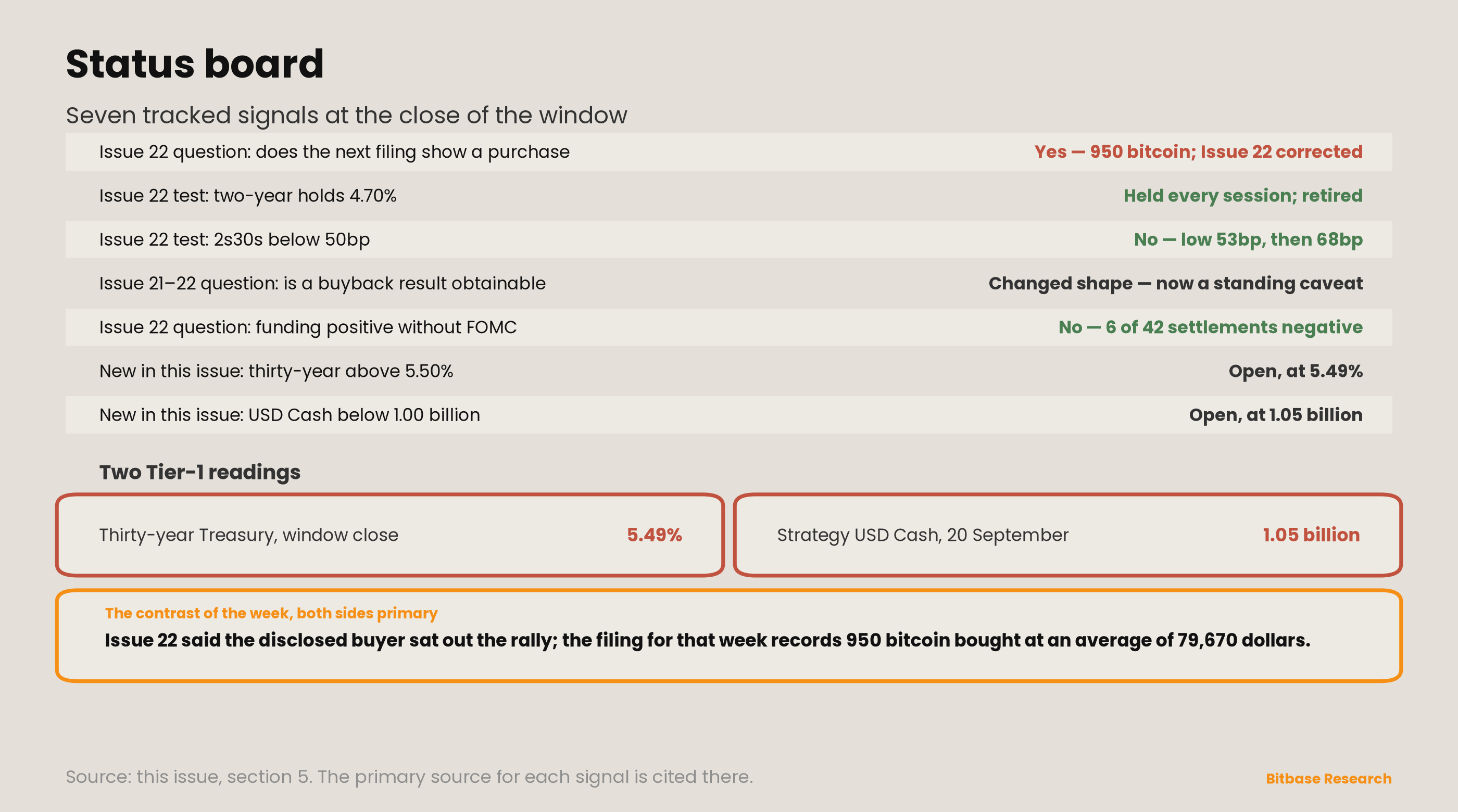
Issue 22's radar asked five questions. Three settle cleanly, one settles by correcting Issue 22 itself, and one changes shape after a third window without an answer.
First, does the Strategy filing covering Issue 22's window disclose a purchase? Yes — 950 bitcoin for $75.7m, at an average of $79,670 including fees, paid for from USD Cash [1]. Holdings as of September 20 were approximately 846,000 bitcoin at an aggregate $63.80bn and an average of $75,416. This settles the question and corrects the issue that asked it. Issue 22's section 6 was titled for the rally the disclosed buyer sat out and said that the one buyer whose purchases are disclosed weekly "did not participate". Its evidence was the filing covering September 8 to 13 — the week before Issue 22's window. This series reads each filing when it is released early in the following week, so each issue sees the week before its own; Issue 22 described its window with the prior week's filing, and the filing for its window says the opposite. Issue 22's section 5 also closed its version of this question, calling the single purchase of late August "the exception", one filing too early. The correction is recorded in these terms: the $315.6m of preferred repurchases stands; the reading that the buyer sat the rally out does not.
The filing does not date the purchases within the week. On our arithmetic, an average of $79,670 is above every price the BTCUSDT contract traded at from September 15 to 17 and above September 14's high of 79,570.90, so it is consistent with at least part of the 950 bitcoin having been bought on or after September 18, the rally session [3]. Consistent is the whole of the claim: the average includes fees, the company does not trade the contract this series reads, and nothing in the filing says when. Issue 22's chart 4 needs correcting in three places: the first of its two filings covers August 31 to September 7, not a week to September 6; the pair spans August 31 to September 13, not September 1 to 13; and its note placed the 5.65% rise in the second of the two filing weeks, which ended on September 13, when the rise came in the week after [3][8][9].
Second, did the two-year hold above 4.70%? Yes, on every session, by one basis point at the narrowest [2]. Readings 4.76, 4.71, 4.85, 4.87, 4.81. The test passed, and this issue retires it rather than raising it again: the question that matters for this curve has moved to the long end, and a front-end threshold would now measure the part of the curve that moved least. STATUS: RETIRED.
Third, did the 2s30s spread go below 50 basis points? No — it came within 3, at 53 on September 21, and then widened to 68 [2]. Issue 22 built this test to make its structural claim falsifiable, and the answer came from the other side: the threshold was not crossed because the flattening stopped. The reading Issue 22 held — a long end declining to extend a higher projected path — describes Issue 22's window and not this one, and section 2 records what replaced it.
Fourth, is a Treasury long-end buyback result obtainable at all? Still no, for a third window — and this time the failure mode is identified rather than only observed [17]. The two TreasuryDirect service endpoints and its public results page, and the fiscal-data buybacks endpoint on a separate Treasury host, all reach their servers; every one of those hosts presents a certificate issued by Entrust to the Department of the Treasury, and this machine's TLS library rejects each chain as containing a self-signed certificate. The SEC's host, reached through the same connection path at the same time, verifies normally. Issue 21 recorded a TLS handshake that could not complete; Issue 22 recorded no response from the service endpoints and a results page that loaded without its table, which is filled in by script. The form of the failure has differed by endpoint and by window; the answer has not. STATUS: CHANGED SHAPE. Three windows have produced the same answer, and a radar slot that returns the same answer three times is no longer asking a question. The buyback question moves to section 7 as a standing limitation, restated each issue so that the gap stays visible without holding a slot that a decidable question can use. It is not recorded as "no operation", and this series did not read the data over an unverified connection to make the question go away.
Fifth, did funding stay positive through a week without a scheduled Federal Reserve event? No, on the measure Issue 22 used [5][7]. Issue 22 reported that every one of 42 settlements was positive in a week containing an FOMC decision. In this window, which contained none, six of 42 were negative, the first since September 5. At the level of daily totals, funding stayed positive on every day on both venues, and the question is settled on the measure it was asked on — the individual settlement — with the daily measure recorded beside it rather than substituted for it.
New dimension—the account the disclosed buyer now spends from
This series has tracked Strategy since Issue 14 as the cleanest available proxy for discretionary, non-flow-driven demand: one disclosed buyer, filing weekly. For most of that time the tracked quantity was the purchase. Three consecutive filings now make a second quantity visible, and it may matter more: where the money comes from.
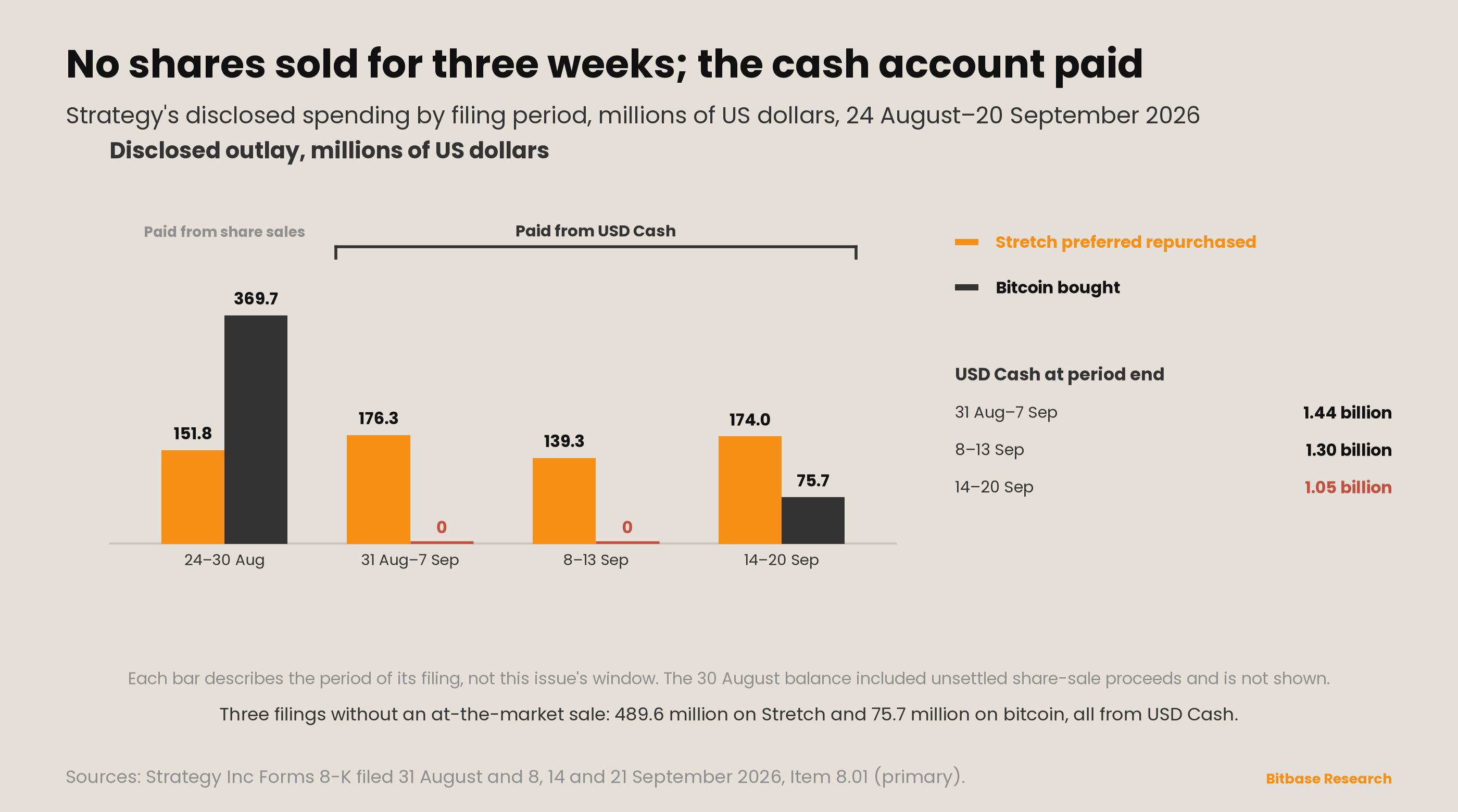
The filing covering August 24 to 30 recorded $602.8m of net proceeds from common-stock sales under the at-the-market programme, and said the 4,603 bitcoin bought that week were bought with those proceeds [10]. The three filings since, covering August 31 to September 20, record no at-the-market sales at all. In those three weeks the company spent $489.6m repurchasing its Stretch preferred and $75.7m buying bitcoin, all of it from USD Cash [1][8][9]. On our arithmetic, 86.6% of the $565.3m went to the preferred.
The account is disclosed weekly and its purpose is stated: USD Cash is maintained "to deploy for broader general Bitcoin Treasury Company purposes, which may include acquiring bitcoin, expanding the USD Reserve, broader capital management uses, and other similar purposes" [1]. It stood at $1.44bn on September 7, $1.30bn on September 13 and $1.05bn on September 20 — on our arithmetic a fall of 27.1% across two filings [1][8][9]. A separate account, the USD Reserve, which the company describes as supporting preferred dividends and interest, paid out $57.4m in the week to September 20 and stood at $5.04bn [1].
The observation this supports is about the proxy, not the asset. While the at-the-market programme is idle, the weekly purchase figure is an allocation out of a disclosed, finite balance, and the preferred repurchases draw on the same balance. For the first time, this series can see the constraint as well as the choice: 950 bitcoin in a week when the same account paid 2.3 times as much for Stretch shares. Under the previous pattern — sell stock, buy bitcoin — the purchase measured how much capital the company chose to raise that week. Under this one it measures how the company divides what it already holds.
One more document moved in the window, and it concerns the same instrument [11][12]. On September 24 the board approved submitting to a special meeting, expected on October 28, a proposal to give each of four preferred series a dividend record date on every calendar day, with payment on the next business day; if it is approved, the company expects to pay Stretch's first daily dividend on November 2, subject to declaration. The filing states that the change alters neither the total dividends nor the rates. The instrument the company has spent $641.4m repurchasing across four filings is also the one it proposes to put on a daily schedule. Separately, on our arithmetic the implied average price of those repurchases, amount divided by shares, ran between $97.36 and $98.24, and a September 1 filing states that management will recommend holding Stretch's 12.00% dividend rate "until STRC has demonstrated sustained, healthy trading near $100 per share" [18]. The filings do not connect these facts, and this issue places them side by side without connecting them either.
What this does not establish. It does not establish that the at-the-market programme will stay idle; one filing could restore the previous pattern. It does not establish why the company is repurchasing Stretch rather than buying bitcoin, and no filing states a reason. It does not establish that USD Cash is the only source available, since the account's own description includes broader capital management uses and the company runs other programmes. What it establishes is narrower and trackable: for three weeks every dollar the disclosed buyer spent on bitcoin and on its own preferred was drawn from a balance it publishes, and that balance is now $1.05bn. Section 4 names the next threshold.
Caveats
Section 1's one-session window is a description of timing, not a mechanism. September 21 carried the whole range of the window, and the hourly record shows most of its gain arriving before Strategy's filing was accepted. That rules out only the simplest story: the company may have published through other channels earlier, and this issue did not check them. Nothing here establishes why the session moved, and every reading this issue holds for it is dated to it rather than ahead of it.
Section 2's steepening has more explanations than the data can separate. A long end that rises 15 basis points in a week without a meeting or a top-tier release is consistent with a delayed response to the September projections, with a rise in the premium investors demand for holding duration, with supply, and with moves in other sovereign markets that this series does not track. Each produces the same observable, a thirty-year at its high of the year. This issue records the move and declines to attribute it, as Issue 22 declined to attribute the flattening that came before it.
The auction calendar is this window's blind spot. Treasury publishes auction results and buyback results on the same host, and that host's certificate chain does not verify on this machine. This issue therefore does not know whether a coupon auction fell inside the window or how it cleared, which would matter for section 2, and it says so rather than writing as if the week carried no supply.
Section 3's fall in open interest counts contracts, not intentions. Coin-denominated open interest falls when positions close on either side; a 7.70% fall across one session is compatible with longs selling, with shorts covering, and with both, and the funding series cannot separate them either. The negative settlements are small — the largest, on Bybit, was −0.001295% — and they are reported because they are the first since September 5, not because of their size.
Section 5 corrects a method error, and the method is now stated. Weekly filings are read when they are released early in the following week, and they describe the week before it. From this issue on, every Strategy figure is labelled with the period it covers. Issue 22 did not misread its filing; it attached a correctly read filing to the wrong week — an error that no number in the filing could have caught, because every number in it was right.
Section 6's reading rests on three filings. Three weeks without an at-the-market sale is a pattern of three observations, and the company has not stated a change in funding policy in the documents this series reads. The USD Cash balance of August 30 included proceeds from share sales that had not yet settled, so it is not on the same basis as the three balances after it, and this issue does not join the four into one series.
One quantity is now a standing limitation rather than a radar question. Treasury long-end buyback results: three windows, three failures, and in this one a stated mode — certificate chains that this machine's TLS library rejects [17]. This is not evidence that no operation ran, and it will be restated each issue until the series has a verified retrieval path.
Related reading
Other Bitbase articles on this topic:
Disclaimer: This article is market commentary from Bitbase Research, provided for information only. The views are those of Bitbase Research as of the date of writing and do not constitute investment, trading, tax, or financial advice, nor an offer or solicitation to trade. Data in this issue is current as of September 27, 2026; markets and disclosures may change, so refer to the latest information from authoritative sources. Trading crypto assets and leveraged products carries significant risk, including the possible loss of your capital.
References
[1] Strategy Inc, Form 8-K filed September 21, 2026, accession 0001193125-26-396093, Item 8.01, period September 14–20, 2026. sec.gov
[2] US Treasury, Daily Treasury Par Yield Curve Rates, 2026 CSV download. home.treasury.gov
[3] Binance USDT-M futures, BTCUSDT klines, daily and hourly, UTC. fapi.binance.com
[4] Binance USDT-M futures, open interest history, BTCUSDT, daily. fapi.binance.com
[5] Binance USDT-M futures, funding rate history, BTCUSDT. fapi.binance.com
[6] Bybit, open interest, linear BTCUSDT, daily. api.bybit.com
[7] Bybit, funding rate history, linear BTCUSDT. api.bybit.com
[8] Strategy Inc, Form 8-K filed September 14, 2026, accession 0001193125-26-389858, Item 8.01, period September 8–13, 2026. sec.gov
[9] Strategy Inc, Form 8-K filed September 8, 2026, accession 0001193125-26-384402, Item 8.01, period August 31 – September 7, 2026. sec.gov
[10] Strategy Inc, Form 8-K filed August 31, 2026, accession 0001193125-26-375463, Item 8.01, period August 24–30, 2026. sec.gov
[11] Strategy Inc, Form 8-K filed September 25, 2026, accession 0001193125-26-401636, Item 8.01. sec.gov
[12] Strategy Inc, preliminary proxy statement on Schedule 14A, filed September 25, 2026, accession 0001193125-26-401630. sec.gov
[13] Board of Governors of the Federal Reserve System, FOMC meeting calendars, 2026. federalreserve.gov
[14] US Bureau of Labor Statistics, schedule of selected releases, September 2026. bls.gov
[15] US Bureau of Economic Analysis, release schedule. bea.gov
[16] Board of Governors of the Federal Reserve System, press release of September 24, 2026, requesting comment on two proposals under the GENIUS Act. federalreserve.gov
[17] TreasuryDirect, buyback announcements and results by operation date; not retrievable over a verified connection from this machine, see sections 5 and 7. treasurydirect.gov
[18] Strategy Inc, Form 8-K filed September 1, 2026, accession 0001193125-26-377583, Item 8.01. sec.gov