Author: @HelloLydia13
Poker went from a game confined to the card table to a mature spectator sport, largely thanks to a very small device: the hole cam.
It allowed TV viewers to see the players' hole cards for the first time.
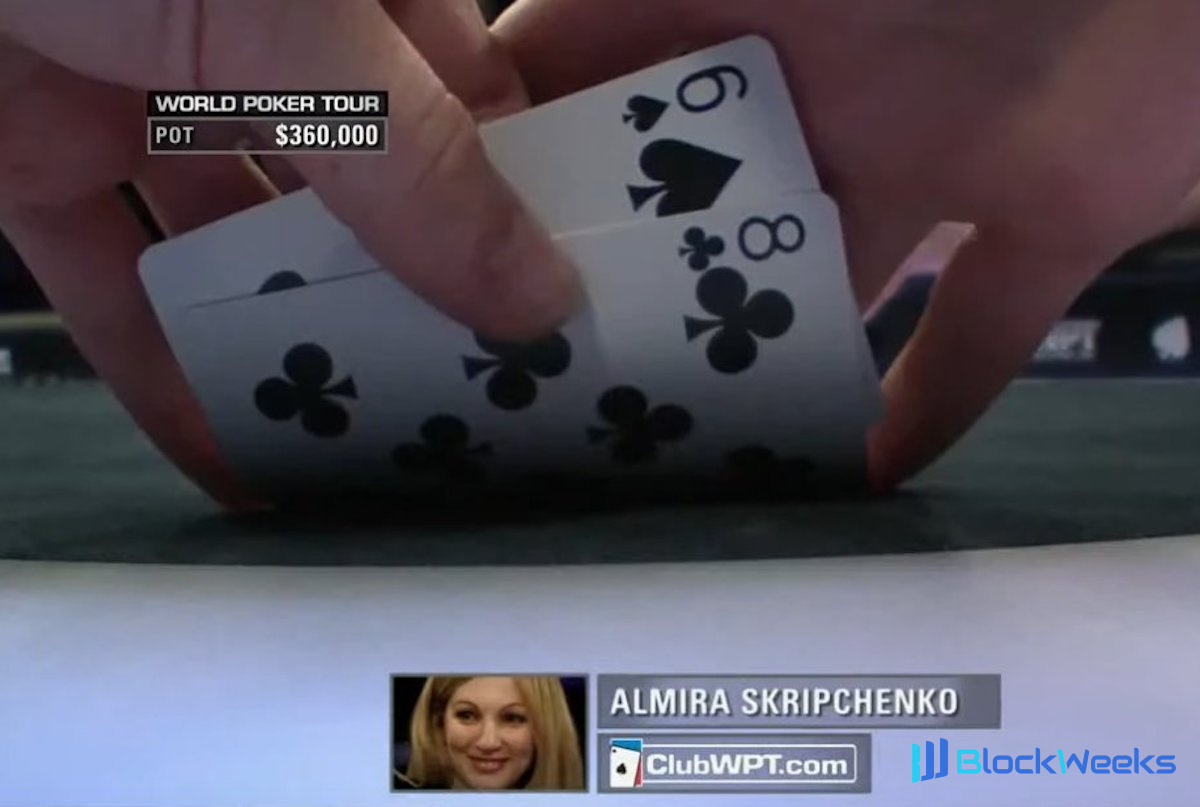
Poker had already made it onto television as early as the 1970s, but for a long time, the game looked incredibly dull.
Viewers could see a person thinking, betting, calling, or folding, but they didn't know what he was actually holding, and it was hard to truly understand what these actions meant.
A brilliant bluff and someone betting methodically with a strong hand could look almost identical from the outside.
In 1999, the British show Late Night Poker began using hole cams. Later, ESPN brought a similar production approach to the WSOP, the world's largest and most influential poker tournament series.
The number of entrants in the WSOP Main Event grew from 839 in 2003 to 2,576 in 2004, 5,619 in 2005, and then 8,773 in 2006.
Of course, a single camera couldn't create a poker boom on its own.
The hole cam didn't change the rules of poker, nor did it suddenly make players better. What it truly changed was what the audience "could see."
For the first time, viewers gained a near god's-eye view. Why a player paused, why he bet, why he folded—all could be understood in the context of his hand. Strategy that had previously existed mainly in the player's mind became something all viewers could read for the first time.
This was, in fact, a media revolution for poker.
More than two decades later, Crypto trading may be undergoing a similar change.
Trading is becoming "watchable"
In 2024, on-chain trading and Memecoins entered a new phase.
@Pumpfun introduced live streaming, compressing token issuance, content production, price discovery, and speculation into the same attention loop on a massive scale for the first time.
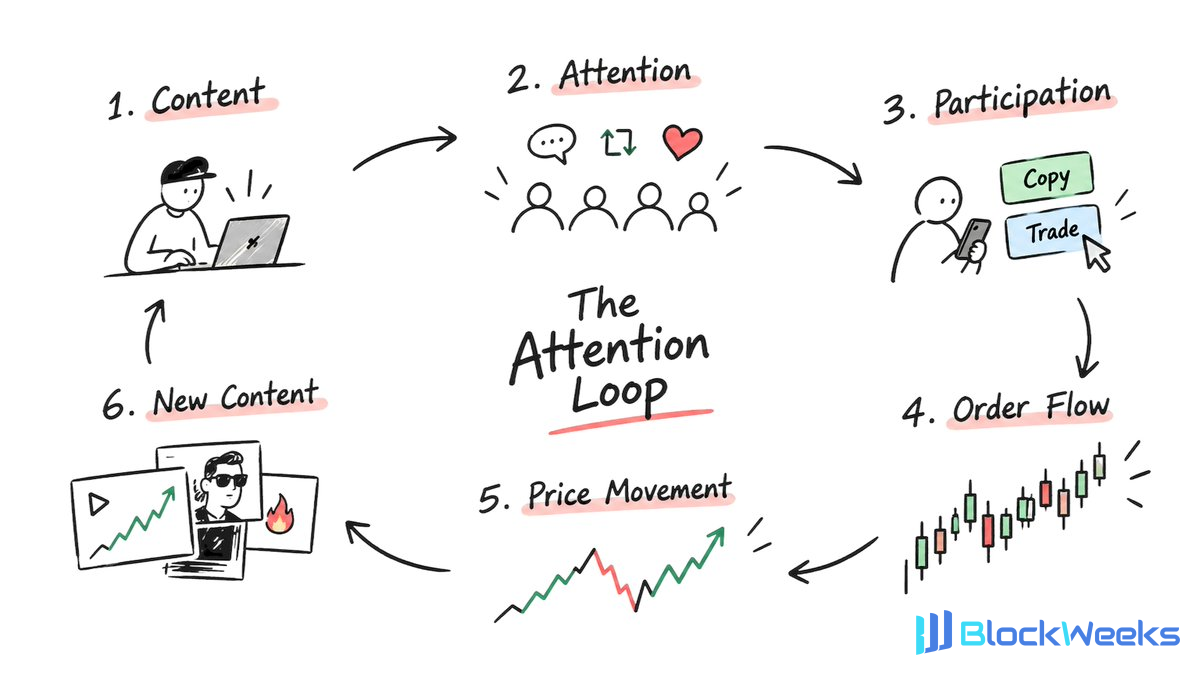
From 2025 to 2026, Perp DEXs grew rapidly, and a new wave of on-chain traders emerged. Their PnL, positions, and liquidation records began making headlines.
Some leading trading platforms noticed this shift and began introducing the production grammar of esports into trading competitions.
At the end of 2025, @Aster_DEX's Human vs AI series turned the real-time PnL of human and AI traders into dramatic ranking curves, staging a series of thrilling reversals.
During KBW 2026, Korean trader @jadoodoo_ contributed a flood of memes in a live-streamed trading competition, giving rise to the viral meme "trading with feet," which quickly made her one of the most recognizable traders on X.

During TOKEN2049, @coinbase directly called its live event an "esports-style Perps live trading tournament," even including trader collectible cards in the event merchandise.

When esports is no longer just an analogy but begins to become a production grammar actively adopted by trading products, I actually feel that rather than asking "why has trading become like this," it's more worth asking:
Why now, of all times?
On-chain trading inherently possesses some "hole cam properties" that traditional finance lacks. Entries, position sizes, leverage, PnL, liquidations—these things can all exist publicly on-chain.
In traditional finance, we usually only see the returns disclosed by fund managers, or see someone saying they're bullish on X.
But on-chain, while a trade is still happening, we can already see much more of it.
However, this still isn't enough: being visible doesn't mean being understandable.
We all know what a highlighter is for. If you highlight every page of a book, you've actually marked nothing.
Blockchain has a similar problem. It generates massive amounts of raw data every second. The data is real, but "real" is still far from a story an ordinary person can understand.
From "visible" to "understandable"
Televised poker was never just about the hole cam. Production also required player names, chip counts, win rates, hand histories, commentary, and editing.
So I think that something like @fomo's Trade Thesis, which looks like a very small feature, actually represents a rather interesting shift in on-chain product design—it allows traders to attach their own reasoning directly to a real trade.
Later, @gmgnai went a step further and put these theses onto the candlestick chart.
Two types of information that had long been separated in the Crypto world are beginning to be placed together:
On X, we have a great deal of language (bullish), but we lack proof.
And on-chain, we have a great deal of proof (this address bought), but we lack language.
When opinions, positions, and identity are placed together, a trade begins to do more than describe the market. It also begins to describe the person behind the trade.
An address gradually becomes a real player. You can see his way of judging, his trading style, and a traceable historical record.
If the chain itself provides the camera, then what this layer of product design does is closer to directing and broadcasting.
The camera solves "being visible"; production solves "being understandable."
And on-chain may ultimately go even further than televised poker.
The hole-card camera made poker more watchable, but the people sitting in front of the TV were always just spectators.
On-chain trading is breaking that boundary. When you follow a star trader, you can copy his strategy, you can take the other side of his trades, or you can directly enter his Vault.
When a spectator can enter the same market and become a participant in it with almost no friction, media structure and market structure begin to truly couple together.
What does this mean for on-chain products?
I see at least three directions.
1. "Watchability" itself will become a product capability.
Traditional trading interfaces have always been designed for people who have "already decided to trade." But in the future, they may also have to serve those who are still watching.
This person does not have a position yet. He is just trying to understand: What is happening in the market? Is there anything worth my participation?
2. Whoever can organize raw data well gains the "editor-in-chief power" to determine market headlines.
The chain has never lacked public data. What is truly scarce is the ability to effectively organize attention around this data.
Products must make judgments:
- Which wallet is worth watching?
- Which trade is worth highlighting?
- What kind of person counts as smart money?
- Which on-chain event is worth connecting to a price movement?
In this sense, the product is becoming the highlighter on the blockchain ledger.
3. On-chain identity will increasingly constitute a trader's reputation.
I do not think it will replace the persona a person builds on X in the short term. At least not now.
@jadoodoo_ herself is a good example. Her personal character and her trading performance actually reinforce each other.
X mainly tells us what a person has said. On-chain history increasingly tells us what this person actually did when real money was at risk.
This difference matters.
Feedback and criticism are welcome; DM @HelloLydia13 is always open.
Also thanks to my friend @otzgary for offering many valuable opinions on this article.