Author: Jae, PANews
Not long ago, the public chain Pearl, which quickly rose to fame with its PoUW (Proof of Useful Work) narrative and high mining returns, has now encountered a market reversal.
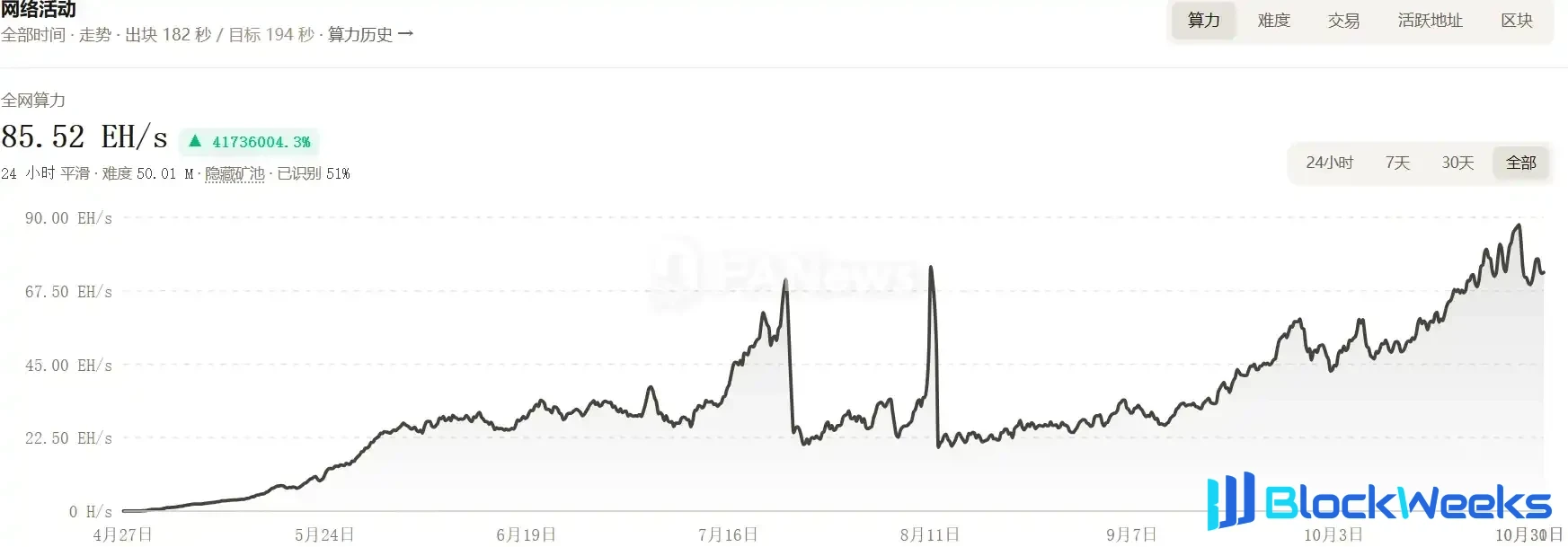
Ten days ago, after the PEARL token hit an all-time high of $2.43, massive GPU computing power rushed in. However, the market quickly reversed, and in just ten days the coin price retraced over 35%, dropping to around $1.5. Following that, the network's total hashrate also fell from a historical peak of 87.79 EH/s to 66.34 EH/s.
As the network hashrate continues to climb and mining difficulty keeps increasing, per-card returns have shrunk significantly, and more and more miners are complaining that mining is no longer profitable. Especially for miners who rent GPUs, the high cost of computing power rental is eating into profits, and some latecomers have even fallen into losses.
This round of drastic hashrate fluctuations is like a mirror, reflecting the vastly different survival realities of different miner groups: some have shutdown thresholds far below the coin price and are guaranteed to profit; others are already standing on the cliff edge of break-even, ready to withdraw at any time.
Hashrate Chases Coin Price, Difficulty Lags Half a Beat: Latecomers Become the "Bag Holders"
In all PoW-type networks, price is always the baton for hashrate, but there is a time lag before the baton's signal reaches the hashrate side.
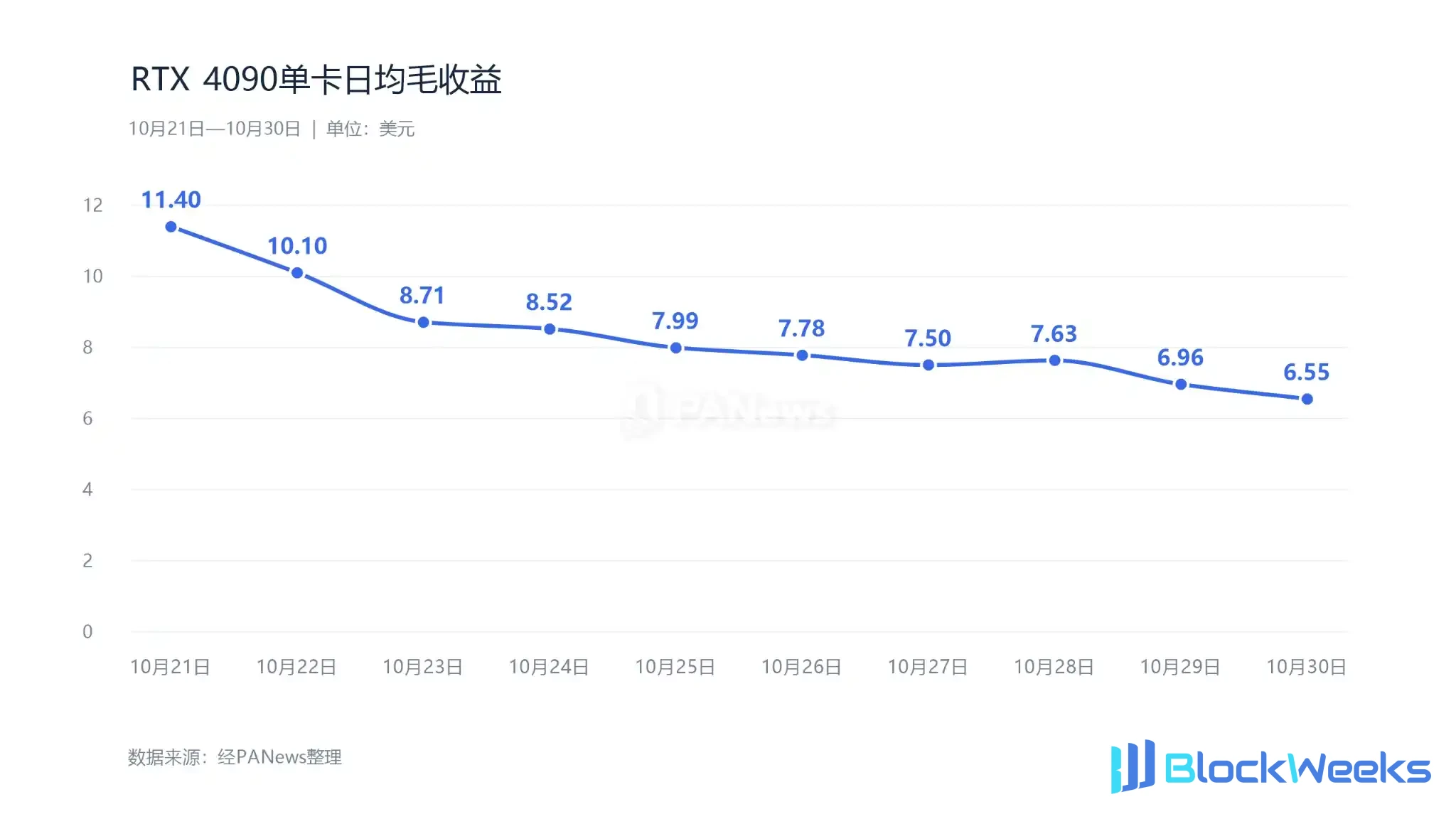
On October 21, the daily gross revenue per RTX 4090 card reached $11.4, far higher than other GPU mining coins in the same period. The generous returns drove a large amount of idle computing power to migrate across networks. The network hashrate climbed from about 70 EH/s all the way to a peak of 100.92 EH/s on October 27. As of now, the network hashrate has fallen back to 85.52 EH/s.
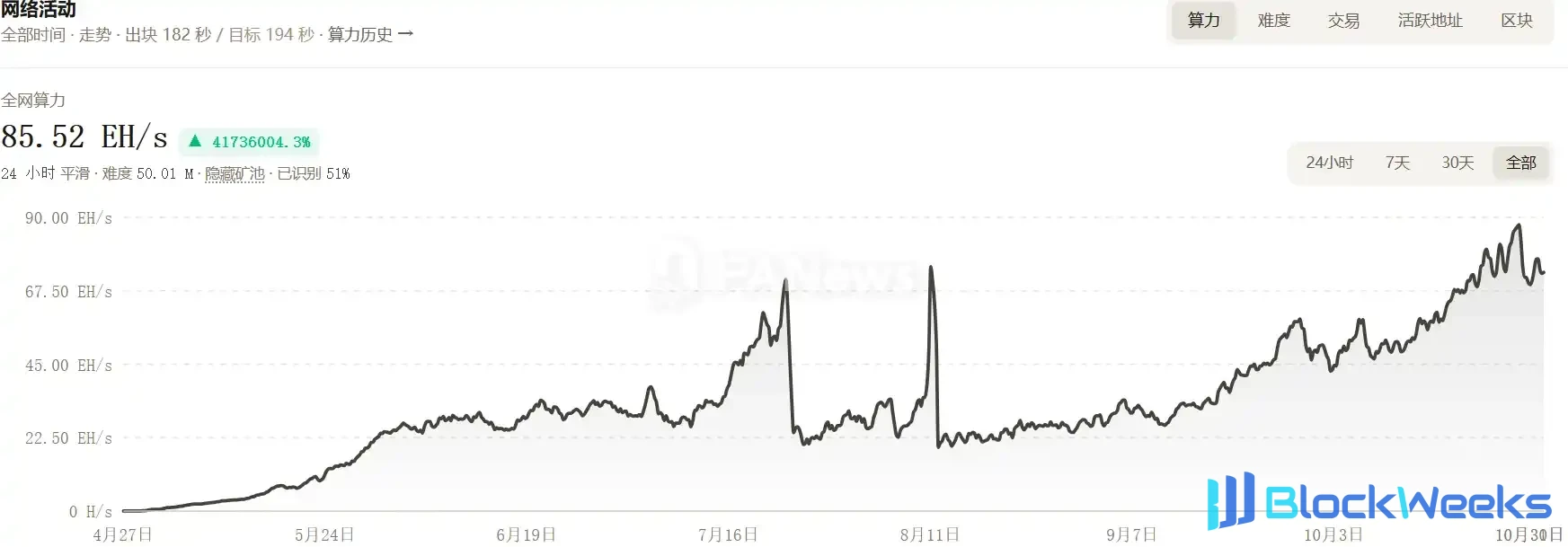
The consequence of hashrate migration is that the block production rhythm is disrupted. Pearl's target block time was originally 194 seconds. During the most frenzied phase of hashrate, the actual block time was compressed to 160 seconds, passively producing nearly 40 extra blocks per day, and millions of new PEARL were created out of thin air every day and dumped into the secondary market.
The most fundamental contradiction is that network difficulty adjustment always lags one beat behind the speed of hashrate influx. It was not until October 28 that network difficulty climbed to a high above 49M, a cumulative increase of nearly 20% compared with the day of the coin price peak, and it continued to hover at a high level. By then, the PEARL price had already fallen to $1.75.
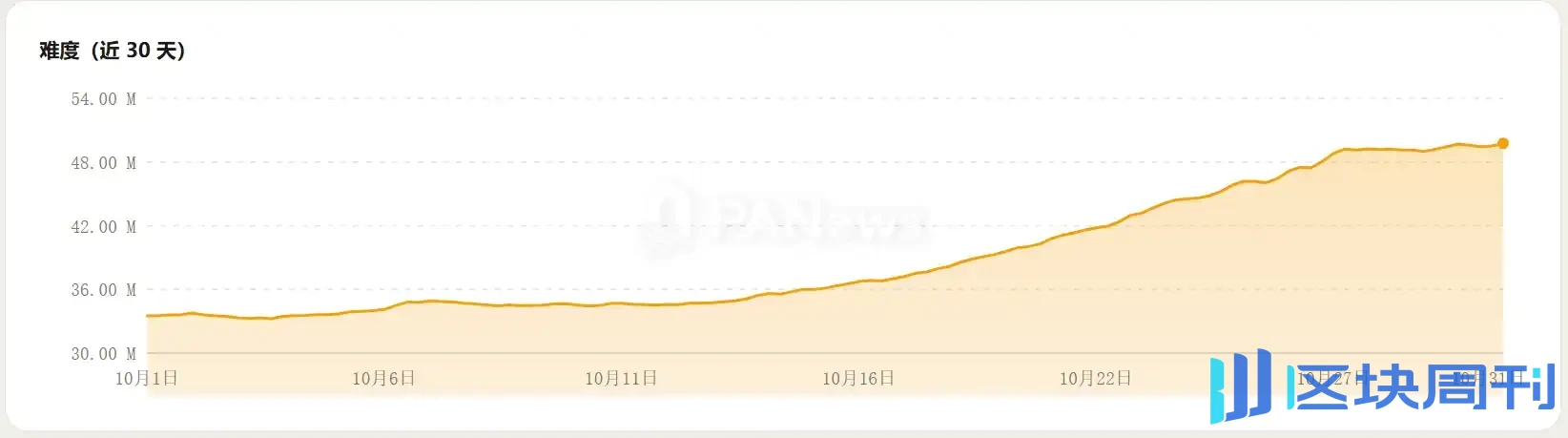
The scissors gap of coin price going down and difficulty going up directly squeezed miner returns, with average daily gross revenue per card falling over 30% from the peak. High-cost computing power was the first to flee, and the network hashrate shrank by nearly a quarter within two days, only then did block time return to the baseline range designed by the protocol.
In this mismatched race, the miners who rushed in first reaped the most dividends, while the latecomers who caught on late became the "bag holders" of the market reversal.
Same Card, Different Accounts: Retail Miners Count Money, Mining Farms Switch to AI, Short-Term Renters Run Away
The same card, in different hands, is a different business. Pearl's miner camp has already differentiated into three distinct groups.
Taking the network's main graphics card RTX 4090 as an example, under the network difficulty and hashrate environment on October 30, a single card could produce about 4.2 PEARL per day. Among them, different miners have vastly different capital costs and shutdown coin prices, which also determines their completely different decision-making logic when facing this round of retracement.
Home Miners: Sunk Costs Provide a Safety Buffer
For most home miners, the graphics card is already used for gaming or work, the hardware purchase cost is already sunk, and mining only requires bearing the electricity cost additionally.
Calculated at an average residential electricity price of $0.16/kWh, the daily electricity cost per card is only $3.84, corresponding to a shutdown average price as low as $0.87. In other words, as long as the average PEARL price remains above $0.87, they are pure profit.
Even though the coin price has fallen over 35%, their daily net profit per card is still stable at around $2.67, with a profit margin of about 70%.
For home miners, this retracement is not even a winter, at most "a bit windy". As long as cash flow remains positive, they will keep their machines running, unless the coin price continues to halve, or a higher-yielding alternative coin appears.
Large-Scale Mining Farms: Calculating Not Just Electricity, But Also Opportunity Cost
Mining farms with industrial-grade power are the cost depression of the mining industry. PPA contract electricity prices are as low as $0.05/kWh, and after adding all allocated costs such as site and operations, the all-in daily cost per card is only $0.48, corresponding to a shutdown average price of only about $0.11. In terms of mining itself, their safety cushion is even thicker than that of home miners.
But there is another way to calculate the mining farm's account.
Computing power is a general-purpose asset. The cuPOW algorithm is compatible with AI inference tasks, so the hardware can switch at any time between mining and renting out AI computing power. Currently, the net cash flow from providing AI inference rental services with one RTX 4090 is about $0.35/hour, equivalent to about $8.4 per day.
On October 30, the daily revenue per card from PEARL mining slid to $6.51, already lower than the return from AI inference rental.
Rather than continuing to mine while risking a decline in coin price, it is better to collect computing power rent steadily. As a result, some mining farms with lower risk appetite began to withdraw voluntarily, shifting their hardware to AI rental business or other PoW networks with more competitive returns, becoming one of the drivers of the hashrate peak and decline.
For mining farms, opportunity cost and GPU return per unit time are also two important financial indicators.
Cloud Computing Power Renters: The Main Force Behind This Round of Drastic Hashrate Fluctuations
In this round of hashrate clearing, short-term computing power renters are the most determined fugitives.
They do not hold any physical hardware, but only rent computing power by the hour on platforms such as Vast.ai, "mine, withdraw, and sell" on the same day, earning the intraday spread. Calculated at an average rental of $0.35/hour, the average daily cost is as high as $8.4, corresponding to a shutdown average price of about $2.
When the coin price plummeted to $1.75, lessees collectively fell into losses. Cloud computing power has no sunk costs, and the decision to shut down is made in an instant.
Within the three days of the computing power crash, the vast majority were short-term rental "speculators" exiting on a large scale.
However, some cloud computing power miners signed weekly or monthly non-refundable long-term contracts. The rent has already been paid, and as long as they continue mining, they can recover part of their losses. If the PEARL price rebounds, there may still be a chance to break even. Therefore, some long-term rental miners are still holding on.

Ninety percent of computing power is idling, with liquidity and centralization risks looming
In addition to the internal worry of computing power retreat, Pearl also faces the external trouble of its narrative being questioned. Pearl paints a story of "mining = doing useful AI computation," but between reality and the ideal, there is still a huge gap.
90% of PoUW computing power is idling
PEARL's main selling point is "replacing useless hashing with AI computation, making mining generate commercial value." But the reality is that this vision currently remains on paper.
Scholar Abhinaba Basu's empirical research, after sampling and analyzing 8,012 active mining machines, pointed out that more than 90% of the network's computing power is not running any deep learning models or real inference tasks, but is merely continuously computing meaningless random matrices.
The reason is that connecting to real AI inference requires handling context scheduling, model weight loading, and network I/O overhead, which would cause the effective computing power of mining machines to drop by 10%-30%. Under the rule that block rewards depend only on hash difficulty, the optimal choice for rational miners is to abandon real demand and purely idle by running random matrices. The so-called "useful work" is to a large extent "garbage mining" operations.
Potential selling pressure in the secondary market
The continuous release of tokens also brings considerable selling pressure to the secondary market.
Pearl currently produces about 1 million tokens per day. At market prices, the daily new selling pressure from miners exceeds $1.55 million, and the annualized inflation scale exceeds $565 million, already close to the protocol's circulating market value.
Spot trading is also concentrated in a few small and medium-sized exchanges, with average daily spot trading volume of less than $10 million. The daily selling pressure from miners alone accounts for nearly 20% of the trading volume, and depth is limited. Once concentrated selling occurs, thin bid depth can easily trigger a liquidity stampede.
In addition, during the low-difficulty period in the first 6 days after the mainnet launch, nearly 122 million tokens were mined across the network, accounting for more than 35% of the circulating supply. This portion of early chips lacks lock-up restrictions and has always been a dammed lake hanging over the secondary market.
Mining pool computing power has centralization risks
Pearl's computing power distribution also exposes potential network security risks. On-chain data shows that a single mining pool, Kryptex, has long occupied nearly half of the network's computing power, approaching the 51% attack security red line. For PoW-type systems that rely on computing power competition to maintain network security, a single mining pool holding too high a proportion of computing power means the network is more susceptible to risks such as computing power concentration, transaction censorship, and potential attacks.

Today, Pearl is standing at a critical watershed: after the mining dividend fades and narrative heat cools, whether it can attract enough real AI inference demand and make "useful work" generate commercial value will become the key to determining its long-term development prospects.
For miners or investors, this round of computing power ebb and flow also provides a realistic lesson. More important than chasing short-term returns is recognizing which cost line you are on. In the crypto industry, market conditions determine the upper limit of returns, while costs determine whether an individual can survive the cycle.