Recently, information disclosed by the Hong Kong Stock Exchange shows that semiconductor packaging and testing service provider Xinde Semiconductor has updated its post-hearing information pack and successfully passed the listing hearing for the Hong Kong Stock Exchange Main Board. This means it has completed a key step in regulatory review and is just one step away from landing on the Hong Kong Stock Exchange Main Board.
This OSAT (semiconductor outsourced assembly and testing) newcomer, established in September 2020, has knocked on the door of the capital market in just six years. Its luxurious shareholder lineup is the chip most often mentioned by the market about Xinde Semiconductor. Its investors include a number of large industrial capital groups, local government funds and venture capital institutions, including Xiaomi Yangtze River Industry Fund, Xunxing Investment, an entity associated with OPPO founder Chen Mingyong, Gaintech under MediaTek, as well as Chenyi Fund, Nanjing Pukou Industrial Investment and others.
However, the halo of shareholders cannot conceal operating pressure. Xinde Semiconductor's performance shows a typical characteristic of revenue growth without profit growth. From 2023 to 2025, its revenue increased from 509 million yuan to 1.012 billion yuan, doubling its revenue scale, but its cumulative net loss over the same period exceeded 1.2 billion yuan, and its gross profit margin remains negative to this day. After landing in the capital market, how to deliver on the profitability narrative will be the core proposition that Xinde Semiconductor must face directly.
01 Revenue doubled in three years
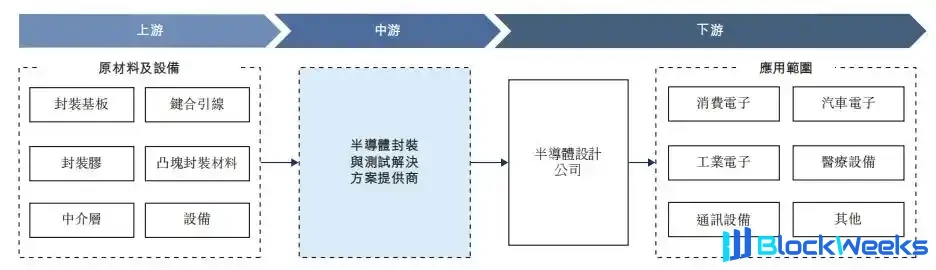
Xinde Semiconductor is mainly engaged in developing packaging designs, providing customized packaging products and packaging product testing services.
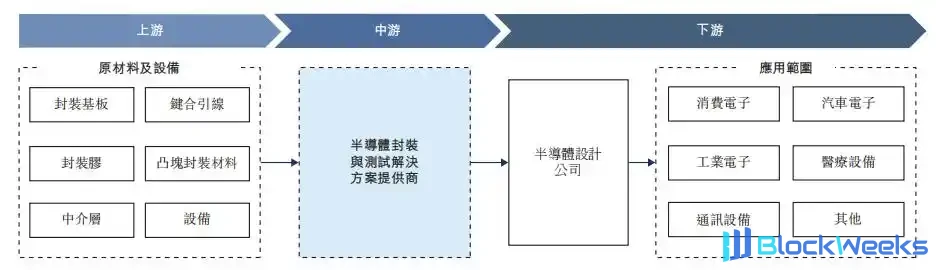
Source: Xinde Semiconductor prospectus
According to Frost & Sullivan, in the "post-Moore era" when transistor density growth is approaching its scale limit, relying on new semiconductor packaging architectures (such as miniaturization, thinning, high efficiency, heterogeneous integration and other packaging technologies) as a key link connecting chip design and applications has become a key driving force for improving chip performance, efficiency and functional flexibility. By revenue from advanced semiconductor packaging and testing in 2025, Xinde Semiconductor ranked seventh among general OSAT companies in China, with a market share of 0.6%.
The prospectus shows that from 2023 to 2025, Xinde Semiconductor's revenue was 509 million yuan, 827 million yuan and 1.012 billion yuan, respectively, with a compound annual growth rate of 41.0%; revenue in the first four months of 2026 was 360 million yuan, an increase of 17.4% from 306 million yuan in the same period of 2025.
Capacity utilization also rose in tandem. The capacity utilization rate of Xinde Semiconductor's Nanjing production base climbed from 62.3% in 2023 to 77.3% in 2024 and 84.5% in 2025. The Yangzhou production base only began operations in July 2025 and is still in the capacity ramp-up stage. Affected by this, the capacity utilization rate in the first four months of 2026 fell back to 80.0%, and there has not yet been a contradiction in which capacity is released but revenue cannot match.
A breakdown of the revenue structure easily reveals that advanced packaging products are the core source of revenue for Xinde Semiconductor. According to the prospectus, advanced packaging products include BGA, LGA, WLP, 2.5D/3D, FC-QFN and FC SOT, while traditional packaging products are mainly WB-QFN.
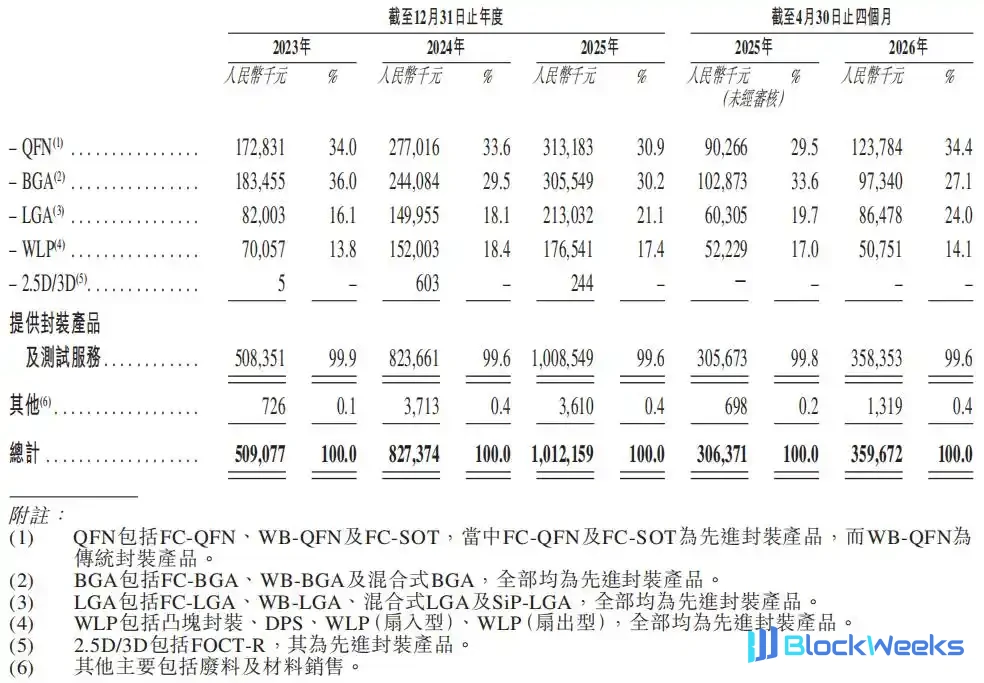
Source: Xinde Semiconductor prospectus
From 2023 to 2025, advanced packaging revenue was 347 million yuan, 587 million yuan and 737 million yuan, respectively, accounting for 68.2%, 71.3% and 73.1% of revenue from packaging products and testing services, respectively. Over the same period, traditional packaging revenue increased from 162 million yuan to 237 million yuan and 271 million yuan. The change in revenue structure reflects that more than 70% of Xinde Semiconductor's revenue is no longer in the low-end packaging category.
However, there are also technological gaps within advanced packaging. Xinde Semiconductor's main advanced packaging products are still mature products such as BGA, LGA and WLP, and there is still a substantial gap compared with top-tier high-end packaging such as 2.5D/3D.
The tier gap within advanced packaging can be seen from average selling prices. Taking 2025 as an example, the average selling prices of BGA, LGA and WLP were 1.54 yuan, 0.19 yuan and 0.17 yuan, respectively, while the average selling price of 2.5D/3D was as high as 244.00 yuan.

Source: Xinde Semiconductor prospectus
From 2023 to 2025, the combined revenue of QFN, BGA, LGA and WLP accounted for 99.9%, 99.6% and 99.6% of revenue, respectively, making them the absolute pillar of Xinde Semiconductor's revenue. Revenue from 2.5D/3D was negligible, at 5,000 yuan, 603,000 yuan and 244,000 yuan, respectively, and mostly came from non-recurring engineering batches, accounting for less than 0.1% of revenue for a long time.
In other words, Xinde Semiconductor's revenue doubling over three years mainly relied on relatively mature packaging products such as BGA, LGA and WLP, while 2.5D/3D, which represents the technological direction of the "post-Moore era," remains at the sample and customer laboratory verification stage. There is still a commercialization gap that is difficult to cross between technological capability and revenue contribution.
02 The other side of high growth
Although revenue has shown significant growth, Xinde Semiconductor has not yet crossed the break-even line.
From 2023 to 2025, Xinde Semiconductor's net losses were 359 million yuan, 377 million yuan and 483 million yuan, respectively, with cumulative losses exceeding 1.2 billion yuan over three years, and it recorded another loss of 162 million yuan in the first four months of 2026. After excluding the effects of interest on redeemable liabilities, share-based payment and listing expenses, adjusted net losses were 266 million yuan, 238 million yuan and 274 million yuan, respectively, still not escaping a loss-making state. Xinde Semiconductor explicitly stated in its prospectus that it expects to continue recording losses in 2026.
Xinde Semiconductor admitted in its prospectus that the semiconductor packaging industry is inherently capital-intensive. From its establishment in 2020 to April 30, 2026, the company's total initial capital expenditure was approximately 4.063 billion yuan, mainly used to establish and expand production facilities and production capacity. Massive upfront investment has brought huge depreciation and amortization expenses, and the new Yangzhou base is still in the capacity ramp-up stage, so these fixed costs cannot be fully absorbed in the early stage.
Fortunately, Xinde Semiconductor's profitability indicators are improving. Its gross loss margin narrowed significantly from 38.4% in 2023 to 20.1% in 2024, and further narrowed to 18.0% in 2025. In the first four months of 2026, the gross loss margin continued to improve to 17.9%. A negative gross loss margin means that for every one yuan of packaging and testing business revenue Xinde Semiconductor realizes, after deducting direct materials, direct labor and manufacturing expenses, gross profit is still negative.
It is also worth mentioning that Xinde Semiconductor's revenue doubling over three years is highly dependent on a small number of core major customers. The revenue contribution of Xinde Semiconductor's top five customers increased from 50.4% in 2023 to 53.0% in 2024 and 54.6% in 2025, and further rose to 55.0% in the first four months of 2026. Among them, the largest customer contributed 24.5% and 19.7% of revenue in 2025 and the first four months of 2026, respectively. The advantage of high customer concentration is that it can quickly expand order volume, but the hidden danger is also obvious: once core major customers reduce procurement,压低报价 or encounter problems in their own operations, Xinde Semiconductor's capacity utilization and profit improvement process will come under direct pressure.
In addition, Xinde Semiconductor's revenue is highly concentrated in the consumer electronics and communications industries. At present, the consumer electronics industry is highly competitive and is in a downturn cycle, and its revenue performance is highly susceptible to fluctuations in downstream market demand.

Image source: Xinde Semiconductor prospectus
From 2023 to 2025 and the first four months of 2026, the proportion of Xinde Semiconductor's revenue from consumer electronics industry products was 65.0%, 67.8%, 54.3% and 57.2%, respectively; the proportion of revenue from communications industry products was 23.6%, 27.5%, 40.2% and 38.4%, respectively. The combined proportion of revenue from products in these two major industries reached as high as 88.6%, 95.3%, 94.5% and 95.6%. Meanwhile, 2.5D/3D, regarded as a long-term growth engine serving artificial intelligence and data centers, is still in its early stages and will be difficult to use to offset the cyclical fluctuations of consumer electronics in the short term.
Xinde Semiconductor therefore warned in its prospectus that if market demand further weakens or deteriorates, customers may reduce, postpone or cancel their orders, which may lead to a decline in orders and sales volume.
03 Can industrial capital provide a safety net?
Xiaomi, OPPO and MediaTek all appear on the shareholder list at the same time. What kind of support can they actually provide to Xinde Semiconductor?
The core motivation for industrial capital to invest in Xinde Semiconductor lies in supply chain security and industrial synergy, rather than purely financial investment. In essence, it is both recognition of Xinde Semiconductor's packaging capabilities and a strategic binding made out of consideration for hedging supply chain risks.
For MediaTek, supporting a local OSAT manufacturer with advanced packaging capabilities is intended to secure a key supplementary production capacity for its own layout. For Xiaomi and OPPO, taking stakes in Xinde Semiconductor is likewise out of supply chain considerations, especially so that during periods of tight capacity or technological iteration they can obtain more controllable supply chain guarantees and deeper customized collaboration.
However, judging from the shareholding ratios, the equity weight held by the three industrial capitals is not enough to obtain control: Xiaomi Yangtze River Industrial Fund holds 2.61%, Xunxing Investment controlled by OPPO founder Chen Mingyong holds 1.14%, and MediaTek's Gaintech holds 0.31%. Together, the three hold less than 5% of the equity and are minority shareholders at the financial level. They can neither intervene in the pace of Xinde Semiconductor's capacity expansion nor guarantee order scale. What they bring to Xinde Semiconductor is more industrial endorsement than an exclusive supply commitment.
In fact, there are clear boundaries to the role that industrial capital can play. On the one hand, Xiaomi, OPPO and MediaTek generally adopt multi-supplier strategies and will not put all their chips on a single manufacturer. Once any indicator such as yield, delivery or cost falls short of expectations, orders will flow to Xinde Semiconductor's competitors; on the other hand, industrial capital can provide funding and validation scenarios, but cannot replace Xinde Semiconductor in completing yield improvement, production line operations, cost control and large-scale customer introduction. Such hard operational capabilities can only be gradually accumulated by Xinde Semiconductor itself.
In other words, for Xinde Semiconductor, Xiaomi, OPPO and MediaTek are accelerators of business development, not a safety cushion that guarantees a fallback. The star-studded shareholder lineup amplifies market expectations for Xinde Semiconductor, but cannot bridge its commercialization gap.
Xinde Semiconductor is about to complete its Hong Kong IPO. Rather than a celebration of reaching the finish line, it is more like a major exam at a new starting point. How far Xinde Semiconductor can go depends on whether it can reverse its gross loss margin and achieve full profitability. This exam question does not belong only to Xinde Semiconductor; it is also an answer sheet that all semiconductor packaging and testing service providers still in their expansion phase need to complete together.
This article comes from the WeChat public account "DoNews" (ID: lovedonews), author: Zhang Yu