
Author: Zuo Ye Wa Bo Shan

The crypto market has performed poorly recently. This decline is partly due to low coin prices and declining trading volumes, but the more important reason is the disillusionment of narrative. Once upon a time, SBF really did blow the bubble sky-high and guided crypto capital and AI to merge with each other—another unreached realm of the metaverse.
Even the cleverest housewife cannot cook a meal without rice; the core issue is still the lack of forms of asset creation. As for liquidity exit methods, crypto can only choose between a TGE facing crypto retail investors and an IPO facing the stock market, while capital outside the circle rarely chooses M&A, and PE and other counter-trend bottom-fishing are almost never seen—even more projects simply run away.
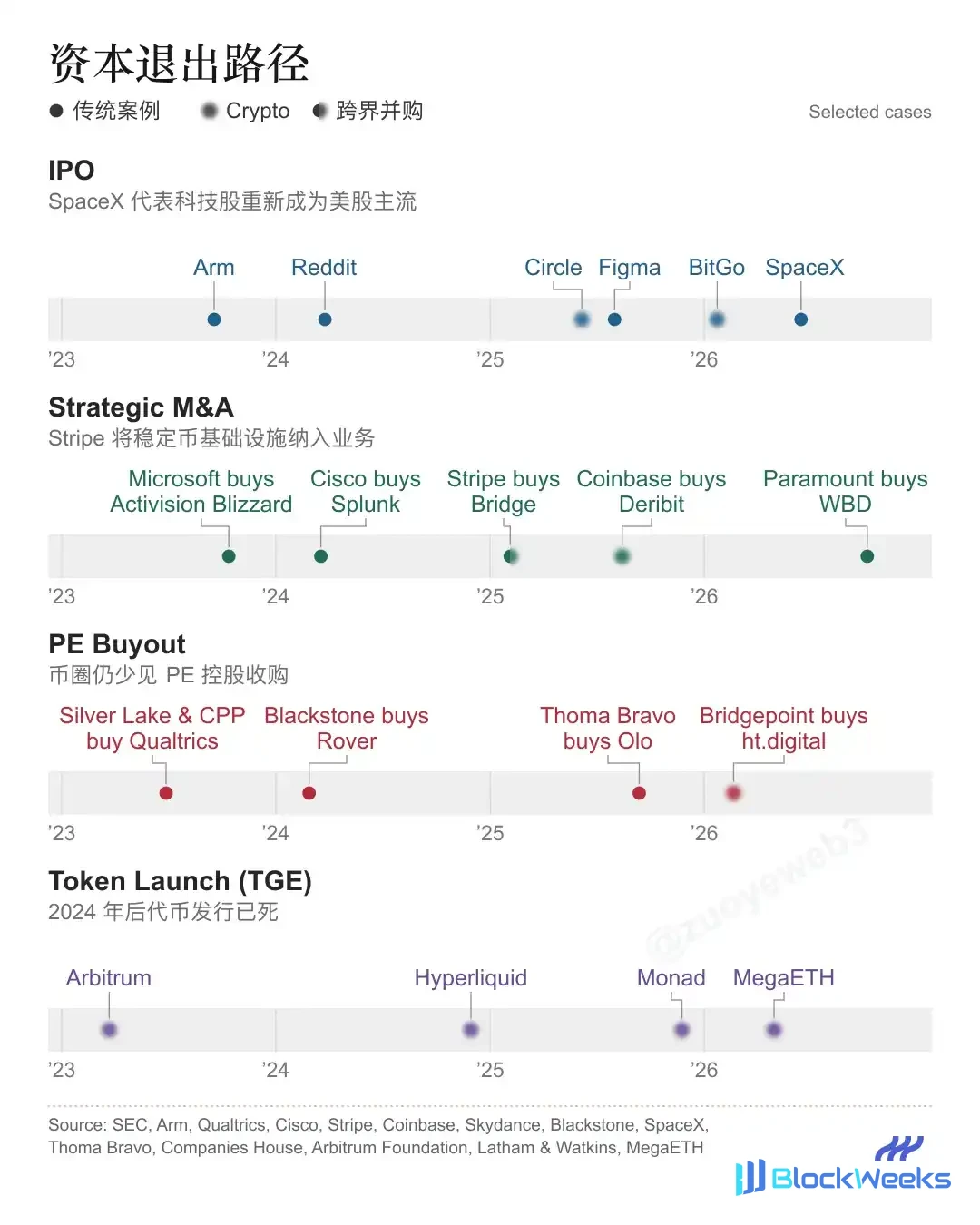
Figure: Capital exit paths
To put it more bluntly, the creativity of cryptocurrency keeps declining. It always comes down to Meme/Perp and prediction markets, entering a bewitched moment like running in circles—making everything into Perp, and then both SpaceX/ANT new share subscriptions were toyed with by brokers.
In other words, the offerings launched by the crypto circle can no longer attract external buying volume. The art of issuing offerings has become the worst class ever; it is necessary to learn how the earliest Ponzi schemes were repeatedly invented and even survive to this day.
Let us give the answer first: the first Ponzi scheme was the state. Ponzi is not an anomaly of finance but the essence of finance. Sovereign-level assets are that most successful Ponzi scheme—starting from war, spreading through securitization, and gaining a sense of eternity through time. The crypto circle's problem is not that there are too many Ponzi schemes, but that it cannot issue a sovereign-level Ponzi scheme.
War Invented Government Bonds
The starting point of sovereign-level assets is not in finance, but on the battlefield.
In the Middle Ages, the only industry requiring large-scale capital investment was running a state, and the only large project requiring massive funds was war.
The invention of government bonds was related to only one thing, namely the state's foreign wars—whether it was medieval Venice raising funds for an expedition to Constantinople, or Britain issuing bonds for an expedition against Napoleon and creating the Rothschild myth, or the United States during the Civil War when "Jay Cooke" initiated the socialization of investment, which truly made government bonds modern bonds.
Wars between feudal lords gave birth to the predecessor of modern finance, and the financial industry's return on investment in risk gave birth to the Age of Discovery, capitalism, and science and technology.
It was not that after the Industrial Revolution the economy shifted from the real to the virtual; rather, the creation of sovereign-level assets brought about the Industrial Revolution.
Even more, the mobilizing nature of war bonds was not only for raising funds externally during wartime, but is even the everyday version of modern democratic politics: votes are donations, and election campaigns are civil wars.
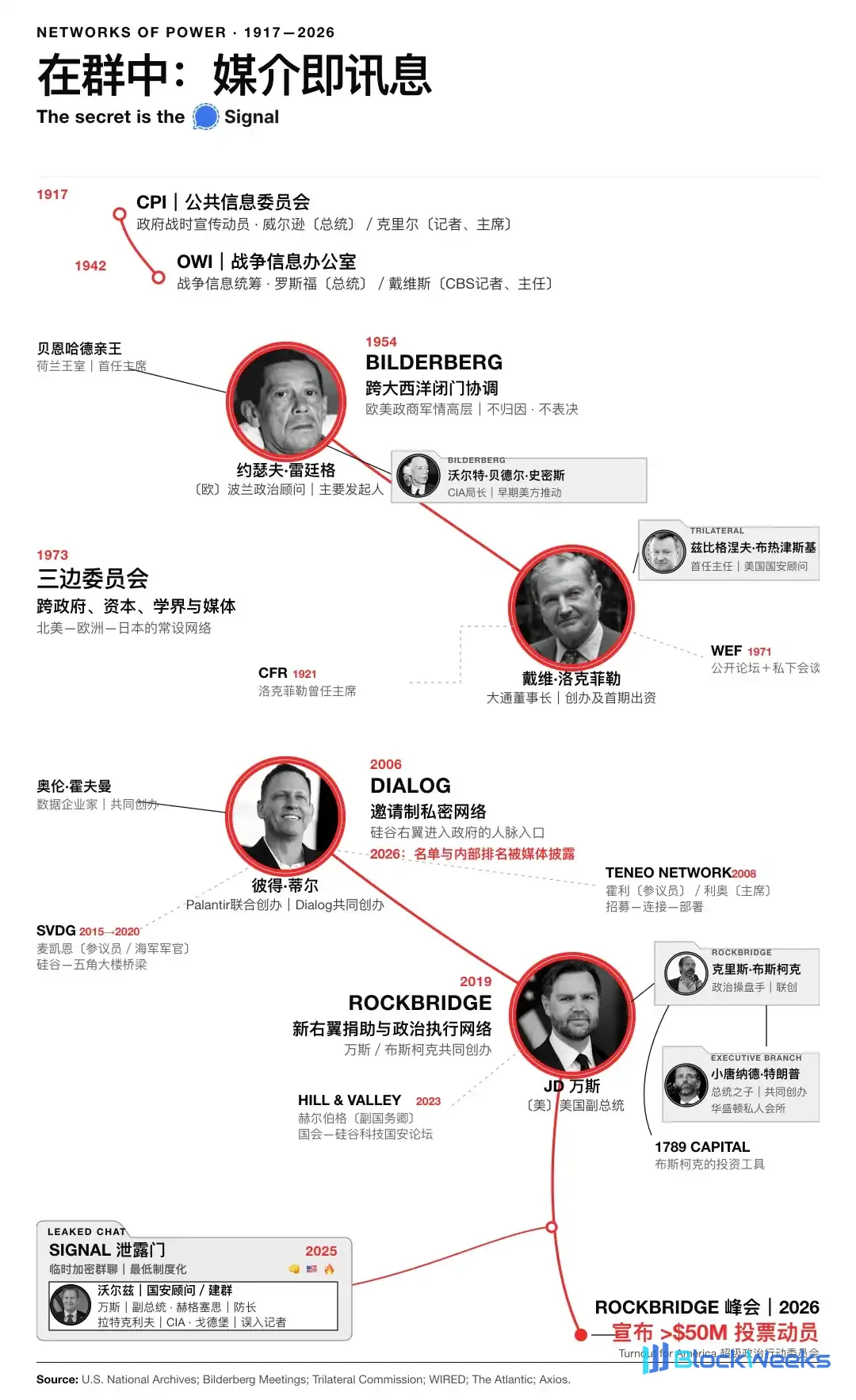
Figure: Fundraising is mobilization
Although the Republican Party did not win the midterm elections, he himself could raise more than 50 million dollars in political donations. The battle never stops, and funds are more important than approval ratings.
It can even be argued that political donations are more scientific than handing out welfare in exchange for votes, because welfare is a long-term liability with extremely low returns.
You can even think that the South Sea Bubble was only a small problem for Britain, one that could be gradually digested over a long period of time, but war cannot—one can lose the Boer War once, but must win it back, otherwise financial confidence will collapse, just as failing to defeat Iran will mean losing both houses.
Commerce was therefore militarized and used by the entire Western world as a means of social mobilization, and means of credit creation were continuously created.
Getting rich followed the continuous opening of sovereign-level assets to commerce and individuals. Britain's privateers were essentially public-private partnerships; the pirates who robbed Spain were the English king's partners; and the East India Company could obtain a stock pricing benchmark by managing the cash flow of India.
In our impression of sovereign-level assets, ordinary individuals can only act as funders, but from the perspective of Western history, ordinary individuals and enterprises could fully become the main body, and its form was recognition or retroactive acknowledgment of innovators, not at all an intentional invention of the government.
Ponzi Creates Liquidity
War taught the state to borrow money, but what truly turned debt into assets was someone cutting it up and selling it to retail investors.
We can even go to an extreme: war bonds gave birth to stocks, the social insurance system, and even the modern monetary system. This is not alarmist.
The South Sea securities and the Mississippi scheme were essentially the British and French governments, in order to solve government revenue and expenditure problems, packaging government debt and taxation rights as a whole and selling them to specific companies, and the companies, in order to sell to retail investors, further securitized them, truly giving birth to the modern stock market, while financial instruments such as options and short selling, which had been repeatedly banned, were invented almost in an instant.
Bugs have never been eliminated, and derivatives have never been banned.
Whether it was the British Empire or the American empire after World War II, neither could maintain the peg between its own currency and gold. Under the wave of foreign exchange liberalization in the 1970s and 1980s, the Chicago Mercantile Exchange was the first to invent interest rate futures. Before that, all options/futures essentially required physical delivery; even foreign exchange was the exchange of different currencies, but interest rates had no physical counterpart at all.
In the end, innovation ran ahead of regulation, and the CFTC eventually stamped its approval after the fact, allowing settlement in US dollars and creating the modern version of difference settlement. This is the true starting point of Arthur Hayes's invention of perpetual contracts.
By 2025, the largest lending institution is not JPMorgan Chase, but BlackRock, which crushes the entire banking system with a scale of 3.2 trillion dollars, and its core asset is bonds. We can even argue that monetary banking theory centered on central banks no longer conforms to reality.
Nixon could not withstand the pressure of US dollar inflation; this is the origin of the entire cryptocurrency leverage mechanism. History is very humorous, and will even repeatedly try to teach humanity in the name of technological innovation.
The invention of Gutenberg's printing press not only raised literacy rates and thereby triggered religious revolution, but also led to large-scale printing of paper money, which was a catalyst for severe inflation.
Derivatives are only a side branch. The greater product of sovereign-level assets is the nationwide frenzy that comes once every hundred years.
Debt is only a credit certificate; the swap of funds and resources is more real.
The principle is not complicated: creditors invest in a certain target in an overseas country, such as the French frenzy over the Mississippi in the 1720s, the British frenzy over Latin American minerals, and even the ancestor of Ponzi schemes, the 1637 Dutch tulips, which itself was a by-product of the Dutch East India Company actually making money.
Since the end of the Middle Ages, in human history, roughly every hundred years or so, humanity has fallen into a collective frenzy, and apart from war bonds in the narrow sense, most assets capable of triggering nationwide frenzy have been represented by bonds:
- 1637: Tulip Mania
- 1720: South Sea Bubble, Mississippi Bonds
- 1820: American Railway Mania
- 1920: Coolidge Prosperity
- 2020s: AI Mega Funds
The above cases are of course not all bond trading, but Nvidia's AI chip circular lending, the stock market surge of the Coolidge era, and the capital forms of railway mania basically all follow the path of being driven by bonds in the early stage and retail investors taking over in the stock market in the later stage.
Debt-to-equity conversion is not Jia Yueting's creation, but merely an unintentional homage to Britain and France 300 years ago; MicroStrategy's STRC re-issuance based on BTC is merely the accumulation stage of the South Sea Bubble. Returns must be guaranteed from real production, or frenzy for AI factories—perhaps this time is different.
In the boring years of the interwar period, bankers and ordinary citizens who had enjoyed high interest rates eagerly sought the next high-return project, and even ordinary investors were more frenzied than bankers, just as Hyperliquid community members are more devout than the project team.

Figure: Sovereign-level assets are repeatedly invented
The sovereignization of US stocks is not a romantic tale under the buttonwood tree. Even though the Great Depression of 1929 originated from a stock market crash, it cannot prove that the stock market kidnapped the American economy. The modern stock market is still the latest invention of the 1970s. Employee pensions, executive options, and corporate stock buybacks comprehensively channeled the assets of all Americans into the stock market, truly innovating the stock market into a nationwide asset.
Even Day Traders are a creation of this wave, and Robinhood is nothing but its reinvention in the internet age.
Therefore, Peter Thiel placed the "Conquest of the World Index" in the PayPal office. It was clearly just the number of users bought with burning money, but under the miraculous packaging of growth rates, this is a discounting standard based on expectations—everything has been financialized.
Switching to the new century, the only industry requiring large-scale capital investment is conquering the world, and the only large project requiring massive funds is innovation.
From South Sea securities to the Chicago Mercantile Exchange, from interest rate futures to perpetual contracts, and then to PayPal's Conquest of the World Index, the crypto world's Perp and TGE are already in this family tree, just of the lowest generation.
Moreover, when a Ponzi scheme encounters a state entity and becomes a sovereign-level asset—especially for a regime that controls some kind of hegemony, channel, or resource for a certain period—it becomes a mechanism that repeatedly extracts wealth from counterparties. When the Ponzi scheme reaches its end and debt reaches its limit, eliminating creditors is far simpler than paying interest.
Nations Do Not Go Bankrupt
The question is, if every round of frenzy ultimately collapses, why can sovereign-level assets come back again and again?
In the news, we often see abstract cases such as US government shutdowns, the debt crisis of the five Southern European countries, and even Sri Lanka's national bankruptcy. This contradicts our common sense—how can a sovereign state, like a company, go bankrupt due to poor management?
In fact, compared with war and sanctions, the international debt system has a stronger binding capacity on governments, because credit ratings can truly determine whether a government can obtain external funding. Compared with collecting taxes domestically, borrowing money to do projects is often more direct, and the return rate may even be higher.
And counterintuitively, the consequences of most sovereign debt defaults are not as terrifying as we imagine. Take Argentina as an example: after default, it can still obtain IMF loans and US disbursement support.

Figure: Sovereign debt default
From the perspective of the history of sovereign-level assets, war bonds hinder the state's ability to repay individual annuities, thus causing multiple collapses. The state's repeated credit defaults against individuals are the historical basis for "internal debt is not debt."
When sovereign-level assets ultimately cannot be redeemed, they degenerate into a Ponzi mechanism, but this itself is not the problem—even in the long debt-resolution cycle, humanity invented capitalism and modern science, at the cost of merely two world wars.
And by the 2008 financial crisis to which we belong, we are still in the aftermath stage of that cycle. As mentioned earlier, the way to solve the European debt crisis was two world wars; the way to solve the American debt crisis will obviously not be the Federal Reserve. If you do not look forward to the arrival of World War III, then you had best hope that AI's promises are true.
In particular, central banks are simply powerless to stop the continuous erosion by the administrative system, but in order to prevent a total collapse of the credit system, they must perform on stage, pretending they still care about the money supply.

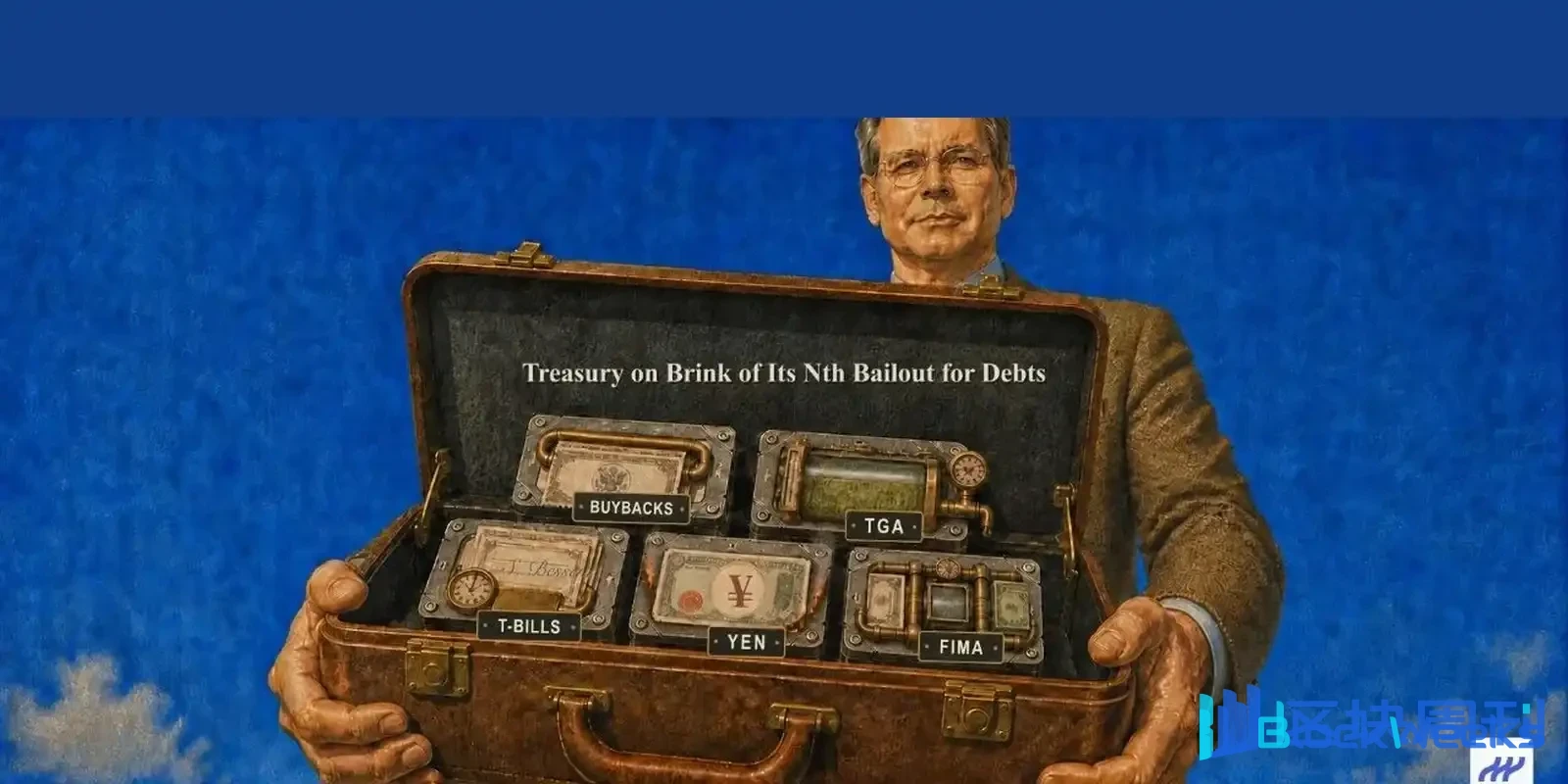
Figure: Treasury QE
During the Biden era, under Treasury Secretary Yellen, in 2023 there was a bold financial innovation: swapping long-term US Treasuries for short-term Treasuries, or even CMB ultra-short-term instruments, in order to压低 long-term bond yields. Let me explain briefly here: the long-term interest rate of US Treasuries is the true "risk-free rate," which determines basic rates such as student loans and mortgages.
Carrying out such operations in Biden's election year, Bessent repeatedly criticized Yellen, believing that she deliberately operated this way to help the election campaign. Swapping long and short bonds would quickly drain the government's cash flow reserves, because they would have to be repaid next year. But for Biden at that time, if he could not win, there would be no future at all. Besides, if he failed to win, he could still create huge funding trouble for Trump.
Sure enough, although Trump won the 2024 presidential election, facing a structural fiscal crisis, campaign promises to voters, and fiscal expenditures under the tariff war, Bessent could only transform into Yellen and continue issuing short-term debt to drink poison to quench thirst.
It can be understood this way: issuing short-term debt is the Treasury bypassing the Federal Reserve and forcibly using fiscal means to create short-term market liquidity, at the cost of interest scale rising year by year.
But even so, compared with European and Japanese government bonds and corporate bonds, US Treasuries and AI bonds are still more cost-effective—at least they are still raising military funds rather than paying welfare, at least investing in productivity rather than paying welfare.
We all know that US Treasuries are collapsing, yet we still regard them as the risk-free foundation of the entire world financial system. These two things themselves exist simultaneously. Ponzi schemes are not scary; sovereign-level assets are themselves Ponzi schemes that cannot be collapsed away even when they collapse.
Conclusion
Why can sovereign-level assets be repeatedly invented?
It is not the sacredness of the state: responsibility for debt repayment—recently Sri Lanka, distantly French annuities—nor is it the scale of the state: corporate bonds and sovereign bonds are essentially no different, both guaranteed by profitability, but ultimately crushed by interest itself.
A more reasonable explanation is time. When any system spans the cycle of a generation, it will be regarded by the world as eternal. From the establishment of the Bretton Woods system to its collapse was only 27 years, and people at the time never considered collapse itself. During the Clinton era, the US government even had a surplus. The current surge in US Treasuries is, strictly speaking, the direct consequence of 2008.
According to calculations, government bailouts of the financial sector generally create a 188% impulse to raise taxes; debt never disappears, it is only transferred to ordinary individuals, and it is precisely because sovereign governments control the population that they have the confidence to default continuously.
They are not pure scams; even after deleveraging they can exist for the long term, forming an everyday mechanism without excess profits.
Back to the crypto world.
Starting in 2025, the PE Guy image went viral on the American internet. As US stocks approached their extreme, ever-newer (repeatedly reinvented) asset forms continued to appear, yet the crypto industry instead fell into bewilderment, believing that everything was about to end. In fact, there is no need for that at all; the road of innovation is long, and even destructiveness itself has value in being co-opted.
Comparing with the rise of sovereign-level assets, what the crypto world lacks is actually very clear:
- It lacks war. There is no collective goal that forces everyone to pay up; DeFi Summer and the metaverse briefly played that role, and now the only hope is AI;
- It lacks a securitization channel. Perp-ification is only self-circulation within the circle, without connecting to cash flows outside the circle; the SpaceX/ANT new-share subscription being toyed with by brokerages is precisely because the channel is not in its own hands;
- It lacks time. No crypto system has survived a generation, so naturally no one treats it as eternal.
As for the Ponzi schemes of enterprises and individuals, they are nothing more than clumsy imitations of sovereign-level assets; how well they can imitate depends on how much state credit they can borrow. This will be elaborated in later articles of this series.