

Ethereum developers have scheduled the Glamsterdam upgrade for activation on the Hoodi testnet on December 15, ending nearly seven weeks of delays over smart contract compatibility concerns as ETH price recovers above $1,700.
Summary
- Ethereum developers schedule Glamsterdam’s Hoodi testnet upgrade for December 15.
- Developers retain EIP-8037 despite potential risks to up to 15,000 smart contracts.
- Security audits identify 200 compatibility issues, with 24 requiring upgrades or migration.
- Ethereum developers reconsider FOCIL as quantum-resistant cryptography gains priority.
- Ethereum price rises 3% to $1,740 as MACD registers a bullish crossover.
During the November 26 All Core Developers Consensus (ACDC) meeting, Ethereum’s core development teams agreed to retain the existing specifications for EIP-8037, a proposal that changes how the blockchain charges for creating permanent data.
The upgrade will activate at 19:12 UTC on December 15, corresponding to 03:12 Beijing time on December 16, at epoch 143616.
Meanwhile, Ethereum price rose 3% over 24 hours to $1,740 on November 27, outperforming Bitcoin during a recovery across the cryptocurrency market.
Ethereum developers retain disputed Glamsterdam upgrade specifications
The Hoodi deployment was originally scheduled for October 26 but was postponed after blockchain security researchers identified potential disruptions to existing smart contracts under Glamsterdam’s proposed gas pricing rules.
Developers have since reviewed alternative specifications and findings from security audits before agreeing to proceed with the existing design.
The November 26 meeting summary described the agreement as a “rough consensus to proceed with the current Glamsterdam spec as is.”
At the center of the discussions is EIP-8037, which introduces separate accounting for the gas consumed during transaction execution and the creation of permanent blockchain data.
Under the proposal, creating a smart contract would incur 183,600 units of state gas alone, compared with the existing base creation charge of 32,000 gas units. Developers would face separate execution and bytecode storage charges.
The proposal’s authors noted that after Ethereum raised its block gas limit from 30 million to 60 million units, average daily state growth rose from approximately 105 MiB to 326 MiB.
Glamsterdam previously went live on Sepolia on October 6, where developers began testing a 200 million gas limit alongside changes to block production and transaction processing.
Consensus-layer developers have now agreed on a mechanism for validating execution payloads through pull request 5770, which avoids introducing consensus-breaking changes.
Security audits identify 200 smart contract compatibility issues
Before agreeing to retain the existing specifications, the Ethereum Foundation worked with security firms ChainSecurity and Dedaub to identify applications that could encounter problems following the gas pricing changes.
As crypto.news previously reported, the combined smart contract security assessment identified 200 compatibility findings, including three classified as high severity, 30 as medium and 167 as low.
Fixed gas budgets appeared in 182 findings, representing 91% of the identified issues. While most can be addressed through configuration changes, 24 require contract upgrades or migration.
Ethereum Foundation developer Marius van der Wijden previously estimated that between 10,000 and 15,000 of Ethereum’s roughly 90 million contracts could encounter compatibility problems.
Although Hoodi now has an activation date, Ethereum’s mainnet deployment remains unscheduled.
Ethereum developers reconsider Hegotá features amid quantum security concerns
With the Glamsterdam testnet schedule settled, developers turned their attention to Hegotá, the subsequent network upgrade, and whether its proposed features could interfere with Ethereum’s post-quantum security roadmap.
Much of the discussion centered on Fork Choice-Enforced Inclusion Lists (FOCIL), a mechanism designed to improve censorship resistance by limiting the ability of block builders to exclude eligible transactions.
Ethlabs researcher Caspar Schwarz-Schilling argued that developers should reconsider FOCIL’s inclusion and dedicate available resources to quantum-resistant cryptography. Other participants maintained that both projects could progress concurrently.
The disagreement follows earlier discussions about reducing Hegotá’s development scope to accelerate cryptographic security work.
Ethereum Foundation researcher Kev Wedderburn presented a proposal to adopt Keccak-256 as a common hash function across Ethereum’s post-quantum infrastructure, citing its extensive security research in a November 24 publication.
Meanwhile, researcher Justin Drake outlined a late-2028 target for completing Ethereum’s post-quantum and post-AI security transition during Devcon in Mumbai.
Developers will revisit Hegotá’s proposed features at their next consensus-layer meeting in two weeks.
Ethereum price prediction as ETH approaches $1,750 resistance
Ethereum traded between $1,670 and $1,750 over the preceding 24 hours. Despite its recovery, ETH remained approximately 65% below its August 2025 all-time high of $4,950.
On the daily chart, the Moving Average Convergence Divergence (MACD) line has crossed above its signal line, with respective readings of negative 143.55 and negative 153.03.
Although the histogram has turned positive at 9.48, both lines remain below zero, indicating that the recovery has yet to reverse the prevailing bearish trend.
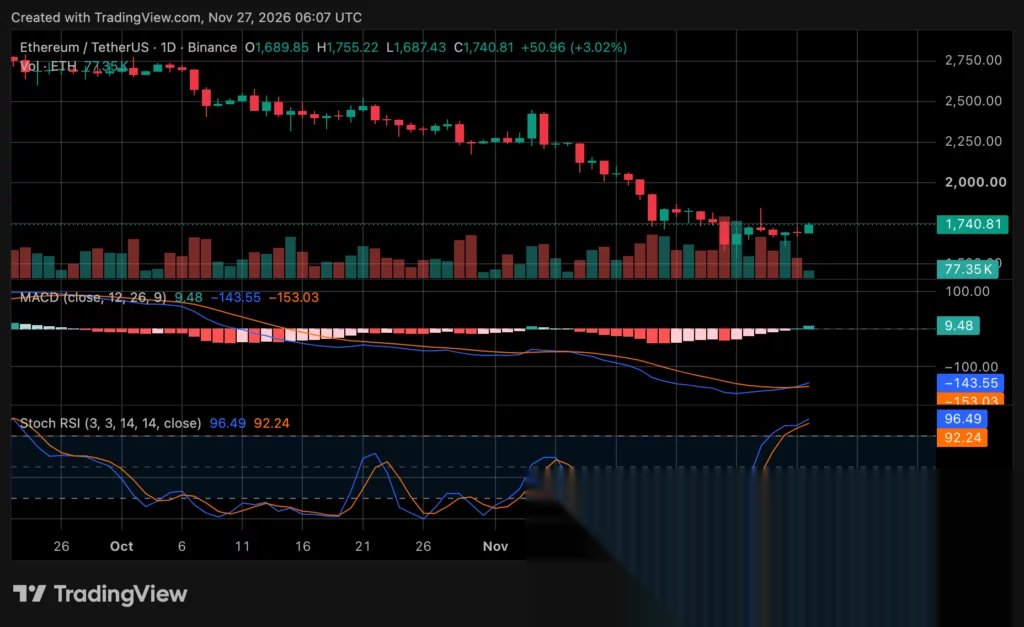
Meanwhile, the Stochastic Relative Strength Index has reached 96.49 and 92.24 on its respective %K and %D lines, placing both readings above the conventional overbought threshold of 80.
The daily chart places immediate resistance near $1,750, followed by the 1,800–1,850 region and the psychological $2,000 level. On the downside, support stands near $1,667, followed by $1,600 and $1,500.