

Author: Wall Street Insights
The selling pressure in the gold market comes not only from investors taking profits, but also from some official holders who continue to reduce their holdings under financial pressure.
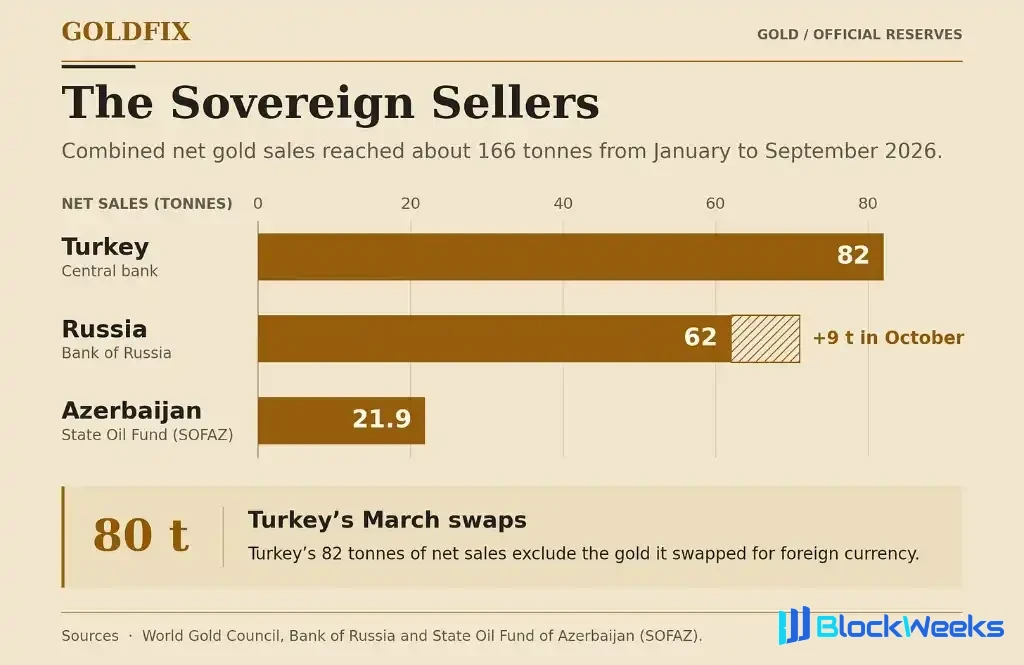
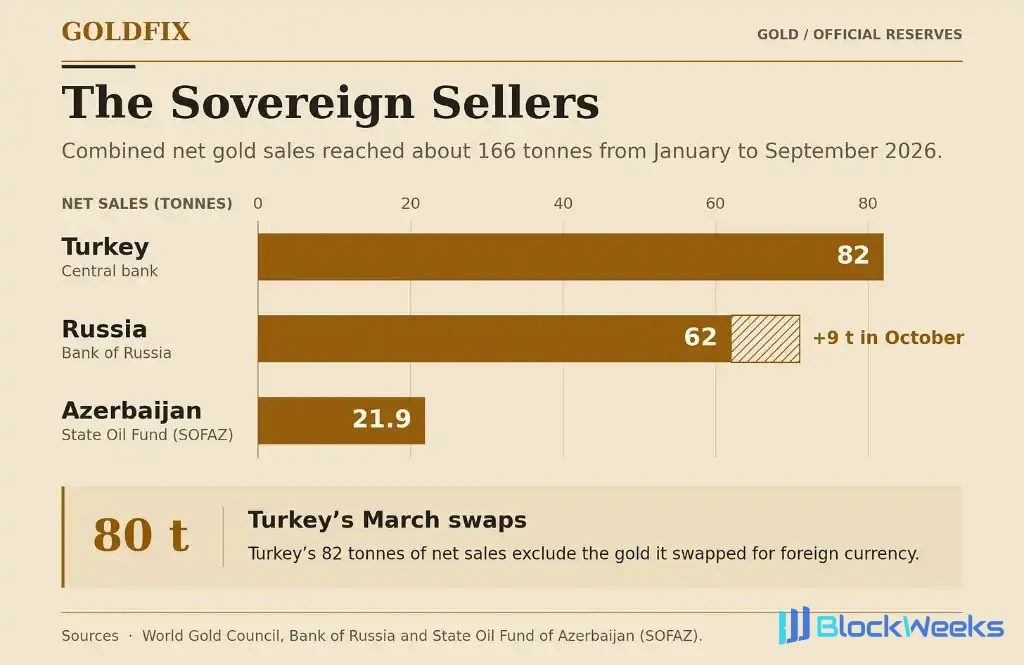
According to GoldFix statistics, as of September, the central banks of Turkey and Russia, along with the State Oil Fund of Azerbaijan, collectively sold a net total of approximately 166 tons of gold.Among them, Russia is the only holder that has been selling every month for ten consecutive months, with its gold holdings declining month by month from January to October, for a cumulative reduction of about 72 tons.
The Central Bank of Turkey sold a net total of about 70 tons in the first quarter, mainly concentrated in March, and in the same month it also used another 80 tons of gold for gold-for-foreign-exchange swaps. The State Oil Fund of Azerbaijan sold 21.9 tons in the first quarter because rising gold prices caused its gold holdings to exceed the portfolio limit; thereafter, its holdings remained unchanged at 178.1 tons for six months.
Tether, which the market repeatedly mentions, did not engage in large-scale selling. Its vault corresponding to USDT reserves decreased by 3.4 tons in September compared with June, but the vault corresponding to XAUT tokens increased by 3.7 tons over the same period, and the combined holdings of the two actually rose slightly from 168.2 tons to 168.5 tons.
Russia continues to sell gold, Turkey concentrates its reductions, Azerbaijan rebalances at high prices
The Bank of Russia's gold sales mainly take place in the domestic market, driven by the Ministry of Finance's use of the National Wealth Fund to finance the budget. From January to October, Russia's gold holdings declined for ten consecutive months, for a cumulative reduction of about 72 tons.
Compared with other sellers, Russia's reduction is more sustained. Turkey mainly faces financial pressure from exchange rates and energy imports, while Azerbaijan is rebalancing after its gold holdings exceeded the portfolio limit.Russia's gold sales directly serve the need for fiscal financing and are not a one-off position adjustment.
Azerbaijan's reduction is closer to a one-off portfolio rebalancing. The country's State Oil Fund sold 21.9 tons of gold in the first quarter, mainly because rising gold prices pushed up the proportion of its holdings, causing it to exceed the portfolio limit. Over the following six months, its gold holdings remained at 178.1 tons.
Turkey sold a net total of about 70 tons of gold in the first quarter, with the reduction mainly concentrated in March. At that time, rising energy import bills and the need to defend the lira exchange rate created financial pressure, and the central bank also used an additional 80 tons of gold for gold-for-foreign-exchange swaps.
Central Bank of Turkey Governor Fatih Karahan said that the gold in the swap transactions will return to reserves upon maturity. By June, the scale of outstanding swaps had fallen to about 60 tons, and direct net selling in the second quarter was only 4 tons.This indicates that Turkey's gold reduction was mainly a concentrated operation in March, not sustained large-scale selling.
Saudi Arabia: Dollar demand triggers market speculation
Saudi Arabia is also drawing attention for fiscal and dollar liquidity pressure. In the third quarter, oil revenue fell 23% year on year, Riyadh recorded a deficit of 84.3 billion riyals, and at the same time it needs to maintain the riyal's peg to the dollar. On the other hand, Saudi Aramco's revenue and other sales-related income rose from $111.5 billion to $140.5 billion, and free cash flow also increased.
In October, affected by the threat of Houthi attacks, Bloomberg reported that Saudi Aramco was negotiating a $10 billion revolving credit facility to cope with potential funding needs arising from shipment disruptions.
The market is also watching whether Saudi Arabia is raising dollars by selling gold or U.S. Treasuries.U.S. data show that net sales of U.S. Treasuries attributed to Saudi investors reached $18.7 billion in March and April, but this includes private accounts, so the central bank's share cannot be determined. Saudi Arabia's official gold reserves stood at 323.1 tons as of August. At $3,558 per ounce, raising $10 billion by selling gold would require selling about 87 tons. At present, neither the Saudi central bank nor the Public Investment Fund has disclosed such transactions, and there is no evidence that Saudi Arabia is selling gold on a large scale.
Qatar and the UAE also reported slight declines in gold holdings in the third quarter. QatarEnergy estimates that repairing damaged facilities and restoring the portion accounting for 17% of LNG export capacity will take three to five years. However, Qatar's gold holdings were exactly the same from August to October, so it cannot yet be concluded that it is continuously selling.

Tether: Cooling buying is more noteworthy than selling
Changes in Tether's gold holdings do not support the claim of large-scale selling. In September, its vault corresponding to USDT reserves decreased by 3.4 tons compared with June, but the vault corresponding to XAUT tokens increased by 3.7 tons over the same period, and the combined holdings of the two rose slightly from 168.2 tons to 168.5 tons.
These two types of vaults correspond respectively to USDT reserves and gold tokens held by customers. They are combined for statistics in order to measure the total physical gold demand of the related projects, excluding Tether's own gold investments.
However, Tether's pace of accumulation has indeed slowed markedly. Its filings show that, after including changes in asset value, the company lost $4.21 billion in the second quarter.From buying 14 tons of gold in a single quarter to recently almost stopping accumulation, the cooling of Tether's buying means that gold has lost an important source of marginal demand.