7 hours, 45,000 lines of code, and Claude moved the entire continental United States into Civilization.
From New York's GDP and Detroit's automotive industry to the visitor numbers of national parks and the research funding of universities, everything comes from real-world data.
Even the trailer below was made by Claude writing the code itself.
The usaciv project trailer produced by Claude.
And the person who initiated this project is none other than Andrej Karpathy, the father of Vibe Coding.
On November 26, Karpathy showed off this latest work.
Musk appeared in the comments section and left a single remark: Very impressive.

One netizen even sighed in the comments: "The benefit of unlimited Claude Token usage, so enviable! (sigh)"

However, this project did not have unlimited Tokens. Karpathy himself revealed that he had already used up half of this week's Claude usage quota, and the remaining development would have to be handed over to someone else to continue.
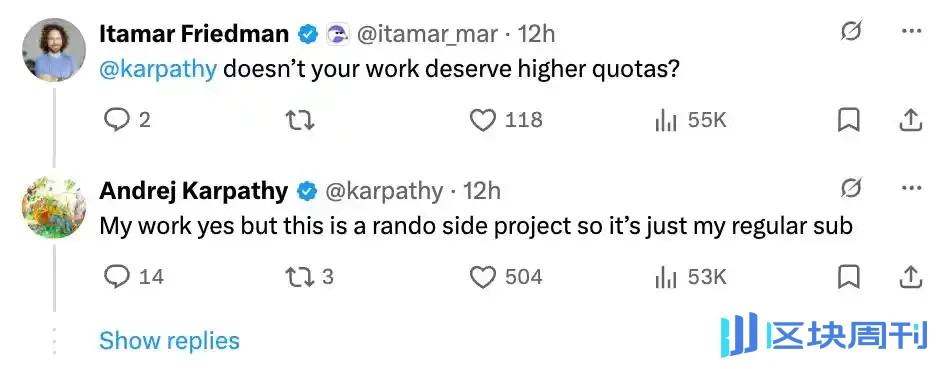
A netizen asked him why he couldn't use a higher quota.
Karpathy replied that of course he could for official work, but this was just a casual personal project, using his own ordinary subscription.
This is already the third piece of software he has publicly released within 24 days.
Think YouTube isn't good enough? He just made one himself in two hours. Saw a good video channel ranking? In 3 minutes, he turned it into a website cataloging 47,000 videos.
What is even more striking is that, as an AI researcher with a deep programming background, Karpathy's way of programming has now become:
"I no longer do anything resembling traditional software engineering, such as reading and writing code, running commands in the terminal, etc. I just talk to Claude and let it do all the work."
Less than two years ago, when Karpathy first proposed Vibe Coding, he was still manually copying error messages, and when he encountered bugs that AI couldn't fix, sometimes he could only work around them.
Now, even server security hardening, processing tens of millions of data records, and video editing and scoring can all be handed over to AI.
The father of Vibe Coding is already living the programming life he predicted, ahead of everyone else.
7 hours, moving America into Civilization
What would it look like if the numbers in Civilization all came from the real world?
This time, the task Karpathy gave Claude was: fill a Civilization-style game map with real data from the United States.
He used the Claude Code desktop app, set Opus 5.5 to Medium mode, and enabled ultracode.
Seven hours later, a project called usaciv was born.

Karpathy's latest work, usaciv.
Players familiar with Civilization should find this map familiar: forests, mountains, and farmland are distributed across a hexagonal grid, banners showing population and various outputs hang above cities, and roads and railways connect different cities.
But this time, the data on the map comes from the real world.
Opus 5.5 downloaded and parsed a large amount of public data, ultimately integrating information on population, terrain, economy, energy, transportation, and disasters from 31 data sources, mapping them onto a unified 25-kilometer hexagonal grid.
Claude retained the game language of Civilization, but redefined its various metrics.
Gold corresponds to real GDP, food corresponds to employment in agriculture, forestry, fishing, and hunting, production corresponds to employment in manufacturing, construction, and mining, and science and culture values are also determined by employment data from related industries.
The industrial characteristics of cities also have a real-world basis.
In the source code, Claude used a classic indicator from economic geography—the Location Quotient (LQ)—to measure the degree of industrial concentration in a city by comparing the local employment share of an industry with the national average.
Thus, Detroit became the "Motor City", and San Jose gained a "University District" representing the tech industry.
The "citizens" in the cities are also generated according to the real labor force composition.
For example, in San Jose, one out of every 4 workers is an engineer, programmer, or scientist, while the U.S. national average is only one out of every 14 workers.

Details of the San Jose city in the project, showing industry and labor force composition.
The map also includes national parks selected by tourist numbers, research universities selected by R&D spending, and trade routes drawn based on real freight data.
Claude also added 19 data perspectives to this map; after switching, you can view information such as income, population, education level, broadband coverage, and natural disasters across the United States.

The same map switched to the median household income perspective.
Combined with city details covering 524 metropolitan areas, nine advisors responsible for different fields, and an explorer capable of converting data from more than 3,100 counties into tables and scatter plots, usaciv is in fact already a geographic data analysis tool wrapped in the shell of Civilization.
Compared with the final visual effect, the engineering work Claude completed behind the scenes is also quite interesting.
Data published by different U.S. government agencies has different file formats, statistical standards, and geographic granularity. To make them work together on the same map, Claude built a Python data processing pipeline that supports data downloading, caching, source tracing, and incremental builds.
The first complete build of the entire project required downloading about 500 MB of raw data.
Looking at the public source code, the data pipeline supports download caching, source tracing, and incremental builds; the front end uses native JavaScript and Canvas 2D, the map art is drawn by code, and 176 Python unit tests were run locally, all of which passed.
Even more, to make a 30-second trailer for this project, Claude developed a video production tool that completes storyboarding, camera movement, frame-by-frame rendering, and video encoding directly in the browser.
Even the background music was programmatically synthesized through the Web Audio API.
Project address: https://karpathy.ai/usaciv/
Source code address: https://karpathy.ai/usaciv/usaciv-source.zip
As for what this project will become next, Karpathy himself has not figured it out clearly. He just finds browsing and playing with it interesting, and perhaps in the future it could be made into a real game.
And Karpathy has already publicly released three such personal projects this month.
2 hours, 3 minutes: Karpathy has already turned programming into a daily routine
It started on a Friday night. Karpathy opened YouTube to find something to watch, but was completely put off by exaggerated video thumbnails, constantly repeated recommended topics, and poor-quality content.
So the next morning, he asked Opus 5.5 to build his own YouTube based on videos people had recommended on Hacker News.
About 2 hours later, HackerTube was born.

The video browsing interface of HackerTube, project address: https://hackertube.org/
Claude downloaded nearly 20 years of 43 million comments from Hacker News, performed preliminary filtering, and then used the Workflow feature of Claude Code to call Sonnet to analyze the comments and remove spam, ultimately filtering out about 40,000 comments recommending YouTube videos, corresponding to 6,454 videos under 150 topics.
HackerTube does not use carefully designed video thumbnails from creators, but directly captures frames from the middle of the videos; users do not need to log in, and the state required for personalized recommendations is stored in the local browser.
YouTube has Shorts, so he made a Longs, specifically for watching long videos.
Karpathy also disclosed in detail in his blog the division of labor between himself and Claude.
Throughout the entire development process, he personally completed only three manual tasks: applying for the API Key needed to query video metadata, creating a VPS (Virtual Private Server), and purchasing a domain name.
These were all done in the gaps while Claude was working. After the server was ready, he gave the IP address to Claude and let it complete system updates, deployment, security hardening, and code optimization.

Karpathy introduces his process of developing HackerTube.
Just 6 days later, Karpathy released another video website.
The reason was that Tristan Hume updated a list of YouTube channels he had compiled six years earlier, dividing 156 channels into five tiers: S, A, B, C, and D.

Tristan Hume's original YouTube channel tier list, list address: https://thume.ca/2026/11/01/youtube-tier-list-2026/
Karpathy thought these channels were pretty good, so he had Claude Code turn the list into a website called TristanTube .
This development was completed in one go, taking only 3 minutes.

Karpathy releases TristanTube.
In the end, a blog post became a video browsing application that includes 47,339 videos, supports channel and tier filtering, random playback, and TV mode.
From being dissatisfied with YouTube's recommendation algorithm, to seeing a list shared by someone else, to wanting to see a real-world version of Civilization, all three of Karpathy's software projects stemmed from interests and curiosity in daily life.
This is probably also the most authentic daily programming life of the person who proposed Vibe Coding.
From Vibe Coding to Agentic Engineering
In February this year, when talking about the dramatic changes in the way of programming, Karpathy once said something quite radical:
"Since the birth of computers, people have been writing code line by line in editors. Now, that era is over."
And just a year earlier, his own AI programming experience was still a completely different picture.
In February 2025, Karpathy first proposed Vibe Coding. At the time, he used Cursor Composer powered by Sonnet, together with the voice tool SuperWhisper, and barely touched the keyboard.
He also did not really look at what code the AI changed, and directly chose to accept it all. When encountering errors, he would copy the error message to the AI; for bugs that really could not be fixed, sometimes he simply found a way to work around them.

The post in which Karpathy first proposed Vibe Coding.
At the time, he felt that this approach was quite suitable for making some throwaway weekend projects.
A year later, he believes that programming through LLM Agents is gradually becoming the default workflow for professional developers, but it requires more supervision and review to ensure software quality.
To distinguish it from Vibe Coding, he prefers the term Agentic Engineering: people's work shifts from directly writing code to organizing and supervising the work of Agents

In February 2026, Karpathy's retrospective on the first anniversary of Vibe Coding.
At the end of February this year, he shared a case of a home camera video analysis system: the Agent configured the server itself, installed vLLM, downloaded and tested Qwen3-VL, wrote the web page, troubleshot issues, and deployed the service. After about 30 minutes, it came back with a report.
Karpathy said that three months earlier this might still have been a weekend project. He also emphasized that Agents still need people to provide high-level direction, judgment, supervision, and just the right amount of task decomposition.
On October 2, Karpathy further proposed that, as intelligence and code become increasingly abundant, people can have AI create large, customized, even throwaway software, such as web applications and video explanations, things that in the past might not have been worth developing at all.

Karpathy's thoughts on customized software and forms of AI output.
A month later, he successively released HackerTube, TristanTube, and usaciv.
From filtering 43 million community comments to integrating 31 real-world data sources, these engineering tasks that once required a large investment of time and energy have now become Karpathy's weekend pastime.
And it has been less than two years since he first proposed Vibe Coding.
When releasing HackerTube, Karpathy left a meaningful remark:
"Many wonderful projects that originally required weeks or even months to complete can now be done in the time it takes to eat breakfast, with a few rounds of interaction with AI."
"What else is there that we haven't thought of yet?"
This article comes from the WeChat public account "Machine Heart" (ID: almosthuman2014), author: one who follows AI