Author: Lone Wolf
Recently, bullish and bearish signals in the AI sector have been released in clusters, making the market's atmosphere of worry considerably thicker.
Goldman Sachs recently released its 2027 global market outlook report, warning that the accelerating wave of AI capital expenditure will most likely peak in early 2027, and that the market will shift from a one-way uptrend to two-way volatility, recommending increased diversified allocation and hedging;
The Federal Reserve also explicitly named artificial intelligence in its latest financial stability report, warning of its potential threat to asset valuations and financial stability.
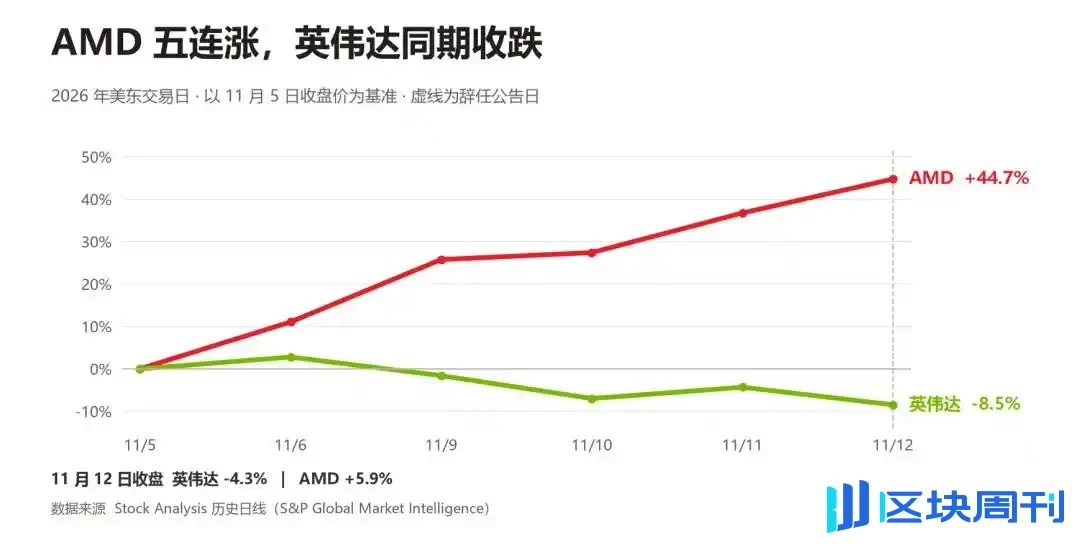
And the well-known short seller Michael Burry chose to make his stance directly with positions, doubling his put options on the Nasdaq 100 while re-establishingsemiconductor ETFshort positions, bluntly saying this is a "bull market trap," especially benchmarking against the top of the 2000 internet bubble; Jensen Huang's departure further deepened his concerns about the entire AI industry chain.
01
Specifically, several reports basically point to several hard constraints currently facing the AI narrative:capital expenditure, high interest rates, Democratic regulatory constraints, and industry chain trust concerns.
These factors are actually also where recent market concerns lie.
The Goldman Sachs report says that in early 2027 the share of AI investment increment in GDP will peak, but it does not say capital expenditure will turn downward, only that the pace of increased input will slow.
And stock market pricing inherently places more emphasis on marginal changes. The past bull market in the upstream computing power sector relied on continuously rising capital expenditure growth; once this driving force stops, the core support for high valuations will loosen.
According to Goldman Sachs estimates, the curve of cloud vendors' capital expenditure pulling S&P 500 EPS has a clear corresponding relationship: contributing 2 percentage points in 2024, 5 points in 2025, surging to a peak of 12 points in 2026, falling back to 9 points in 2027, and directly becoming a 5-point drag on earnings in 2028.
And 2026 is basically the final window for capital expenditure to drive earnings.
The step-down in earnings growth also reflects this change synchronously, with S&P-related earnings expectations falling from 36% to 11%, and European, Japanese, and Asian markets weakening in sync.
Objectively speaking, 11% growth is not bad historically. What is uncomfortable is the decline process from 36% to 11%.
What was previously enjoyed was a Davis double-click with earnings and valuations rising together; going forward, most likely only earnings will slowly provide support while valuations remain under pressure, making it hard to replicate the past two years' market where one could win by lying flat with eyes closed.
The second unavoidable real constraint is the high interest rate market environment.
The suppression of the AI sector by a high interest rate environment is two-way.
AI is a typical long-duration asset, with most returns in the distant future; rising long-term rates directly raise the discount rate, naturally compressing valuations.
Cloud giants like Microsoft and Google have deep pockets and abundant cash flow, so the impact is limited. Those suffering most are the mid-tier GPU cloud service providers, such as CoreWeave and Nebius named by Burry. They are major customers of Nvidia, expanding rapidly through large-scale leasing and purchasing of GPUs, and are themselves highly dependent on external financing.
Once interest rates rise, their borrowing costs directly increase, expansion is forced to contract, and since their valuations were originally given based on extremely high growth, the expectation gap is easily widened.
The circular transaction risk mentioned by the Federal Reserve is also worth noting.
Tech companies and startups invest in each other, purchase from each other, and endorse each other's revenue. When funding is loose, this can beautify the books and push up valuations; after financing tightens, it becomes a string of bound risk exposures. If one company has a cash flow problem, the risk will transmit along the cooperation chain. This is not a question of valuation level, but a hidden danger at the credit level.
And the biggest negative trigger recently is the Jensen Huang incident, which shook the pricing anchor of the entire chain.
It is still difficult to conclude now how much long-term impact this matter will have on Nvidia's own products and orders.
In the past few years, the order expectations and valuation logic of many companies in chips, foundries, storage, and downstream cloud vendors were built on Nvidia's strong position. Once this anchor shakes, everyone will reassess the assets in their hands.
The big short seller Burry has clearly seized this window, but his approach has also changed.
Previously he preferred to bet directly on individual stocks like Nvidia and Palantir; now his focus has shifted to index and semiconductor ETFs. While doubling Nasdaq 100 put options, he is buying back VanEck semiconductor ETF short positions, and TSMC and Nvidia are precisely the heaviest holdings in this ETF.
He benchmarks the Nasdaq's early October high against the 2000 bubble peak and calls out "bull market trap," targeting whether Nvidia's influence will gradually weaken.
Of course, his strategy may not be right; after all, this analogy is very different.
During the 2000 bubble, many companies had no cash flow and their debt was a mess; now the balance sheets of leading U.S. tech giants are quite healthy, and the valuation premium of the five major tech stocks relative to other stocks has converged to a very low level, far from the madness of back then.
Moreover, this options bet has a very high threshold: it only profits if the index falls more than 20% before expiration, so time, magnitude, and direction cannot be wrong on any one.
There is another layer of pressure that is easy to overlook, coming from a regulatory shift.
After the Democrats come to power, the U.S. attitude toward AI infrastructure will most likely gradually shift toward control, and there will begin to be more constraints on energy consumption, land, and power supporting facilities for computing clusters and large data centers.
Although this is not intended to strangle AI, it will disrupt the rhythm of unrestrained computing power stacking, lengthen the expansion cycle, and raise construction costs.
Put back into the capital expenditure curve, this variable will further lower the expansion slope. Originally, computing power was expected to continue explosive growth; now with more approval, energy consumption, and compliance constraints, the peak comes earlier and the realization pace is slower.
With four layers of pressure stacked together, it is only natural that the valuation bubble blown up by optimistic narratives is squeezed.
02
But we must be clear that the bursting of AI's valuation bubble does not mean the AI industry is going downhill; the underlying demand supporting AI's long-term logic has not disappeared.
There is also a very interesting signal that Goldman Sachs has mentioned many times.
The forward PE of U.S. cloud giants is only 19.7 times, below the lower bound of their own 20-year historical range, and even lower than the generally recognized defensive sector of consumer staples.
What many people see as high-elasticity growth stocks have seen valuations fall below defensive stocks, indicating that a large part of pessimistic expectations has already been priced in, and not everyone is blindly optimistic.
Tighter regulation is not entirely bad in the long run. Once the disorderly computing power arms race stops, everyone will be forced to do the math: can the computing power invested bring stable revenue and profit?
Only when the business model works and does not rely on endless money-burning to expand cards will the AI story become more solid. Short-term pain, long-term separation of truth from falsehood.
After the bubble is squeezed out, the market's opportunity structure will also switch to a different logic.
The simplest game in the past two years was to go all in on upstream shovel sellers—chips, optical modules, storage; whoever was closer to computing power rose the most. This logic was built on continuously accelerating capital expenditure and will be hard to replicate going forward.
The market's assessment standard will change from "who is expanding production" to "who can earn real money."
The first category worth tracking is cloud giants whose valuations have corrected sufficiently.Slower capital expenditure growth actually means less input and improved free cash flow for them. With solid balance sheets and diversified revenue structures, they are gradually changing from high-volatility growth stocks into defensive names with growth attributes, and their cost-effectiveness will gradually become prominent in a volatile market.
The second category is AI application companies that are truly being implemented.In the past, all market attention was on computing power, and the value on the application side was obscured.
Next, there will be repeated questioning of whether AI can help customers save money and increase revenue, and whether there is stable payment and renewal. Only companies that obtain real productivity dividends and have a clearly calculable ROI can possibly take over and become the new main line.
This is also what Goldman Sachs calls the "relay echelon." Whether the switch goes smoothly determines whether this round of adjustment is a soft landing or a continued sell-off.
The third category is cyclical sectors that have already priced in a large amount of pessimistic expectations, such as Korean memory.Share prices have already implied expectations of a sharp 70% downward revision in 2027 earnings, but order schedules are sold out through 2029, and PB has been compressed to a historical low. The odds look high, but the risk is by no means small, and volatility is extremely severe.
Goldman Sachs also did not blindly turn bullish on Asia. Its core concern is that concentration is too high, with a few names such as TSMC, Samsung, and SK Hynix accounting for too heavy a share. Once the logic reverses, the damage from drawdowns will be very large.
Conversely, there are also many names that need to be actively avoided. Small and medium-sized GPU cloud providers that are highly tied to Nvidia orders, lack stable cash flow, and rely on financing to stay alive, as well as pure cash-burning startups without implemented products, are the most fragile groups in this round of stress testing.
03
Overall, the current AI narrative is indeed under great pressure. In this market environment, if one still holds on to the thinking of previous years and heavily bets on upstream computing power, continuing to pay for "increasingly faster growth," this is an inertia that very easily leads to losses.
A more prudent approach is to reduce concentrated bets on a single track and diversify positions appropriately.
The market has now shifted from a one-sided bull market to two-way volatility. The value of hedging and multi-asset allocation will be higher than in previous years.
The test that this round of AI narrative faces is not whether AI can change the world, but whether these investments can be converted into stable returns. The process of the bubble dissipating is bound to be difficult, and volatility will last for a long time, but after the market clears, only assets that can withstand the test and have solid cash flow will usher in the next phase of a market that goes further.
During this period, just steady your mindset, withstand the pressure, and slowly wait for the dawn.