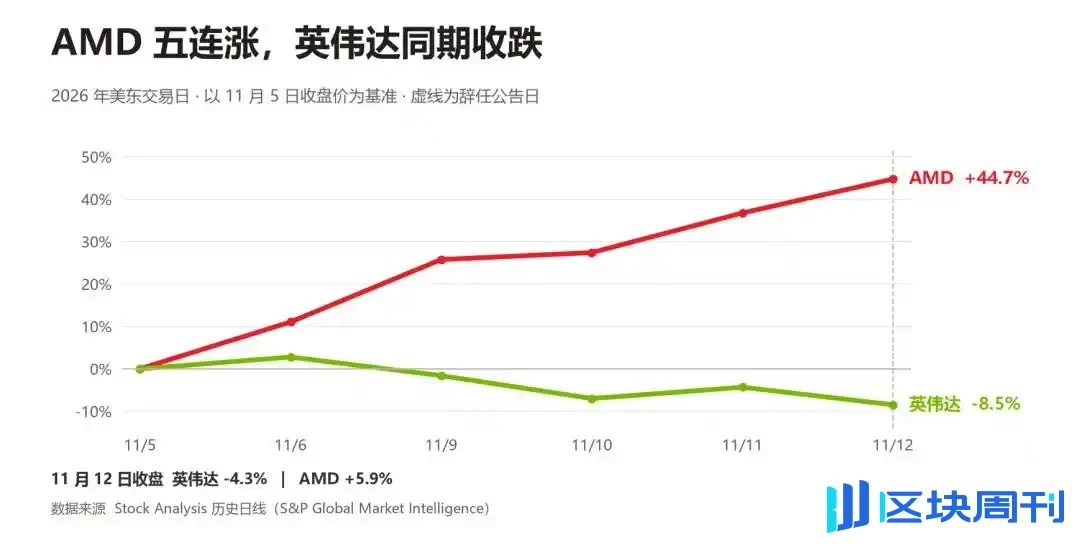
On November 12, Jensen Huang publicly announced his resignation as President, Chief Executive Officer, and Director. Nvidia's stock price fell as much as 14.4% intraday, with market value briefly dropping by about 600 billion USD, before the closing decline narrowed to 4.3%.
Meanwhile, AMD, Nvidia's biggest rival, closed up 5.9% that day. This was already AMD's fifth consecutive trading day of gains, rising a cumulative 44.7% from the close on November 5 to the close on the 12th.
This reminds me of the Polymarket betting pool on who will succeed Jensen Huang. In a screenshot posted by the official account on November 12, Huang's daughter Huang Minshan ranked first with 12%, while AMD's CEO Su and Nvidia's CFO Colette Kress were tied for second at 7% each. AMD is really skilled at being the "second place"!

In the PC era, the CPU was the most core hardware, and AMD was always chasing behind Intel; in the AI era, cloud vendors buy GPUs in batches to build data centers, and AMD is still second, except the leader has become Nvidia.
Now that this has happened to Nvidia, AMD must be smiling in its dreams!
01 AI data centers have already been targeted by AMD
What AMD is targeting now is Nvidia's biggest business.
Because Nvidia will not announce its third-quarter financial report until November 17 Eastern Time, let's first look at the second-quarter financial data.
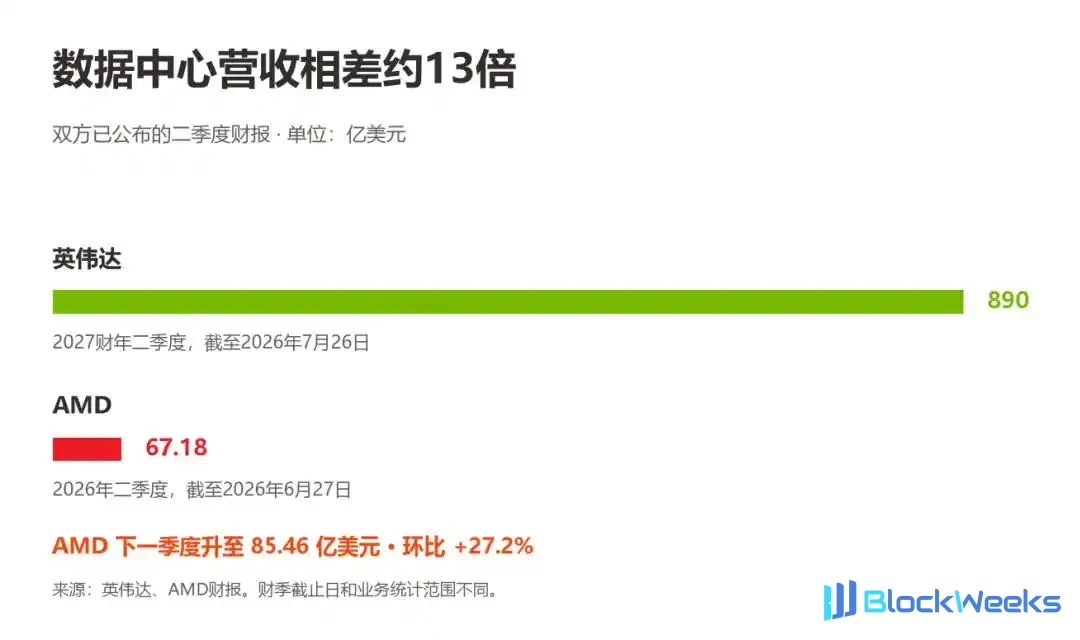
According to Nvidia's second-quarter financial report this year, Nvidia's total revenue was about 96.2 billion USD, of which the data center business contributed 89 billion USD, accounting for more than 90%. In AMD's financial report, AMD's data center business was only 6.7 billion USD, which also includes some server CPU revenue.
AMD has combined its server CPUs, AI accelerator cards, and high-speed networking into a rack called Helios, corresponding to Nvidia's full-rack product called Vera Rubin NVL72.
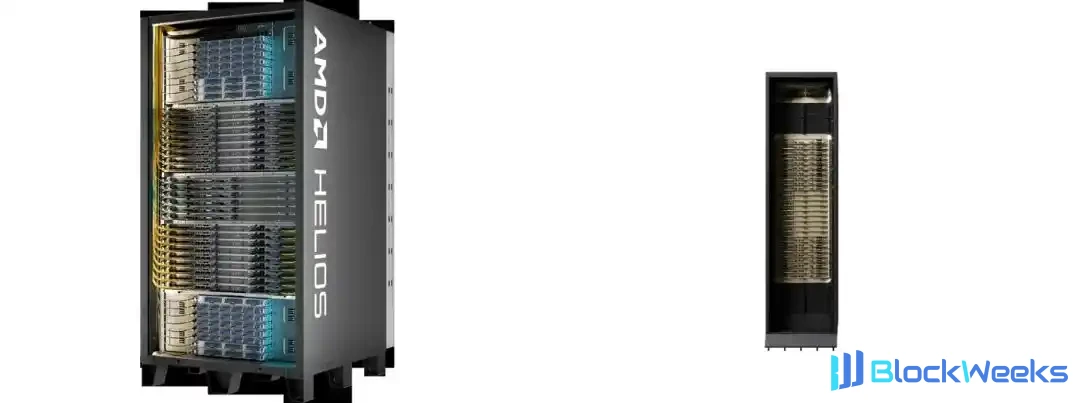
On the left is AMD Helios, on the right is NVIDIA Vera Rubin NVL72.
On September 30, enterprise IT equipment vendor Hewlett Packard Enterprise (HPE) disclosed that it had signed a 1.2 billion USD Helios rack order with U.S. cloud service provider Vultr. AMD can already participate in billion-dollar-level cloud vendor procurement.

The Sabey SDC Columbia data center campus in East Wenatchee, Washington, USA. Vultr once expanded GPU computing power in the Seattle region here.
But for Nvidia, an order of this level can only be considered a "small order."
On November 2 last year, cloud computing company IREN signed a procurement agreement of about 5.8 billion USD with Dell for Nvidia GPUs and supporting products and services. In the second-quarter financial report this year, a certain "golden patron" contributed 16% of Nvidia's total revenue, equivalent to about 15.4 billion USD, more than twice AMD's second-quarter data center revenue.
To put it exaggeratedly, a single hair pulled from Nvidia is thicker than AMD's waist.
However, now that Jensen Huang has resigned from his positions at Nvidia, the interim CEO is CFO Colette M. Kress. After the leadership change, some customers may reconsider their next round of procurement.

Colette M. Kress, Interim Chief Executive Officer and Chief Financial Officer of NVIDIA.
Just nine days before NVIDIA announced Jensen Huang's departure, AMD had just released its third-quarter financial report. Among them, data center revenue rose to $8.546 billion, up 27.2% quarter-over-quarter and 97% year-over-year, mainly driven by demand for EPYC server CPUs and the launch of the Instinct MI450 series GPUs. On the conference call that day, Su said this was the first quarter in which AMD shipped MI455 and Helios racks and recognized revenue.
Although the financial report did not separately list Helios revenue, it is clear that full-rack products have begun to contribute revenue to AMD.
NVIDIA is about to release its third-quarter data on November 17, US Eastern Time, with the statistical period ending October 25. At this point in time, Jensen was still in office, so the data should not have been affected. What is more noteworthy is the fourth-quarter guidance given by management.
For AMD, this is like buying its own equipment and waiting for the jungle monsters to respawn, when suddenly news comes from the top lane that the opponent has been solo-killed. To win this game, now is a good opportunity, but whether it can "snowball" and push straight through, there are still quite a few difficulties waiting.
02 Desktop graphics cards: truly no match at all
AMD was founded in Silicon Valley in 1969, the same generation as Intel, and even earlier than NVIDIA. It made CPUs, and in 2006 it bought the graphics card company ATI, bringing Radeon into AMD. Since then, the company has been fighting Intel for the CPU business while fighting NVIDIA for the GPU business.
At the very beginning, AMD could still go toe-to-toe with NVIDIA, but now, in terms of desktop graphics cards, AMD is completely no match for NVIDIA.
According to Jon Peddie Research data, in the second quarter of 2026, global desktop discrete GPU shipments were about 12.5 million units, with NVIDIA accounting for about 90%, AMD about 8%, and Intel about 2%.

The first obvious gap opened up in 2014 to 2015. NVIDIA first launched the more power-efficient GTX 970 and 980, while AMD did not launch the Radeon 300 series and Fury X until June of the following year. By the time AMD's new cards hit the market, its quarterly shipment share had already fallen to 18%.
In the second quarter of 2018, AMD once returned to 36.1%, then fell back to 18.8% by the end of the year. That year, mining demand receded, and both companies encountered channel inventory problems. NVIDIA launched the RTX 20 series, focused on real-time ray tracing, in the second half of the year, while AMD did not fight back into mainstream price points until 2019 with the RX 5700 series, with its share returning to 31.1% by the end of the year. Later, the RX 9070 XT could also achieve higher frame rates on a similar budget, but by the second quarter of 2026, AMD's desktop discrete GPU shipment share was still only about 8%.
Today, the flagship tier is still led by NVIDIA's RTX 5090, and AMD can only compete with NVIDIA cards at the same level on cost-effectiveness. TechSpot tested 52 games in September 2026, and the RX 9070 XT, priced at about $730 to $750, had an average frame rate at 1440p that was 24% higher than the RTX 5070, which started at $800 at the time.

On the left is the Radeon RX 9070 XT, and on the right is the GeForce RTX 5070.
A lot of the "crushing" in desktop graphics cards is thanks to Jensen.
In November 2006, NVIDIA launched the CUDA-supporting GeForce 8800. Jensen Huang later recalled that putting CUDA into gaming cards would eat up a lot of profit, but he insisted on doing it anyway. By May 2008, cumulative shipments of CUDA-supporting GeForce 8 and 9 series GPUs had exceeded 70 million units.
What is CUDA?
CUDA is a set of software tools made by NVIDIA. Engineers use it to hand tasks such as training models to GPUs, and can directly call code that NVIDIA has already written and debugged. For example, when dozens of cards train together, there are ready-made tools for how the cards exchange data with one another.

Illustration of CUDA parallel computing. The same piece of code can be handed to multiple GPU threads to process different data simultaneously.
People who buy gaming cards may not necessarily use CUDA, but developers have hardware they can buy at any time to write programs and run experiments.
Although Jensen Huang has left, CUDA, which developers are used to, is still there. It is still relatively "easy" for AMD to win over gamers, but if it wants to win over people who buy graphics cards for development, it has to get past the CUDA hurdle.
03 Can CUDA's moat really be crossed?
The biggest challenge for AMD in trying to win over NVIDIA's customers is CUDA.
This set of things was built by NVIDIA one
Diandian
step at a time."The NVIDIA Way: Jensen Huang and His Tech Empire" wrote that NVIDIA not only put CUDA into gaming cards that developers could afford, but also sent people to help developers move molecular simulation programs onto GPUs.
NVIDIA disclosed that by fiscal year 2026, more than 7.5 million developers were using CUDA and its other software tools, with hundreds of accompanying specialized software libraries.
Of course, AMD is not without countermeasures.
ROCm is AMD's software tool to compete with CUDA, allowing developers to change fewer lines of code when switching cards. For example, when training a photo classification model with PyTorch on your own computer, as long as all the features used are supported, installing the ROCm version of PyTorch lets the original training script continue to run on Radeon.

In AMD's official tutorial, a local AI demo on the Radeon RX 9000 series, showing ComfyUI running SDXL image generation.
But what is truly hard to catch up with CUDA is the ready-made tools and code. The more features a project depends on, the more items must be checked one by one when switching to AMD.
And for data centers, replacing NVIDIA with AMD makes things even more complicated: a single card may run, but you still have to verify whether dozens of cards training together work properly.This is not just a matter of money; time is actually more important.
Midjourney encountered a similar problem. In May this year, Midjourney founder David Holz said in an interview that Midjourney chose Google TPU early on; had it used NVIDIA's full toolset from day one, the team's research progress would probably have been a year earlier.If he could do it over, he would use NVIDIA GPUs from day one. Different technical choices really do affect business progress.

A file photo of Midjourney founder David Holz.
When talking about catching up with NVIDIA graphics cards, Liang Wenfeng said, "Technology has no secrets, but resetting takes time and cost."
AMD's approach is to make customers change as little code as possible. For example, if a customer writes a model in PyTorch, as long as the features used are already supported on AMD, most of the model code can stay the same, and PyTorch hands the computation to AMD's GPU through ROCm. For customers' own CUDA code, AMD also has tools that can help convert part of it.
In its IPO roadshow, Anthropic said it used Claude Mythos Preview to help modify computation code and got a model's input processing running on AMD MI355X in about three days, reaching a usable speed.
Meta and AMD adapted 10 recommendation models to both companies' GPUs; training with the same number of cards, each side won some and lost some, and overall training speed was about the same.

Cloud providers have already started using both, no longer putting all their eggs in one basket.
On October 26 this year, NVIDIA announced an expansion of its model collaboration with Meta; the next day, AMD disclosed that Meta was already using Helios. For procurement departments, this means the same round of expansion can be split by task. Training that depends on CUDA continues to use NVIDIA, while recommendation model training already validated on ROCm can separately purchase AMD compute.
Of course, losing Jensen Huang as the face of the company will inevitably affect NVIDIA's business, mainly because Jensen really can win people over with his face.
In 2025, NVIDIA signed a deal with CoreWeave initially worth $6.3 billion, agreeing to buy its unleased compute through 2032. Jensen Huang's face represents NVIDIA.

After he leaves, whose face would dare make commitments on NVIDIA's behalf?
04 AMD nearly died, and was even less willing to be second
In 2006, AMD bought ATI, and from then on fought Intel in CPUs while fighting NVIDIA in graphics cards.
But over the next decade, both fronts fell one after another.By 2015, AMD's global x86 shipment share had fallen from 25.3% at the end of 2006 to 12.1%, and desktop discrete GPUs at one point had only 18%.
By the end of 2015, AMD had only $785 million in cash and marketable securities, with $2.26 billion in debt. The division selling PC processors and graphics cards saw revenue fall 42% that year.

At the time, AMD pitted the FX-8370 against Intel's Skylake Core i7-6700K on desktop. In a contemporaneous test covering 14 applications, the FX-8370's overall score was about 39% lower.
With CPU share down to just over 10%, AMD had to hold on until the next generation of products arrived.
Game console orders and cash from selling equity bought AMD time. Su Zifeng later recalled that AMD first concentrated resources on redoing CPU cores, then expanded investment in GPUs. A new set of CPU cores could help it win back the desktop business and also return to the server market.
This new design is Zen. At the same frequency, one core can do more.
The Zen series helped bring AMD back from the dead. AMD used it to make desktop Ryzen, win back the desktop business, and also used it to make server EPYC, re-entering the server market. By the second quarter of 2026, looking at EPYC and Xeon in servers alone, AMD's shipment share had caught up to 46.4%, only 7.2 percentage points behind Intel's 53.6%.

In 2017, Su Zifeng showed the first-generation Ryzen processor.
The GPU line was not abandoned.
At the time, Sony's PS4 and Microsoft's Xbox One both used AMD custom chips, with a CPU and a graphics processor in a single chip. The technology accumulated from making graphics cards could be sold both to PC gamers and to console makers.

The first-generation PlayStation 4 and DualShock 4 controller announced at E3 in 2013.
In December 2016, the day before AMD showed its Zen desktop processors, it announced the Radeon Instinct plan for deep learning.
While saving the CPU, AMD was already making GPUs for data centers to train AI models.
That courage finally began to pay off. AMD launched the Instinct MI100 for data center computing in 2020, and in 2023 used the MI300X to compete for large-model computing power. Today, the rescued EPYC and the Instinct developed along the way have become the core of the Helios rack.

Cover of AMD's official engineering video "Building Helios," showing the development site.
Oracle Cloud is a very good case. Because it both buys racks and rents computing power to customers.
Oracle plans to use 50,000 AMD Instinct MI450 series GPUs, starting deployment in the third quarter of 2026, to build an AI cluster open to cloud customers, and to continue expanding deployment in 2027 and beyond. Calculated at 72 cards per Helios rack, that is nearly 700 fully configured racks at the start.
Take Vultr as a reference. Its planned previous-generation AMD AI cluster in Ohio is set to use about 24,000 MI355X cards, and the entire cluster project is planned to invest more than $1 billion. Oracle's first batch of deployment alone plans to use more than twice the number of cards of that project.

With Jensen Huang gone, AMD's sky has brightened.
Desktop graphics cards can finally breathe a sigh of relief. Although CUDA, which developers are used to, is still there, it is good to win over some gamers.
Data centers are where AMD can take the opportunity to grab orders. The full Helios rack is filled with Su Ma's hopes, ROCm can also help bypass CUDA's moat, and customers have even signed up, just waiting for shipment.
But I guess AMD won't laugh out loud; they will only be unable to hold it in when Chen Liwu also leaves Intel.
This article is from the WeChat public account "Hardcore Kanban" (ID: yinghekb), author: the one embracing AI