Yutai Semiconductor, which had failed in two IPO attempts, missed out on the "chip tycoon" Zhang Shilong worth tens of billions, but now welcomes "Jiangsu wealthy man" Sun Hongjun.
On the evening of November 23, Awinic Electronics (688798.SH), which had been suspended from trading for half a month, disclosed a major asset restructuring plan. The company plans to acquire 100% of the shares of Yutai Semiconductor held in aggregate by 34 counterparties including Shanghai Yubo, Shanghai Jinweili, Shanghai Yitiai, and Shanghai Yuzong through the issuance of shares and payment of cash, and to raise supporting funds.
The issue price is set at 43.69 yuan per share, no less than 80% of the average stock trading price over the 20 trading days before the pricing benchmark date. However, the audit and evaluation of the target assets have not yet been completed, and the valuation and pricing have not been determined. This transaction is expected to constitute a major asset restructuring and will also constitute a related-party transaction, but the company's control will remain unchanged.
Awinic Electronics and Yutai Semiconductor are in the same business, both in the analog chip track. And Awinic Electronics' 2026 third-quarter report shows that both operating revenue and net profit attributable to the parent company declined year-on-year in the first three quarters. Under such performance conditions, why still acquire a peer?
Interestingly, the second-largest shareholder of Yutai Semiconductor is precisely the listed company in the same track, SG Micro Corp (300661.SZ), holding about 25.02%. And SG Micro Corp had once attempted to acquire all the equity of Yutai Semiconductor, but later voluntarily gave up. What exactly is the "charm" of Yutai Semiconductor?
Trading resumed on November 24, but the market voted with its feet. Awinic Electronics closed at 57.1 yuan per share, down 6.16%; as of November 25, Awinic Electronics closed at 49 yuan per share, down 14.19%, with a total market value of 11.423 billion yuan.
"Jiangsu wealthy man" makes his move
According to the announcement disclosed by Awinic Electronics, the top five shareholders of Yutai Semiconductor are, in order, Shanghai Yubo, SG Micro Corp, Shanghai Jinweili, Maiketong Electronics, and Shanghai Yuzong, with shareholding ratios of 28.35%, 25.02%, 8.70%, 7.21%, and 6.58%, respectively. The 34 counterparties have almost gone through the company's entire shareholder list.
It is worth noting that SG Micro Corp did not previously appear in the announcement disclosed by Awinic Electronics regarding the signing of the equity acquisition intention agreement, but on November 23 it also announced that it had signed a conditional effective asset purchase agreement with Awinic Electronics, planning to transfer its 25.02% stake in Yutai Semiconductor.
Awinic Electronics' founder Sun Hongjun was born in 1973 in Huai'an, Jiangsu. From 1990 to 1997, he completed his bachelor's and master's degrees in semiconductor devices and microelectronics at Southeast University. In 1997, he joined Huawei to engage in chip design and once led a team to complete China's first commercial digital-analog mixed-signal chip; from 2002 to 2008, he served as product director at Qipan Microelectronics, and in 2008 he founded Awinic Electronics.
Awinic Electronics' earliest business landed in the then hottest mobile phone market, starting from audio power amplifier chips. In the years when feature phones shifted to smartphones, chip demand came wave after wave, and Awinic Electronics step by step made its way into the supply chain of domestic mobile phones. In August 2021, Awinic Electronics listed on the STAR Market, with an issue price of 76.58 yuan per share. On the first day of listing, the stock price rose more than two times, closing at 260.8 yuan per share, and its total market value once stood above 40 billion yuan. Sun Hongjun's personal wealth once exceeded 18 billion yuan.
On the 2026 "Hurun Rich List," Sun Hongjun ranked 1,097th with 7 billion yuan in wealth. He once said: "Awinic is a very small company. We do not blindly pursue the company's size. As long as we do our products well, we can surpass others in a place as small as the tip of a needle."
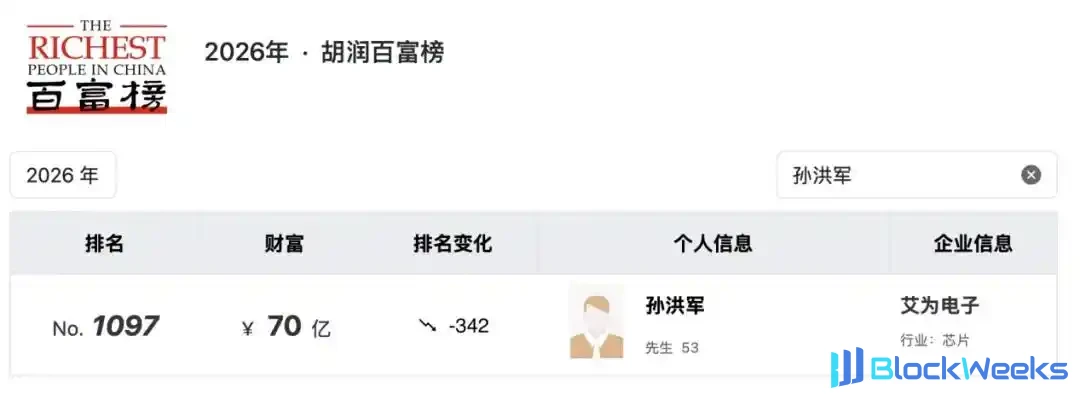
Image source: Hurun Rich List
But as the dividends of the mobile phone market gradually fade, Awinic Electronics' situation has also become delicate. Awinic Electronics' 2026 semi-annual report shows that power management chips accounted for 36.97% of the company's total revenue, and their main scenario is precisely consumer electronics, but consumer electronics has been in a downturn cycle in recent years.
Awinic Electronics may urgently need to use mergers and acquisitions to open new markets, and the Yutai Semiconductor selected by Awinic Electronics has long left a tortuous story in the capital market.
Yutai Semiconductor's two failed IPOs
The first listed company to take a fancy to Yutai Semiconductor was not Awinic Electronics, but SG Micro Corp. SG Micro Corp is also a listed company in the analog chip track and is currently the second-largest shareholder of Yutai Semiconductor.
Yutai Semiconductor was established in November 2017, headquartered in Nantong, Jiangsu. Its founding team has a background from the U.S. company Maxim, and it has R&D centers in Nantong, Shanghai Zhangjiang, Silicon Valley in the United States, and Hanoi, Vietnam.
In December 2018, SG Micro Corp spent 115 million yuan of its own funds to buy a 28.7% stake in Yutai Semiconductor, taking the position of second-largest shareholder. Based on this transaction, Yutai Semiconductor's overall valuation at that time was 425 million yuan.
A year later, SG Micro Corp wanted to acquire the remaining equity as well. In December 2019, the company announced plans to acquire the remaining 71.3% equity of Yutai for 1.07 billion yuan through the issuance of shares plus cash payment, corresponding to a 100% equity valuation of about 1.5 billion yuan, a premium of 1,015.52% over book net assets. The exchange issued two rounds of inquiries in succession, questioning the reasonableness of the valuation's sharp jump within one year.
In October 2020, SG Micro Corp announced the termination of this transaction, citing "the impact of domestic and international macroeconomic and capital market environments." Later, after several rounds of equity adjustments, SG Micro Corp's shareholding ratio dropped to about 25.02%, and its position as second-largest shareholder has remained to this day.
The actual controller of SG Micro Corp is Zhang Shilong. On the 2026 "Hurun Rich List," the Zhang Shilong family ranked 396th with 18 billion yuan in wealth.
After missing this "chip tycoon" worth tens of billions, Yutai Semiconductor tried to knock on the door of the capital market itself. In June 2022, Yutai Shares applied for listing on the STAR Market, planning to raise 750 million yuan, to be invested in high-performance power management chip R&D and industrialization of 350 million yuan, automotive power management chips of 80 million yuan, Nantong R&D and testing center of 100 million yuan, and supplementary working capital of 220 million yuan. But the review was suspended in November of that year, because the company's founding shareholder and then director and deputy general manager Peng Yin was suspected of bribing non-state functionaries and was placed under investigation by judicial authorities. In February 2023, the company and its sponsor voluntarily withdrew the application.
In August 2023, Yutai Semiconductor restarted its listing tutoring, but in January 2026 the tutoring broker pointed out problems such as an imperfect internal control system and inadequate implementation, and adjustments to fundraising, and it has still not completed listing to this day.
Public information shows that Yutai Semiconductor has gone through four rounds of financing, with the most recent round exceeding 100 million yuan, and the investor was Leishi Investment; in earlier rounds, industrial capital such as SK Hynix Semiconductor (China), Transsion Holdings, Longcheer Technology, Volkswagen Group Capital, and SMIC Capital all appeared.
Shi Lei, a postdoctoral fellow in economics at Fudan University, once told the media that Yutai Shares' previous failed capitalization attempts were mainly affected by multiple factors such as changes in the macroeconomic environment and capital market, adjustments in review pace, performance fluctuations, and historical compliance matters. This time, Yutai Shares being acquired by Awinic Electronics objectively provides its shareholders with a path to securitization through merger and reorganization, but the transaction still depends on Awinic Electronics' industrial need to improve its power management product matrix and expand high-value application scenarios.
But now, whether Yutai Semiconductor's path to completing capitalization through mergers and acquisitions can be paved remains to be seen.
Revenue and profit both decline, why acquire a peer?
Both in the analog chip track, Awinic Electronics and Yutai Semiconductor can be considered peers, but their focuses are different.
In addition to power chips, Awinic's signature products are audio power amplifiers and haptic driver chips, most of which are supplied to consumer electronics such as mobile phones, smartwatches, and AI terminals; Yutai Semiconductor focuses almost entirely on power management chips, with a more complete product line, and is used more in scenarios such as electricity meters, security cameras, communication equipment, and industrial equipment, with high-voltage industrial power chips being its strength.
According to Awinic's 2026 third-quarter report, revenue in the first three quarters was 2.117 billion yuan, down 2.75% year on year; net profit attributable to shareholders was 107 million yuan, down 61.08% year on year; net profit after deducting non-recurring gains and losses was only 24.1133 million yuan, down 87.53% year on year. In the third quarter alone, revenue was 766 million yuan, down 5.05% year on year, and net profit attributable to shareholders was 12.4337 million yuan, down 89.57% year on year.
In addition, Awinic's gross margin in the first three quarters fell from 35.73% in the same period last year to 30.37%. The company explained that on the one hand, global memory chip supply was tight, mobile phone manufacturers faced pressure in production scheduling, competition in consumer analog chips intensified, and wafer foundry and packaging and testing costs rose, squeezing gross margin space; on the other hand, new interest on convertible bonds and exchange rate fluctuations pushed up financial expenses, and R&D investment continued to increase; in addition, the decline in the share price of Tongfu Microelectronics (002156.SZ), which the company holds, brought fair value change losses.
However, Awinic's net cash flow from operating activities in the first three quarters was 32.1886 million yuan, up 19.73% year on year. As of the end of the third quarter, its monetary funds were 703 million yuan and trading financial assets were 3.08 billion yuan, which together totaled nearly 3.783 billion yuan; total assets were 7.276 billion yuan, up 37.22% from the end of the previous year, mainly due to the arrival of funds raised from convertible bonds. Although profit fell by 60%, it has nearly 3.8 billion yuan in quasi-cash on its books, which may be where its confidence to make acquisitions comes from.
According to Jiemian News, a relevant person at Awinic said that the company has long relied on organic development, but the pace of purely self-developed, organic expansion is limited; in order to quickly complete its product line and enhance overall competitiveness, we now hope to accelerate growth through extensional mergers and acquisitions. This acquisition is not a simple superposition of consumer electronics business, but more about completing capabilities in industrial, automotive, and high-end intelligent hardware tracks, which is a clear optimization of the company's business structure and can hedge against the cyclical pressure of consumer electronics.
According to a relevant person at Awinic, the company will focus on two major directions in the future: the automotive electronics track will rely on the Lingang automotive-grade center for continued deep cultivation, and the other end is edge intelligent hardware, including power chips for physical AI hardware such as embodied intelligent robots.
What Yutai Semiconductor has is exactly what Awinic needs. Yutai Semiconductor has accumulated medium- and high-voltage power supply part numbers in industrial scenarios such as smart electricity meters, security, and communication equipment, laid out automotive-grade products around 2020, obtained automotive functional safety system certification in 2024; its series for small-space applications has already been mass-produced with dexterous hand customers, extending its reach into humanoid robots.
Zhao Zhanxiang, founding partner of IO Capital, told the media that mergers and acquisitions in China's analog chip market have just begun. "There are not many domestic giants, and too many players have led to excessively fierce industry competition and excessive dispersion of resources. Analog chip companies that emerged intensively over the past five years have entered maturity and are shifting from independent IPOs to being acquired, which can create larger Chinese analog chip companies."
Of course, from the intention to the final completion of this transaction, there are still many hurdles in between. The compliance issues left over from Yutai Semiconductor's historical IPO, the transaction valuation, and the subsequent integration of teams and customers are all focuses of continued market attention.
After going around in circles, from SG Micro's acquisition plan, to two failed IPO attempts, and now to sitting at the negotiating table with Awinic, Yutai Semiconductor is also a microcosm of industrial integration amid the involution in the domestic analog chip track. But the market is still watching to see whether Yutai Semiconductor, which missed the tens-of-billions "chip tycoon" Zhang Shilong, can this time smoothly come under the command of "Jiangsu rich man" Sun Hongjun?
This article comes from the WeChat public account "Yema Finance", author: Yema Finance