
Author: Zuo Ye Waibo Shan

When someone is famous, there is no shortage of gossip; even in prison, SBF cannot find peace.
First came Anthropic's IPO, and onlookers daydreamed about SBF's $500 million investment back then: if it could smoothly reach an IPO, would it give crypto a more AI-driven future?
Then came the release of Netflix's documentary "The Altruist." What SBF thought of it, the world does not know, but CZ and others were jumping around, giving off a strong sense of Xia Luo at Qiu Ya's wedding.
Some people are outside, but the people want him inside; some people are inside, but the people want him outside.
Since You Left, Only Parting Sorrow Remains
SBF is of course a sinner; misappropriating user funds is a heinous crime, and even today the creditor process has still not been completely finished. But whenever the industry is cold, there are always people who keep missing him.
If one must find a reason for this, the spirit of innovation may be the best choice.
SBF's view of finance was not limited to "casino thinking"; he was seriously considering how to push the crypto industry toward both the top level and the masses at the same time. Unlike Trump's co-optation of the crypto industry, FTX under SBF actively seized leadership in financial development.
Rewind to 2022: UST collapsed first, and FTX did not stampede or create FUD sentiment. SBF tried to imitate Morgan in 1907 and play the role of savior as lender of last resort amid panic.
Coincidentally, after a CoinDesk report detonated FTX, Binance also tried to save the industry. In addition to setting up the $1 billion SAFU fund, it also joined with the industry to launch the Industry Recovery Initiative (IRI), planning to raise more than $1 billion.
The final result need not be elaborated: the industry has still not recovered to this day.
Binance did not save the industry, and FTX and SBF even destroyed it, yet there are still people who defy the world to hope Trump will pardon SBF. That is very worth pondering.
Ultimately, we feel a sense of humiliation about the industry under the shadow of AI, and we are dissatisfied with leaders who flatter compliance. We always need some spiritual sustenance in order to survive in the reality of Fintech, payments, and Meme casinos.

Image: Briefly Reaching the Future
Looking back at SBF's crypto journey from 2017 to 2022, FTX at least led the industry trend in five areas: prediction markets, Perp DEX, pre-market contracts, tokenized stocks, and internationalization.
Arthur Hayes took the empirical route of productizing financial engineering (perpetual contracts, hedged stablecoins), while SBF considered the future of the crypto industry entirely from the perspective of liquidity.
In a recent interview, SBF was asked why he could keep innovating, and he answered, "Liquidity leads to liquidity." Most users do not care about market costs such as funding rates and premiums; a good user experience and wealth effect reinforce each other.
This of course stems from SBF's personal background as a trader and from Alameda starting out in market-making, but there are many entry points into the market. After SBF, what we saw was the collective credit collapse of VC coins in 2024, as well as the clumsy performances of many MMs such as Web3Port.
The obsession with liquidity is actually no less than Anthropic's blind all-in on the Scaling Law. A priori is always greater than a posteriori; only by breaking through at a single point can one monopolize the market. Yet FTX ultimately died from insufficient liquidity, so profit and loss came from the same source, as it were.
For a time, the FTX App slogan was Trader for Trader. I do not want to say Jeff is an imitator, but FTX indeed had more original spirit than Hyperliquid. If you capture users' interest in the Trump election, you will naturally launch binary options and still put them on the main site (international site).
I will always miss the crypto industry where there was a new mechanism every day. This may be SBF's spiritual legacy, at least more creative than $I'm Fucking Here and $The Bull Is Coming.
Looking Back Ten Thousand Miles, Old Friends Are Gone Forever
SBF was once a revolutionary, but in the end he betrayed the revolution.
A revolution in products can only capture the market; a revolution in financial leadership still needs a banner hard enough. FTX launched new mechanisms every day, SBF went to Congress to discuss regulation and bought naming rights all over the world. What held all this up was not the slogan of decentralization, but a set of values that could persuade both Wall Street and Washington at the same time: making money is for doing good, and crypto is a means, not a casino.
So when SBF fell, what fell was not just an exchange, but also the crypto industry's only opportunity so far to approach a mainstream narrative.
Today's crypto industry, East or West, is basically full of rats that cannot be put on the table, but the turning point of all this was precisely SBF's personal fall from power.
When SBF was questioned by Congress, he was once the focus of the whole world. Once FTX collapsed, the industry's image plummeted. After that, only a long process of debt resolution and restructuring remained. You can neither expect Satoshi Nakamoto to appear nor expect Vitalik's PoS route to be entirely correct.
I really cannot help it: a16z and others followed Vitalik's personal vision and invested tens of billions of dollars into LST, ZK, and L2, and then the Web3 vision was downgraded to the intersection of FinTech and payments, commonly known as the urban-rural fringe.
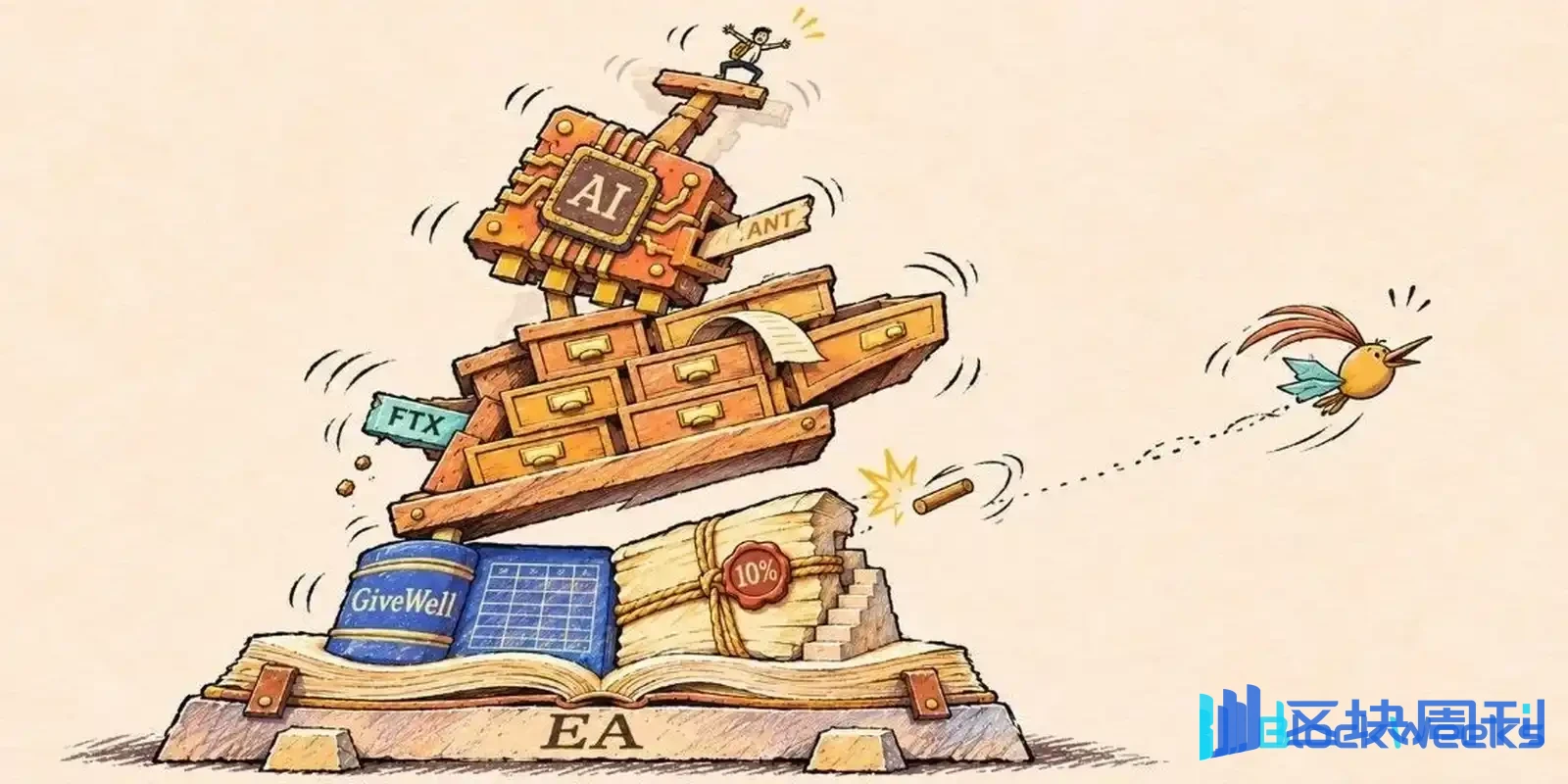
It should not have been like this. The metaverse made Zuckerberg an epic laughingstock, but EA (Effective Altruism) almost replaced the dark enlightenment of Peter Thiel and Nick Land and became the most powerful mainstream ideology in Silicon Valley's tech circles.

Image: Finance for Charity
This is no joke: the person who led SBF into finance was MacAskill, and what he believed in was EA. Its core idea is that to save people, one must first make money, and transform the world for good in a capitalist way, so that one can empathize with capitalists and also use capitalists' money to help others.
EA adherents at that time were to Silicon Valley tycoons what Shaoxing advisors were to officials posted elsewhere.
Altruism is the motive for doing good, effective altruism is precise calculation, and the financial industry happens to be the most profitable field.
Anthropic founder Amodei himself donated to the EA organization GiveWell as early as 2009, and published an article recounting his intellectual journey, while Daniela Amodei herself married one of GiveWell's founders, Karnofsky.
Back to Anthropic's Series B funding: at the time, SBF invested not because he identified with AI, but because he identified with Amodei's EA identity. This was a capital circulation within the EA circle, and barring surprises, SBF would play a role like Peter Thiel's, leading the EA mafia to rise in Silicon Valley circles.
Unfortunately, if there are no surprises, then there are no surprises: after SBF's collapse, EA's public image also went completely bankrupt. Although Facebook co-founder Dustin Moskovitz still stubbornly persisted, the Amodeis and their ilk had gradually drawn a line between themselves and it.
MacAskill also briefly became an advisor to the FTX Future Fund, and after receiving SBF's donations also lived a comfortable personal life, but all of this suddenly collapsed, as if waking from a dream, and what disappeared along with it was also crypto's dream of turning things around.
It can be said that the collapse of SBF and EA left the crypto industry in a very awkward position in the United States. Crypto does not lack political power: in 2024 Fairshake spent money on the election, and the stablecoin bill was waved through all the way, but having money and votes without a soul means decentralization can unite all humanity, yet it cannot develop its own ideology from within, and the ending can only be co-optation, while EA was supposed to undertake this mission.
Later arrivals have also tried. The GENIUS Act landed, and stablecoins finally had a proper status; Armstrong led Coinbase charging at the forefront, running around for more than a year for the CLARITY Act, at the start of the year wrestling with the banks over the stablecoin yield clause, then withdrawing support at the last moment; in September the Senate procedural vote got only 50 votes, falling short by 10 votes, and he turned around and said then let's go to the SEC and CFTC.
The difference lies exactly here: what SBF spoke about in Congress was what crypto could bring to the world; what Armstrong speaks about is what business Coinbase can do; the former wanted to be a rule-maker, the latter can only be a rule-lobbyist. Stablecoins entered the system, but crypto's narrative did not enter along with them, and stablecoins have also suffered as a result.
A co-opted industry only deserves a narrative that is assigned to it.
You may think A\ is unhinged, but pushing something out into the world inherently requires being eccentric and going it alone; now crypto is no longer trendy or cool, nor is it regarded by the mainstream as a threat.
Now watching the conspiracy group on BSC circle around CZ, and then CZ being whipped by Americans like a spinning top, all that is left is lamentation: will there be another SBF?
We do not hate or hope for any one person; rather, we are waiting for the next opportunity, the next wave. Revolutionaries are forever young.