
Pi Network has clarified its plans to introduce stablecoins into its ecosystem while keeping PI as the main cryptocurrency, as its native token struggles near $0.08 following a 10% weekly decline.
Summary
- Pi Network says PI will remain its primary cryptocurrency while stablecoins support selected payment activities.
- Open Standard partnership will explore OUSD rewards for Pioneers, with no confirmed Mainnet integration date.
- Protocol 28 is scheduled for October 16, with node upgrades required by October 13, 2026.
- PI traded near $0.0812 after falling approximately 10% over seven days, according to CoinGecko data.
- Technical indicators remain negative, with $0.080 support and $0.090 resistance defining the immediate trading range.
According to the Pi Core Team, the network’s partnership with Open Standard will explore ways to bring OUSD stablecoin payments and reward programs to Pioneers. In an October 8 update, the team explained that stablecoins could support payments, commerce and settlement where predictable prices are needed.
However, PI will continue serving as the primary digital asset across network activities, and no date has been announced for an OUSD Mainnet integration.
The clarification arrives ahead of Pi Network’s scheduled Protocol 28 upgrade on October 16, while its token remains under pressure following the latest cryptocurrency market selloff.
Pi Network says stablecoins will not replace PI
Pi Network’s latest statement explains how stablecoins could operate within an ecosystem that currently relies on PI for transactions and other network activities.
The team said stablecoins could be useful for merchants, businesses and applications that require predictable prices. Their value is generally linked to another asset, such as the U.S. dollar, which makes them suitable for transactions where frequent price changes may create difficulties.
However, developers intend to preserve PI’s existing role within the network. In its official statement, the team said, “Pi should remain the primary crypto across the network’s processes.”
Stablecoins would serve a complementary function, allowing selected activities to use more stable pricing without replacing the native token.
The Core Team explained that stablecoin integration requires careful planning because introducing another digital asset does not automatically create useful services or additional economic activity.
Its initial work will focus on deciding how the tokens should operate alongside PI, including which applications might benefit from stable-value payments and how the arrangements would comply with applicable regulations.
The statement follows Pi Network’s September 30 partnership with Open Standard, the company behind Open USD (OUSD).
Open Standard operates a consortium involving more than 200 companies across finance, payments and technology. Its stablecoin model is designed to distribute a portion of reserve income to participating partners.
Through the agreement, Pi Network intends to explore reward programs for Pioneers and potential OUSD use across applications and services.
The company has not announced the amount or eligibility requirements for any rewards, nor has it confirmed that OUSD is available on Pi Mainnet.
Open Standard partnership raises questions about OUSD launch
The September partnership introduced the possibility of bringing stablecoin transactions into Pi Network applications, although implementation details remain under development.
According to Open Standard, OUSD uses a partner-governed model designed to support payments and other financial transactions. Participating partners can receive distributions linked to the stablecoin’s reserve earnings under the applicable arrangements.
Pi Network said it selected Open Standard because the company’s model aligns with its approach to supporting activity among businesses and users participating in the ecosystem.
In its October update, the Core Team said stablecoins could allow certain transactions to remain within Pi applications instead of requiring users to rely on outside payment services.
However, developers are still establishing the principles that will govern future integrations, including compliance requirements and how stablecoins will interact with PI.
The Pi Network partnership with Open Standard has attracted attention from holders expecting further uses for the native token. The existing announcement does not specify whether OUSD transactions will require users to hold PI beyond any applicable network fees.
There is no confirmed date for the proposed reward programs, and neither partner has announced a completed integration or a schedule for public testing on Mainnet.
The team said more information would follow as it develops its approach to stablecoins.
Pi Network prepares Protocol 28 upgrade for October 16
While stablecoin plans remain under development, Pi Network has scheduled its next Mainnet software upgrade for October 16, 2026.
The Pi Core Team confirmed on September 25 that Protocol 28 had reached Testnet following the successful deployment of Protocol 27 on Mainnet.
The upgrade introduces changes to how the blockchain processes delays in transaction data. Developers will gain the ability to upgrade groups of smart contracts together and modify stored application information more safely.
According to the team, the improvements are intended to support applications as their software and data requirements change.
Protocol 27 previously introduced more flexible smart contract authentication, expanding the ways accounts and applications could authorize transactions.
Protocol 28 builds on that work through improvements to transaction-data handling and software maintenance.
Node operators must install version 28.0 by October 13, three days before the scheduled Mainnet activation. The official Pi Network node instructions confirm that Mainnet operators are required to update their software.
The October Protocol 28 upgrade is still scheduled for October 16, with the changes being tested before deployment to the network handling users’ actual balances.
The technical improvements do not include a confirmed OUSD launch date or a new stablecoin integration feature. Pi Network has presented the two developments as separate areas of ongoing work.
Pi Network price remains weak near $0.08 support
Despite the latest development announcements, Pi Network price has struggled to recover from the cryptocurrency market’s recent losses.
According to CoinGecko data, PI traded near $0.0812 on October 9, declining approximately 1.78% over 24 hours and 10% over seven days. Trading volume stood at $8.36 million, while its market capitalization was around $914 million.
The token had traded above $0.09 earlier in October before selling pressure pushed it below that level on October 7. The decline extended toward $0.078, bringing PI close to its lowest price in approximately three months.
The latest recovery above $0.08 has remained limited, with buyers struggling to move the price back toward the previous trading range.
On the supplied daily technical chart, PI traded at $0.08128, gaining 0.58% during the session while continuing to form lower highs and lower lows.
The Moving Average Convergence Divergence (MACD) indicator remained negative, with the MACD line at -0.00210 and the signal line at -0.00121. The histogram stood at -0.00089, indicating that downward momentum had not yet reversed.
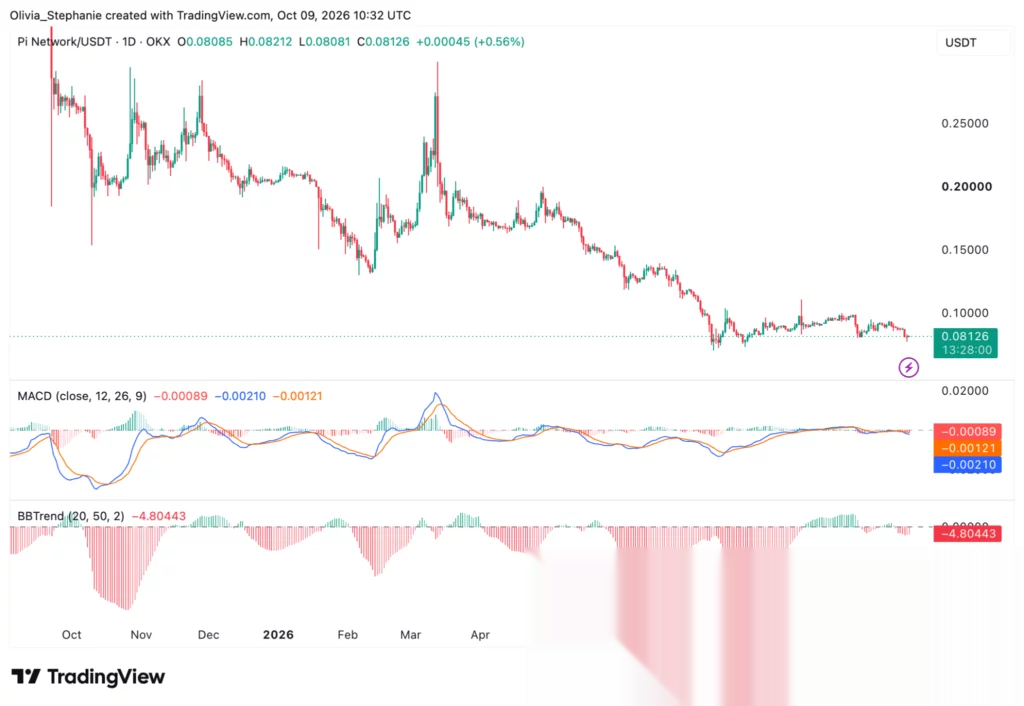
The BBTrend indicator was similarly negative at -4.80947, following a short period of improvement in September. Its reading pointed to continued selling pressure, although the indicator was less negative than during previous declines.
Immediate support remains near $0.080. A confirmed breakdown below that level could expose PI to further losses toward $0.075 and $0.070, based on the supplied chart levels.
For buyers, $0.090 represents the first important resistance. A sustained recovery above that price would bring the psychological $0.10 level back into focus.
The October 16 Protocol 28 activation remains the next scheduled technical milestone. Node operators have until October 13 to complete their software updates, while the Core Team has not provided a timetable for launching OUSD-related services.