
Pyth Network price has surged more than 14% to $0.08605 on Friday, October 9, after its decentralized autonomous organization (DAO) approved a plan to direct all eligible product revenue toward buying PYTH tokens on the open market.
Summary
- Pyth Network price climbed 14.20% to $0.08605, with daily trading volume reaching approximately $119 million.
- Pyth DAO approved allocating 100% of eligible product receipts toward PYTH purchases under OP-PIP-136 governance.
- Pyth reported $11.5 million in annual recurring revenue for September, up 86% quarter over quarter.
- PYTH faces resistance between $0.086 and $0.090, while its RSI stands near the overbought threshold.
According to CoinGecko, PYTH recorded approximately $119 million in 24-hour trading volume, with activity rising more than 287% from the previous day. The token gained 11.27% over seven days, while its market capitalization reached approximately $677 million, placing it among the 100 largest cryptocurrencies.
Meanwhile, the buying activity followed the Pyth DAO’s October 8 announcement of a new revenue allocation policy known as the “100% Rule.”
Pyth Network price jumps after DAO approves 100% buybacks
The Pyth DAO has approved proposal OP-PIP-136, which changes how revenue received from its data products is used to purchase the network’s native token.
Pyth Network announced the decision on October 8, confirming that 100% of funds received by the DAO from eligible products will now be allocated to accumulating PYTH in its reserve. Previously, monthly purchases were based on one-third of the DAO’s non-PYTH treasury balance and required a separate governance vote.
The revised arrangement establishes permanent authorization for purchases without requiring another vote each month. Funds received in stablecoins will be used to buy PYTH on the open market, while payments received directly in PYTH will move into the reserve.
The policy covers revenue received by the DAO from Pyth Pro subscriptions, Listing as a Service, the Data Marketplace and Pyth Indices. It extends to eligible non-PYTH assets already held in the treasury.
Under the existing revenue-sharing arrangements, approximately 60% of revenue from DAO-owned products reaches the organization. The new policy applies to the funds received by the DAO, not every dollar earned across the entire network.
The buybacks will continue through a pre-authorized council, which handles market purchases under established rules. Individual transactions remain subject to a $25,000 limit and a maximum permitted slippage of 5%, with purchases recorded on-chain.
Pyth confirmed that acquisitions under the new authorization began on September 30. Its October 8 announcement placed reserve holdings at approximately 42 million PYTH, although an earlier section of the same announcement referred to 41 million tokens.
Unlike token-burning programs, the Pyth Reserve retains the purchased assets in the DAO’s treasury. The organization has described the reserve as a resource for supporting contributors, developers and future network activities.
Pyth reports $11.5 million in annual revenue as adoption grows
The governance decision follows stronger revenue figures from Pyth’s expanding financial data business.
In its September report, Pyth recorded $11.5 million in annual recurring revenue (ARR), representing growth of approximately 86% from the previous quarter. The figure increased from $10.4 million in August, supported by additional paying customers and subscriptions.
Annual recurring revenue measures the annualized value of recurring business at a given point. It does not represent revenue already collected by the DAO or the amount available for immediate token purchases.
Pyth Indices contributed $1.81 million in fixed ARR, while the network expanded its market data coverage to more than 3,811 symbols through Pyth Pro.
The company reported 129,265 monthly active users for Pyth Terminal in September, an increase of 44% from the previous month. Pyth operates data services for trading platforms, prediction markets and financial institutions requiring regularly updated market prices.
Its commercial services have expanded into traditional financial markets. In June, Nasdaq began providing market data through Pyth Network, allowing blockchain applications to access information from Nasdaq’s TotalView order book.
Pyth’s September report confirmed approval to distribute Nasdaq Basic data through its marketplace, covering U.S. equity prices and trading information.
The network has partnerships with platforms including Polymarket and Kalshi, which use Pyth data for financial market contracts. In April, Polymarket expanded its stock and commodity markets using Pyth price feeds for contract settlement.
According to Pyth, more than 94% of tracked real-world asset perpetual futures trading volume during the previous three months relied on its pricing data. The company reported that those markets generated more than $2 trillion in trading volume during the quarter.
Pyth Network price technical analysis: Can PYTH reach $0.10?
Pyth Network price remains above its major exponential moving averages following the latest rally, although buyers face resistance around 0.086–0.090.
On the supplied daily chart, PYTH traded at $0.08528, gaining 5% during that candle. Its 20-day exponential moving average (EMA) stood at $0.07433, while the 50-day EMA was positioned at $0.06444.
The 100-day and 200-day EMAs were at $0.05670 and $0.05562, respectively. The price’s position above all four averages indicates that its recent recovery has carried it beyond short-, medium- and longer-term trend levels.
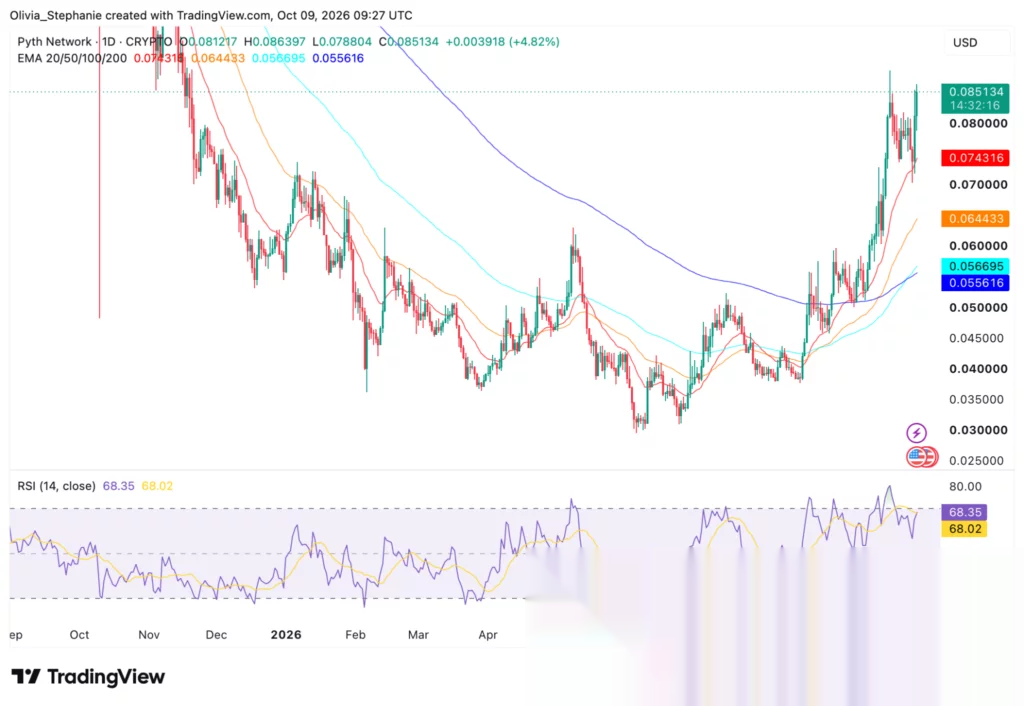
The first resistance area sits between $0.086 and $0.090, where previous trading activity showed selling interest. A confirmed daily close above $0.090 would strengthen the bullish technical case and place the psychological $0.10 level in focus.
However, a rejection around $0.090 could bring attention back to the 20-day EMA at $0.07433. A break below that average would leave the 50-day EMA near $0.06444 as the next potential support level.
Momentum indicators suggest the rally is approaching a level where buying pressure may become harder to sustain.
The Relative Strength Index (RSI) stood at 68.47, slightly above its moving average of 68.03 and approaching the commonly watched overbought threshold of 70.
An RSI near 70 indicates strong recent buying momentum, although it does not establish that an immediate reversal will occur. The indicator can remain elevated during sustained upward trends.
PYTH remains well below its historical peak of $1.20 despite the recovery. CoinGecko’s market data places the token approximately 93% beneath that level, while its all-time low remains $0.02953.
Trading volume rises as PYTH tests resistance
The sharp rise in trading activity accompanied the governance announcement, with CoinGecko recording more than $118 million in transactions over 24 hours and a daily volume increase of approximately 287%.
The token’s circulating supply stood near 7.9 billion PYTH, with a market capitalization of approximately $675 million during the later CoinGecko check. Its ranking had risen to 99th among tracked cryptocurrencies.
PYTH has previously recorded strong trading activity following exchange listings and institutional developments. In January, the token rallied following its Robinhood listing, rising more than 17% shortly after the U.S. brokerage confirmed support.
The current buyback program introduces a different source of token demand because purchases will depend on the DAO’s eligible product receipts. Pyth has not committed to purchasing a fixed dollar amount of tokens each month.
Mike Cahill, CEO of Douro Labs and a core contributor to Pyth Network, described the governance decision as a way to connect the network’s commercial activity with its reserve.
“The DAO committing all of it to the Reserve is the strongest alignment this network has had,” Cahill said in the October 8 announcement.
The DAO will continue publishing acquisition records on-chain and reporting purchases monthly. Its approved controls retain the $25,000 transaction limit, 5% slippage restriction and existing procedures for routing trades through aggregators.