Zcash developers have set January 2027 as their target for adding quantum-resistant payment support to the network, as concerns over future attacks on cryptocurrency wallets grow and ZEC trades near $1,240 following a sharp weekly decline.
Summary
- Zcash developers target January 2027 for quantum-resistant payment instructions, with no confirmed network activation date yet.
- Nearly 12 million ZEC remain in transparent addresses, representing roughly 70% of the issued supply.
- Zakura developers have introduced experimental private balance checks that conceal wallet address searches from servers.
- ZEC rebounded above $1,240 after recent losses, although its weekly performance remained negative on CoinGecko.
- Technical indicators show continued selling pressure, with resistance near $1,305 and immediate support around $1,180.
Zakura engineer Roman Akhtariev announced the timeline in a technical update, explaining that developers intend to introduce new instructions allowing Zcash to verify hash-based signatures. The proposal focuses on transparent transactions, which account for approximately 70% of the cryptocurrency’s issued supply. However, the January target does not establish a confirmed date for activating the changes across the network.
Zcash developers target January for quantum-resistant payments
The planned upgrade would introduce new signature verification instructions designed to protect transparent Zcash transactions against potential future advances in quantum computing.
Currently, transparent Zcash payments use elliptic-curve cryptography to verify that someone spending coins controls the corresponding private key. The system relies on mathematical problems that conventional computers cannot practically solve using known methods.
Researchers have warned that sufficiently powerful quantum computers could eventually weaken this protection, potentially allowing attackers to recover private keys from exposed public keys.
Zakura’s proposed instructions would allow payments to use hash-based signatures, which rely on different mathematical assumptions. The developers are considering constructions such as Winternitz One-Time Signatures, commonly called WOTS.
In the engineering update, Akhtariev wrote, “Our team plans for post-quantum signature opcodes to land in Zcash in January.”
The timing remains a development target. No confirmed Mainnet activation, final network upgrade specification or mandatory migration schedule has been announced for the January proposal.
Zakura is an alternative Zcash full-node implementation developed by Valar Group and Project Tachyon. Its initial release arrived in July 2026, offering improved synchronization performance and support for the network’s Ironwood upgrade.
Although developers are preparing quantum-resistant payment instructions, Zcash is not yet fully protected against quantum attacks. Its existing shielded transaction systems still depend on cryptographic components that would require further changes.
Nearly 70% of ZEC supply remains in public addresses
The planned signature changes focus on transparent Zcash addresses, where transaction details are publicly visible on the blockchain.
Unlike shielded transactions, which conceal payment information, transparent transactions expose addresses and transferred amounts in a manner similar to Bitcoin.
According to ZecStats, approximately 11.96 million ZEC sat in the transparent pool on October 9, representing 70.4% of the roughly 16.98 million coins issued. Another 4.95 million ZEC was distributed across the network’s shielded pools.
Standard transparent addresses contain a hash of the owner’s public key. The public key itself is generally disclosed when the owner spends funds from that address.
Zakura’s engineers explained that creating a fresh address after spending can limit exposure to certain future attacks. Coins transferred to a new address remain protected by a different public-key hash until its corresponding key is revealed.
However, protecting individual public keys does not guarantee that every wallet remains secure. The team warned that exposing an account’s extended public key or related viewing information can reveal additional keys associated with the same wallet.
The network previously introduced other security improvements through its July 28 Ironwood upgrade.
As covered in the Zcash Ironwood upgrade, developers introduced a new shielded pool with additional supply protections and provisions for future recovery under certain quantum attack scenarios.
Ironwood’s recovery features do not independently make its existing shielded transaction cryptography quantum-resistant.
Zakura introduces private balance checks for Zcash wallets
Alongside the proposed signature upgrade, Zakura has developed a system that allows wallets to check transparent balances without revealing their entire address history to a server.
The technology uses private information retrieval, or PIR, to conceal which records a wallet requests from a database.
Ordinarily, a wallet that manages several transparent addresses must ask a server for transaction records linked to each address. The server can observe those requests and potentially connect addresses belonging to the same user.
Zakura’s system allows the wallet to retrieve the necessary records while hiding the selected database entries from the service providing them.
The developers explained that the software groups confirmed transaction information into smaller database sections. Wallets examine compact activity filters locally before making private requests for matching records.
According to the engineering explanation, the method supports balance checking, transaction history recovery and wallet restoration without sending a readable list of addresses to the server.
The protection does not conceal transactions recorded on the transparent blockchain. It prevents the wallet’s balance queries from independently exposing which addresses the user is checking.
An experimental implementation is available through the Private queries setting in Vizor, a Zcash wallet.
Akhtariev explained that the feature is intended to work alongside address rotation, allowing users to manage newly generated addresses without repeatedly disclosing their relationships through ordinary wallet synchronization.
Zcash price rebounds near $1,240 as selling pressure continues
While developers prepare the security changes, Zcash price has recovered modestly after a recent market correction pushed the token toward $1,180.
According to CoinGecko, ZEC traded near $1,240 on October 9, gaining approximately 2.5% over 24 hours despite remaining almost 12% lower over seven days. Daily trading volume stood near $1.57 billion, with a market capitalization of approximately $21 billion.
The cryptocurrency had previously rallied toward the 1,600–1,700 area before losing momentum. Its subsequent retreat brought prices below several short-term technical levels.
In the supplied daily chart, ZEC traded at $1,237.39 after recovering from an intraday low of $1,181.84. The rebound represented a 4.37% daily gain, although the token continued trading below its nine-day simple moving average of $1,305.05.
The moving average currently forms an important resistance level. Until ZEC moves back above it, the short-term chart continues to show lower highs following the recent rally.
Crypto analyst Trader Symba identified the 1,300–1,330 region as an important recovery level after ZEC lost its previous rising trendline.
The analyst said a sustained recovery above that region could open the way toward 1,350–1,370, followed by $1,430.
On the downside, Symba identified 1,195–1,200 as a zone to monitor, with additional support at $1,115 and 1,040–1,050. Those are technical projections, not confirmed future price movements.
The supplied Moving Average Convergence Divergence indicator supports a cautious short-term outlook. Its MACD line stood at 11.94, below the signal line of 58.26, while the histogram remained negative at -46.32.
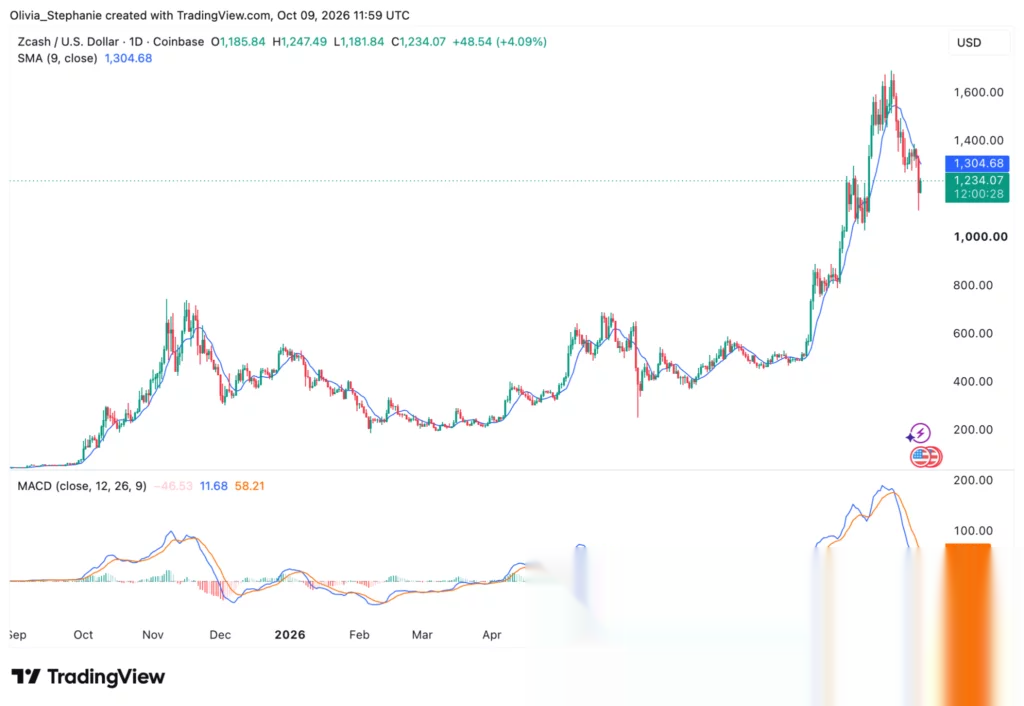
Although both lines were above zero, the negative histogram indicated that selling momentum had strengthened compared with the preceding bullish phase.
Another analyst, More Crypto Online, described the recent decline as a fourth-wave correction under an Elliott Wave interpretation. The analyst said a break above the previous high would be needed to confirm that the pullback had ended.
The immediate technical levels remain $1,180 on the downside and $1,305 on the upside. If ZEC falls below the former, the supplied chart identifies $1,100 and $1,000 as further support areas.