Gemini 4 these past two days has really been leaking like a sieve on social media.
New checkpoints, new works, new comparison images, popping up one after another.
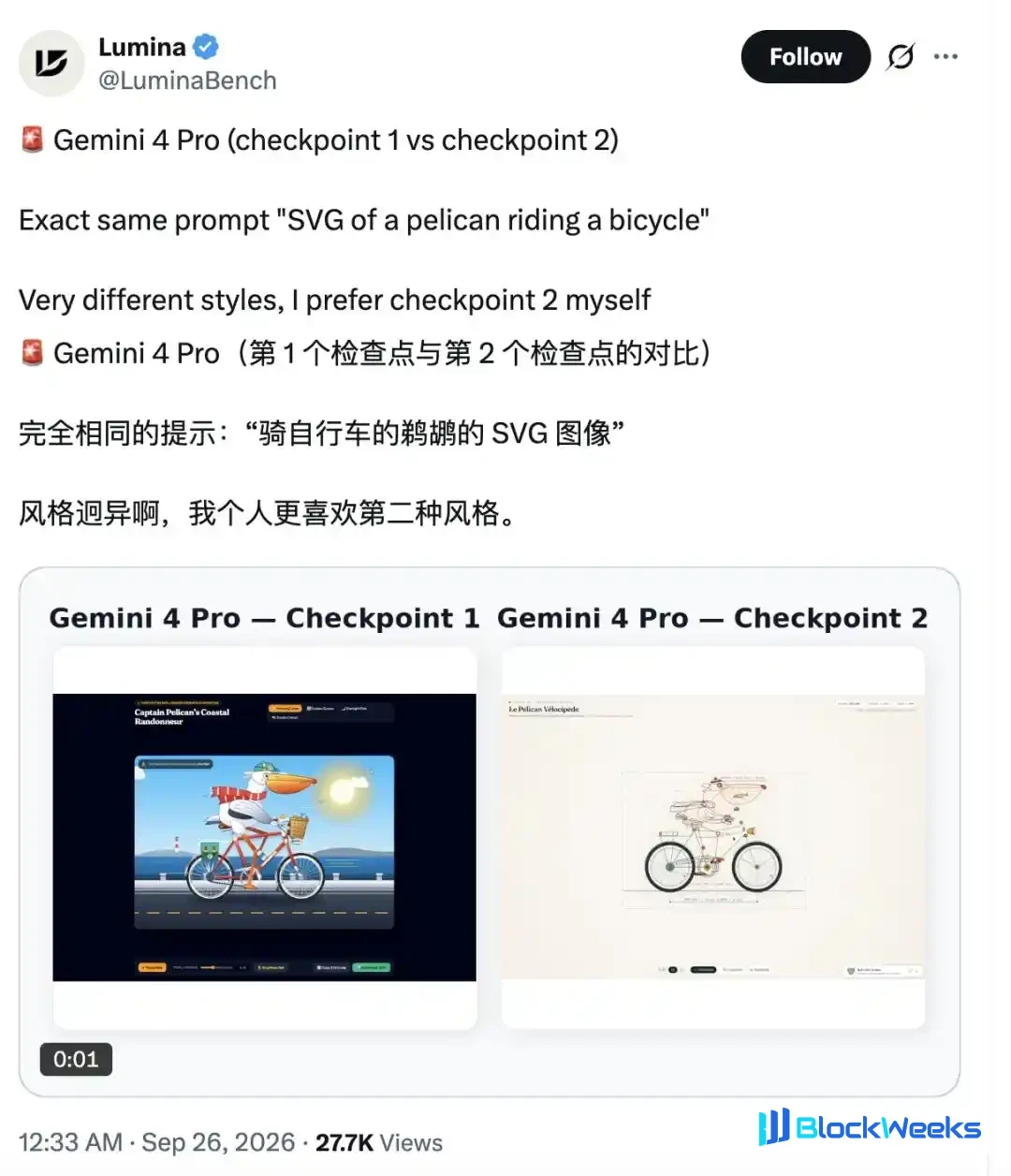
Just now, Lumina released another set of quite entertaining tests:
The same "pelican riding a bicycle", with two checkpoints before and after Gemini 4 Pro, directly drew two completely different styles.
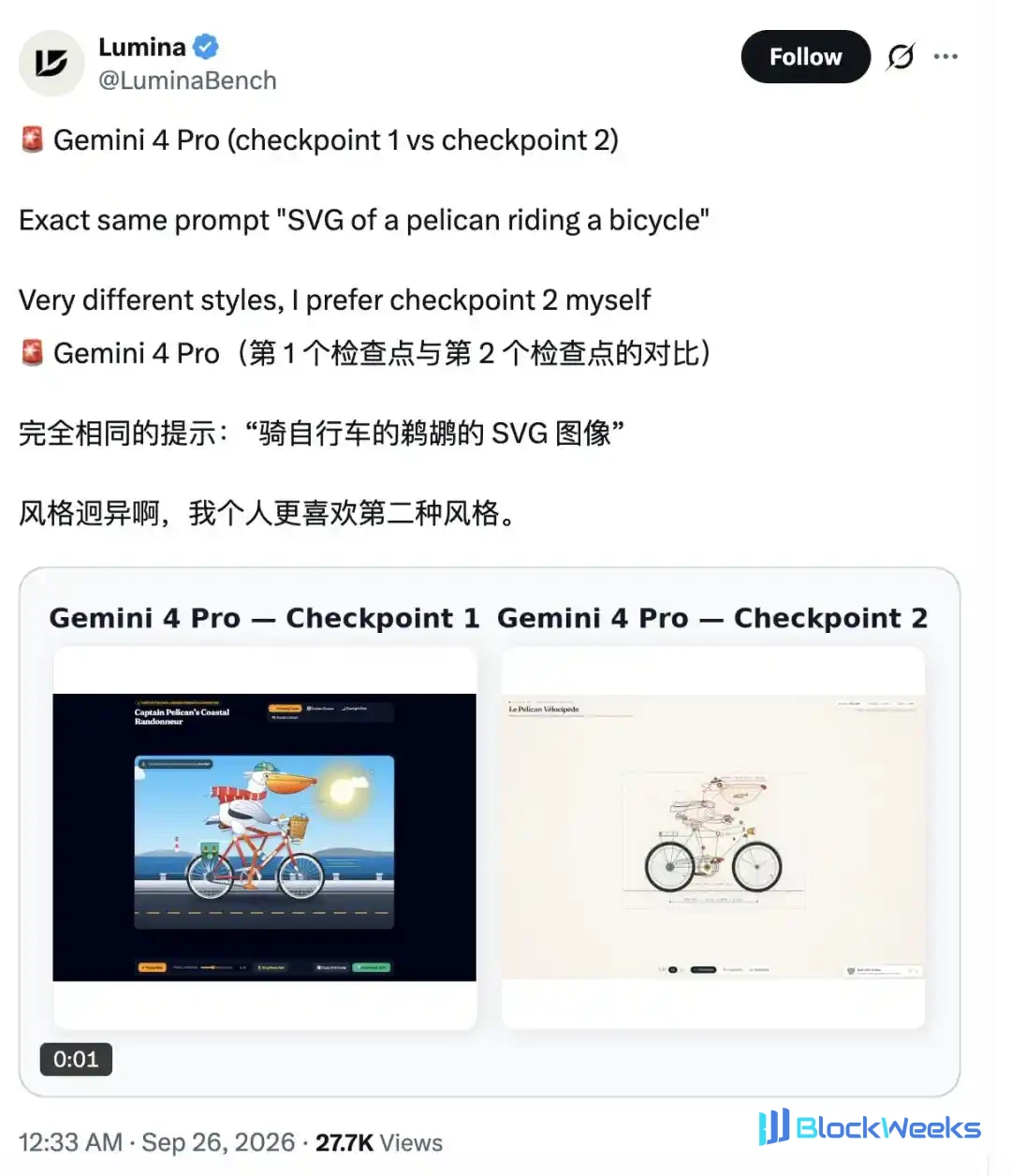
Checkpoint 1 went for a vibrant cartoon style; Checkpoint 2 was noticeably more restrained, like a mechanical structure sketch.
Putting the two checkpoints together, the traces left by post-training are already clearly visible: lines, structure, and detail handling are all changing. The model's capabilities have visibly jumped forward by a notch.
And this, is already countless as the umpteenth suspected new checkpoint of Gemini 4 Pro to emerge in the Arena.
While the community is still frantically digging into details, Google itself is no longer hiding it.
This week, Google DeepMind's new head Koray Kavukcuoglu for the first time confirmed to the media: Gemini 4 has already entered early post-training.

△
And his goal is to release it as soon as possible.
We've seen the results, we're very excited, and we'll continue to push the work forward in a rapid iteration manner.
Well well. So the checkpoints popping up round after round are warming up the stage for Gemini 4 in advance?
Anyway, from Koray's tone, the main point is: if it can be released early, it absolutely will not be released late.
And this time, it's not just the model that's speeding up. Google is also preparing to send TPU chips into space.
The new project is about to start prototype testing, and even AI computing infrastructure is beginning to extend beyond Earth.
Gemini 4, entering the sprint phase
It's not surprising that everyone is watching Gemini 4 so closely.
After all, from the previous generation flagship model Gemini 3 to now, Google has been through quite a lot in between.
Originally, according to plan, this June should have first brought Gemini 3.5 Pro. Google CEO Sundar Pichai even previewed it in advance at the May I/O developer conference.
In the end, it wasn't released.

Although Gemini 3.1 and several Flash models were updated successively in the meantime, 3.5 Pro never made an official appearance.
Koray also explained this time that the team chose to "pause a little" midway, and first put energy into the Flash series.
And now, the rhythm has clearly changed again.
Koray made it clear that they want to achieve the maximum learning speed in the shortest possible time.
Listen to the tone. This almost makes Google's current approach clear.
Although it was not explicitly said whether Google has officially canceled the Gemini 3.5 Pro project, what is certain is that the team has shifted all its attention to Gemini 4.
Gemini 3.5 Pro can be put aside for now, but Gemini 4's training, testing, feedback, and re-iteration must run round after round as quickly as possible.

To this end, Google has already begun simultaneously building Gemini 4's internal safety guarantees and testing processes. At present, this mechanism has already been running on internal AI coding tools first.
At this point, looking again at the suspected Gemini 4 checkpoints that have recently emerged in the Arena becomes even more interesting.
With Lumina's latest release of "pelican riding a bicycle," the center of everyone's discussion has shifted from "which checkpoint is better" to "How far has Gemini 4 actually caught up?"

Some people directly shouted: Gemini is back in the game, believing that if these checkpoints are real, Google is rapidly closing the gap with OpenAI /Anthropic.

Others feel that it currently cannot go head-to-head with GPT-6 SOL, and compared with the Mythos series that Anthropic launched this spring and recently upgraded, it cannot be said to have an overwhelming advantage.

Facing doubts, Koray is quite confident.
I am full of confidence in this team. We will definitely always be at the forefront.
In August of this year, after Hassabis stepped down from the day-to-day management of Google DeepMind, Koray officially took over this business, while continuing to serve as Google's Chief AI Architect.
How Gemini runs next and how fast it runs, Koray is now one of the most critical decision-makers.
Anyway, his words are already out there, and next it depends on whether Gemini 4 itself can catch them.
Challenging Nvidia, TPU goes to space for the first time
If you only look at Gemini 4, it is easy to think that Google's model team is just starting to accelerate again this round.
Actually, what is even more exaggerated is that even computing power has started to step on the gas in sync.
Koray recently clearly mentioned that DeepMind's frontier model research and development is now also directly "feeding back" into Google's own hardware business.
Previously, TPU was mainly hidden behind Google Cloud, and customers bought cloud services. But now, Google has started selling TPU chips directly!
The goal is quite clear, challenge Nvidia.

Moreover, the model team and the chip team are also becoming more and more tightly bound.
New requirements generated when DeepMind makes next-generation models will be fed back to hardware engineers in advance, letting them plan the next two to three generations of TPU.
Model: Bro, I'm preparing to consume ✕✕ computing power again next round. Chip: Got it, starting to build now.
Google is cooperating with the American commercial satellite company Planet, planning to launch prototype satellites via SpaceX Falcon 9, which will carry 4 TPUs to test their ability to operate in orbit.
The project is called "Project Suncatcher".
The idea is also very Google: since ground-based AI data centers consume electricity, occupy land, and require large amounts of water cooling, why not simply move part of the machine learning infrastructure to orbit, where solar energy is more abundant?
However, it is currently only the first step.
In space, there is no way to dissipate heat through air convection like in ground data centers, and chips running continuously under high load will quickly encounter thermal management problems.
According to the plan, the chips can operate in space for about 15 minutes, after which they need to be shut down to cool.
So this time it is more like verifying one thing: whether TPU can first survive and run in orbit.
As for truly connecting dozens of satellites into a network with lasers and turning it into a "space AI data center", that is still a later matter.

Others are still fighting for data center rooms, while Google has already begun thinking about land in the sky.
However, just as everyone at Google was shouting for acceleration, someone on the team quit.
Former Mozilla engineer Robert O'Callahan, who later joined DeepMind, announced his resignation yesterday.

The reason turned out not to be that he despised Google's AI development for being too slow, but rather "too fast"?
Robert did not directly train models, but was responsible for hardware chip design tools.
But as he worked on it, he discovered that these tools would accelerate the design of next-generation AI chips, further reducing the cost and latency of AI.
In his view, this meant that artificial intelligence would become cheaper, more efficient, and thus more widespread and more powerful.
Robert talked with DeepMind colleagues about AI risks, and almost everyone was deeply worried about it, but many did not express it publicly.
Moreover, Koray had no intention of stopping, and even felt that "it needs to be even faster."
At first, Robert did not think about leaving directly, after all, the pay was quite generous. He only wanted to switch to an engineering position that did not accelerate AI at all.
But limited by his region and job options, this path ultimately did not work out.
One more thing
Checkpoints popping up wildly, TPUs soaring, engineers resigning. Looking at these things in this week, there is somewhat of a dark humor to it.
Back then, Gemini 3's performance had once put OpenAI into "red alert," but Google itself then fell half a beat behind on its flagship cadence.
Now, with Koray leading the team, it chooses to re-accelerate and push learning speed to the maximum. And it is not just one product line speeding up; models, chips, and organizational cadence are all starting to press forward.
Google: it really cannot afford to wait any longer.
This article comes from the WeChat public account "Quantum Bit," author: Focus on Frontier Technology