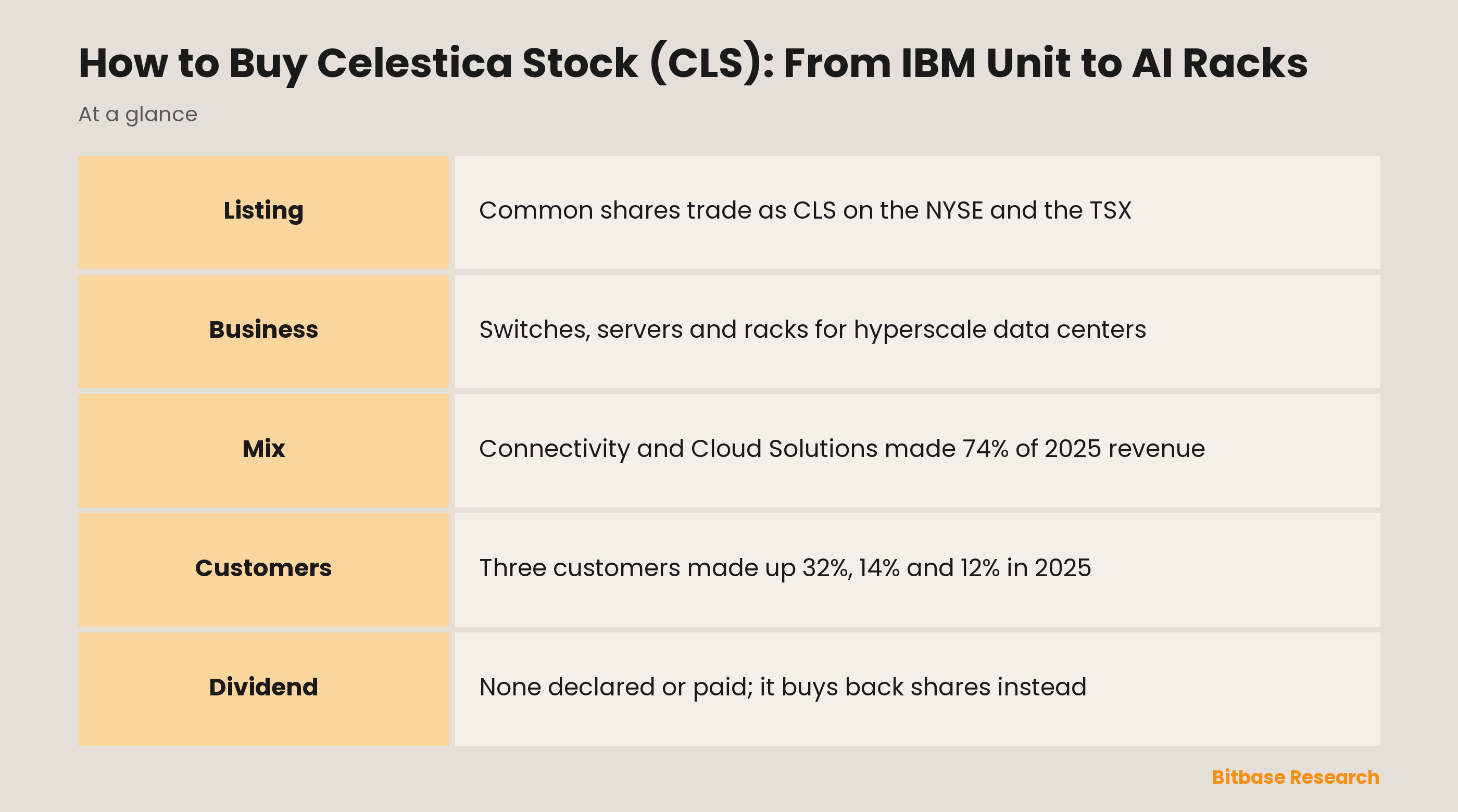
For Celestica shares, any broker that reaches the New York Stock Exchange or the Toronto Stock Exchange will do, since the same common shares trade under CLS in both cities. The Toronto company began as an IBM manufacturing unit and now builds networking and compute hardware for hyperscale data centers: in 2025 its Connectivity and Cloud Solutions segment produced 74% of revenue, and three customers accounted for 32%, 14% and 12%.
What Does Celestica Do?
Celestica designs, manufactures and services electronics for other companies, today mostly data center hardware.
Before its incorporation in Ontario in 1996, Celestica was an IBM manufacturing unit that had served IBM for more than 75 years. It took its first outside customers in 1993, was bought from IBM in October 1996 by an investor group led by Onex Corporation, and went public in 1998. Onex kept control through multiple voting shares until 2023, when those shares were converted and sold in two secondary offerings; since then only one class, the common shares, remains.
The company reports two segments.
Connectivity and Cloud Solutions (CCS) makes networking switches, optical systems, data center racks, servers and storage, used mainly in hyperscale data centers. Its two end markets were renamed in the third quarter of 2026: Communications became Networking, and Enterprise became Compute & Storage. Inside CCS sits Hardware Platform Solutions (HPS), where Celestica acts as an original design manufacturer (ODM), designing the product alone or with the customer. The 10-K says HPS "typically has a higher margin profile" than traditional electronics manufacturing services (EMS), though it requires research and development spending.
Advanced Technology Solutions (ATS) groups Aerospace and Defense, Industrial, HealthTech and Capital Equipment, which includes semiconductor equipment.
The 10-K names Amazon Fulfillment Services, Meta Platforms, Google, Ciena, Dell Technologies, Hewlett-Packard Enterprise and IBM among CCS customers. Rivals include EMS firms such as Flex, Jabil and Sanmina, ODMs such as Quanta and Wiwynn, and, in data center switching, Arista Networks and Cisco. About 75% of 2025 revenue was produced in Asia and about 20% in North America.
How Celestica Makes Money
Master supply agreements "do not typically guarantee a particular level of business or fixed pricing"; work is bid program by program and ordered through purchase orders, and most agreements require a customer to take back unused inventory bought for its forecast.
Revenue rose 28% in 2025, carried by data center work:
| Revenue line | Share of 2025 revenue | Change in 2025 | What it covers |
|---|---|---|---|
| Communications (now Networking) | 57% | Up 81% | Switches and optical systems |
| Enterprise (now Compute & Storage) | 17% | Down 19% | Servers, including AI compute, and storage |
| ATS segment | 26% | Up 1% | Aerospace, industrial, HealthTech, equipment |
CCS as a whole grew 42% and reached 74% of revenue, up from 67% in 2024 and 58% in 2023. The Enterprise decline came from "a technology transition in an AI/machine learning (ML) compute program with one of our hyperscaler customers."
Segment margin, segment income as a share of segment revenue, was 8.2% in CCS and 5.3% in ATS in 2025. HPS made up 41% of total revenue, against 29% in 2024 and 21% in 2023. In the third quarter of 2026, revenue rose 83% from a year earlier, and Compute & Storage reached 28% of the total.
CLS Stock at a Glance
| Feature | CLS |
|---|---|
| Exchanges | New York Stock Exchange and Toronto Stock Exchange, both as CLS |
| Security | Common shares, the only class registered under Section 12(b) |
| Depositary receipt | None; the same shares trade in both cities |
| Sector | Electronics design and manufacturing, mainly data center hardware |
| Index membership | Held by XIU, an S&P/TSX 60 index fund, on 10 November 2026 |
| Headquarters | Toronto, Ontario |
| Incorporated | Ontario, 1996 |
| Fiscal year | Ends 31 December |
| Reporting | 10-K, 10-Q and 8-K; US GAAP, in US dollars |
| Dividends | None declared or paid; buybacks through a normal course issuer bid |
| SEC identifier | CIK 1030894 |
Price and market value move all day; the Celestica stock page on Bitbase shows them live.
How to Buy Celestica Stock
Celestica is Canadian, yet no depositary receipt stands between you and the shares: the 10-K lists the common shares on the NYSE and the TSX under the same symbol. An order takes five steps:
1. Choose the market. CLS in New York is quoted in US dollars, CLS in Toronto in Canadian dollars; most brokers outside Canada reach the New York line.
2. Open and fund an account. The broker verifies your identity and tax residence. If your money is in another currency, compare the conversion rate as well as the commission.
3. Confirm the line. Search CLS and check that the result reads Celestica Inc. common shares on the exchange you intended.
4. Choose an order type. A market order fills at the prices on offer; a limit order caps what you pay and may not fill. FINRA's guide to order types explains both.
5. Size the position. Fractional shares let you invest a fixed sum, but FINRA notes that not every firm offers them and that fractional owners may not get voting rights.
Taxes. Celestica has never declared a dividend, so dividend withholding does not arise today; gains on a sale are taxed under the rules where you live. Ask your broker what forms it needs.
Through a fund. BlackRock's iShares S&P/TSX 60 Index ETF (XIU) held CLS on 10 November 2026.
What Moves CLS Stock
Hyperscaler spending. The 10-K describes hyperscalers as "cyclically different from our traditional OEM customers." When they speed up or pause data center build-outs, CCS volume follows.
A few large customers. The top 10 customers produced 79% of 2025 revenue and 85% in the third quarter of 2026, when the three largest accounted for 35%, 17% and 14%. One program won, moved or ended can swing a year.
Design-led programs. HPS rose 81% in 2025 and 70% in the third quarter of 2026. Its higher margins come with R&D costs, so its share shapes overall profit.
Capacity and funding. In August 2026 Celestica sold 11.1 million new common shares and said the proceeds would fund working capital and capital expenditures. Item 1A warns that capital investments "may not proceed as anticipated," citing materials, labor, power availability and grid interconnection.
Trade and geopolitics. Most electronic components come from Asia, so US tariffs, export controls and tension between mainland China and Taiwan reach costs and customer decisions; the 10-K cites "duties, tariffs or taxes" among the risks.
Buybacks and outlooks. A new normal course issuer bid allows repurchases of up to about 2.5% of the public float from 3 November 2026 to 2 November 2027. The 10-K notes the price can fall when results miss what analysts or investors expect.
Hyperscaler Dependence and Other Risks for CLS Holders
These Item 1A entries bear most on a shareholder.
Concentration. Celestica is "dependent on a limited number of customers and end markets," and "revenue decline or loss of any major customer could have a material adverse effect."
The AI build-out. Data center deployment depends on "the availability and cost of critical inputs (including power and water)," and customers short of them may "slow, scale down or cancel programs with us."
Order visibility. Customers "typically do not commit to long-term production schedules in advance," and some contracts require "specific price reductions" over their term.
Competition. The 10-K reports "aggressive bidding from EMS providers and increased competition from ODMs" for data center work.
The share itself. "The market price of our Common Shares has been volatile," and new shares, for equity pay or for financings like the August 2026 offering, dilute holders. One stock also ties your result to one company.
How to Research CLS Yourself
Celestica files with the SEC under CIK 1030894 and on SEDAR+ in Canada. Since its 2024 annual report it uses the forms of a US domestic company: a 10-K each year, 10-Qs for the first three quarters, 8-Ks for events. Through 2023 it filed a 20-F and 6-Ks, so older years sit under different forms.
In the 10-K, Item 1 gives end-market shares, customers and competitors, Item 1A the risks, Item 5 the dividend policy and buybacks, and the MD&A segment margins. The third-quarter 2026 10-Q already shows earlier periods under the new end-market names. For two rivals, see our Arista Networks guide and Cisco guide; Bitbase's US stock pages list other companies.
Celestica Stock FAQ
Can I buy Celestica stock with crypto?
Not directly. CLS shares are bought through a brokerage account in US or Canadian dollars, so crypto must first be sold for cash and transferred, and that sale can be taxable where you live. A share is also a claim on a company, as our explainer on how stocks differ from crypto sets out.
Does Celestica pay a dividend?
No. The 10-K says Celestica has "not declared or paid any dividends" and plans to retain earnings for growth. It buys back shares instead.
Is CLS listed in the United States or in Canada?
Both. The same common shares trade as CLS on the NYSE in US dollars and on the TSX in Canadian dollars. There is no ADR.
Who are Celestica's biggest customers?
The 10-K lists Amazon Fulfillment Services, Meta Platforms, Google, Ciena, Dell Technologies, Hewlett-Packard Enterprise and IBM among CCS customers, but does not say which three each passed 10% of 2025 revenue.
Why does a Canadian company like Celestica file a 10-K?
It moved to reporting as a US domestic filer. Its 2023 annual report was a 20-F; from the 2024 report on it has filed a 10-K, with statements under US GAAP.
Conclusion
Celestica's share now rides mostly on how fast a handful of hyperscalers keep building data center networks and AI compute, with a smaller aerospace, industrial and equipment business underneath at lower margins. The filings point both ways: fast growth and wider segment margins, next to three customers supplying more than half of 2025 revenue and a capacity build paid for partly with new shares. Read the latest 10-Q for customer concentration and segment margins, follow the next quarterly outlook, and decide how much weight one contract manufacturer should carry in your portfolio.
Related reading
Other Bitbase articles on this topic:
- How to Buy Ciena Stock (CIEN): Optics, Cloud Buyers, No Dividend
- How to Buy Ericsson Stock (ERIC): B Shares, ADS and 5G Gear
- How to Buy Everpure Stock (P): Formerly Pure Storage, PSTG
- How to Buy Flex Stock (FLEX): Singapore Shares, Axiom Spin-Off
Disclaimer: This article is educational content from Bitbase Academy, provided for information only. It explains what a company or fund does and how the instruments referenced here differ from one another; it does not constitute investment, trading, tax, or financial advice, and it is neither a recommendation nor an endorsement of any security, token, or trading strategy. A tokenized stock is issued by a third party and is designed to give economic exposure to an underlying asset: it is not a share, it carries no shareholder rights, and it depends on the issuer's structure, eligibility rules, and redemption terms, which the issuer can change. Perpetual futures are leveraged derivatives that hold no underlying asset and can be liquidated, and trading hours, product availability, and eligibility differ by instrument and by jurisdiction and can change at any time. Written as of November 2026; verify everything yourself through company filings, the issuer's own documentation, and the product pages of the venue you trade on.
References
[1] Celestica Form 10-K for 2025 (SEC EDGAR) www.sec.gov
[2] Celestica 2025 Form 10-K, XBRL cover page (SEC EDGAR) www.sec.gov
[3] Celestica Form 10-Q for the third quarter of 2026 (SEC EDGAR) www.sec.gov
[4] Celestica third-quarter 2026 results release, filed with Form 8-K (SEC EDGAR) www.sec.gov
[5] Celestica Form 8-K: August 2026 share offering (SEC EDGAR) www.sec.gov
[6] Celestica Form 8-K: new normal course issuer bid, October 2026 (SEC EDGAR) www.sec.gov
[7] Celestica Form 20-F for 2023 (SEC EDGAR) www.sec.gov
[8] BlackRock: iShares S&P/TSX 60 Index ETF (XIU), fund page and holdings www.blackrock.com
[9] FINRA: Order Types www.finra.org
[10] FINRA: Investing in Fractional Shares www.finra.org