
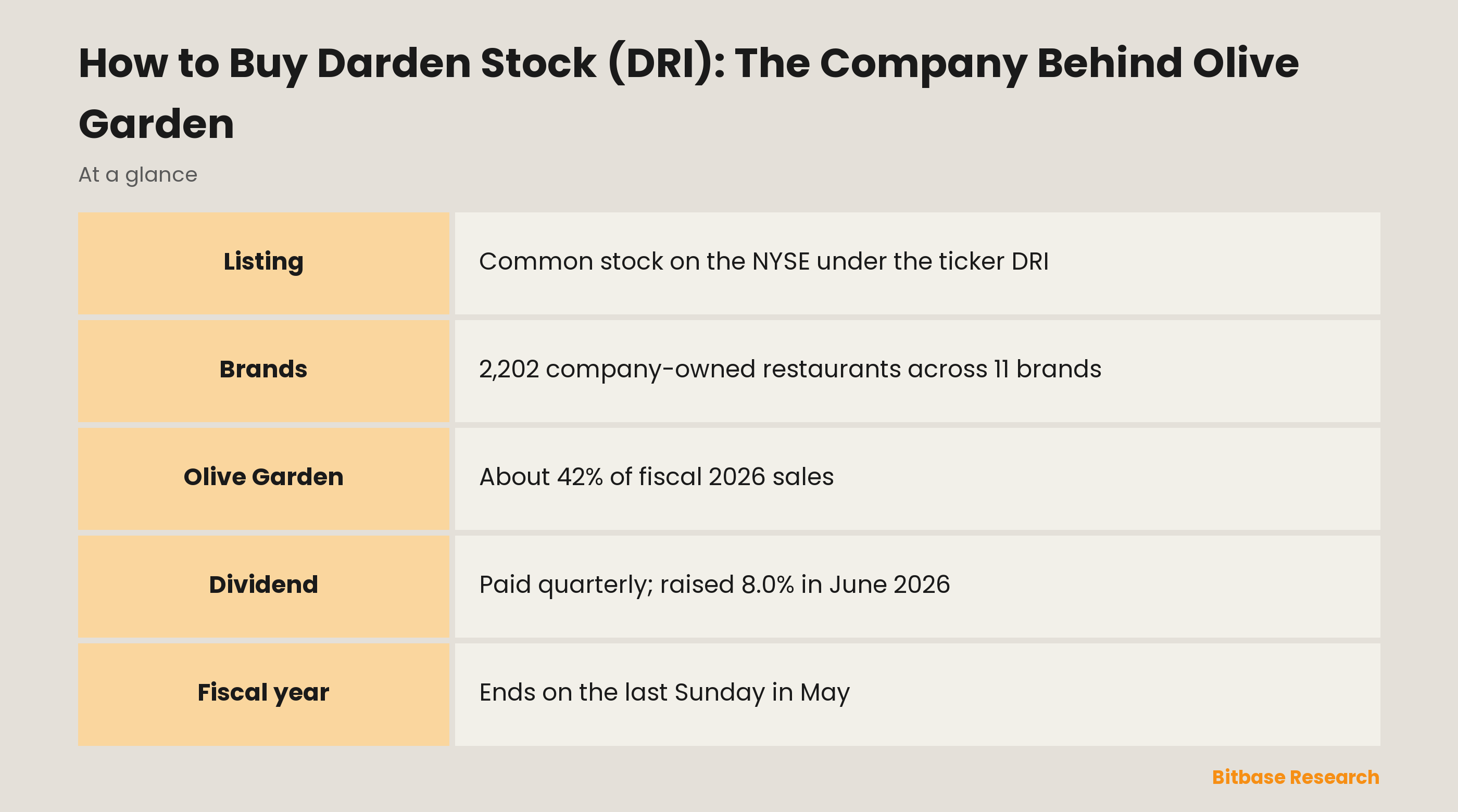
Your best route to Darden stock is any broker that offers shares listed on the New York Stock Exchange, where Darden Restaurants trades under the ticker DRI. That order buys a slice of 2,202 company-owned sit-down restaurants across 11 brands, and in fiscal 2026 one of them, Olive Garden, produced about 42% of sales and 49% of segment profit. Below: what each brand contributes, how a purchase works, and the pressures the filings keep naming, from beef and wages to guest counts and the wind-down of Bahama Breeze.
What Does Darden Do?
Darden Restaurants calls itself "a full-service restaurant company." On 31 May 2026 it owned and operated 2,202 restaurants in the United States through subsidiaries, under 11 brands: Olive Garden, LongHorn Steakhouse, Yard House, Ruth's Chris Steak House, Cheddar's Scratch Kitchen, The Capital Grille, Chuy's, Seasons 52, Eddie V's Prime Seafood, Bahama Breeze and The Capital Burger. Franchisees ran another 167, of which 80 were outside the United States.
Every one of those restaurants has table service. The 10-K splits the industry into quick service, fast casual and full-service, places all of Darden in the last group, and calls it "highly fragmented," with "many independent operators and small chains."
The corporate story starts with seafood. Darden's main operating subsidiary, GMRI, Inc., was incorporated in March 1968 as Red Lobster Inns of America. General Mills bought the business in 1970 and in 1995 distributed all of its stock to General Mills shareholders, which made Darden a separate public company. Darden itself is a Florida corporation formed in March 1995 and based in Orlando. Red Lobster has since left the group; the annual report refers to "the disposition of Red Lobster in fiscal 2015."
Some brands were built in-house and others were bought. Olive Garden opened its first restaurant in Orlando in 1982, and Seasons 52 followed in 2003. LongHorn Steakhouse and The Capital Grille arrived with RARE Hospitality in October 2007, Eddie V's in 2011, Yard House in 2012, Cheddar's Scratch Kitchen in 2017, Ruth's Chris in June 2023 and Chuy's in October 2024. Olive Garden is, in the company's words, "the largest full-service dining Italian restaurant operator in the United States."
Two portfolio changes are recent. In July 2025 Darden sold its eight Olive Garden restaurants in Canada to Recipe Unlimited Corporation, which now runs them as a franchisee. In February 2026 it decided to close about half of the Bahama Breeze restaurants for good, done by around 5 April 2026, and to convert the rest into other Darden brands over the following 12 to 18 months.
Purchasing is centralized. Darden buys from more than 1,400 suppliers whose products originate in more than 30 countries, and a subsidiary, Darden Direct Distribution, owns the food and supplies that third-party distributors deliver. Delivery orders placed through Darden's own apps and websites have been carried by Uber since fiscal 2025 under an exclusive multi-year arrangement.
How Darden Makes Money
Nearly all revenue is food and drink sold in restaurants Darden runs itself. The 10-K says sales "are derived principally from food and beverage sales" and that the company does "not rely on any major customers"; franchise and licensing income is described as not material. The brands are reported in four segments:
| Segment | Brands | Share of fiscal 2026 sales | Share of segment profit | Segment profit margin |
|---|---|---|---|---|
| Olive Garden | Olive Garden | 42% | 49% | 22.5% |
| LongHorn Steakhouse | LongHorn Steakhouse | 26% | 25% | 18.6% |
| Fine Dining | Ruth's Chris, The Capital Grille, Eddie V's | 10% | 9% | 17.7% |
| Other Business | Yard House, Cheddar's, Chuy's, Seasons 52, Bahama Breeze, The Capital Burger, franchise fees | 21% | 17% | 15.9% |
Shares are calculated from the segment figures published with the fourth-quarter fiscal 2026 results. Darden defines segment profit as sales minus food and beverage, restaurant labor, restaurant expenses and marketing, before non-cash real estate costs, so these margins sit well above the company-wide operating margin.
Fiscal 2026, which ended on 31 May 2026, ran 53 weeks instead of 52. Total sales grew 9.4%: the extra week added 2.1%, and the rest came from a blended same-restaurant sales increase of 4.5% and 43 net new restaurants. LongHorn led, with same-restaurant sales up 7.2% on a 3.4% higher average check and 3.7% more guests. Olive Garden's rose 4.0%, from a check up 2.9% and guest counts up 1.0%. Fine Dining managed 1.2%, as a higher check offset slightly fewer guests.
Costs explain why traffic matters. Food and beverage came to 30.6% of sales and restaurant labor to 31.7%, while operating income was 12.0%. Alcohol made up 10.0% of sales, from 4.1% at Olive Garden to 28.9% at Yard House. Diluted earnings per share from continuing operations rose 17.6%.
DRI Stock at a Glance
| Feature | DRI |
|---|---|
| Exchange | New York Stock Exchange |
| Ticker | DRI |
| Security | Common stock without par value, the only class registered under Section 12(b) |
| Sector | Full-service restaurants |
| Largest brands | Olive Garden, LongHorn Steakhouse, Cheddar's Scratch Kitchen, Chuy's, Yard House |
| Index membership | S&P 500 |
| Headquarters | Orlando, Florida |
| Incorporated | Florida, March 1995 |
| Fiscal year | 52 or 53 weeks, ending on the last Sunday in May |
| Payouts | Quarterly cash dividend; share repurchases |
| SEC identifier | CIK 940944 |
Brands are ranked by company-owned restaurants on 31 May 2026. Price, market value and dividend yield move with every trade; live figures are on the Darden stock page on Bitbase.
How to Buy Darden Stock
Darden has one class of common stock on a US exchange, so there is no depositary receipt and no second share class to weigh: the NYSE line is the share itself. At a broker the purchase takes six steps:
1. Pick a broker with NYSE access. Outside the United States, that means a local firm that routes orders to US markets or an international broker. Check which legal entity holds your account and who regulates it.
2. Open the account and fill in the tax forms. Non-US individuals are normally asked for IRS Form W-8BEN, the certificate of foreign status that sets how much tax is withheld.
3. Deposit money. Funding in euros, won or another currency means a conversion into US dollars, and the exchange rate can cost more than the commission.
4. Search for DRI. Make sure the result reads Darden Restaurants, Inc. common stock on the New York Stock Exchange.
5. Set the order type and its time limit. A market order gives the best chance of a fill near the current price; a limit order caps what you pay. FINRA adds that orders can carry time conditions, such as day orders, "which expire at the end of the trading day if they aren't executed."
6. Choose whole or fractional shares. Fractions let you invest a set sum, but FINRA cautions that "at the moment, you can't transfer fractional shares to another brokerage firm," so switching brokers may mean selling first.
Tax on dividends abroad. The IRS says US-source income paid to a foreign person is generally taxed at 30%, and that a tax treaty with your country of residence can lower or remove that rate. Your own country may tax the dividends again.
Owning it inside a fund. Darden is an S&P 500 constituent, listed in State Street's daily holdings file for SPY on 10 November 2026, so funds tracking that index hold a small amount of DRI.
What Moves DRI Stock
Guests versus check. Same-restaurant sales combine how many people come in with how much each spends, and Darden reports both. In the first quarter of fiscal 2027, the three months to 30 August 2026, Olive Garden's same-restaurant sales rose 1.1% because a 3.4% higher average check outweighed a 2.2% fall in guest counts, while LongHorn's rose 6.2% with guest counts up 1.6%. The 10-K warns that the "ability to offset the effects of inflation through pricing actions may be constrained by competitive dynamics and consumer demand sensitivity."
Food and labor costs. In fiscal 2026 food and beverage costs rose as a share of sales, mainly from a 1.2% inflation impact partly offset by 0.9% from pricing. The 10-K lists beef, pork, chicken, seafood, cheese, butter and produce among the commodities that shape margins, and says tariffs on imports "such as produce and seafood, could increase our costs."
Olive Garden's weight. A brand that earns about half of segment profit dominates every quarter. In the first quarter of fiscal 2027 its segment profit margin eased to 20.4% from 20.6% a year earlier, which the 10-Q attributes mainly to higher restaurant expenses.
Openings and closures. Darden opened 72 restaurants in fiscal 2026 and plans 75 to 80 in fiscal 2027; a new one takes about 250 days to build once the site and permits are secured. On the other side, 13 Bahama Breeze restaurants were still open on 31 May 2026, and those are being converted.
A 53-week year. Because fiscal 2026 had 53 weeks and fiscal 2027 has 52, ending on 30 May 2027, quarters are offset by one week against the prior year. Darden now gives same-restaurant sales on two bases: for the first quarter, 3.1% on the fiscal calendar and 3.2% on a comparable calendar.
Capital returns. In June 2026 the board raised the quarterly dividend by 8.0% and approved a new buyback program with no expiration date. Darden has repurchased stock since December 1995.
Beef, Wages and Leases in Darden's Risk Factors
These passages from Item 1A of the 10-K bear most directly on a DRI share; the first-quarter 10-Q reports no material changes to them.
Cost pressure. Failing to manage rising costs "for commodities, labor, health care, and utilities used by our restaurants" could "compress our margins and adversely affect our sales and results of operations."
Wages. "We operate in many states and localities where the minimum wage is significantly higher than the federal minimum wage."
Discretionary spending. "Economic uncertainty has caused and may continue to cause guests to make fewer discretionary purchases," and cheaper formats and home delivery "could cause consumers to choose less expensive alternatives or reduce the frequency of their restaurant visits."
Food safety. Problems "could be caused at the source or by food suppliers or distributors and, as a result, may be out of our control."
Leases. "As of May 31, 2026, 2,104 of our 2,202 restaurants operating in the United States operate in leased locations," on leases "generally non-cancellable for some period of time," so closing a restaurant does not end the rent.
One headquarters. "Many of our corporate systems and processes and corporate support for our restaurant operations are centralized at one Florida location," and the 10-K names hurricanes among the disasters its continuity plans cover.
Two further risks come with the stock itself. A single company concentrates your money on one set of brands. And neither payout is promised: "any future dividend payments remain subject to the discretion of our Board of Directors," and repurchases "may occur or be discontinued at any time."
How to Research DRI Yourself
Darden's filings are on EDGAR under CIK 940944, and darden.com posts the 10-K, 10-Q and 8-K reports on the day they are filed. The calendar follows the May year-end: the annual report comes in July, quarterly results in late September, December, March and June. The four most recent releases were dated 18 December 2025, 19 March, 25 June and 24 September 2026, each with a webcast on investor.darden.com.
In the 10-K, Item 1 gives restaurant counts by brand, a five-year table of openings and sales, and each brand's alcohol share; Item 1A the risk factors; the MD&A same-restaurant sales split into check and guest counts, plus segment margins; and Item 5 Darden's five-year return against the S&P 500 and the S&P Composite 1500 Restaurant Sub-Index.
Two habits avoid misreadings. Take out the 53rd week before comparing fiscal 2026 with the years around it, and keep segment profit apart from operating income. For other restaurant companies listed in the United States, see our McDonald's stock guide and Starbucks stock guide, or the list of US stock pages on Bitbase.
Darden Stock FAQ
Can I buy Darden stock with crypto?
Not in one step. A broker sells you DRI for US dollars, so crypto must first be converted into cash, which can count as a taxable sale in many countries, and then sent to the brokerage account. The result is a different kind of asset: a registered share with dividend and voting rights, which is how a share differs from a crypto asset.
Does Darden pay a dividend?
Yes, every quarter. The 10-K says Darden has "a history of paying cash dividends." In June 2026 the board lifted the quarterly rate by 8.0%, and the September 2026 declaration kept it there. Amounts and dates are in each earnings release.
Is DRI in the S&P 500?
Yes. Darden Restaurants appeared in State Street's daily holdings file for SPY, an S&P 500 fund, dated 10 November 2026.
Does Darden still own Red Lobster?
No. The link is historical: Darden's main subsidiary began in 1968 as Red Lobster Inns of America. The 10-K describes "the disposition of Red Lobster in fiscal 2015," and the remaining tie it reports is guarantees on some leases assigned to third parties.
What is happening to Bahama Breeze?
About half of the restaurants closed by around 5 April 2026, and the rest are being turned into other Darden brands over 12 to 18 months from February 2026. Thirteen were open at the end of fiscal 2026, and two conversions had been completed by 30 August 2026.
Conclusion
Owning DRI means owning a portfolio of sit-down restaurants in which one brand, Olive Garden, earned about 49% of segment profit in fiscal 2026. The figures worth following are the ones Darden breaks out every quarter: guest counts against average check, food and labor as a share of sales, and how many restaurants open, close or change name. Read the latest 10-K and quarterly release with the 53-week year in mind, and size the holding against everything else you own.
Related reading
Other Bitbase articles on this topic:
- How to Buy AutoZone Stock (AZO): Mega Hubs, Buybacks, No Dividend
- How to Buy Carnival Stock (CCL): One Listing, Eight Cruise Lines
- How to Buy Chipotle Stock (CMG): No Dividend, a 50-for-1 Split
- How to Buy SharkNinja Stock (SN): Two Brands, Three Key Retailers
Disclaimer: This article is educational content from Bitbase Academy, provided for information only. It explains what a company or fund does and how the instruments referenced here differ from one another; it does not constitute investment, trading, tax, or financial advice, and it is neither a recommendation nor an endorsement of any security, token, or trading strategy. A tokenized stock is issued by a third party and is designed to give economic exposure to an underlying asset: it is not a share, it carries no shareholder rights, and it depends on the issuer's structure, eligibility rules, and redemption terms, which the issuer can change. Perpetual futures are leveraged derivatives that hold no underlying asset and can be liquidated, and trading hours, product availability, and eligibility differ by instrument and by jurisdiction and can change at any time. Written as of November 2026; verify everything yourself through company filings, the issuer's own documentation, and the product pages of the venue you trade on.
References
[1] Darden Restaurants Form 10-K for fiscal 2026 (SEC EDGAR) www.sec.gov
[2] Darden fiscal 2026 Form 10-K, XBRL cover page (SEC EDGAR) www.sec.gov
[3] Darden Form 10-Q, first quarter of fiscal 2027 (SEC EDGAR) www.sec.gov
[4] Darden fiscal 2026 fourth-quarter and full-year results release, filed with Form 8-K (SEC EDGAR) www.sec.gov
[5] Darden fiscal 2027 first-quarter results release, filed with Form 8-K (SEC EDGAR) www.sec.gov
[6] State Street SPDR S&P 500 ETF Trust (SPY): fund page and daily holdings www.ssga.com
[7] FINRA: Order Types www.finra.org
[8] FINRA: Investing in Fractional Shares www.finra.org
[9] IRS: NRA Withholding www.irs.gov