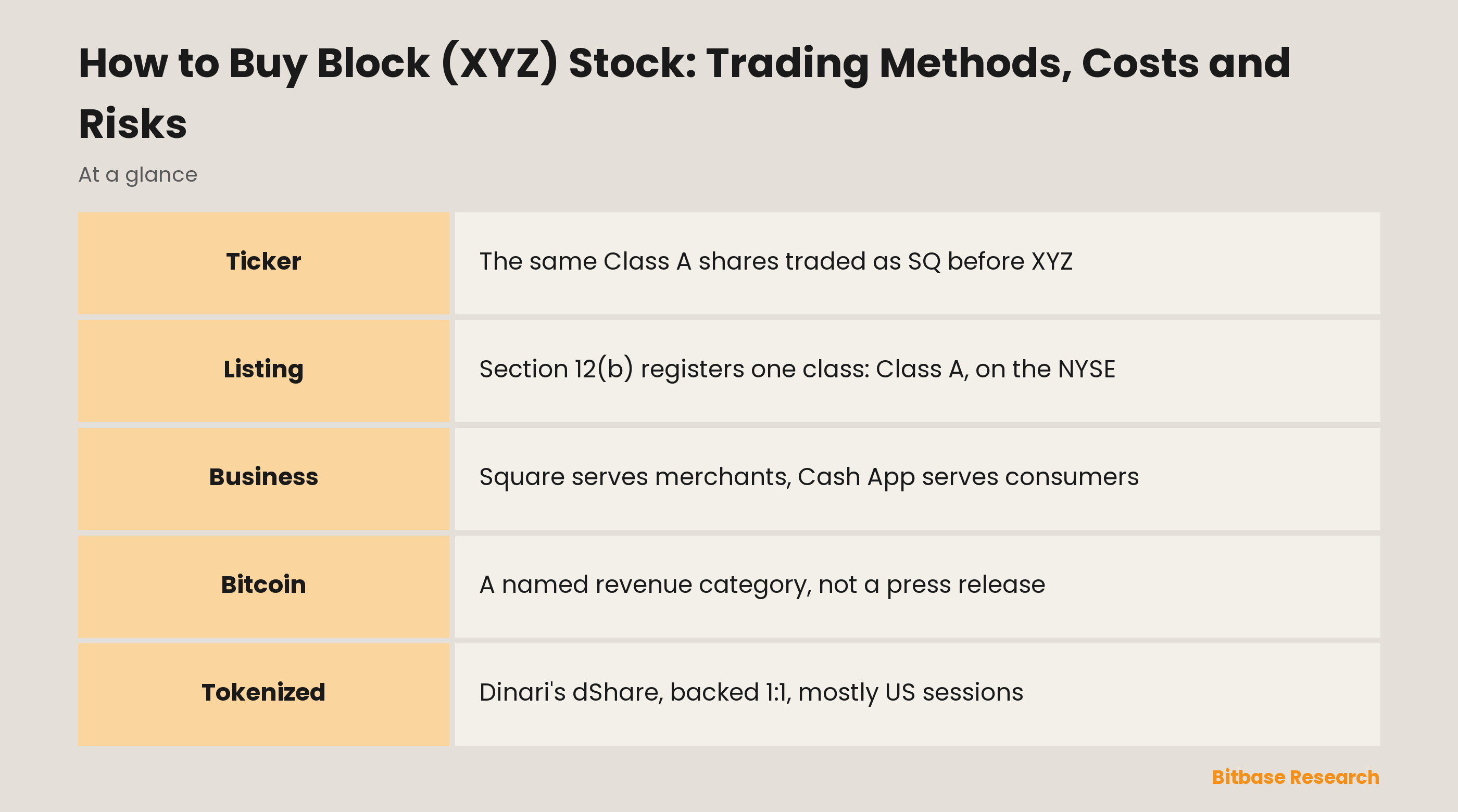
Block did not always trade under XYZ. The same Class A shares carried the symbol SQ on the cover of the fiscal 2023 annual report, which is why a search for the old letters and a search for the new ones can land in different places. This profile covers what Block sells, which of its share classes the New York Stock Exchange actually lists, and how that registered share differs from the tokenized version carrying the same three letters.
What Is Block (XYZ)?
Block states its own job in one line: "we are building technology that enables people and businesses to participate more fully in the economy," with a purpose it calls "economic empowerment, helping individuals and businesses manage, move, and grow their money through simple and connected tools."
That work splits across two ecosystems, and the split is how the company reports rather than how it markets. "Our two reportable segments are Square and Cash App, which reflects our two primary ecosystems." The older one came first: "We started Block with the Square ecosystem in February 2009 to enable businesses to accept card payments, a critical capability that had previously been inaccessible to many businesses." The other faces the opposite counterparty, because "Cash App provides an ecosystem of financial products and services to help consumers manage their money."
Two smaller lines sit outside that pair. One is musical — "TIDAL expands our purpose of economic empowerment to artists" — and one is hardware: "Our bitcoin ecosystem includes our bitcoin hardware projects, which include Bitkey, which is a self-custody bitcoin wallet, Proto, which is a bitcoin mining system, as well as Spiral."
The corporate facts are where the confusion lives. Block, Inc. is a Delaware corporation with a fiscal year ending 31 December. Its annual report registers exactly one security under Section 12(b): the Class A common stock, listed on the New York Stock Exchange under XYZ. The same cover reports shares outstanding for two classes, Class A and Class B — a second class exists, but only Class A is registered and listed. Anyone reaching this company through an exchange is reaching for Class A.
Why People Trade XYZ
A card payment has a merchant at one end and a shopper at the other, and Block is built into both.
What each side is sold is stated plainly: "We monetize these products primarily through our Commerce Enablement solutions, including payment processing, software, and hardware as well as through Financial Solutions, such as lending and banking services." A third named revenue category, Bitcoin Ecosystem, sits beside those two — so bitcoin activity reaches the reported figures as a line of its own rather than as an aside in a press release. For anyone arriving from crypto and looking at listed companies reached with stablecoins, that is the difference between a filed business line and an announcement.
The consumer end of that category is a retail product rather than a treasury policy: "We have a simple bitcoin exchange and custody solution that provides customers with an on-ramp and off-ramp to buy and sell bitcoin with Cash App," alongside "a custodial account to store it securely without needing to keep track of any private keys."
The case for trading XYZ therefore rests on three activities under one listing — merchants accepting cards, consumers borrowing and moving money, bitcoin changing hands — and on the view that they do not move on the same clock.
The Share, the dShare and the Contract
The market page carrying these letters is titled Block (Dinari Tokenized Stock) (XYZ). Read the issuer name in that title first: it, and not the ticker, fixes what the instrument is. This one belongs to Dinari, so Dinari's structure governs it — not any general notion about tokenized stocks and stock contracts.
Dinari calls the wrapper a dShare and defines it without hedging: "A dShare is a token 1:1 backed by a security, commonly a U.S. equity." Tokens are created or destroyed only after a matching order fills at the broker, routed through Alpaca, so supply tracks executed orders rather than appetite for the token.
Hours are where assumptions break. Most dShares follow the American trading day across its four sessions, and only some tickers have an around-the-clock on-chain channel, where liquidity is thinner. Outside regular hours a market order is converted automatically into a marketable limit order, which may fill in full, in part, or not at all. A buyer who does not know which session they are in does not know what their order will do.
Distributions follow the underlying rather than a schedule the issuer picks: once cash from the security arrives, Dinari calculates and distributes it, and a direct holder receives it in USD+.
Shareholder rights are what the documentation does not address. Those pages set out backing, routing, sessions and distributions, and say nothing about voting. The silence answers neither way, and the word "backed" supplies nothing.
The contract route holds nothing at all. A perpetual follows the quoted price, is margined in stablecoin, and moves a periodic funding rate from one side of the book to the other; when margin runs short, the venue exits the position on the holder's behalf.
Costs differ in shape, not only in size. A token trade pays the spread on entry and again on exit, plus whatever the venue charges. A perpetual keeps paying or collecting funding while the position lives, which turns holding time into a cost of its own. A share bought through a broker pays that broker's commission and settles through the American equity system.
What Moves XYZ
Follow the money into the company and the drivers separate.
Commerce Enablement is paid when merchants sell, so its inputs are how many businesses use the tools and how much those businesses transact through them.
Financial Solutions covers lending and banking services, which answer to credit conditions and to repayment. Money lent is money exposed, and the cost of funding it moves with rates.
Bitcoin Ecosystem responds to bitcoin activity, and it is the line that can put this share in sympathy with crypto while the rest of the business is doing something unrelated.
Above all three sits permission. The filing states that "certain jurisdictions in the United States require a license to offer money transmission services, such as Cash App's peer-to-peer payments, and we maintain a license in each of those jurisdictions and comply with new license requirements as they arise," and that the company is registered as a "Money Services Business" with the U.S. Department of Treasury's Financial Crimes Enforcement Network. Permission is granted jurisdiction by jurisdiction and renewed on somebody else's terms.
Competition is described without flattery: "The markets in which our Square ecosystem operates are competitive and evolving. Our competitors range from large, well-established vendors to smaller, earlier-stage companies." Pressure can arrive from either end of that range.
Risks and Limits
Issuer structure is the risk that only the tokenized route carries. A dShare is a claim arranged by Dinari and depends on that arrangement continuing to work — backing held, broker routing functioning, redemption honoured on published terms. A blockchain changes the record, not the dependency.
Session mechanics are the quieter risk. An order placed outside the regular session becomes a converted limit order in thin liquidity: a reliable way to be filled at a price nobody intended, or not filled at all while news moves the underlying.
Leverage compounds both. Closure is decided against a mark price, which need not match the last trade anyone saw, and funding keeps running whichever way the crowd leans. A position sized for a calm week can end on a move that a token holder would have sat through.
The wrapper decides none of this. Merchant activity, credit performance, bitcoin volumes and licensing reach all three routes unchanged. What you hold sets your rights and your settlement; it does not set what you are exposed to.
How to Verify XYZ Information
Start at the cover page, because this ticker has a past. Block files on EDGAR under CIK 1512673; open an annual report and read the box headed "Securities registered pursuant to Section 12(b) of the Act." Three columns name the class, the trading symbol and the exchange. The fiscal 2023 report shows the earlier symbol there; the later ones show XYZ. One box settles what search results muddle.
For the wrapper, use Dinari's own documentation, where the backing ratio, the Alpaca routing and the session rules are stated. Anything about dShares that is absent from it is unverified rather than implied.
For the market, open the Bitbase market page and read its title before the chart. It names the issuer. Ticker letters are reused freely across crypto, and a title that identifies no issuer is not necessarily about the company you were looking for.
Conclusion
Buying XYZ begins with a question that is easy to skip: which XYZ. The exchange-registered answer is Block, Inc. Class A stock, listed in New York under a symbol the company has not always used. The tokenized answer is a Dinari dShare, backed one-for-one against a security bought through a broker, trading mostly on American sessions and under different rules outside them. The contract answer owns nothing and bills by the hour for direction.
The same company sits under all three. Read the segment names and the licensing language in the filing before anything else written about the ticker.
Related reading
Other Bitbase articles on this topic:
- How to Buy QEW: Equal Weighting, Costs and Comparison with QQQ
- How to Buy QQQM and Compare It with QQQ
- How to Buy RSP: Equal Weighting, Costs and Comparison with SPY
- Payment Technology Stocks: Business Models and Ways to Invest
Disclaimer: This article is educational content from Bitbase Academy, provided for information only. It explains what a company or fund does and how the instruments referenced here differ from one another; it does not constitute investment, trading, tax, or financial advice, and it is neither a recommendation nor an endorsement of any security, token, or trading strategy. A tokenized stock is issued by a third party and is designed to give economic exposure to an underlying asset: it is not a share, it carries no shareholder rights, and it depends on the issuer's structure, eligibility rules, and redemption terms, which the issuer can change. Perpetual futures are leveraged derivatives that hold no underlying asset and can be liquidated, and trading hours, product availability, and eligibility differ by instrument and by jurisdiction and can change at any time. Written as of September 2026; verify everything yourself through company filings, the issuer's own documentation, and the product pages of the venue you trade on.
References
[1] Block FY2025 Form 10-K: cover 12(b) box, segments and Item 1 (SEC EDGAR) www.sec.gov
[2] Block FY2023 Form 10-K: the cover 12(b) box still showing the earlier symbol www.sec.gov
[3] Dinari documentation: what a dShare is, its backing and its broker routing docs.dinari.com
[4] Dinari documentation: the four sessions and how orders behave outside them docs.dinari.com