You can hold a tokenized stock and be handed a second decision almost immediately: whether to let it earn something while you hold it. That decision is not a smaller version of the first. It adds counterparties you were not facing before, a new way the position can be closed without you, and it turns on the question that settles every yield product — who is paying, and out of what. Here is how an xStocks vault is assembled, what the operator's own documentation says happens to a deposited token, and the checks worth doing before any advertised rate means anything.
What an xStocks Vault Does With Your Token
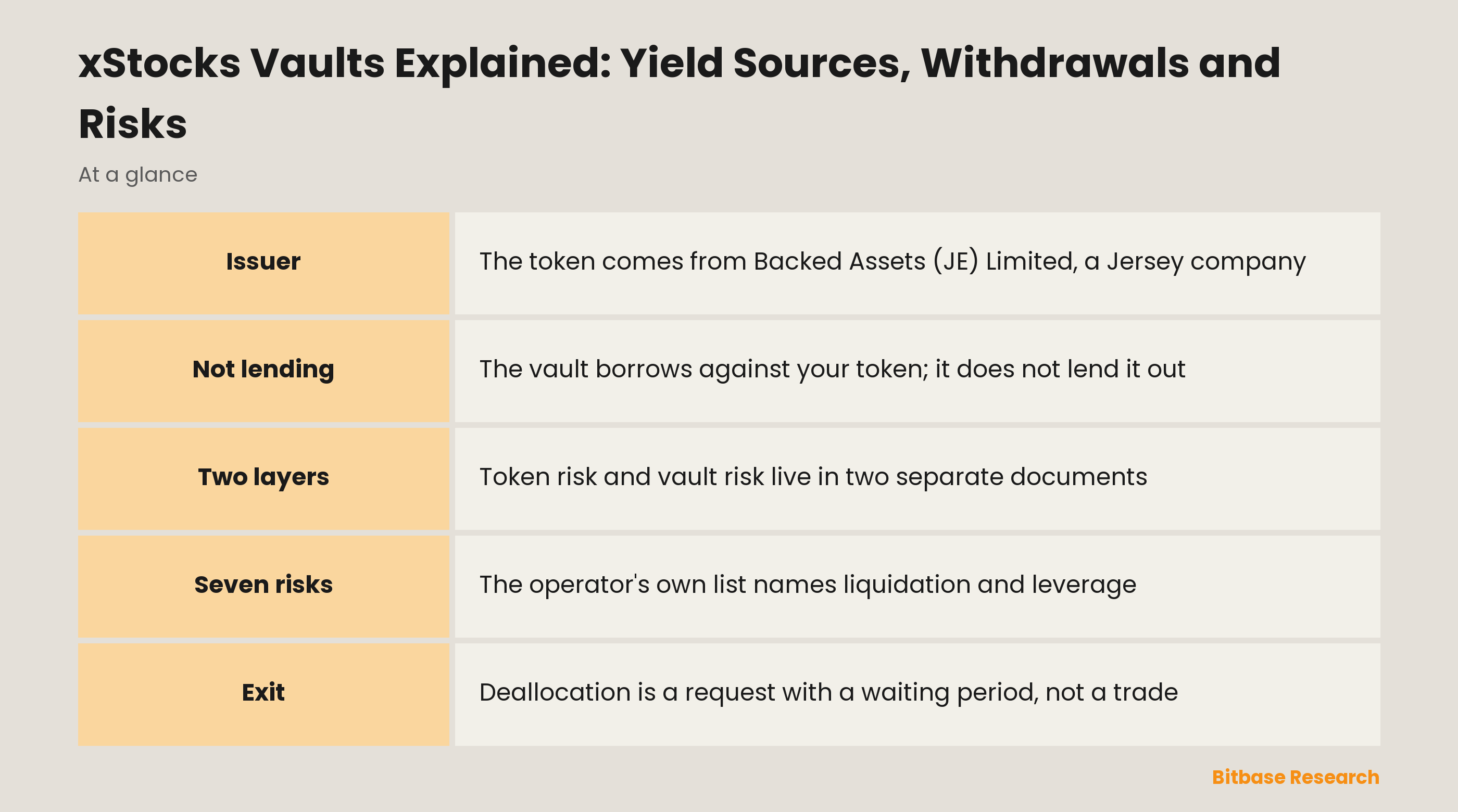
xStocks are tokenized securities issued by Backed Assets (JE) Limited, a Jersey private limited company. Each is backed one-for-one by the underlying stock, held in regulated custody, and the token moves on public blockchains around the clock. On its own that structure produces no yield: holding the token is holding a claim, not a position in anything that earns.
A vault sits on top. The operator's support documentation describes the sequence plainly: "When you allocate SPYx, QQQx, or NVDAx to a vault, it's sent to your embedded wallet on the Ink network, wrapped to each xStocks wrapped version for vault accounting purposes, and deposited into a Veda vault managed by the vault's risk manager, Sentora." Four things happen before anything earns: the token moves chains, its custody arrangement changes, it is wrapped into a second representation, and it comes under a third party you were not previously dealing with.
Then comes the part that decides everything else. "Your xStocks are supplied as collateral to a lending protocol, and stablecoins are borrowed against them. These stablecoins are deployed into reward-generating DeFi strategies. Rewards are converted back into your xStock and re-deployed so they auto-compound."
Read that twice, because the popular description of this product has it backwards. Coverage of vaults like these routinely says the deposited stock is lent out to earn interest. The operator's own page says something materially different: the stock is pledged, and the vault borrows against it. You are not the lender here. The vault is the borrower, and what you earn is whatever the borrowed money makes after the cost of borrowing it — which is why the operator's own risk list contains the words "liquidation" and "leverage."
Coming back out runs in reverse: "When you deallocate, your xStock is unwrapped and returned to your Kraken balance." A deallocation is a request rather than a trade, and it carries a waiting period set by the operator, stated on that same page and theirs to change.
Why Anyone Would Put a Tokenized Stock to Work
The appeal is easy to state. An equity position sits idle between the day you buy it and the day you sell it, and the wrapper it lives in is programmable in a way a brokerage share is not. The same platform's guidance lists what holders do with xStocks outside a vault: post them as collateral and borrow against them, supply them to liquidity pools for trading fees, or lend them through on-chain lending markets. A vault packages these so that one deposit replaces a sequence of manual steps. Tokenized equities trade on a number of venues, Bitbase's tokenized stock market among them, and the vault question only arrives once the holding already exists.
Convenience is a genuine benefit worth naming honestly: running a collateralised borrow and compounding what it returns is a job, and paying a share to have it done is a legitimate trade. What the packaging cannot do is change what sits underneath. A wrapper that hides steps has not removed them, and the risks belong to the steps rather than to the interface.
The Token Is One Structure; The Vault Is Another
The two layers fail for unrelated reasons and are documented in different places.
The first layer is the tokenized security. Its issuer is Backed Assets (JE) Limited in Jersey. The entity offering the product to clients is a different company in a different jurisdiction — the risk disclosure names Payward Digital Solutions Ltd., "a Bermuda exempted company licensed to conduct digital asset business by the Bermuda Monetary Authority." The shares backing the tokens sit somewhere else again: "The underlying stocks are maintained in depositary institutions in accordance with a custody agreement to which Kraken is not a party." The same disclosure spells out the implication, noting that credit risk "includes the possibility that the depositary institution holding a financial instrument (cash, crypto or securities) will fail to fulfil an obligation or commitment to Backed."
Three entities, three jurisdictions, and a custody agreement the platform you transact with is explicitly not party to — all before any yield enters the picture.
The second layer brings its own cast: a wrapped version of the token, an embedded wallet on a particular network, a vault contract, a named risk manager who sets the strategy, a lending protocol the documentation does not name, and downstream strategies it does not name either.
| Layer | What you are facing | Where it is documented |
|---|---|---|
| The token | Issuer, offering entity, and depositary institutions holding the shares | Issuer risk disclosure |
| The wrapper | A second on-chain representation used for vault accounting | Vault support page |
| The vault | A vault contract and the risk manager setting its strategy | Vault support page |
| The strategy | A lending protocol and downstream venues, unnamed | Largely undisclosed |
The bottom row is not a criticism of the product; it is where the documentation stops, and knowing where it stops is the point. A position you cannot describe one layer at a time is a position whose risks you cannot locate.
What Moves the Yield
Because the vault borrows rather than lends, the return is a spread rather than a rate. Three quantities set it, and none is under the operator's control: what the borrowed stablecoins earn wherever they are deployed, what it costs to borrow them against equity collateral, and the fees taken along the way. When borrowing costs rise faster than deployment returns, the spread compresses regardless of how the underlying stock performs.
Two quieter drivers sit alongside. The collateral is an equity token, so what secures the loan moves with the stock market, on the stock market's schedule rather than the vault's. And borrowing rates in on-chain lending markets are set by utilisation, so the same deposit earns differently depending on how much other people want to borrow that week. The operator states the consequence in its own words: "The rewards you earn can change over time, and there's a chance you could lose some or all of your deposit." An advertised figure is an estimate of a spread, not a promise of one.
Where the Losses Would Come From
The operator names seven risk categories, and the list is more informative than most because of what is on it: smart contract risk, liquidity risk, bad debt and market risk, liquidation risk, cross-chain execution risk, leverage risk, and downstream asset exposure.
Liquidation and leverage appearing at all is the most important disclosure here. A product described casually as earning a return on stock you already own needs neither word. They appear because the structure is a borrowing position, and borrowing positions can be closed involuntarily when collateral falls or carrying them gets expensive. That is a route by which a deposit shrinks even when the underlying company is doing fine.
Bad debt is a shared loss, not an individual one. In a pooled vault the losses land on the pool, so an outcome produced by a market event you never saw can reduce what you get back.
Cross-chain execution and smart contract risk are plumbing risks, real precisely because the token moved: it left the chain it was issued on, became a wrapped representation, and entered contracts written by parties other than the issuer. Each step is code that can fail whether or not the equity thesis was right.
Liquidity risk shows up at exactly the wrong moment. Withdrawing from a strategy with money deployed requires unwinding positions, and unwinding is easiest when nobody else is doing it. That is the structural reason waiting periods exist: the assets behind the position are not instantly realisable, so a queue is what stands between an orderly exit and a forced one.
None of this replaces the layer underneath. Issuer structure, custody, redemption terms and the trading calendar all still apply: the vault adds risks, it does not substitute for them. Our explainers on RWA tokenization and on tokenized securities and funds cover that first layer in more depth.
How to Check a Vault Before You Use One
Start from the operator's own page, not from coverage of it. The difference is not academic: widely republished descriptions of these vaults say the deposited stock is lent out, while the operator's support article says it is posted as collateral against a stablecoin borrow. Only one of those is what the documentation describes.
Read the risk headings before the rate. A risk list is a structural disclosure in disguise. If it includes liquidation and leverage, the position is levered whatever the marketing says. If it includes bad debt, losses are mutualised.
Name every party and what each controls. Write down the issuer, the offering entity, the custody arrangement, the vault contract, the risk manager and the lending protocol. Where the documentation names no party, that gap is itself a finding rather than a zero.
Read the issuer's legal disclosure separately from the vault documentation. They describe different layers, and the terms governing the token — backing, custody, redemption with the issuer — are not in the vault pages at all. The word "vault" does not appear in the issuer's risk disclosure even once.
Check the exit before the entry. Find where the waiting period is stated and whether the operator can change it. Terms one party can change are current settings, not fixed properties.
Verify on-chain what is verifiable. The wrapped token and the vault contract have addresses, and balances, supply and flows are public. On-chain data cannot tell you whether a strategy is sound, but it can confirm the structure matches the description.
Conclusion
A vault turns a holding into a position. The token alone is a claim on an issuer that keeps shares with institutions your platform is not contracted to; the vault adds a wrapper, a chain hop, a risk manager, a collateralised borrow and downstream venues the documentation leaves unnamed.
The most useful question is the one that applies to every yield product ever built: where does the money come from? Here the operator answers directly — the position borrows against your token and earns on the proceeds. Once that is clear, the liquidation risk, the leverage risk and the withdrawal queue stop reading as fine print and start reading as consequences of the structure, which is what they are.
Related reading
Other Bitbase articles on this topic:
- How to Buy SoFi (SOFI) Stock: Trading Methods, Costs and Risks
- How to Buy SQQQ: Daily Inverse Exposure vs Shorting QQQ
- How to Buy TLT: Trading Hours, Costs and Bond ETF Risks
- What Is POND? Marlin, Oyster, and Asset Boundaries
Disclaimer: This article is educational content from Bitbase Academy, provided for information only. It explains what a company or fund does and how the instruments referenced here differ from one another; it does not constitute investment, trading, tax, or financial advice, and it is neither a recommendation nor an endorsement of any security, token, or trading strategy. A tokenized stock is issued by a third party and is designed to give economic exposure to an underlying asset: it is not a share, it carries no shareholder rights, and it depends on the issuer's structure, eligibility rules, and redemption terms, which the issuer can change. Perpetual futures are leveraged derivatives that hold no underlying asset and can be liquidated, and trading hours, product availability, and eligibility differ by instrument and by jurisdiction and can change at any time. Written as of September 2026; verify everything yourself through company filings, the issuer's own documentation, and the product pages of the venue you trade on.
References
[1] What are xStocks Vaults: allocation flow, yield mechanism and the seven named risks support.kraken.com
[2] xStocks Risk Disclosure: issuer, offering entity, backing and custody www.kraken.com
[3] xStocks FAQ: chains, self-custody withdrawal and the DeFi uses outside a vault support.kraken.com